Shortlisted for the Alice Davis Hitchcock Medallion 2021 (The Society of Architectural Historians of Great Britain)
"It will become the standard work on the subject." Literary Review
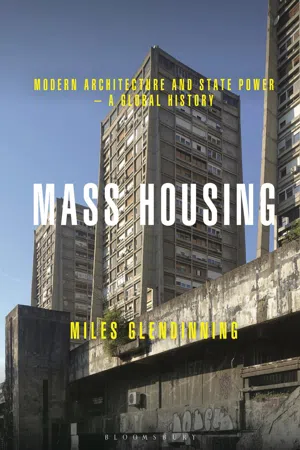
This major work provides the first comprehensive history of one of modernism's most defining and controversial architectural legacies: the 20th-century drive to provide 'homes for the people'. Vast programmes of mass housing – high-rise, low-rise, state-funded, and built in the modernist style – became a truly global phenomenon, leaving a legacy which has suffered waves of disillusionment in the West but which is now seeing a dramatic, 21st-century renaissance in the booming, crowded cities of East Asia.
Providing a global approach to the history of Modernist mass-housing production, this authoritative study combines architectural history with the broader social, political, cultural aspects of mass housing – particularly the 'mass' politics of power and state-building throughout the 20th century.
Exploring the relationship between built form, ideology, and political intervention, it shows how mass housing not only reflected the transnational ideals of the Modernist project, but also became a central legitimizing pillar of nation-states worldwide. In a compelling narrative which likens the spread of mass housing to a 'Hundred Years War' of successive campaigns and retreats, it traces the history around the globe from Europe via the USA, Soviet Union and a network of international outposts, to its ultimate, optimistic resurgence in China and the East – where it asks: Are we facing a new dawn for mass housing, or another 'great housing failure' in the making?
- 688 pages
- English
- ePUB (mobile friendly)
- Available on iOS & Android
eBook - ePub
About this book
Information
PART 1
MID-NINETEENTH CENTURY TO 1945:
THE GATHERING STORM
CHAPTER 1
PRE-1914: THE LONG MOBILIZATION
Introduction
Although modernist mass housing only reached its full, explosive force after World War II, its roots extended back nearly a century – and from the beginning it was characterized by a strong diversity of approach between different countries and cities. The decisive early twentieth-century shift towards state interventionism and modernist architecture, across the developed world, rested on a more amorphous foundation of professional and political reformist initiatives during the nineteenth century. During that time, although all-consuming total warfare was beyond the horizon, constant mid-level crises arose out of the economic, industrial and political turmoil of the ‘Great Transformation’.1 In continental countries, following the 1814–15 Congress of Vienna’s resurrection of the old order, the mid-nineteenth century saw repeated popular uprisings, while in Britain, capitalist ‘improvement’ generated unprecedented urban poverty. Swelled by the destabilization of traditional rural society, and catastrophes such as the 1845–9 Irish famine, the poor seemed to pose a growing menace to the middle and upper classes.2 In Europe, rural-to-urban migration was internal, but in North America, the more open societies attracted constant flows of migrants from Europe, with shanty towns ringing most major American cities. In the unique case of New York City, the combination of concentrated immigration and constricted site created the world’s first ‘siege metropolis’ – a pattern of externally-constrained density that would frequently recur elsewhere in the mass housing era.3
Mid-nineteenth-century innovators and experiments
By the late nineteenth century, responses to these ‘threats’ began coalescing into coherent ideologies of low-income housing reform. From the very beginning, specific recipes were associated with specific countries and showed a remarkable resilience and longevity. The mid-nineteenth century had witnessed seminal initiatives by individual pioneers in a handful of hotspot-cities, especially London and Paris. In Britain, fear of disease and social degeneration outweighed fear of revolution, and an impassioned discourse emerged of outrage and violent attack against the ‘slums’ – dilapidated areas where these evils were thought to be concentrated – and an influential 1842 report by Edwin Chadwick began to sensitize middle-class opinion to the idea of publicly-orchestrated intervention in the urban fabric of the ‘slums’. As these, in Britain, were clustered around city centres, the concept of surgical slum redevelopment, first pioneered in 1820s Edinburgh, naturally stimulated the idea of building new ‘sanitary dwellings’ for the working classes. The years 1849–51 saw the first significant schemes of philanthropic housing, masterminded by the world’s first international housing reformer, the architect Henry Roberts. He not only designed some of the earliest social housing complexes, but was an indefatigable pan-European traveller and proselytizer, enthused by the fervent social Protestantism of the Evangelical Conscience.4
For designers of prototype schemes of urban social housing, the paradox was that England was one of the few European countries lacking an urban flatted tradition, other than in specialized collegiate contexts.5 Accordingly, other collective building types provided significant inspiration, especially those emphasizing hygiene, openness and surveillance. On an 1829 Italian tour, Roberts had been impressed by Naples’s Albergo dei Poveri, a vast, six-storey courtyard hostel housing 2,600 inmates, begun in 1751. In England, William Blackburn’s pioneering late eighteenth-century prison designs had developed continental precedents into a pattern of tiered cells accessible by external galleries, as at Gloucester and Northleach prisons.6 Equally relevant were mid-century hospitals, with their well-ventilated parallel north–south wards, maximizing cross-ventilation and insolation – a pattern combined with external galleries by the 1810s, as at Port Royal Hospital, Jamaica.7 The undisputed continental capital of gallery-access was Budapest, whose speculative-built tenements combined galleries with top-lit internal courtyards, but it is unclear whether Hungarian precursors influenced English reformist housing designs.
Exploiting these precedents, Roberts’s first philanthropic workers’ scheme, the ‘Model Houses for Families’ in Streatham Street, London (1849–51), single-handedly established one of the most enduring social housing typologies: the block of self-contained flats accessed by individual doorways on continuous side galleries, reached by a common staircase. Its hygienic-cum-moral aim was ‘the preservation of the domestic privacy and independence of each distinct family, and the disconnection of their apartments’.8 An ingenious alternative formula, incorporating greater subdivision of communal spaces, was pioneered in Roberts’s two-storey Model Lodge, built with financial support from Prince Albert at the 1851 Great Exhibition, incorporating staircase-access to smaller balconies, accessing only four flats per floor (see Fig. 1.1).
There ensued a frenzy of experimentation and debate about how to house the ‘lower classes’. A higher-density alternative was provided by model army married-quarters at Hounslow (1860), designed following an outcry over ‘insanitary barracks’ by the Inspectorate-General of Fortifications: three-storeyed, with one-room flats and cast-iron galleries.9 Within a decade, too, the special strength of municipalities in Britain prompted the first local-authority attempts to intervene in this field, through urban improvements including not only slum demolition for new street-lines, but also building of municipally-owned replacement ‘council’ dwellings. The very first ‘council-housing scheme’, a gallery-access tenement block built by the wealthy Corporation of London in its Farringdon Road street-improvements of 1863–4, was followed by a smaller-scale redevelopment by the City of Liverpool in 1869. At this stage, even the most basic issues were up for debate. Who should the dwellings be built for? How large and costly they should be? Should they be one-roomed flats, lacking self-contained facilities but affordable by the very poor (especially displaced slum-inhabitants) or larger dwellings for artisans, with self-contained sanitary facilities and multiple bedrooms (to ensure hygienic and moral wholeness)? Here an inexorable trend emerged, later to recur in many places across the world: a ratchet-effect of cost–income escalation, as dwellings intended for the ‘poor’ became too expensive for them, and were appropriated instead by politically-influential ‘respectable’ workers excluded from the normal housing market. Should the aim be regulation of the poor, or emancipation of the ‘respectable’ working class, and should the dwellings be for rental or home ownership? Roberts hailed the latter tenure as an effective means of social stabilization. What should be the location and architectural form: garden-suburb cottages, or dense flats conveniently close to urban workplaces? And if the latter, could the blocks be planned to avoid excessive site density and internal promiscuity? All these challenges would continue, with ever-broader geographical scope, throughout the entire period covered by the narrative in this book.
Architecturally, the most pressing issue was probably the access layout, and here, within Britain, a very different formula from Engl...
Table of contents
- Cover
- Title Page
- Contents
- Acknowledgements
- Interviews
- Illustration Credits
- Introduction
- Part 1 Mid-Nineteenth Century to 1945: The Gathering Storm
- 1 Pre-1914: The Long Mobilization
- 2 1914–1945: The Maturing of Mass Housing in the Age of Emergencies
- Part 2 1945–1989: The ‘Three Worlds’ of Postwar Mass Housing
- 3 Postwar Mass Housing: An Introductory Overview
- 4 Housing by Authority: Postwar State Interventions in the ‘Anglosphere’
- 5 Council Powers: Postwar Public Housing in Britain and Ireland
- 6 France: The Trente Glorieuses of Mass Housing
- 7 The Low Countries: Pillars of Modern Mass Housing
- 8 Stability and Continuity: West Germany and the Alpine Countries
- 9 The Nordic Countries: Social versus Individual?
- 10 Southern Europe: Social Housing for Kinship Societies
- 11 The USSR: Developed Socialism and Extensive Urbanism
- 12 A Quarrelsome Family: The European Socialist States
- 13 Socialist Eastern Asia: Mass Housing and the Sino-Soviet Split
- 14 Latin America: Chameleon Continent
- 15 Echoes of Empire: Postwar Housing in the Middle East, South Asia and Africa
- 16 From Third World to First World: Mass Housing in Capitalist Eastern Asia
- Part 3 1989 to the Present: Retrenchment and Renewal
- 17 Resilience and Renewal: Mass Housing into the Twenty-first Century
- 18 Race to the Top: The New Asian Developmentalism
- 19 Conclusion: Global and National, Idealism and Realpolitik
- Notes
- Bibliography
- Index
- Copyright
Trusted by 375,005 students
Access to over 1.5 million titles for a fair monthly price.
Study more efficiently using our study tools.
Frequently asked questions
Yes, you can cancel anytime from the Subscription tab in your account settings on the Perlego website. Your subscription will stay active until the end of your current billing period. Learn how to cancel your subscription
No, books cannot be downloaded as external files, such as PDFs, for use outside of Perlego. However, you can download books within the Perlego app for offline reading on mobile or tablet. Learn how to download books offline
Perlego offers two plans: Essential and Complete
- Essential is ideal for learners and professionals who enjoy exploring a wide range of subjects. Access the Essential Library with 800,000+ trusted titles and best-sellers across business, personal growth, and the humanities. Includes unlimited reading time and Standard Read Aloud voice.
- Complete: Perfect for advanced learners and researchers needing full, unrestricted access. Unlock 1.5M+ books across hundreds of subjects, including academic and specialized titles. The Complete Plan also includes advanced features like Premium Read Aloud and Research Assistant.
We are an online textbook subscription service, where you can get access to an entire online library for less than the price of a single book per month. With over 1.5 million books across 990+ topics, we’ve got you covered! Learn about our mission
Look out for the read-aloud symbol on your next book to see if you can listen to it. The read-aloud tool reads text aloud for you, highlighting the text as it is being read. You can pause it, speed it up and slow it down. Learn more about Read Aloud
Yes! You can use the Perlego app on both iOS and Android devices to read anytime, anywhere — even offline. Perfect for commutes or when you’re on the go.
Please note we cannot support devices running on iOS 13 and Android 7 or earlier. Learn more about using the app
Please note we cannot support devices running on iOS 13 and Android 7 or earlier. Learn more about using the app
Yes, you can access Mass Housing by Miles Glendinning in PDF and/or ePUB format, as well as other popular books in Architecture & History of Architecture. We have over 1.5 million books available in our catalogue for you to explore.