Tackling the intellectual histories of the first twenty women to earn a PhD in philosophy in the United States, this book traces their career development and influence on American intellectual life. The case studies include Eliza Ritchie, Marietta Kies, Julia Gulliver, Anna Alice Cutler, Eliza Sunderland, and many more. Author Dorothy Rogers looks at the factors that led these women to pursue careers in academic philosophy, examines the ideas they developed, and evaluates the impact they had on the academic and social worlds they inhabited.
Many of these women were active in professional academic circles, published in academic journals, and contributed to important philosophical discussions of the day: the question of free will, the nature of God in relation to self, and how to establish a just society. The most successful women earned their degrees at women-friendly institutions, yet a handful of them achieved professional distinction at institutions that refused to recognize their achievements at the time; John Hopkins and Harvard are notable examples.
The women who did not develop careers in academic philosophy often moved to careers in social welfare or education. Thus, whilst looking at the academic success of some, this book also examines the policies and practices that made it difficult or impossible for others to succeed.
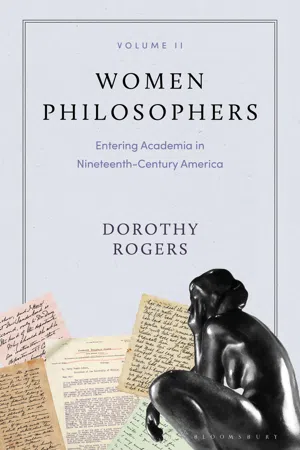
eBook - ePub
Women Philosophers Volume II
Entering Academia in Nineteenth-Century America
- 376 pages
- English
- ePUB (mobile friendly)
- Available on iOS & Android
eBook - ePub
About this book
Information
1
Introduction
Women and Early Academic Philosophy in America
The first volume in this pair of works on women in the history of philosophy in North America focused on women who entered philosophical discourse through education and social/political activism in the nineteenth century. The sixteen women in that volume generally studied philosophy far less formally than we do today—among fellow educators in the public schools, in parlor discussions, or in and through social/political conflict. The group under discussion in the current volume are the first women to have completed doctoral work and to teach philosophy or related disciplines at colleges and universities in the United States. The majority of them earned their degrees before 1900.
At the turn of the twentieth century, the academic world was becoming more accessible to women. Prior to 1900, just over 200 women were awarded doctoral degrees in all fields—or just over 7 percent of the total doctoral degrees awarded by 1900. Twenty of these women completed doctoral degrees in philosophy proper, and twenty-seven more did so in related fields—twelve in psychology, two in sociology, five in political science, four in economics, two in religion, and two in law.1
After they earned their degrees, the majority of the women in philosophy secured full-time positions, primarily in women’s colleges, and became active in professional networks, like the Association of Collegiate Alumnae (now AAUW) and the American Philosophical Association (APA). In fact, several of the women in this volume were charter members of the APA: Mary Whiton Calkins (Harvard/Radcliffe, 1895), Anna Alice Cutler (Yale, 1896), Grace Neal Dolson (Cornell, 1899), Clara Hitchcock (Yale, 1900), Vida Moore (Cornell, 1900), and Ellen Bliss Talbot (Cornell, 1898).2
For the first three decades of the APA’s existence, women made up just over 10 percent of its membership. In 1918, the APA elected its first woman president. Mary Whiton Calkins was well known and well respected as chair of the department of philosophy at Wellesley College, and served well in this role. A few years later, Anna Alice Cutler was the first woman to serve on the APA’s Executive Committee. Women’s participation in the APA is more significant than it may at first appear, because membership in the organization was by invitation only at the time. This leads to another critical factor in women’s success in academic philosophy: male allies. Henry Norman Gardiner and James E. Creighton were among the founders of the APA and were highly supportive of women in the discipline—serving as thesis advisors, soliciting or reviewing work for publication, and providing referrals or recommendations for open positions. A number of male colleagues, both within academia and outside of it, were supportive in similar ways: J. G. Schurman, George S. Morris, William Torrey Harris, Thomas Davidson, George Holmes Howison, John Dewey, James Tufts, George Herbert Mead, William James, and Josiah Royce.
Even with the support of male colleagues, larger social forces often shaped women’s career options. Of the twenty-five women discussed at length in this volume, the majority taught at single-sex colleges. Only five held positions at coeducational institutions: Anna Julia Cooper (Wilberforce, 1885–7; Frelinghuysen [no longer in operation], 1930–43), Marietta Kies (Butler College, 1896–9), Ella Flagg Young (Chicago, 1900–5), Eva B. Dykes (Howard, 1929–44), and Georgiana Simpson (Howard, 1931–9). With some overlap, just over half of the women in this volume held positions at women’s colleges for ten years or more. Again with some overlap, roughly a quarter of the women under discussion taught at secondary schools for up to ten years after completing their doctorates. Four women were unable to obtain full-time college-level positions at all, primarily due to sex-biased hiring policies, especially against married women with children: Christine Ladd-Franklin taught part-time or on a volunteer basis at Johns Hopkins and at Columbia University. Eliza Sunderland taught informal classes at the University of Michigan. Caroline Miles Hill taught and served as a principal at some fledgling private schools, volunteered at Hull House, and held a part-time librarian position at the University of Chicago. Ethel Puffer Howes does not seem to have held any full-time positions after she married. Two additional women appear to have remained outside the academic world by choice: Emma Rauschenbusch worked as a missionary, and Anna Louise Strong became a journalist and an activist.
In regard to the larger social forces that influenced women’s career choices, however, we need to take a step back and ask ourselves: Who earned doctoral degrees in the late nineteenth and early twentieth centuries? The demographic profile of this group of women speaks volumes about gender, culture, and privilege in this era. (And, sadly, evidence points to demographic patterns being similar today.)
Across academic fields, women in this era tended to be older than men when they entered graduate programs and earned their degrees. Often women’s personal circumstances or social norms led them to delay attending college or embarking on graduate study. Nine women in this volume completed their degrees before the age of thirty, but the average age at time-of-degree was thirty-five years. Six women earned their doctorates after the age of forty-five. Interestingly enough, May Preston Slosson was the first woman to earn a doctoral degree in philosophy, in 1880, and she was one of the youngest at time-of-degree: twenty-two years old. Anna Julia Cooper was the last woman featured in this volume to earn her degree, in 1925. She was sixty-seven years old at the time. Slosson was the daughter of a white clergyman. Cooper was born into slavery. And the two were born in the same year.
Slosson was among twenty-one women in this volume who were of European descent. Roughly two-thirds of them were from middle or upper-middle class families, with fathers who were educators, ministers, lawyers, or businessmen. Four or perhaps five of them were from poor or working-class families. Four or five more appear to have been extremely wealthy. Even geographically, there was little diversity in this group. Nine were from the northeastern United States. Nine were from the midwestern states. Only three were born in the mid-Atlantic or southern states. Two were raised in the western plains, and two were from the maritime provinces in Canada. Two were the children of immigrants.
This is one of two important reasons for going beyond the confines of philosophy proper in
this study: diversity. Given the barriers to higher education that were in place for white women in this period, it should come as no surprise that barriers were even greater for women of color. Based on extensive searches, it appears that the first woman with Latin American heritage to earn a doctorate in philosophy was Matilde Castro who completed her studies at the University of Chicago in 1907. The first woman of Asian descent to do so was Grace Lee Boggs over three decades later—at Bryn Mawr in 1940. The first woman of African descent to earn a doctorate in philosophy proper, Joyce Mitchell Cook, did so two decades after that—at Yale in 1965. The record is not much better among men of color. Only three African American males earned degrees in philosophy proper before 1930. If we expand to related fields—religion, sociology, and history—that number increases to only nine in the same period of time.3
I have not been able to locate documentation about other doctoral recipients who were men of color, but it seems clear that philosophy has not had the best track record in regard to cultural inclusion.
In order to be inclusive as I explored the contributions of women to the development of American philosophy as it became a professional academic enterprise, I made two decisions that disrupt any neat categories of thought that might currently exist in the discipline: I extended the period under discussion from 1900 to the early 1920s, and I included women whose work was in “philology” and history rather than only “philosophy” proper. While doing so did not retroactively dismantle barriers to the advanced study of philosophy that so many women faced in the past, it did open a passageway in the barrier, which allows us to consider their work today.
These two decisions have allowed me to include five women of color in this volume. Three of these women completed their studies at the University of Chicago: Matilde Castro, mentioned before, who earned a doctorate in philosophy in 1907; Rachel Caroline Eaton, a Native American woman who completed a doctorate in history in 1919; Georgiana Simpson, who earned a doctoral degree in German philology in 1921. Eva Dykes also studied philology, but focused on English literature, earning a degree from Radcliffe in 1921. Anna Julia Cooper completed a degree in history at the Sorbonne in 1925. The work these women produced either intersected with ideas under discussion in philosophy at the time or bring our attention to issues of importance to philosophy today. The last four contributed to laying the foundation for critical race theory to develop later in the twentieth century. They, along with Sadie Mossell (economics, Chicago, 1921) and Otelia Cromwell (literature, Yale, 1926) were the first women of color to earn doctorates in any field before 1930. I seriously considered including these two women in the volume as well. Unfortunately, Mossell produced few publications and devoted her career to practical work in economics. And the majority of Cromwell’s writings were produced in the 1930s and 1940s; thus her work took on a more modern, twentieth-century tone than the other women in this volume. Perhaps there will be an occasion to study their lives and work in a future project.
Yet, even if I had been content to ignore the lack of diversity in philosophy, inclusion of these women makes sense, because disciplinary boundaries were considerably more fluid at the turn of the twentieth century than they are today. The social sciences were just emerging as independent fields of study in this period. Many women who earned doctoral degrees in “philosophy” wrote dissertations in psychology, published additional work in this newly emerging field, and were offered positions in which they taught psychology throughout their career. This is true of nearly half of the women who earned doctorates in philosophy from Cornell. Similarly, education/pedagogy was often central to the curriculum in philosophy departments in this period. At both long-established traditional departments, like Yale, and at new and innovative departments, like Cornell and Chicago, the study of pedagogical methods as well as courses in the history and theory of education were key features of graduate education in philosophy until roughly 1910. Among the twenty-five women discussed at some length in this volume, therefore, eight crossed today’s disciplinary boundaries in this way.
This volume is arranged in clusters with each chapter focusing on women who earned degrees within a specific institution, each of which conferred doctoral degrees on three or more women. An exception is the final chapter—on women who did not have female peers at their degree-granting institution.
Cornell University was the first institution to open the study of philosophy to women in 1880. Like most departments of philosophy in this era, German idealism was influential, but women at Cornell appear to have been free to explore ideas and thinkers that interested them. A total of eleven women studied philosophy at Cornell by 1900, five of whom moved into psychology or education. The remaining six women are featured in this volume: May Preston Slosson, Eliza Ritchie, Ethel Gordon Muir, Ellen Bliss Talbot, Grace Neal Dolson, and Vida Frank Moore. Their written work demonstrates that they were independent thinkers, discussing matters like aesthetics and free will, along with the ideas of Spinoza, Henry More, Nietzsche, Fichte, and Lotze. Each of these Cornell women also succeeded in obtaining teaching positions and held them for ten years or more. Three of them remained in academia throughout their careers.
The next institution to produce a core group of women doctorates was the University of Michigan, in 1891 and 1892. German idealism was again a central focus, although the department also seems to have encouraged study of the history of philosophy, including American intellectual traditions. Marietta Kies, Caroline Miles Hill, and Eliza Read Sunderland completed doctoral studies there, and the influence of German idealism is apparent in their work—in Kies’s political theory, in Sunderland’s discussion of religious and philosophical history, and in Miles Hill’s attempt to reconcile transcendentalism and idealism. Kies and Miles Hill held faculty positions for considerable periods of time. Sunderland was in her fifties when she completed degree work and was never considered for the academic positions for which she applied.
Women began studying at the University of Chicago as soon as it opened in 1892. This institution became well known for producing an “instrumentalist” school of philosophy and facilitating growth of the pragmatist tradition. At this early stage in its history, pedagogy and psychology were also important features of the curriculum, as was the institution’s commitment to serving the needs of the city of Chicago. Six women who completed degrees here are discussed in this volume: Ella Flagg Young, Clara Millerd, Anna Louise Strong, Matilde Castro, Rachel Caroline Eaton, and Georgiana Simpson. These women’s career paths were diverse. Young remained solidly within education/pedagogy and produced several publications. She held a faculty position at Chicago before becoming the superintendent of the city’s schools. Strong took on the study of philosophy to challenge herself, then abandoned academia by choice. Millerd, Castro, and Simpson remained
in academic positions most of their lives. Millerd spent the majority of her career at Grinnell College and the University of Oregon. Castro taught at Vassar for a short time, then helped establish a strong program in pedagogy at Bryn Mawr. Eaton spent the majority of her career at reservation schools, namely, the Cherokee Female Seminary and Nowata tribal school. Simpson taught at the well-regarded Dunbar High School in Washington, DC, before closing out her career at Howard University. Yet with the exception of Young and Strong (who became a journalist), none of these women published a great deal. Like many academics in this era, they were expected to teach rather than conduct research—especially in women’s college networks. This was also the case with the women who completed doctorates at Yale, interestingly enough.
Harvard was formally closed to women, and when Mary Whiton Calkins and Ethel Puffer (later Howes) challenged the institution by studying with Harvard faculty and completing all requirements for the doctoral degree, the college balked. Harvard was a men’s institution, and it was not until 1902 that women could be conferred with a Radcliffe doctoral degree, which Eva B. Dykes received in 1921. The work these women produced does not resemble each other. Calkins succeeded in balancing her interests in philosophy and psychology; Howes did a bit of work in experimental psychology and in aesthetics. Dykes completed her degree work considerably later, and with an advisor who had previously taught ethics but had moved to literary theory.
Yale opened its doors to women for graduate study in 1892, but there was a lack of cohesiveness in the philosophy department at this time.4
The institution had very traditional roots, and the new faculty who were eager to explore the then-new field of psychology were rebelling against the chair, George Ladd, and other senior faculty. Yale produced a small group of women doctorates in philosophy who spent their careers as teaching professors at women’s colleges: Anna Alice Cutler chaired the department at Smith College, Blanche Zehring taught biblical studies at Wells College, and Clara Hitchcock taught philosophy and psychology at Lake Erie College. Available accounts indicate that these women were beloved professors, but none of them produced scholarship beyond their dissertations.
The closing chapter is devoted to a discussion of women who were “solo acts”—that is, women who were the first to complete degrees in the discipline in this era without the benefit of female peers to confer with when needed. Their areas of focus are as distinctive as the institutions at which they studied: Christine Ladd-Franklin (Johns Hopkins) was an intellectual powerhouse who published work on mathematics, psychology (specifically color theory), and logic. Julia Gulliver (Smith College) focused on social and political theory. Emma Rauschenbusch (University of Leipzig) produced what is quite likely the first full-length study of Mary Wollstonecraft by a woman. Anna Julia Cooper (Sorbonne) focused on social/political thought, especially as related to race.
Each of the women under discussion in this volume was highly accomplished. Yet, they were exchanging ideas apart from their male colleagues, and at this point in history, men were in more prestigious and powerful institutions. Women in philosophy did not get as broad a hearing as they would have had they taught in coeducational institutions or elite men’s institutions. Still, investigating the work of these women is instructive, both in terms of mapping out the genealogy of women’s thought in America, and as a way to point to the directions philosophy might have taken had it been more gender inclusive.
2
Institutional Strength and Support
Women at Cornell
Introduction
Eleven women completed doctoral degrees in philosophy at Cornell between 1880 and 1900—more than at any other institution in the United States in the nineteenth century. The majority of them were academically successful, holding faculty positions for a decade or more. Six of these women established themselves within philosophy and are featured at some length here: May Preston Slosson (1880), Eliza Ritchie (1889), Ethel Gordon Muir (1896), Ellen Bliss Talbot (1898), Grace Neal Dolson (1899), and Vida Frank Moore (1900). With the social sciences under development during this period, four other Cornell doctoral alumni in philosophy moved into careers in psychology: Margaret Floy Washburn (1894), Alice (Hamlin) Hinman (1896), Eleanor Acheson McCull...
Table of contents
- Cover
- Half-Title
- Series
- Title
- Contents
- Acknowledgments
- About the Cover
- 1 Introduction: Women and Early Academic Philosophy in America
- 2 Institutional Strength and Support: Women at Cornell
- 3 A Window of Opportunity: Women at Michigan
- 4 Beyond Philosophy: Women at Chicago
- 5 Isolated in the Ivy League, Prestige without Support: Women at Harvard and Yale
- 6 Overcoming the Odds: Women on Their Own at Johns Hopkins, Smith, Bern, and the Sorbonne
- 7 Conclusion
- Notes
- References
- Index
- Copyright
Trusted by 375,005 students
Access to over 1.5 million titles for a fair monthly price.
Study more efficiently using our study tools.
Frequently asked questions
Yes, you can cancel anytime from the Subscription tab in your account settings on the Perlego website. Your subscription will stay active until the end of your current billing period. Learn how to cancel your subscription
No, books cannot be downloaded as external files, such as PDFs, for use outside of Perlego. However, you can download books within the Perlego app for offline reading on mobile or tablet. Learn how to download books offline
Perlego offers two plans: Essential and Complete
- Essential is ideal for learners and professionals who enjoy exploring a wide range of subjects. Access the Essential Library with 800,000+ trusted titles and best-sellers across business, personal growth, and the humanities. Includes unlimited reading time and Standard Read Aloud voice.
- Complete: Perfect for advanced learners and researchers needing full, unrestricted access. Unlock 1.5M+ books across hundreds of subjects, including academic and specialized titles. The Complete Plan also includes advanced features like Premium Read Aloud and Research Assistant.
We are an online textbook subscription service, where you can get access to an entire online library for less than the price of a single book per month. With over 1.5 million books across 990+ topics, we’ve got you covered! Learn about our mission
Look out for the read-aloud symbol on your next book to see if you can listen to it. The read-aloud tool reads text aloud for you, highlighting the text as it is being read. You can pause it, speed it up and slow it down. Learn more about Read Aloud
Yes! You can use the Perlego app on both iOS and Android devices to read anytime, anywhere — even offline. Perfect for commutes or when you’re on the go.
Please note we cannot support devices running on iOS 13 and Android 7 or earlier. Learn more about using the app
Please note we cannot support devices running on iOS 13 and Android 7 or earlier. Learn more about using the app
Yes, you can access Women Philosophers Volume II by Dorothy G. Rogers in PDF and/or ePUB format, as well as other popular books in Education & Education Theory & Practice. We have over 1.5 million books available in our catalogue for you to explore.