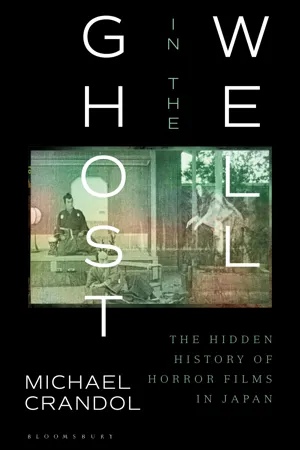
Ghost in the Well is the first study to provide a full history of the horror genre in Japanese cinema, from the silent era to Classical period movies such as Nakagawa Nobuo's Tokaido Yotsuya kaidan (1959) to the contemporary global popularity of J-horror pictures like the Ring and Ju-on franchises.
Michael Crandol draws on a wide range of Japanese language sources, including magazines, posters and interviews with directors such as Kurosawa Kiyoshi, to consider the development of kaiki eiga, the Japanese phrase meaning "weird" or "bizarre" films that most closely corresponds to Western understandings of "horror". He traces the origins of kaika eiga in Japanese kabuki theatre and traditions of the monstrous feminine, showing how these traditional forms were combined with the style and conventions of Hollywood horror to produce an aesthetic that was both transnational and peculiarly Japanese.
Ghost in the Well sheds new light on one of Japanese cinema's best-known genres, while also serving as a fascinating case study of how popular film genres are re-imagined across cultural divides.
- 272 pages
- English
- ePUB (mobile friendly)
- Available on iOS & Android
eBook - ePub
About this book
Information
1
Kaiki eiga: Defining Classic Japanese Horror Films
On February 12, 1931, Universal’s Dracula premiered in New York, and no one knew quite what to call it. Today the Bela Lugosi classic is often identified as the first full-fledged specimen of the horror genre,1 but distributors, exhibitors, and critics at the time of its release struggled to label the picture in generic terms for potential audiences. Not that Dracula had materialized, like its titular vampire, out of thin air. The nascent horror film genre it birthed had several important precursors in both America and Europe, notably the German Expressionist masterpieces The Cabinet of Dr. Caligari (Das Cabinet des Dr. Caligari, 1920) and Nosferatu (1922), John Barrymore’s turn as Dr. Jekyll and Mr. Hyde (1920), and Universal’s own releases of The Phantom of the Opera (1925) and The Cat and the Canary (1927). The German Expressionist films were presented and discussed as art films at the time of their release,2 and Dr. Jekyll and Mr. Hyde was received as a filmographic record of the talents of a great stage actor preserved for posterity,3 while the Universal pictures leading up to Dracula could be pegged into other already established genres by the invested parties. The Phantom of the Opera contained enough love-story elements to be labeled a romance, and the haunted house whodunit The Cat and the Canary was easily marketed as a mystery.4
Dracula, however, seemed to be an entirely new beast. Exhibition campaigns tried to sell the film as a mystery, while much of the advertising material portrayed Bela Lugosi as something approaching a romantic lead. Several critics followed suit, calling the film a mystery or a romance in their reviews. But as Robert Spadoni points out in Uncanny Bodies: The Coming of Sound Film and the Origins of the Horror Genre, there is no mystery for the audience, who knows Dracula is the killer from the start, and Lugosi’s coldly aloof portrayal of the Count lacks the romantic overtures that later Draculas would bring to the role.5
The reviews from 1931 are invariably aware that a sense of horror is a thematically unifying presence in Dracula, and most of them use the word “horror” at least once. Variety called it “a sublimated ghost story related with all surface seriousness and above all with a remarkably effective background of creepy atmosphere. So that its kick is the real emotional horror kick,” while Film Spectator noted, “The dominant note of the production is eeriness, a creepy horror that should give an audience goose-flesh and make it shudder.”6 Still, they stop short of calling the film a “horror movie.” Later the same year Universal followed up the success of Dracula with Frankenstein, by which time there seems to have been a consensus that a new film genre was emerging from a ghastly womb, and one can see the ongoing struggle to christen it in Variety’s prediction that Frankenstein would prove “whether nightmare pictures have a box office pull, or whether Dracula is just a freak.”7 The term “horror movie” does not appear to have been widely settled upon until after the release of Frankenstein, when Universal had fleshed out their cycle of “nightmare pictures” with such entries as The Mummy (1932), The Invisible Man (1933), and Bride of Frankenstein (1935), and rival studio Paramount threw their hats into the ring with Dr. Jekyll and Mr. Hyde (1931) and Island of Lost Souls (1932).8
Roughly two months before Frankenstein proved that “nightmare pictures” were here to stay, Dracula opened in Japan. Unlike their American counterparts, the Japanese critics knew exactly what to call it. In his review for Kinema junpō, Japan’s longest-running and most prestigious film magazine, Murakami Hisao acknowledges the picture’s novelty (as well as Universal’s attempts to sell it as a mystery), but appears to be quite familiar with its generic species, opening with the line, “Now this is something novel these days, a mysterious kaiki eiga that deals with vampires.”9 The term kaiki eiga is most commonly translated into English as “horror film,” but as we have just seen, in 1931 the phrase had yet to take root in the English-speaking world. What had defied generic classification in its native country seemed to fit neatly into a preexisting category in Japan. The word kaiki reappears throughout Murakami’s review: he praises director Tod Browning for “successfully brewing a kaiki atmosphere that catches hold of the audience’s heart” and suggests cinematographer Karl Freund’s camerawork is the likely source for much of the “kaiki flavor” of the production.10
The Japanese reception of Dracula upends assumptions about the Hollywood-centric origins of popular commercial film genres, throwing into the question the appropriateness of treating the phrase kaiki eiga as a mere analogue of the English “horror film” even as the former clearly encompasses much of the latter. Both terms have also shifted their meanings over time. At some points in history kaiki and horror have been treated as synonyms; at others they appear to be understood quite differently. Kaiki eventually fades into obsolescence as a generic category by the 1980s, subsumed into the English transliteration horā, an evolution that effaces a historically unique way of understanding a significant part of Japanese film culture. Instead of approaching kaiki, horā, and horror as interchangeable terms, this chapter seeks to illuminate the cultural and historical factors that make both Japanese and Western kaiki eiga unique in the global history of on-screen terror.
Kaiki as Film Genre
The word kaiki is composed of two characters, 怪 (“kai”) and 奇 (“ki”), both of which mean “strange,” “weird,” or “bizarre.” Variations on the word, all beginning with the character kai, recur throughout Japanese history to describe literature and drama featuring the weird, grotesque, and otherworldly. In his introduction to a collection of essays on kaiki cinema, Uchiyama Kazuki argues that kaiki to gensō, or “the weird and the fantastic,” was an established literary subgenre by the Heian period (794–1185), as one classification of the short prose tales in such collections as the twelfth-century text Konjaku monogatari-shū (“Collection of Tales New and Old”),11 although the Heian word used to describe prose tales with weird or fantastic themes is kai-i (怪異), another synonym for “strange” or “bizarre.”
During the Edo period (1603–1868), the advent of cheap printing processes and an affluent urban merchant class with time and money to spare sees an explosion of another type of kai literature, kaidan (怪談). Literally meaning “strange tales” but frequently translated as “ghost stories,” kaidan are narratives more often than not dealing with themes of revenge from beyond the grave or encounters with bizarre spooks, goblins, and monsters collectively categorized as yōkai. Urban Japanese of the seventeenth to nineteenth centuries delighted in reading collections of kaidan aloud at social gatherings as part of the “100 Ghost Stories” parlor game (hyaku monogatari kaidankai, “gathering of one hundred ghost stories”). These overnight, marathon recitations were playfully believed to have the power to summon real spirits, as one hundred candles doused one by one with the conclusion of each tale gradually plunged the gathering into darkness. As Michael Dylan Foster suggests in his study of yōkai culture, Pandemonium and Parade, the intersection of the horrific and the ludic in these ghost-story parties anticipates the same ambiguous enjoyment that horror films offer in the modern era.12
In addition to written collections printed for reading at “100 Ghost Stories” gatherings, the most popular kaidan tales further anticipated modern horror films in their adaptation to the kabuki theater (as well as the kōdan and rakugo oral storytelling formats), bringing grisly tales of terror to life in front of a paying audience. Kabuki playwright Tsuruya Nanboku IV’s 1825 script for The Ghost Story of Yotsuya (Tōkaidō Yotsuya kaidan, literally “The Ghost Story of Yotsuya on the Tōkaidō Road,” commonly shortened to Yotsuya kaidan), in which the vengeful ghost of a woman named Oiwa returns from the grave to torment her wicked samurai husband, Iemon, remains Japan’s most famous ghost story to this day and a perennial presence on stage, film, and television, as well as the subject of a well-known belief that past productions of the story were cursed by Oiwa’s spirit, resulting in the injury and even deaths of its performers.13
Following the arrival of motion pictures in Japan during the last years of the nineteenth century, the frequently performed kaidan of the kabuki stage soon found their way to Japanese cinema screens, with ghost stories being among the very first examples of commercial cinema in Japan. Adaptations of the most popular kaidan, including The Ghost Story of Yotsuya, The Dish Mansion at Banchō (Banchō sarayashiki), and variations on tales of the popular bakeneko cat monster (felines that imbibe the blood of a murder victim and take on their form as a half-human, half-feline werecat) were remade on a semiannual basis from about 1910 onward, with all of the major studios frequently producing competing versions of the same story. Most were released during the summer months of the Obon festival of the dead. Not only was this an appropriately spooky practice akin to the Hollywood strategy of releasing horror films during the Halloween season, it also carried on a tongue-in-cheek tradition from the kabuki theater that ghost-story plays performed in the heat of summer provided free ...
Table of contents
- Cover
- Halftitle Page
- Title Page
- Contents
- List of Figures
- Acknowledgments
- Note on the Text
- Introduction
- 1 Kaiki eiga: Defining Classic Japanese Horror Films
- 2 Ghost Cats versus Samurai: Prewar Kaiki Cinema
- 3 The Dead Sleep Unwell: Wartime and Occupation Censorship and the Postwar Return of Kaiki
- 4 Uncanny Invasions: The Shintōhō Studio and Nakagawa Nobuo
- 5 Back from the Grave: The Death of a Genre and the Kaiki Legacy of J-horror
- Afterword: The End …?
- Bibliography
- Index
- Copyright Page
Trusted by 375,005 students
Access to over 1.5 million titles for a fair monthly price.
Study more efficiently using our study tools.
Frequently asked questions
Yes, you can cancel anytime from the Subscription tab in your account settings on the Perlego website. Your subscription will stay active until the end of your current billing period. Learn how to cancel your subscription
No, books cannot be downloaded as external files, such as PDFs, for use outside of Perlego. However, you can download books within the Perlego app for offline reading on mobile or tablet. Learn how to download books offline
Perlego offers two plans: Essential and Complete
- Essential is ideal for learners and professionals who enjoy exploring a wide range of subjects. Access the Essential Library with 800,000+ trusted titles and best-sellers across business, personal growth, and the humanities. Includes unlimited reading time and Standard Read Aloud voice.
- Complete: Perfect for advanced learners and researchers needing full, unrestricted access. Unlock 1.5M+ books across hundreds of subjects, including academic and specialized titles. The Complete Plan also includes advanced features like Premium Read Aloud and Research Assistant.
We are an online textbook subscription service, where you can get access to an entire online library for less than the price of a single book per month. With over 1.5 million books across 990+ topics, we’ve got you covered! Learn about our mission
Look out for the read-aloud symbol on your next book to see if you can listen to it. The read-aloud tool reads text aloud for you, highlighting the text as it is being read. You can pause it, speed it up and slow it down. Learn more about Read Aloud
Yes! You can use the Perlego app on both iOS and Android devices to read anytime, anywhere — even offline. Perfect for commutes or when you’re on the go.
Please note we cannot support devices running on iOS 13 and Android 7 or earlier. Learn more about using the app
Please note we cannot support devices running on iOS 13 and Android 7 or earlier. Learn more about using the app
Yes, you can access Ghost in the Well by Michael Crandol in PDF and/or ePUB format, as well as other popular books in Medios de comunicación y artes escénicas & Películas y vídeos. We have over 1.5 million books available in our catalogue for you to explore.