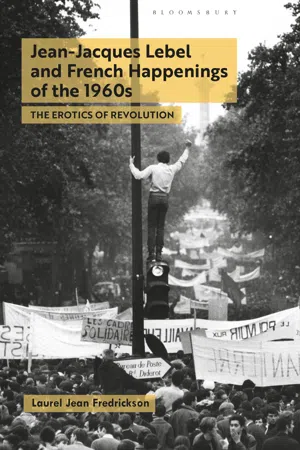
Combining a broad overview of Jean-Jacques Lebel's coming-of-age among Surrealists and his rupture with the movement, Laurel Jean Fredrickson focuses on two landmark happenings in this book: the first, "Funeral of the Thing of Tinguely" (1960), and the most scandalous, "120 Minutes dedicated to the Divine Marquis" (1966). This study illustrates the development and significance of French happenings in relation to cultural and political changes of the 1960s.
Research in Lebel's archives, and others like the Archives nationale d'outre-mer are indispensable in the telling of this extraordinary historical and theoretical narrative. It illuminates sensitive, often veiled dimensions of postwar French society, from torture during the Algerian War, to government censorship, to the sexual politics of nudity in art. This volume shows how Lebel synthesized the lessons of Dada and surrealism and 1960s experimentalism, electrified by political radicalism, to participate in shaping the erotics and forms of revolution in May 1968.
eBook - ePub
Jean-Jacques Lebel and French Happenings of the 1960s
The Erotics of Revolution
- 160 pages
- English
- ePUB (mobile friendly)
- Available on iOS & Android
eBook - ePub
Jean-Jacques Lebel and French Happenings of the 1960s
The Erotics of Revolution
About this book
Information
1
Eros, Revolution, Transmutation
In 1942, Marcel Duchamp disrupted the exhibition First Papers of Surrealism (October 14–November 7, organized by André Breton in New York in support of the Coordinating Council of French Relief Societies), creating a labyrinth of one to three miles of string throughout the space.1 He also had six boys in sports uniforms throw balls and six girls play jacks and skipping games during the opening reception.2 If asked, they would say they were doing as told.3 Duchamp then left. In the artist’s first monograph, Robert Lebel describes an “inextricable tangle of string, which forced spectators into contortions inappropriate to their equilibrium and their dignity.”4 Dalia Judovitz calls this and earlier works an “antidote” to an optical (retinal) emphasis in art.5 As explored in this book, Jean-Jacques Lebel’s later integration of viewers in happenings in the 1960s exaggerated such precedents—and, like his anti-aesthetic collage paintings and assemblages, had a basis in this lesson of Duchamp. Like Duchamp, his mentor, Lebel repositioned the artist from one who makes to one who shows, and the spectator from one who views to one who thinks and acts.
Duchamp’s readymades were pivotal in shifting art from a visual object-based practice to one that is conceptual. In the most famous example, he transformed a piece of plumbing into art, taking an ordinary urinal, recontextualizing it by placing it on its back on a pedestal, and signing it R. Mutt. Anonymously submitted to the New York Society of Independent Artists’ unjuried exhibition, Fountain disappeared, exposing the prudishness and outdated understanding of art of the society’s members. In 1957, Duchamp declared that “the creative act is not performed by the artist alone; the spectator brings the work in contact with the external world by deciphering and interpreting its inner qualifications and thus adds his contribution to the creative act.”6 In language suggestive of alchemy, he announced that through a “phenomenon of transmutation” the spectator transforms “worked matter” (what the artist has made) into art, and into posterity.7 This work draws viewers into mental acts of “making” the urinal into art and reveals the artist as a stager of situations, shifting completion of creative acts to viewers.
Jean-Jacques Lebel finds Fountain the prototypical readymade, which, though iconic, has retained its ambiguity and continues to question its own status as art—and, by implication, the status of all art.8 For Lebel, Fountain shows art to be a process of “transubstantiation and of transsexualization.”9 Placing a urinal on its back on a pedestal, he asserts, has sexual connotations: altering function and genus, in Duchamp’s hands a “passive receptacle destined to collect and evacuate corporeal liquid became transformed into a machine to produce this same liquid, that is to say into a watering fountain.”10 The fountain’s action of emitting liquid, Lebel continues, is “an activity admirably appropriate to Rrose … The mythic woman-fountain … of Étants donnés.”11 Abstruse games with words (puns) and gender or sexual identity were Duchamp’s sine qua non: he named his alter-ego Rrose Sélavy—a pun—which spoken in French, rolling one’s r’s, is Eros c’est la vie (Eros is life). Eros is as conceptual as corporeal. The making of art, Lebel learned, is a “mental matter” (cosa mentale).12
But mental acts may have corporeal effects and gendered implications. Comparing Fountain to a watering fountain insinuates that its liquid is either semen, the male ejaculate (product of a creative act?), or urine—“golden showers” suggesting male diuretic fantasies involving pisseur or pisseuse and carrying sacred and profane associations.13 This artistic tradition in Western art is evoked, praised, and mocked by Duchamp and his Fountain. His erotics of engagement with viewers offers intellectual stimulation and questions the nature of art and identity. Lebel’s erotics, sometimes involving an actual or represented pisseuse, elicits a more affective embodied response—or, for some, the opposite. Lebel’s art is Bacchanalian to Duchamp’s Apollonian. Each sets up a charged—as in electricity—circuit between artist, object, and observer in the works discussed in this book: cerebral for Duchamp, corporeal for Lebel. As a poetic act of experimenting with libidinal energy, Fountain positions Duchamp as a key node in Lebel’s rhizome of poets of erotico-political revolution and as a member of Dada, notorious for provocative dissent.
The preceding example, of Duchamp and his importance for Lebel, lays out but one node in a vast rhizome of artistic and poetic connections. Lebel’s relationship to this network, as to Duchamp, should not be understood as one of simple influence. Rather, Duchamp was a presence in Lebel’s work as Lebel was a presence in Duchamp’s. This is true across the rhizome, where many threads stretch outward from Lebel to most of the avant-garde movements of his time; threads from those movements also cross through him. This chapter describes the artistic culture out of which Lebel emerges—the contested and tumultuous world of the European avant-gardes, to which he connected avant-gardes in other parts of the world—while also demonstrating the ways in which his work was a force within those movements, helping to reshape his own influences.
Dada and Surrealism: Eros and Dissent
Lebel’s approach was decisively informed by Dada: its strategies of collage and assemblage; its irony and embrace of absurdity, provocation, anticlericalism, and antimilitarism; its antibureaucratic stance in art as in politics; its linking of iconoclasm in art to insubordination to all authority. A set of interlinked groups (a rhizome?), c. 1917 to 1923, Dada emerged during the First World War in Zürich in 1916 and, earlier, in New York with the Armory show of 1913 in which Francis Picabia and Duchamp exhibited, and where they later took refuge from the war. Duchamp’s readymades (c. 1913–17) were Dada. In Zürich, poet Tristan Tzara and painter Marcel Janco, Romanians, presented themselves at the Cabaret Voltaire run by the pacifists who had escaped Germany: actor and theater director Hugo Ball and Emmy Hennings, a poet and cabaret performer. Others followed, including the Swiss painter and designer Sophie Taeuber (Arp), German-French sculptor and painter Hans Arp, and Richard Huelsenbeck, a political radical and artist who knew Ball from Munich, also German. At the Cabaret Voltaire they exhibited artworks, staged evenings of events, and published manifestos and journals, upending the expectations of audiences. Deliberately aggravating, Cabaret Voltaire artists and poets provoked response, usually vituperative.14 Their actions and writings informed the postwar cultural vanguards, in France through Lebel, who at 17 knew more about the historical avant-gardes than anyone else of his generation.15 Dada reemerged in Cologne, Berlin, and Hanover. In Hanover, Kurt Schwitters, a key influence for Lebel, exploited the conjunctions and contradictions of collage and assemblage for varied works titled Merz, a word he coined by cutting up the German word for commerce: commerz. His fo...
Table of contents
- Cover
- Half-title Page
- Dedication Page
- Title Page
- Contents
- Acknowledgments
- Introduction: Poetry as Dissent
- 1 Eros, Revolution, Transmutation
- 2 L’enterrement de la Chose de Tinguely
- 3 120 minutes dédiées au Divin Marquis
- 4 Desire, Spontaneity, Revolution
- Bibliography
- Index
- Copyright Page
Trusted by 375,005 students
Access to over 1.5 million titles for a fair monthly price.
Study more efficiently using our study tools.
Frequently asked questions
Yes, you can cancel anytime from the Subscription tab in your account settings on the Perlego website. Your subscription will stay active until the end of your current billing period. Learn how to cancel your subscription
No, books cannot be downloaded as external files, such as PDFs, for use outside of Perlego. However, you can download books within the Perlego app for offline reading on mobile or tablet. Learn how to download books offline
Perlego offers two plans: Essential and Complete
- Essential is ideal for learners and professionals who enjoy exploring a wide range of subjects. Access the Essential Library with 800,000+ trusted titles and best-sellers across business, personal growth, and the humanities. Includes unlimited reading time and Standard Read Aloud voice.
- Complete: Perfect for advanced learners and researchers needing full, unrestricted access. Unlock 1.5M+ books across hundreds of subjects, including academic and specialized titles. The Complete Plan also includes advanced features like Premium Read Aloud and Research Assistant.
We are an online textbook subscription service, where you can get access to an entire online library for less than the price of a single book per month. With over 1.5 million books across 990+ topics, we’ve got you covered! Learn about our mission
Look out for the read-aloud symbol on your next book to see if you can listen to it. The read-aloud tool reads text aloud for you, highlighting the text as it is being read. You can pause it, speed it up and slow it down. Learn more about Read Aloud
Yes! You can use the Perlego app on both iOS and Android devices to read anytime, anywhere — even offline. Perfect for commutes or when you’re on the go.
Please note we cannot support devices running on iOS 13 and Android 7 or earlier. Learn more about using the app
Please note we cannot support devices running on iOS 13 and Android 7 or earlier. Learn more about using the app
Yes, you can access Jean-Jacques Lebel and French Happenings of the 1960s by Laurel Jean Fredrickson in PDF and/or ePUB format, as well as other popular books in Arte & Arte generale. We have over 1.5 million books available in our catalogue for you to explore.