Ladies Get Paid
eBook - ePub

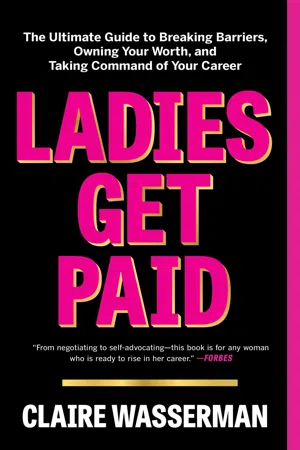
Ladies Get Paid

The Ultimate Guide to Breaking Barriers, Owning Your Worth, and Taking Command of Your Career

  1. 320 pages
  2. English
  3. ePUB (mobile friendly)
  4. Available on iOS & Android
eBook - ePub

Ladies Get Paid

The Ultimate Guide to Breaking Barriers, Owning Your Worth, and Taking Command of Your Career

About this book

From career coach and founder of the startup Ladies Get Paid — the eponymous organization leading the fight for equality in the workplace—comes a "powerful call to action" (Reshma Saujani, CEO and author of Brave, Not Perfect ) that provides the tools you need to strategically navigate the workplace, achieve success, and become a true leader. Claire Wasserman has one goal for women: Rise up and get paid. As the founder of Ladies Get Paid, Claire has worked her entire adult life to promote gender equality in the workplace. If you're looking to navigate a promotion or break the glass ceiling, Ladies Get Paid is your essential toolkit for achieving success. Filled with straightforward advice and inspiring stories, this book is a transformative "guide to succeeding in your field, even when you feel completely stuck" (Beth Comstock, author of Imagine It Forward ), by encouraging self-advocacy and activism. Covering topics as crucial and varied as how to combat imposter syndrome, deal with office politics, and negotiate a raise, Ladies Get Paid is a reminder that you are valuable—both as an individual woman and as part of the female community. And ultimately, it's about more than your wallet—it's about your worth.
Frequently asked questions

Yes, you can cancel anytime from the Subscription tab in your account settings on the Perlego website. Your subscription will stay active until the end of your current billing period. Learn how to cancel your subscription.
At the moment all of our mobile-responsive ePub books are available to download via the app. Most of our PDFs are also available to download and we're working on making the final remaining ones downloadable now. Learn more here.
Perlego offers two plans: Essential and Complete
  • Essential is ideal for learners and professionals who enjoy exploring a wide range of subjects. Access the Essential Library with 800,000+ trusted titles and best-sellers across business, personal growth, and the humanities. Includes unlimited reading time and Standard Read Aloud voice.
  • Complete: Perfect for advanced learners and researchers needing full, unrestricted access. Unlock 1.4M+ books across hundreds of subjects, including academic and specialized titles. The Complete Plan also includes advanced features like Premium Read Aloud and Research Assistant.
Both plans are available with monthly, semester, or annual billing cycles.
We are an online textbook subscription service, where you can get access to an entire online library for less than the price of a single book per month. With over 1 million books across 1000+ topics, we’ve got you covered! Learn more here.
Look out for the read-aloud symbol on your next book to see if you can listen to it. The read-aloud tool reads text aloud for you, highlighting the text as it is being read. You can pause it, speed it up and slow it down. Learn more here.
Yes! You can use the Perlego app on both iOS or Android devices to read anytime, anywhere — even offline. Perfect for commutes or when you’re on the go.
Please note we cannot support devices running on iOS 13 and Android 7 or earlier. Learn more about using the app.
Yes, you can access Ladies Get Paid by Claire Wasserman in PDF and/or ePUB format, as well as other popular books in Business & Imprenditoria femminile. We have over one million books available in our catalogue for you to explore.

Information

PART ONE BUILD YOUR FOUNDATION

CHAPTER ONE GET ALIGNED

By her senior year of college, Alisha had become seriously concerned about her future. She’d started her freshman year confident about what she would do after graduation. She always loved writing, being creative, and learning about other people. Growing up, Alisha idolized Barbara Walters and wanted to follow in her footsteps and become a journalist.
But over time, a little voice crept into her consciousness. Her parents had emigrated from Korea to the United States with very little, and here she was at Harvard, one of the world’s most prestigious institutions. Shouldn’t she be using this one-in-a-million opportunity to set herself up on a path toward success and financial security? Suddenly her dream of becoming a journalist felt frivolous, and even a little selfish. So, during her freshman year, Alisha switched her major from English to sociology, rationalizing that it was more “business”-oriented and therefore more practical.
As graduation loomed large and official adulthood crept closer, Alisha was feeling anxious, even panicked. She worried that she might have actually squandered her education by denying herself the chance to pursue what she was genuinely excited about. Now she feared it was too late to turn back. Her anxiety (or as she referred to it, “that sick feeling”) grew and grew until Alisha was almost paralyzed by it, barely leaving her room except for meals.
Then the recruiters came. Descending on campus in droves, they represented hedge funds, consulting firms, and investment banks, pitching the students on careers befitting Ivy League graduates. These soon-to-be grads had gone to the “best” schools; didn’t they deserve the “best” jobs (not to mention the enormous paychecks)? The recruiters assured them that starting their careers at such elite companies would put them on the fast track to guaranteed success.
But what exactly was success? Alisha wondered. Financial security? An impressive title at a big-name company? Or was it something more personal, and harder to describe? She banished that sick feeling and dutifully dressed up in what she hoped resembled business attire and joined the rest of the students who jostled to get into the right networking events in front of the right recruiters. Everyone was competing for the pot of gold that was promised at the end of the rainbow. All they had to do was follow it.

Whether it’s silently modeled or explicitly stated, many of us are raised with a vision of what our lives will look like: stability, a spouse, kids. Certain professions are deemed serious, and others silly. As adults, we take that vision on as our own, even though it’s inherited from those who came before us: our parents, schools, society; our churches, role models, and mentors. When we are faced with making critical decisions, we may orient toward that vision without question, choosing paths that will lead us to the “right” destination with the least amount of struggle.
Early on in my own career, I was very lucky to have been challenged to push myself past what I thought I wanted, to what I deeply needed. Just a few months after I’d graduated, I met Stephane, who was around fifteen years older than me and much wiser, and who would go on to become a mentor of mine. I vividly remember a conversation we had where he asked me what my definition of success was. As I began to answer, Stephane waved his hand, motioning me to stop. “Whose voice is that?” I was confused. I hadn’t said anything. “Try again,” he said. I’d barely uttered a sound when Stephane put his hand up again. “Try again.” Now I wasn’t just confused, I was annoyed. But before I could say anything, he smiled. “Is that voice your mother’s? Your father’s? Your school’s?”
I then realized that what he was doing was pushing me to consider that there are infinite ways to imagine the future and that I was allowed to have my own, personal definition of success, not bound or limited by who may have influenced me, or what I’d been exposed to. He was also challenging me to be brave and think for myself. Coming up with my own definition of success meant that I had to question—and maybe even reject—what I’d always thought to be true and start fresh with my own ideas.
This is what Alisha had attempted to do during her freshman year when she set her sights on a journalism career. But her inner critic had quickly swooped in to protect her from taking a risk, and she changed her course. Four years later, even though she felt lost, Alisha actually knew more than she realized. That sick, anxious feeling was like a signal trying to alert her that she was headed in a direction that was unlikely to lead to purpose and fulfillment. Still, it would take some time (and real-world experiences) before she was able to heed the signs her body was sending her. In this chapter we’ll see how Alisha, a high achiever most anyone would consider “a success,” confronts the assumptions about work that she’s carried her whole life, and how they’ve influenced the decisions she’s made in her career—not always for the best.
Overcoming external expectations means recognizing that you have the power to define your own direction, no matter your circumstances. To change your way of thinking, you have to confront the assumptions you carry, where they come from, and how they’ve influenced your decisions, for better or worse. As you do this work, you may find that you begin to look at the unknown as exhilarating, not terrifying. There is no formula whereby you answer some questions and out pops your dream career. Instead, you’ll learn how to trust your instinct over your inner critic and create a system to evaluate opportunities that are aligned with your values and goals. And while it will always be a little scary to stand up for what you want, you’ll feel pride in taking control of your career. You’ll also be more motivated, which in turn will help you do your best work, putting you in a position for rewards and recognition. You’ve earned it.

LISTEN TO YOUR INSTINCT

When Alisha received a job offer from a big consulting firm shortly after graduation, she took it immediately. While this wasn’t what she would necessarily have imagined for herself during college, it would at least put her on a track where she knew she’d have financial and professional security. She assumed that sick feeling, still with her since college, would go away soon.
A few months into the job, it was still there, but Alisha was so busy that she barely noticed it. She was putting in long days at the office, so what little energy she had left was spent doing the minimal self-care necessary for survival: sleeping, eating, and showering. The workload was grueling, but it was the norm; everyone was in the same boat, so who was she to complain? This was the price you had to pay for a big paycheck.
No stranger to working hard in college, Alisha could handle long hours and taking work home on the weekends, but it was the office politics that really rankled her. After proving her competence on smaller projects over a few months, Alisha got the opportunity to lead a project for a high-profile client. She prepared for weeks, only to have the opportunity to present her hard work to the client taken away and given to someone else the day of the presentation. “I was laying out all the slides of our PowerPoint to do one final review. As I was walking the team through it, a senior executive walked in. She thanked me for my work and informed me that Paul would be presenting it to the client. I was stunned.” Paul was a newer employee and from what Alisha could gather, a master at politicking. She, on the other hand, would describe herself as an introvert. She’d never considered this a liability before. It didn’t matter whether or not you were gregarious, she thought; what mattered was how well you did the job, right? She’d been raised to believe that working hard would get her ahead. And it had, until then. But now something was off, and she didn’t know what.
Like so many other women, Alisha assumed the problem was with her. She needed to not just work hard, but schmooze better, and be aggressive in the way that the company clearly rewarded. She never really considered that contorting herself into what the company needed her to be wasn’t the only way to work. But it was hard to see any other way, given that most of her friends were having similar experiences. Clearly this was just what it meant to be a working professional.
Alisha hit her breaking point a year later when she returned from a major business trip. She’d gone to Korea, where, almost as soon as her team landed after a fourteen-hour flight, they rushed right into their first client meeting. For the next three days they ran around the city, gathering firsthand market research, talking to locals, and all the while Alisha (who is half Korean) was real-time translating from Korean into English for her teammates, then back into Korean. “A two-way language translation is incredibly draining mentally and difficult to pull off well, and doubly so when you are doing it for your direct boss. I was obviously sent on this business trip because of my language skills, and because it would save the company thousands of dollars (perhaps tens of thousands) rather than paying an external interpreter.”
Upon her return to the United States, Alisha promptly got sick. She was able to hold it together for a client presentation, but the next day, jet-lagged and ill, she called in sick. She figured she could take a day to recover, given how hard she’d just worked. Wrong. Early that morning the phone rang: it was her boss’s boss, calling to express his concern—not for her health, but for her absence. If she wasn’t willing to put in the hours, he said, he was worried that she wasn’t cut out to be a consultant. Alisha was taken aback. She’d been killing herself working around the clock! The conversation then spiraled into whether she was a good fit for the company. Similar to the time her presentation was given to Paul, Alisha was left feeling totally unsure and unsettled, not understanding where things had gone wrong.
As upsetting as the call was, it was the catalyst Alisha needed to be brutally honest with herself. Why wasn’t she getting ahead at this job? Why wasn’t she happier? It wasn’t just the work-life balance that was exhausting, it was also constantly trying to twist into what she thought she needed to do and be in order to be successful. Alisha was starting to wake up to the possibility that as much as she needed to be right for the company, the company had to be right for her as well. The relationship needed to go both ways. This duality was something she had never really considered before. Instead of pushing the dread and discomfort away, Alisha needed to pay attention when things felt wrong and get to the bottom of it.

CHALLENGE YOUR ASSUMPTIONS

In the 1950s, psychologist Karen Horney identified a phenomenon that Alisha—and so many others—subscribe to: “The Tyranny of the Should.” Her theory posited that we have two views of ourselves: the “real self” (who we are) and the “ideal self” (the model of who we think we should be). If we feel our real self isn’t living up to the ideal (hello to all the perfectionists and “imposters” in the room), we believe we are fundamentally flawed, and as a result, can have a hard time fulfilling our potential. Unless we challenge the assumption that there is some ideal self we should inhabit, we’ll continue the cycle of self-doubt, self-flagellation, and dissatisfaction.
A way to replace those “shoulds” is to understand where they came from. That means digging into your past: how you were raised, the messages you received, how those around you influenced your opinions and choices about work, including whether or not it was gendered. For example, growing up, were you taught that certain jobs were or were not meant for women? It can be hard to imagine ourselves in industries and roles that for so long have been deemed “male” (engineering, construction, tech). With so few women at the top or in visible roles, we can feel even more cut off from those spaces. As the saying goes, “you can’t be what you can’t see.” Throw some imposter syndrome into the mix, and our vision of what a career “can” or “should” be becomes even more limited.
Sadly, these limitations can be as much internal as external. I’ve heard from too many women who don’t think they’re good enough or deserving enough to have a job that brings fulfillment. It’s not that they don’t want it, it’s just so far from their current circumstances that they can’t even consider it a possible outcome.
If any of this sounds familiar, it’s time for a gut check. How much have the “shoulds” dominated the way you’ve approached your career? How much are you guided by your voice, versus the voice of your parents, schoolmates, or the culture around you? Take some time to consider the following questions—you can write down your answers if you like or simply think them through, but allow yourself the space to really consider what has influenced the beliefs you carry about your career path.
UNDERSTAND YOUR INFLUENCES
  • What career paths did you have exposure to growing up?
  • Did the adults around you discuss their jobs openly? What was your impression of them?
  • Did adults in your life ever explicitly share their expectations for your career? What did they say?
  • Did anything in your environment influence what you thought of work in general, and the way you looked at your own career?
  • What has been the major driver of your career choices? Has anyone commented on those choices and if so, what did they say?
  • Have you ever done ...

Table of contents

  1. Cover
  2. Title Page
  3. Dedication
  4. Author’s Note
  5. Introduction: How It All Began
  6. Part One: Build Your Foundation
  7. Part Two: Game Time
  8. Part Three: Level Up
  9. Part Four: Make a Difference
  10. Appendix: How to Effect Policy Change
  11. Acknowledgments
  12. Continue the Conversation
  13. About the Author
  14. References
  15. Index
  16. Copyright