![]()
1
Preparation
My addiction to travel and adventure took hold when I was a child, largely under the influence of my parents who sent me out of the country every year during the winter. When they later sent me away to school, that too was abroad. With the army, I found myself in France—so when circumstances after the war made travel beyond my homeland impossible, I found this fate hard to accept. I found the solution to my restlessness by going to work on merchant vessels and that gave me an opportunity to visit South America, the African coast, India, Indochina. Along the way, I realized that if one wants to really see something while travelling, there is no need to be an unthinking, plodding tourist, the target for all sorts of travel agencies that seduce you to join their flocks to be herded along well-beaten paths. One must liberate oneself from the tedium of the routine, to avoid at all costs ordinary modes of travel such as trains or large steamships from which one sees nothing, experiences nothing.
Travelling further inland from the ports was largely out of my reach due to the cost of train fares and accommodation, and passport restrictions were another factor. Little by little, an idea took form in my mind for a long journey on a yacht. This idea first occurred to me earlier, when I visited the National Maritime Centre in Gdynia where I met my present collaborators, Jan Witkowski and Jerzy Świechowski.
I remember it as if it happened yesterday: I arrive at the Centre late in the evening, take my things to the tent, place them on the bunk assigned to me, and step out again into the yard. It is a beautiful night, though not moonlit; some 20 metres away from shore I see ghostly silhouettes of several yachts, their masts swaying lazily, hear the gentle waves lapping against the pier. The starry summer night is magical—what more do I need to inspire dreams and arouse my wanderlust?
A nearby voice interrupted my thoughts: “Very glad that you have arrived.” I turn and in the darkness I make out the shadowy form of a young man, perhaps twenty-something. “Witkowski,” he introduces himself, “I am the supply officer here.” Then he adds, “Know what we should do? Let’s take two of the yachts, and shake up some young people who have gathered here. There’s a nice breeze, lovely night don’t you think? I’ll take Kaper.” And to entice me further, “You take Gryf.”
A crew I’ve never met, a yacht I’ve not even seen in daylight, unfamiliar with local conditions—but I don’t have a chance to protest, Witkowski is already on his way. I hear his voice from afar, calling, swearing, and ordering what they are to bring on this nighttime expedition, though finding everything at once was not easy.
A quarter hour later, I am on a rowboat with my crew heading to board Gryf. Nearby, I can already hear all the voices and the general knocking about indicative of preparations for embarking out to sea.
“The sails are in the cabin, the lights in the forepeak and the lines… I checked them out this morning myself… watch out! There’s a strong wind and waves smashing against the pier,” he shouts.
In semi-darkness faintly lit by a swaying lantern, we raise our sails, and unmoor… On the other side of the pier a brisk breeze tips us to the side and we can hear the water pounding against the side of the boat as we gather speed and the harbor lights dim in the distance.
The next night we sail to the Hel peninsula, then later to Orlówo, then to Jastarnia. A year later, we sail to Sweden and Copenhagen with General Zaruski1. And then we launch a plan for a grand project.
It was during this time that I meet Świechowski, the youngest but also the coolest and most important of us three. He wasn’t yet the great sailor he is today having not yet sailed on yachts but he was already known as an excellent navigator and had worked on steamboats. We are to learn later that he well deserved this reputation when we were caught in the hurricane that blew us far off course; we survived the hurricane and he expertly guided us safely to Bermuda having only a general map of the Atlantic Ocean and, as a chronometer, a pocket watch that he scrupulously wound every day, even on those days when we were shut up in a cabin half-filled with water, constantly tossed against one another and desperately waiting for the end. But that’s still to come.
I started looking around for some kind of yacht for a longer expedition. My plans were beginning to take shape and I engaged the interest of some people who could influence the outcome. We were to be given a large yacht to sail off to the farthest corners of the earth… meanwhile things turned out quite differently. I was quite unexpectedly called to join a cavalry regiment in the Kresy, the eastern borderlands.
Well, that certainly made our plans go up in smoke since I was sent off to a distant part of Poland where I had difficulty communicating with Warsaw, let alone with Gdynia. The people who promised us a yacht abandoned us but, abandoned or not, our spirit was not broken. I corresponded regularly and frequently with Witkowski and Świechowski. Our plans once again crystallized but in a somewhat different form. Since we can’t get help from anyone, we will simply have to arrange everything ourselves.
I had, at the time, a couple of thousand złoty at my disposal; that’s the amount I was expecting to soon get my hands on. It was time to look around for a yacht. Easier said than done.
We examined every possibility we could think of. We needed a strong yacht, in the style of the cutters used by fishermen on their long voyages. Unfortunately, we found nothing of that sort. We set off on long and tedious searches outside Poland; Witkowski even went to Norway, but to no avail. Everywhere there was always, “yes, but…”—the boat was too old, the price too steep, the repair too costly.
But finally, I felt that I found the object of my dreams—a beautiful 2-masted ketch with a steel hull. About 13 metres long, it had a motor, luxuriously appointed interior, and a reasonable price. I was sure I finally found what I wanted.
Thinking I already had what I needed, it was time to approach my superiors for time off and permission to leave the country; they immediately gave me their enthusiastic approval. General Dreszer, as president of the Polish Maritime and Colonial League went so far as to transfer me to the National Institute for Physical Education in Warsaw and arrange the required permission to leave the country on May 1, 1933. We were then already in the month of April.
I will never forget my conversation with the general, which took place in his private home on Aleje Ujazdowskie [Ujazdowska Avenue]. It was only at this point that I admitted to him that our plan was to cross the Atlantic. (Until now, we only hinted about a long voyage perhaps around the coast of Europe.)
The general’s expression became very serious; I nearly died of fear that he would now deny his support.
“My dear sir,” said the general after a moment of serious reflection, “only two weeks ago Captain Skarżynski was here and told me he wanted to do exactly the same thing. I can only do what I did then—and that is to wish you all a successful voyage.”
We are almost there! Just a few more minor details and we’re ready to go. Or so I thought. But just a few days later some news hit me like a bolt of lightening.
Everything one buys abroad has a duty imposed upon it, yachts included. Unless, of course, there’s a special trade agreement with the country of origin. Well, because of its particular country of origin, my yacht would not be exempt but be evaluated and taxed accordingly.
This is an awful blow. What am I to do? I was totally counting on this yacht. A tragic situation—on the one hand I had made a commitment to this voyage and on the other, I have no possible way of being able to do it.
Well, too late to back out. We are going, even if we have to sail in a bathtub, we are going.
I immediately inform my friends about this unexpected development and at the same time ask them to once again check out the possibilities in Gdansk or Gdynia. I don’t wait for a reply but send them a telegram that I am on my way.
They are both waiting for me on the platform at the station in Gdansk, but it is only on the tramcar on the way to Westerplatte that they tell me they have found “something.” But is it suitable? Well, a little small, a little tight for three, but if we have to find something right away then it will have to do.
Indeed, my friends did not try to mislead me. One glance and my blood turns cold at the thought of crossing the Atlantic in this. It is almost the same as the little sailboats anchored at the dock.
But it is affordable so what is there to discuss? A little bargaining, and I find myself the owner of this ship!
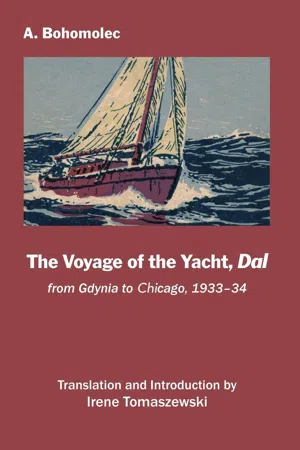
If I were to venture again on another long voyage perhaps I would choose an even smaller boat, but a boat designed like Dal? Not very likely.
Despite being well constructed with a strong hull, this little yacht is designed for coastal waters and has certain limitations for longer excursions into the high seas. For example, the hull is not designed as a “cutter,” the front of the keel is situated under the mast which means in stormy conditions, tossed on a short but high wave, the entire front part of the boat, being flat, would stamp on the wave.
The skylight is leaky, the doors more like framed shutters than watertight doors. The rudder is too big, the deck—despite our reinforcements—is too fragile, the cockpit too big, the keel too light, and the inadequate sails difficult to raise and even more difficult to lower because they frequently get jammed at the top of the mast.
Whenever we broach far on one side, water leaks through the floor and into the cupboards along the side soaking all our supplies, clothing, and tools.
I know that anyone reading this would be inclined to be critical of us but those are people who would never venture beyond the Baltic anyway. They are like the crowd at a boxing match, munching on candies, shouting advice to the boxers and, later, confidently offering their “professional” opinions about the fight.
Most of our yacht’s shortcomings were obvious to us before I bought it, the rest we got acquainted with before our departure from Le Havre. We tried to correct its faults, as much as we could.
But give up our voyage because of this? Never!
Our preparations began at a feverish pitch. We sailed the yacht to Gdynia where we put the boat high and dry in the fishery shipyard. While I rushed off to Warsaw to attend to the final details, my friends took care of the boat. First of all, the underwater part of the boat had to be covered with a sheet of copper that, among other things, protects the hull from seaweed and mussels sticking to the boat in southern waters. Considering that we would have to deal with great oceanic storms, several hoops around the hull were required to strengthen the construction. We added several steel lines to hold the mast. The original builder left space for an engine but we put in its place a large barrel for fresh water plus two more that were already installed beside the rear bunks that, along with a dozen or so containers of various sizes by the time we sailed weighed about half a ton.
Witkowski and Świechowski started making the storm sails. In the cabin we added leeboards to the bunks to prevent flying out when the boat rocked. And my kind and considerate friends even lengthened my 1.85-metre bunk to accommodate my 1.98-metre height. To do this they cut into the sail locker through which I could stretch my legs when I went to bed. As it turned out this space quickly got stuffed with all manner of things but I couldn’t claim any right to complain.
Finally we painted and varnished the entire boat and lowered it into the water.
We spent a month in preparation and felt the pressure of time but there was always something more to be done. The storm sails were not finished, we couldn’t get a sea anchor. But to finish it all always meant “just a few more days” delaying our departure.
Time pressed on.
Because of this we set off on the Baltic not entirely prepared for a voyage to America.
Sailing early we risked heavy storms on the Baltic and the North Sea. On the other hand, delaying our departure we risked the “cyclone season”2 in the western stretch of the Atlantic. And under no circumstances did we want to risk that.
As fate would have it, we were not able to avoid either but for the time being we were optimistic about the future. Our determination to get to America before the hurricane season called for draconian measures. Enough! We leave in three days. We’ll get the rest done along the way, in Copenhagen or Le Havre.
We filled the water tanks and sailed to the Officers’ Yacht Club to load: preserves, dried fruit, vegetables, condensed milk, tea, coffee, sugar, bread, clothing, books, maps, navigation instruments, guns… Thanks to Mrs. Witkowska who generously offered her help, everything was in place, the bunks were made up.
There was an amusing incident during this time. While we were anchored next to the pier a lovely young woman accompanied by an elegant dandy with a foolish grin approached us. “Excuse me, gentlemen, where are you going?”
Startled, I replied, “Copenhagen.”
“Ach,” she said with a grimace. “and I thought perhaps Hel. Then you could have taken us along.”
She turned on her heel and walked away offended. But she may have had a point. Why sail across the Atlantic when you can calmly sail the waters around the Hel peninsula?
Endnote
1. General Mariusz Zaruski (1867-1941), was a pioneer in ...