- English
- ePUB (mobile friendly)
- Available on iOS & Android
eBook - ePub
About this book
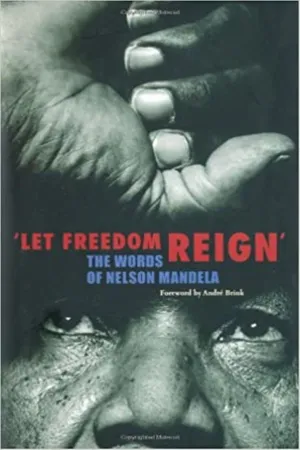
On 10 May 1994, Nelson Mandela became South Africa's first black president, uttering the words 'let freedom reign' as part of his famous inaugural address. More than 100,000 people turned up to hear him speak. Mandela's great skill as an orator has enabled him to use the power of words as an important weapon in his fight against discrimination and injustice in the world. This collection, which marks the 20th anniversary of Mandela's release from prison in February 1990, explores how his electrifying speeches and impressive rhetoric helped bring about social and political change in South Africa, through, among other things, the dismantling of the apartheid system. Throughout his lifetime, Mandela has spoken about and written on such issues as global warming, HIV/AIDS, human rights, racism and discrimination and women's rights, and some of these are showcased in "Let Freedom Reign". In this book, author Henry Russell analyses the linguistic features, content and context of Mandela's speeches, revealing the oratory skill behind this great man's most inspiring words.
Information
Subtopic
African HistoryIndex
History
Chapter 1
Political Awakening
(1948–61)
In 1948, the National Party won the Europeans-only general election and immediately introduced a massive legislative programme that consolidated white supremacy through apartheid (Afrikaans: ‘apartness’). Racial segregation was already well-established in South Africa, but the National Party now codified and enshrined it with draconian laws. The Population Registration Act of 1950 classified all South Africans as Bantu (all black Africans), Coloured (those of mixed race), or White. A fourth category – Asian (Indian and Pakistani) – was later added.
The Group Areas Act in the same year established residential and business sections in urban areas for each race, and members of other races were barred from living, operating businesses, or owning land in them. Thus, 80 percent of the land was given over to the whites, who comprised only 20 percent of the population. Mixed marriages were forbidden, along with any sexual relations between the races. Public facilities were segregated and non-whites were denied direct governmental representation.
Meanwhile, Mandela grew in stature as a political leader. Public speaking did not come easily to him, and the temperate nature of his mature oratory was only gradually achieved. As he later admitted, ‘I was something of a rabble-rousing speaker. I liked to incite an audience’. One day, at a rally in Freedom Square, Johannesburg, he overstepped the mark, saying that the time for passive resistance had ended, that non-violence was a useless strategy and could never overturn a white minority regime bent on retaining its power at any cost. He added: ‘At the end of the day… violence was the only weapon that would destroy apartheid and we must be prepared, in the near future, to use that weapon…’.
He may have been right, but he had spoken too soon. He was reprimanded by the National Executive of the ANC. From that moment until his acquittal at the end of the treason trial, Mandela moderated his language as his politics became more extreme. His rhetoric becomes circumlocutory. The questions ‘How are we going to react?’ (p. 24) and ‘Can the oppressed people count on the Liberal Party as an ally?’ (p. 29) remain unanswered but those who could read the political runes saw that Mandela was referring to a very particular kind of action that most people dared not name.
Lisping in Numbers
Presidential Address at the Annual Conference of the ANC Youth League,
Bloemfontein, December 1951
That Mandela had learned an important early lesson may be seen in the following extracts from his long speech to the ANC Youth League just before the start of the Defiance Campaign Against Unjust Laws – the largest non-violent resistance initiative ever seen in South Africa and the first to be pursued jointly by all racial groups under the leadership of the ANC and the South African Indian Congress (SAIC). The script shows the early coalescence of his oratorical style: mastery of detail; avoidance of inflammatory language, in spite of his apocalyptic vision of the consequences of apartheid for South African society; clear, logical exposition of policy, and, at the end of the opening paragraph, an admixture of humour. His speech also, in spite of the odd omitted preposition, conjunction and article, shows a growing mastery of English – his second language.
It is always a most difficult task to deliver a presidential address to an organization such as ours. One is expected to give as comprehensive a picture as possible of the political situation, both nationally and internationally. Then included must be the review of the organizational strength and power of the movement and the progress it has made in its efforts to carry the people to victory. Lastly, some indication must be given to the reply the organization must make to the situation having regard to the preceding analyses. Quite clearly it is not possible to do justice to all these, and yet a presidential address in which anyone of them is missing is not worthy of the name. I have [heard] it said that Dr. [Kwame] Nkrumah [founding president of Ghana, 1957–66] addresses conferences for five hours. I do not intend to break his record.
Mankind as a whole is today standing on the threshold of great events – events that at times seem to threaten its very existence…
In Africa the colonial powers… are attempting with the help of the notorious American ruling class to maintain colonial rule and oppression. Millions of pounds are pouring into the continent in the form of capital for the exploitation of our resources in the sole interests of the imperialist powers. So-called geological and archaeological expeditions are roaming the continent ostensibly engaged in gathering material for the advancement of science and the furtherance of humanity but being in reality the advance guard of American penetration. It is important for us and for the African people as a whole to realize that but for the support of American finance it would have been difficult if not impossible for the Western colonial powers to maintain rule in Africa, nor indeed anywhere in the world. In thinking of the direct enemies of the African people, namely, Great Britain, Spain, France, Portugal, Italy and S.A. [South Africa], we must never forget the indirect enemy, the infinitely more dangerous enemy who sustains all those with loans, capital, and arms.
In common with people all over the world, humanity in Africa is fighting these forces… These are hopeful signs, but precisely because the African liberation movement is gaining strength the rulers will become more brutal and, in their desperation, will practice all manner of deception in order to stay on at any rate to postpone the day of final victory. But history is on the side of the oppressed.
Here in South Africa the situation is an extremely grave and serious one… The situation is developing [in] the direction of an openly fascist state… The acts passed by the government … provide the ready-made framework for the establishment of the fascist state…
But the development of fascism in the country is an indication of the fear they have [of] the people. They realize that their world is a dying world and that the appearance of impregnable strength is a mere façade. The new world is the one in which the oppressed Africans live. They see before their eyes the growth of a mighty people’s movement. The struggles of 1950 were an indication that the leaders of the Africans and their allies were fully aware of the weakest link in the chain of white supremacy. The labour power of the African people is a force which when fully tapped is going to sweep the people to power in the land of their birth. True, the struggle will be a bitter one. Leaders will be deported, imprisoned, and even shot. The government will terrorize the people and their leaders in an effort to halt the forward march; ordinary forms of organization will be rendered impossible. But the spirit of the people cannot be crushed, and no matter what happens to the present leadership, new leaders will arise like mushrooms till full victory is won…
Sons and daughters of Africa, I do not think we differ concerning our ideas of the aims of African nationalism in Africa. In any case the very nature of [the] national movement to which we belong makes it impossible to expect [an] absolutely identical approach…
Then we have to design on concrete steps to be taken to deal with the situation that has arisen as a result of the Suppression of Communism Amendment Act. How are we going to react to the liquidation of Congress leaders as [a] result of this act? And how are the operations going to be carried on in the event of our being banned?…
We have to discuss measures [for] the creation of strong nuclei of active workers in the struggle on the proper organization of the League and the Congress [and] the elimination of unredeemable reactionaries, which work has proceeded quite far in certain areas. We have to consider measures to eliminate the looseness and lack of discipline in the movement and also the cultivation of a serious approach to the struggle. In this context we have to examine various tactics and weapons in our struggle, including boycott, civil disobedience, and strikes.
Sons and daughters of Africa, our tasks are mighty indeed, but I have abundant faith in our ability to reply to the challenge posed by the situation. Under the slogan of FULL DEMOCRATIC RIGHTS IN SOUTH AFRICA NOW, we must march forward into victory.
Spreading the Word
Liberation magazine, June 1953
Although never a communist, Mandela was twice ‘banned’ under the 1950 Suppression of Communism Act, an apartheid law that enabled the police to prevent dissidents from meeting more than one person at a time and visiting various public places and educational institutions. Nothing the banned person said or wrote could be quoted in the press or used for publication. There was no appeal against a banning order. One of Mandela’s bans prevented him from attending the annual convention of the ANC (Transvaal). His speech had to be delivered by a delegate.
In between arrests and bans, Mandela addressed numerous rallies and wrote a number of articles. The following extract is from ‘Searchlight on the Liberal Party’, which was published in the monthly periodical Liberation in response to those who feared that the ANC was becoming a communist catspaw. Although the trenchant legalese of the piece drove a wedge between the two anti-apartheid groups, it was an important restatement of Mandela’s clarity of vision and firmness of purpose. And to keen political observers, the use in the final sentence of the word ‘struggle’ suggested that the velvet glove might now contain a fist.
The Liberal Party constitution purports to uphold the ‘essential dignity of every human being irrespective of race, colour, or creed, and the maintenance of his fundamental rights’. It expresses itself in favour of the ‘right of every human being to develop to the fullest extent of which he is capable consistent with the rights of others’.
The new party’s statement of principles thus far contents itself with the broad generalizations without any attempt to interpret them or define their practical application in the South African context. It then proceeds to announce ‘that no person (should) be debarred from participation in the government or other democratic processes of the country by reason only of race, colour, or creed’. But here the neo-Liberals abandon the safe ground of generalization and stipulate explicitly ‘that political rights based on a common franchise roll be extended to all SUITABLY QUALIFIED persons. This question-begging formulation will not for long enable our Liberals to evade the fundamental issue: which persons are ‘suitably qualified’?
The democratic principle is ‘one adult, one vote’. The Liberals obviously differ from this well-known conception. They are, therefore, obliged to state an alternative theory of their own. This they have, so far, failed to do. The African National Congress… [stands] for votes for all… Does the Liberal Party support this demand? Historical reality demands a plain and unequivocal answer…
In South Africa, where the entire population is almost split into two hostile camps in consequence of the policy of racial discrimination, and where recent political events have made the struggle between oppressor and oppressed more acute, there can be no middle course. The fault of the Liberals – and this spells their doom – is to attempt to strike just such a course. They believe in criticizing and condemning the Government for its reactionary policies but they are afraid to identify themselves with the people and to assume the task of mobilizing that social force capable of lifting the struggle to higher levels.
The Liberals’ credo states that to achieve their objects the party will employ ‘only democratic and constitutional means and will oppose all forms of totalitarianism such as communism and fascism’. Talk of democratic and constitutional means can only have a basis in reality for those people who enjoy democratic and constitutional rights.
We must accept the fact that in our country we cannot win one single victory of political freedom without overcoming a desperate resistance on the part of the Government, and that victory will not come of itself but only as a result of a bitter struggle by the oppressed people for the overthrow of racial discrimination. This means that we are committed to struggle to mobilize from our ranks the forces capable of waging a determined and militant struggle against all forms of reaction. The theory that we can sit with folded arms and wait for a future parliament to legislate for the ‘essential dignity of every human being irrespective of race, colour, or creed’ is crass perversion of elementary principles of political strugg...
Table of contents
- Cover
- Title
- Copyright
- Contents
- Foreword: Nelson Mandela: Myth • Man • Magician
- Introduction
- 1. Political Awakening (1948–61)
- 2. In Captivity (1962–89)
- 3. Release and Triumph (1990–94)
- 4. President of South Africa (1994–99)
- 5. In Retirement (1999–)
- Acknowledgements
Trusted by 375,005 students
Access to over 1.5 million titles for a fair monthly price.
Study more efficiently using our study tools.
Frequently asked questions
Yes, you can cancel anytime from the Subscription tab in your account settings on the Perlego website. Your subscription will stay active until the end of your current billing period. Learn how to cancel your subscription
No, books cannot be downloaded as external files, such as PDFs, for use outside of Perlego. However, you can download books within the Perlego app for offline reading on mobile or tablet. Learn how to download books offline
Perlego offers two plans: Essential and Complete
- Essential is ideal for learners and professionals who enjoy exploring a wide range of subjects. Access the Essential Library with 800,000+ trusted titles and best-sellers across business, personal growth, and the humanities. Includes unlimited reading time and Standard Read Aloud voice.
- Complete: Perfect for advanced learners and researchers needing full, unrestricted access. Unlock 1.5M+ books across hundreds of subjects, including academic and specialized titles. The Complete Plan also includes advanced features like Premium Read Aloud and Research Assistant.
We are an online textbook subscription service, where you can get access to an entire online library for less than the price of a single book per month. With over 1.5 million books across 990+ topics, we’ve got you covered! Learn about our mission
Look out for the read-aloud symbol on your next book to see if you can listen to it. The read-aloud tool reads text aloud for you, highlighting the text as it is being read. You can pause it, speed it up and slow it down. Learn more about Read Aloud
Yes! You can use the Perlego app on both iOS and Android devices to read anytime, anywhere — even offline. Perfect for commutes or when you’re on the go.
Please note we cannot support devices running on iOS 13 and Android 7 or earlier. Learn more about using the app
Please note we cannot support devices running on iOS 13 and Android 7 or earlier. Learn more about using the app
Yes, you can access Let Freedom Reign by Henry Russell in PDF and/or ePUB format, as well as other popular books in History & African History. We have over 1.5 million books available in our catalogue for you to explore.