The Friday Mosque in the City
eBook - ePub
Available until 23 Dec |Learn more

The Friday Mosque in the City

Liminality, Ritual, and Politics

  1. English
  2. ePUB (mobile friendly)
  3. Available on iOS & Android
eBook - ePub
Available until 23 Dec |Learn more

The Friday Mosque in the City

Liminality, Ritual, and Politics

About this book

Concerned with the relationship between Friday mosque and city in the Islamic context. Focusing particularly on the Friday mosque, the book aims at exploring the concept of liminal(ity) in spatial terms and discuss it in terms of the relationship between the Friday mosque and its surrounding urban context. Transition spaces/zones between the mosque and the urban context are discussed through the case studies from various contexts. In doing so, the manuscript reveals different forms of liminality in spatial sense.

Considers widely-studied topics such as the 'Friday mosque' or the 'Islamic city' through a fresh new lens, critically examining each case study in its own spatial urban and socio-cultural context. While these two well-known themes – concepts that once defined the field – have been widely studied by historians of Islamic architecture and urbanism, this collection specifically addresses the functional and spatial ambiguity or liminality between these spaces. Thus, instead of addressing the Friday mosque as the central signifier of the 'Islamic city', the articles in this volume provide evidence that there was (and continues to be) a tremendous variety in the way architectural borders became fluid in and around Friday mosques across the Islamic geography, from Cordoba to Jerusalem and from London to Lahore.

By historicizing different cases and contributing to our knowledge of the way human agency through ritual and politics shaped the physical and social fabric of the city, the papers collectively challenge the generalizing and reductionist tendencies in earlier scholarship.  The disciplinary approaches are varied, and include archaeology, art history, history, epigraphy and architecture.  

The original approach in the book, addressing of the topic of liminality from different points of view and in different periods, creates a fresh approach that invites students and scholars to think deeply about the imbrication of congregational mosques in the daily life of the cities that host them. Moreover, in considering mosque and city together, the mosque appears as a living space subject to change and history and made with political and social purpose, rather than as a holy space disconnected from the rest of the world.

Traditional studies of mosques focus on architecture and aesthetic language and try to establish a lineal development of the building typology connected to the history of Islam across different territories. The present study offers an alternative (though not competing) perspective where locality and politics play a major role in the materialization of the congregational mosque as a religious and communal space. The wide historical frame enables comparison of congregational mosques in different historical periods: it is particularly a strong contrast to see how the liminality of the mosque changes between the early and classical periods of Islam on one side and the more contemporary times on the other. The consideration of diverging cultural, political and sectarian settings is another interesting element of comparison. 

Primary market will include scholars, academics and students working on or studying Islamic studies, particularly Islamic history, Islamic architecture and Islamic archaeology. 

Also of relevance to architectural historians, architects, art historians, city planners, city historians, urban designers, architectural critics, historians, sociologists, archeologists, and those interested in religious studies, and in archaeology of religion.

Frequently asked questions

Yes, you can cancel anytime from the Subscription tab in your account settings on the Perlego website. Your subscription will stay active until the end of your current billing period. Learn how to cancel your subscription.
No, books cannot be downloaded as external files, such as PDFs, for use outside of Perlego. However, you can download books within the Perlego app for offline reading on mobile or tablet. Learn more here.
Perlego offers two plans: Essential and Complete
  • Essential is ideal for learners and professionals who enjoy exploring a wide range of subjects. Access the Essential Library with 800,000+ trusted titles and best-sellers across business, personal growth, and the humanities. Includes unlimited reading time and Standard Read Aloud voice.
  • Complete: Perfect for advanced learners and researchers needing full, unrestricted access. Unlock 1.4M+ books across hundreds of subjects, including academic and specialized titles. The Complete Plan also includes advanced features like Premium Read Aloud and Research Assistant.
Both plans are available with monthly, semester, or annual billing cycles.
We are an online textbook subscription service, where you can get access to an entire online library for less than the price of a single book per month. With over 1 million books across 1000+ topics, we’ve got you covered! Learn more here.
Look out for the read-aloud symbol on your next book to see if you can listen to it. The read-aloud tool reads text aloud for you, highlighting the text as it is being read. You can pause it, speed it up and slow it down. Learn more here.
Yes! You can use the Perlego app on both iOS or Android devices to read anytime, anywhere — even offline. Perfect for commutes or when you’re on the go.
Please note we cannot support devices running on iOS 13 and Android 7 or earlier. Learn more about using the app.
Yes, you can access The Friday Mosque in the City by A. Hilâl Uğurlu, Suzan Yalman, A. Hilâl Uğurlu,Suzan Yalman, Mohammad Gharipour,Christiane Gruber in PDF and/or ePUB format, as well as other popular books in Social Sciences & Religious Architecture. We have over one million books available in our catalogue for you to explore.

Section I

Spatial Liminalities: Walls, Enclosures, and Beyond

Liminal Spaces in the Great Mosque of Cordoba: Urban Meaning and Politico-Liturgical Practices
Susana Calvo Capilla
To understand the formal and emblematic meanings of the Friday mosques in Andalusi cities, as well as their interactions with urban life, it is necessary to analyse not only the buildings themselves but also the Arab sources and the Christian documents. The case of the Great Mosque of Cordoba is paradigmatic because of its exceptionally good state of preservation and because of the volume of surviving textual information about it and the city of Islamic Cordoba.1 The preservation of the mosque throughout the Middle Ages was probably due to the great admiration of Christian kings for the building: ‘This is the largest and most excellent and noblest mosque of the Moors in Spain’, exclaimed Don Juan Manuel, brother of King Alfonso X (1221–84).
Textual information enables us to surmise what the atmosphere around the mosque in medieval Cordoba, the bustling capital of al-Andalus, would have been like. Juridical texts (fatwas and legal opinions), biographical literature, hisbah treatises (books describing the official supervision of the markets and moral behaviour), and historical chronicles mention the diverse activities, of both religious and profane character, that took place around and in front of the Great Mosque (jami‘) of Cordoba. The large amount of writings on Cordoba under the Umayyads is an exceptional case. In these texts, as well as in the inscriptions preserved, it is possible to notice the connections – the dialogues, we could say – that the building had with its urban surroundings from religious, political, and social points of view. These spaces and the activities that took place in them also left an important mark in the Christian documentation, which allows us to observe and understand the transformations that have occurred in the mosque to the present day.
Excavations carried out in Spain in the twentieth and twenty-first centuries, as well as conservation work begun in the nineteenth century, have corroborated much of the data found in the historical sources, deepening the extant knowledge concerning the religious architecture of al-Andalus. As far as the liminal spaces of the Cordoba Mosque are concerned, work by archaeologists and architects since 1882 – when the building was declared a National Historic-Artistic Monument – has been instrumental in substantiating the words of chroniclers and jurists. Archaeological work at the twelfth-century Great Mosque of Seville and at ninth- and tenth-century local mosques in Cordoba complements the study. This chapter will review the material concerning the area around the Great Mosque of Cordoba, and how it has changed over the centuries.
The Friday mosque of Cordoba was a freestanding monumental building with a fortified appearance and a high tower that was visible from any point in the city, characteristics that explain its great visual and symbolic impact on the city, even today. Furthermore, as it was located next to the seat of power (al-qasr) and other governmental institutions and surrounded by main souks, the Friday mosque became the centre of urban life in medieval Cordoba. As the dynastic and main Friday mosque in al-Andalus, al-masjid al-jami‘ of Cordoba was also a site for political ceremonies: it was here where official statements were made, where emirs and later caliphs were proclaimed (bay‘a), and rulers appeared to the people, and where standards were tied before the troops set off on a campaign. Additionally, public edicts of every sort were read aloud at its gates. Other important activities related to justice (the supreme qadi of Cordoba had his seat in the mosque) and education were carried out in its interior.
Consequently, the mosque’s facade and its impressive entrances also became the most suitable urban public spaces for displaying political, ideological, and religious messages – ultimately, official propaganda. Especially during the first centuries of Islam, the capital jami‘ became the setting for the main social and political events of a given territory: religious controversies, dynastic relays, political or military official announcements, legal enforcement, theological propaganda, and pious exhortations – everything took place in the great mosque and its immediate surroundings. In the case of Cordoba, the decoration and epigraphic programme of the caliphal expansion of the jami‘, and especially of its gates, were conceived for several politico-religious purposes and in dialogue with the urban context.
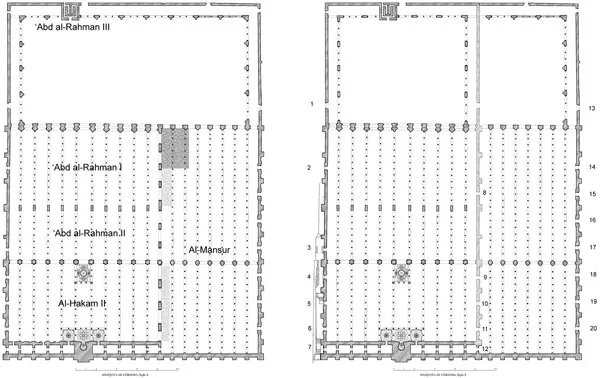
We should first review the various phases of the edifice’s construction in order to establish a better understanding of how its liminal spaces were developed. The Cordoba Mosque was built on the order of the first Umayyad emir of al-Andalus, ‘Abd al-Rahman I (d.788), around 785. This first Friday mosque had a prayer hall divided into eleven naves and a patio with galleries. San Sebastian gate, also called the Viziers’ door, is the oldest gate to the mosque and preserves an inscription documenting its restoration in 855–56, on the orders of the emir Muhammad I. The second emir, Hisham I (r.788–96), added the minaret and an ablutions hall adjoining the eastern side of the building. The mosque was first extended by emir ‘Abd al-Rahman II (r.822–52), who ordered the qibla wall to be pulled down and the naves lengthened to the south. His successors, emirs Muhammad I (r.852–86), al-Mundhir (r.886–88), and ‘Abd Allah (r.888–912), added several features, such as the first maqsura (royal enclosure) in 873 and the first sabat, a bridge joining the palace and the mosque by spanning the street below. In 929, ‘Abd al-Rahman III (912–61) was proclaimed caliph, and, in the early 950s, he began work that would transform the old mosque into the showcase and symbol of a renewed Umayyad Caliphate. The chroniclers state that the first tasks included building a new monumental minaret and enlarging the courtyard so that it would be proportionate to the prayer hall. A few years later, ‘Abd al-Rahman’s son al-Hakam II (r.961–76) ordered the qibla wall to be pulled down again and several sections to be added to the naves. A huge ornate maqsura was built in the new oratory, featuring three covered sections with ribbed domes and decorated with splendid glazed and gilded mosaics. The last large project in the Friday mosque of Cordoba was completed during the time of caliph Hisham II, around 987–88, on the order of his minister Ibn ‘Abi ‘Amir, al-Mansur. This time, fortunately, the qibla wall and al-Hakam II’s magnificent maqsura were preserved; eight naves were added to the east side of the prayer hall and the proportional part of the courtyard [Figure 1].
Two black and white ground plans of the Great Mosque of Cordoba. The one on the left shows the plan after the al-Mansur expansion (987-88). The other one is the same plan with the disappeared facade of Caliph al-Hakam II (961-76), discovered inside the mosque.
1. Gate of the Deans (no inscriptions)
2. St. Sebastian or Viziers door (foundational inscription from Muhammad I period)
3. St. Michael door (no inscriptions)
4. Door of the Holy Spirit (Q. 40:3)
5. Palace or Bishop door (Q. 40:12–14, 40:16–17)
6. St. Ildefonso door (no inscriptions)
7. The sabat doors
8. Door of the ‘Abd al-Rahman II phase, found in the excavations (no inscriptions)
9. Door of the Saint Martha Altar (Q. 3:19)
10. Door of the St. Sebastian Altar (no inscriptions)
11. Door of the St. John the Baptist Altar (Q. 16:90)
12. The ‘Punto’ door or Treasure Gate (Q. 19:35)
13. Saint Catherine door (no inscriptions)
14. San Juan door (Q. 3:191–92)
15. Baptistery door (Q. 59:21–23)
16. St. Nicholas door (Q. 14:52 and 39:53)
17. Door of The Conception (Q. 36:78–79 and 43:68–71)
18. St. Joseph gate (Q. 3:1–4)
19. Magdalena gate (Q. 33:56 + Q.112)
Figure 1: Great Mosque of Cordoba. Left: Ground plan after al-Mansur expansion (987–88). The shaded areas represent the excavations. Right: Same plan with the disappeared facade of Caliph al-Hakam II (961–76), discovered inside the mosque, and main doors numbered. Based on A. Almagro’s plan, 2014.

The Doors of the Great Mosque of Cordoba: Written Sources, Qur’anic inscriptions, and Architectural Remains

The great mosque was Cordoba’s focal point during the medieval period. Everyone would have attended the great mosque at midday for congregational prayers every Friday and to hear the sermon, or khutba. In addition to the ritual prayers, other religious activities, many linked to popular piety and official protocol, were carried out in the mosques or next to them. Several liturgical and secular ceremonies took place before the doors and facades of the Great Mosque of Cordoba, so that the surrounding area became an extension of the prayer hall. When the prayer hall was full, the faithful prayed by the entrances and walkways outside the walls of the building. The hisbah treatises of al-Andalus refer to the custom of placing secondary muezzins at the outside doors and courtyard, who not only repeated the call to prayer, announcing that the salat was about to start, but also repeated the imam’s wo...

Table of contents

  1. Cover Page
  2. Title Page
  3. Copyright
  4. Contents
  5. Acknowledgements
  6. A Note on Transliteration
  7. Introduction
  8. Section I: Spatial Liminalities: Walls, Enclosures, and Beyond
  9. Section II: Creating New Destinations, Constructing New Sacreds
  10. Section III: Liminality and Negotiating Modernity
  11. Author Biographies
  12. Index