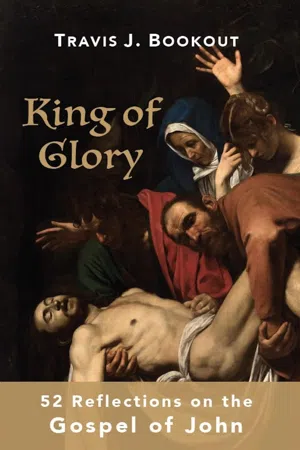
In King of Glory: 52 Reflections on the Gospel of John, Travis Bookout invites readers to join him on a journey with Jesus through the Fourth Gospel. Each reflection challenges readers to consider, imagine, meditate, and be transformed by the life of Jesus. Discussion questions encourage personal contemplation. Written for those who desire deeper Bible study and spiritual growth, this collection is ideal for personal devotion, small group discussions, and Bible classes. A seasoned minister, Bookout, benefit preachers, campus ministers, and Bible class teachers within their church settings. Having the depth of a commentary, yet accessible to any Christian, King of Glory is filled with practical ways to actualize the call of John's Gospel-to embody the love of God and glorify Christ through acts of service, justice, and self-sacrifice.
- English
- ePUB (mobile friendly)
- Available on iOS & Android
eBook - ePub
About this book
Information
Subtopic
Études bibliquesReflection 1
The Logos and the Son
John 1:1–18

The Logos of God
The Gospel begins with a shocking declaration: “In the beginning was the Word, and the Word was with God, and the Word was God” (John 1:1). The “Word” (Logos) existed before the world, existed with God, and existed as God. Throughout John, there is mass confusion about where Jesus came from (John 3:13, 31; 6:32–40, 51; 7:41–42, 52; 16:27–29, etc.). The reader knows from the beginning, He came from being with God. Yet to say someone was “with God” is quite different than saying someone “was God.” How is it possible to be the person you are with? If someone is with you, they cannot be you. It is understandable that this difficult and frustrating concept will forever remain a source of conflict and tension when it comes to Jesus.
Interestingly, Jesus does nothing to ease the tension. He constantly speaks of God as His Father but then says things that only God can say (John 8:58). He speaks as though the Father is distinct from Him, but then says, “I and the Father are one” (John 10:30). Most characters reject these statements as blasphemy (John 8:59; 10:31), but some, though the journey is long and arduous, begin to see in Jesus something truly divine. Some will look upon Him and say “My Lord and My God” (John 20:28).
Seriously, that’s almost an impossible thing to believe. I cannot imagine what it must have been like. I’ve been shaped by 2000 years of Christian tradition. It doesn’t shock me like it should. Imagine you’ve never heard of Jesus. You’ve never heard of the incarnation. You’ve never heard of Christianity. What would it take to convince you some kid who grew up down the street from you, you knew his parents, you saw every awkward stage of his life, was “in the beginning with God and was God?” Could you ever believe He literally came down out of heaven? It’s certainly understandable the crowds say, “Is this not Jesus, the son of Joseph, whose father and mother we know? How does He now say, ‘I have come down out of heaven?’” (John 6:42). That is why it is so imperative to pay close attention to His signs (Reflection #2 and #10). They reveal the impossible. They show you what you’d otherwise never believe.
This prologue frames the Gospel of John and reframes everything we thought we knew about the world and God. God exists and He also speaks. His “Word” is what He speaks. His “Word” is how He created the world. His “Word” perfectly reflects His mind. His being. His “Word” is Him. The two are linked together as One in fascinating ways. This idea is not completely unique to the Gospel of John. The supremacy of the Word, the Logos, has deep roots both in Jewish wisdom tradition and Greco-Roman philosophy, particularly Stoicism, which saw logos as the rational force animating the whole cosmos.
Wisdom and New Creation
For John’s readers, the Jewish Bible will prove a more reliable backdrop to the prologue.1 The Old Testament equates God’s Wisdom with God Himself and His creative nature. Wisdom is personified in Proverbs as having been with God from creation:
I, wisdom dwell with prudence ...When He established the heavens, I was there, When He inscribed a circle on the face of the deep, When He made firm the skies above, When the springs of the deep became fixed, When He set forth the sea its boundary So that the water would not transgress His command, When He marked out the foundations of the earth; Then I was beside Him, as a master workman; And I was daily His delight, Rejoicing always before Him, Rejoicing in the world, His earth, And having my delight in the sons of men (Prov 8:12, 23–31).
If you were asked, “Who was with God when He created the world? Who was the ‘master workman’ with God in creation? Who was ‘His delight’ before He created the world?” how would you answer? If you say, “Jesus” I think that’s probably a good answer (though not exactly what Proverbs has in mind). In fact, the early church always read Proverbs 8 to be about Jesus and it was quite the controversial passage. Most of the early church read the Old Testament in Greek although it was originally written in Hebrew. This means they were reading a translation, just like we do. And anytime you read a translation there are difficulties that arise.
The Greek Old Testament, called the Septuagint (LXX), says God “created” wisdom in Proverbs 8:22. The Hebrew Old Testament says God “possessed” wisdom in that passage. The LXX translators translated the Hebrew word for “possessed” (קָנָה) with the Greek word for “created” (ἔκτισέν). If you assume Proverbs 8 is about Jesus, and you’re reading the LXX, you have a homerun argument that Jesus is a created being, which was a crucial argument for Arianism, an early church controversy saying Jesus is not co-eternal with God, but was created by God. If it’s about Jesus, and you’re reading the Hebrew Bible, you simply have Jesus coexisting with God at the beginning. Early Christians argued about the best way to interpret this passage, but interestingly, no one ever really argued Proverbs 8 wasn’t about Jesus.
Proverbs 8 in its original context, however, isn't so much talking about Jesus, but wisdom personified. God’s wisdom has always been with Him. It is part of Him. Wisdom was active when God created. The same is true for His Word: “By the word of the Lord the heavens were made” (Ps 33:6). In fact, in Jewish writings, the word and wisdom of God are often linked together, especially in creation! The Wisdom of Solomon, a beautiful collection of Jewish poetry, begins a special prayer for wisdom with these words: “God of our ancestors, Lord of mercy, who by your word have made all things, and in your wisdom you have formed man to rule the creatures that have come from you, to govern the world in holiness and justice, and in honesty of soul to wield authority ...” (Wisdom 9:1–2). God created the world and formed man by His logos and sophia, His word and wisdom. There are many ways one can describe the divinity of Jesus, but I think John has picked up on this idea and is bringing them together in his introduction to Jesus.
The word and wisdom of God are eternal and coexistent with God. There was never a time God was without His wisdom or His word (Or Spirit for that matter). They are inexorably linked to each other because God’s word without exception contains His wisdom. God has no words without wisdom. Together, God and His wisdom and His word created the world. In joining all of these together in the person of Jesus, John begins to retell the creation story of Genesis 1.
“In the beginning” is not some accidental, throwaway phrase. It is meant to call you back to creation itself. John reads and retells Genesis 1 with the word of God personified: “All things came into being through Him, and apart from Him nothing came into being that has come into being” (John 1:3). If you open your Bible to Genesis 1, you’ll see the phrases “And God said…” or “God called…” repeated over and over again (Gen 1:3, 5, 6, 8, 9, 11, 14, 20, 22, 24, 26, 28, 29). Just think about how much God speaks in Genesis 1. There are so many words and each one is dripping with wisdom. By taking God’s creative word and wisdom and joining them in Christ, John is beginning His gospel with a call to radically rethink everything you thought you knew about the cosmos and everything God created. Jesus’ fingerprint is everywhere.
The Word has become a character in John’s creation story. God’s Word exists with and as the Creator, from whom also comes the light which shines in the darkness. When all was darkness upon the face of the deep primordial waters of earth, God said, “Let there be light” (Gen 1:2–3). In John’s retelling of the creation story, Jesus is the Light of the World (John 9:5) which shines in the darkness (John 1:5; Gen 1:2–5). God’s wisdom and word, in Jesus, illuminate the world through new creation. In John 1:1–5, God’s new creative work to transform the world through Jesus is being introduced.
God in the Flesh
The most shocking part of this text, which separates it from Genesis, Jewish wisdom tradition, and Greek philosophy, is when “the Word became flesh, and dwelt among us, and we saw His glory” (John 1:14). The Logos which produces new creation became part of old creation. God became flesh. The word “dwelt” (ἐσκήνωσεν) in verse 14 literally means “He tabernacled” among us (see Rev 21:3). The Word became the new tabernacle on earth, which housed the glory of God. Remember the Exodus story? Moses prays, “I pray you, show me Your glory!” (Exod 33:18). The glory of the Lord passed by Moses briefly in the cleft of the rock (Exod 33:22). The glory of God was seen in the tabernacle, a cloud by day and fire by night (Exod 13:21; 40:35). The glory of God is now seen in His new tabernacle. As John continues, we will see Jesus is not only the life-giving force of new creation, He is the new tabernacle, temple, and presence of God on earth. The glory of God is seen in Him, “full of grace and truth.”
If you want to see God, look to Jesus. If you want to see God’s grace, truth, and glory, look to Jesus. “No one has ever seen God; the only God, the One who is in the bosom of the Father, He has made Him known” (John 1:18). Jesus “has made Him known” or literally exegeted (ἐξηγήσατο) God. He has embodied God and shown Him to the world; who He is, what He says, and how He lives. Jesus, the Logos of God, is everything we need to know about God. He has come. He is transforming the world. Come and see how.
Reflection Questions
1. In what ways has God remade the world through Jesus? How is the life of Jesus like the beginning of Genesis? How many connections can you make between the coming of Adam into the world and the coming of Jesus into the world?
2. What has the life of Jesus revealed to you about God? In what ways do you think about God differently because of Jesus?
1 For a good discussion on Jesus as the Word and Wisdom of God, see Richard B. Hays, Echoes of Scripture in the Gospels (Waco: Baylor University Press, 2017), 308–10.
Reflection 2
Signs, Belief, and Eternal Life
That You May Believe
Let’s begin at the end and work our way from there, shall we? “Therefore, many other signs Jesus also performed in the presence of the disciples, which are not written in this book; but these have been written so that you may believe that Jesus is the Christ, the Son of God; and that believing you may have life in His name” (John 20:30– 31). Don’t you just love it when you’re reading the Bible and searching for the occasion or purpose of a book and you come across a verse like this? It does all your thinking for you. He doesn’t leave it ambiguous. John just comes right out and tells you why he wrote this book, why he included the signs he did, and what his goal is for the reader. John was written with an agenda; he lays his biases and motivations right out on the table.
Modern histories are written with the goal of objectivity. They attempt to avoid agendas and slants and just give facts and history. They want to hide their bias, though they always fail. Everything ever written has bias. John wants you to know his. He wants you to pick up this book, read it through, and at the end become a follower of Jesus. He wants you to believe. He wants you to find eternal life. To achieve this, he records a series of signs performed by Jesus. We’ll talk a lot more about these signs throughout this book, but always remember John’s signs have a purpose. They are to bring about belief.
After miraculously turning water into wine, John records, “This beginning of His signs Jesus did in Cana of Galilee, and manifested His glory, and His disciples believed in Him” (John 2:11). The first sign recorded produced belief. A little later Jesus says, “Unless you people see signs and wonders, you simply will not believe” (John 4:48). Then, He heals a Nobleman’s son, “and he himself believed and his whole hous...
Table of contents
- Cover
- Praise for King of Glory
- Title Page
- Copyright
- Dedication
- Acknowledgments
- List of Abbreviations
- Foreword
- Contents
- Prologue
- Reflection 1
- Reflection 2
- Reflection 3
- Reflection 4
- Reflection 5
- Reflection 6
- Reflection 7
- Reflection 8
- Reflection 9
- Reflection 10
- Reflection 11
- Reflection 12
- Reflection 13
- Reflection 14
- Reflection 15
- Reflection 16
- Reflection 17
- Reflection 18
- Reflection 19
- Reflection 20
- Reflection 21
- Reflection 22
- Reflection 23
- Reflection 24
- Reflection 25
- Reflection 26
- Reflection 27
- Reflection 28
- Reflection 29
- Reflection 30
- Reflection 31
- Reflection 32
- Reflection 33
- Reflection 34
- Reflection 35
- Reflection 36
- Reflection 37
- Reflection 38
- Reflection 39
- Reflection 40
- Reflection 41
- Reflection 42
- Reflection 43
- Reflection 44
- Reflection 45
- Reflection 46
- Reflection 47
- Reflection 48
- Reflection 49
- Reflection 50
- Reflection 51
- Reflection 52
- Appendix 1
- Appendix 2
- Bibliography
Trusted by 375,005 students
Access to over 1.5 million titles for a fair monthly price.
Study more efficiently using our study tools.
Frequently asked questions
Yes, you can cancel anytime from the Subscription tab in your account settings on the Perlego website. Your subscription will stay active until the end of your current billing period. Learn how to cancel your subscription
No, books cannot be downloaded as external files, such as PDFs, for use outside of Perlego. However, you can download books within the Perlego app for offline reading on mobile or tablet. Learn how to download books offline
Perlego offers two plans: Essential and Complete
- Essential is ideal for learners and professionals who enjoy exploring a wide range of subjects. Access the Essential Library with 800,000+ trusted titles and best-sellers across business, personal growth, and the humanities. Includes unlimited reading time and Standard Read Aloud voice.
- Complete: Perfect for advanced learners and researchers needing full, unrestricted access. Unlock 1.5M+ books across hundreds of subjects, including academic and specialized titles. The Complete Plan also includes advanced features like Premium Read Aloud and Research Assistant.
We are an online textbook subscription service, where you can get access to an entire online library for less than the price of a single book per month. With over 1.5 million books across 990+ topics, we’ve got you covered! Learn about our mission
Look out for the read-aloud symbol on your next book to see if you can listen to it. The read-aloud tool reads text aloud for you, highlighting the text as it is being read. You can pause it, speed it up and slow it down. Learn more about Read Aloud
Yes! You can use the Perlego app on both iOS and Android devices to read anytime, anywhere — even offline. Perfect for commutes or when you’re on the go.
Please note we cannot support devices running on iOS 13 and Android 7 or earlier. Learn more about using the app
Please note we cannot support devices running on iOS 13 and Android 7 or earlier. Learn more about using the app
Yes, you can access King of Glory by Travis J Bookout in PDF and/or ePUB format, as well as other popular books in Théologie et religion & Études bibliques. We have over 1.5 million books available in our catalogue for you to explore.