On September 9, 1921, a tropical depression stalled just north of San Antonio and within hours overwhelmed its winding network of creeks and rivers. Floodwaters ripped through the city's Latino West Side neighborhoods, killing more than eighty people. Meanwhile a wall of water crashed into the central business district on the city's North Side, wreaking considerable damage.
The city's response to this disaster shaped its environmental policies for the next fifty years, carving new channels of power. Decisions about which communities would be rehabilitated and how thoroughly were made in the political arena, where the Anglo elite largely ignored the interlocking problems on the impoverished West Side that flowed from poor drainage, bad housing, and inadequate sanitation.
Instead the elite pushed for the $1.6 million construction of the Olmos Dam, whose creation depended on a skewed distribution of public benefits in one of America's poorest big cities. The discriminatory consequences, channeled along ethnic and class lines, continually resurfaced until the mid-1970s, when Communities Organized for Public Services, a West Side grassroots organization, launched a successful protest that brought much-needed flood control to often inundated neighborhoods. This upheaval, along with COPS's emergence as a power broker, disrupted Anglo domination of the political landscape to more accurately reflect the city's diverse population.
West Side Rising is the first book focused squarely on San Antonio's enduring relationship to floods, which have had severe consequences for its communities of color in particular. Examining environmental, social, and political histories, Char Miller demonstrates that disasters can expose systems of racism, injustice, and erasure and, over time, can impel activists to dismantle these inequities. He draws clear lines between the environmental injustices embedded in San Antonio's long history and the emergence of grassroots organizations that combated the devastating impact floods could have on the West Side.
eBook - PDF
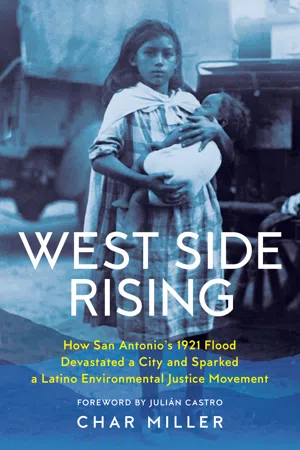
West Side Rising
How San Antonio's 1921 Flood Devastated a City and Sparked a Latino Environmental Justice Movement
- 257 pages
- English
- PDF
- Available on iOS & Android
eBook - PDF
West Side Rising
How San Antonio's 1921 Flood Devastated a City and Sparked a Latino Environmental Justice Movement
About this book
Information
Topic
HistoriaSubtopic
Historia de NorteaméricaTable of contents
- Foreword, by Julian Castro
- Introduction: "Culebra de Agua"
- Prologue: 1819
- One: "Death Rides on Waters of Three Streams"
- Two: Rescue Mission
- Three: Military Intervention
- Four: Dam the Olmos!
- Five: Construction Projects
- Six: Uprising
- Seven: Aftermath
- Appendix: Names of the Dead, Missing, and Injured
- Notes
- Acknowledgments
- Credits
- Index
Trusted by 375,005 students
Access to over 1.5 million titles for a fair monthly price.
Study more efficiently using our study tools.
Frequently asked questions
Yes, you can cancel anytime from the Subscription tab in your account settings on the Perlego website. Your subscription will stay active until the end of your current billing period. Learn how to cancel your subscription
No, books cannot be downloaded as external files, such as PDFs, for use outside of Perlego. However, you can download books within the Perlego app for offline reading on mobile or tablet. Learn how to download books offline
Perlego offers two plans: Essential and Complete
- Essential is ideal for learners and professionals who enjoy exploring a wide range of subjects. Access the Essential Library with 800,000+ trusted titles and best-sellers across business, personal growth, and the humanities. Includes unlimited reading time and Standard Read Aloud voice.
- Complete: Perfect for advanced learners and researchers needing full, unrestricted access. Unlock 1.5M+ books across hundreds of subjects, including academic and specialized titles. The Complete Plan also includes advanced features like Premium Read Aloud and Research Assistant.
We are an online textbook subscription service, where you can get access to an entire online library for less than the price of a single book per month. With over 1.5 million books across 990+ topics, we’ve got you covered! Learn about our mission
Look out for the read-aloud symbol on your next book to see if you can listen to it. The read-aloud tool reads text aloud for you, highlighting the text as it is being read. You can pause it, speed it up and slow it down. Learn more about Read Aloud
Yes! You can use the Perlego app on both iOS and Android devices to read anytime, anywhere — even offline. Perfect for commutes or when you’re on the go.
Please note we cannot support devices running on iOS 13 and Android 7 or earlier. Learn more about using the app
Please note we cannot support devices running on iOS 13 and Android 7 or earlier. Learn more about using the app
Yes, you can access West Side Rising by Char Miller in PDF and/or ePUB format, as well as other popular books in Historia & Historia de Norteamérica. We have over 1.5 million books available in our catalogue for you to explore.