A history of the erosion of democracy across the globe
Democracy is being destroyed. This is a crisis that expresses itself in the rising authoritarianism visible in divisive and exclusionary politics, populist political parties and movements, increased distrust in fact-based information and news, and the withering accountability of state institutions. Over the last four decades, democracy has radically shifted to a market democracy in which all aspects of human, non-human and planetary life are commodified, with corporations becoming more powerful than states and their citizens. This is how neoliberal capitalism functions at a systemic level and if left unchecked, is the greatest threat to democracy and a sustainable planet.
Volume six of the Democratic Marxism series focuses on how decades of neoliberal capitalism have eroded the global democratic project and how, in the process, authoritarian politics are gaining ground. Scholars and activists from the political left focus on four country cases – India, Brazil, South Africa and the United States of America – in which the COVID-19 pandemic has fuelled and highlighted the pre-existing crisis. They interrogate issues of politics, ecology, state security, media, access to information and political parties, and affirm the need to reclaim and re-build an expansive and inclusive democracy.
Destroying Democracy is an invaluable resource for the general public, activists, scholars and students who are interested in understanding the threats to democracy and the rising tide of authoritarianism in the global south and the global north.
eBook - ePub
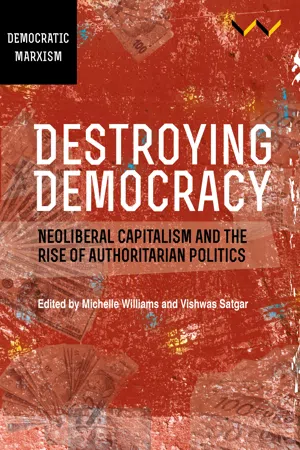
Destroying Democracy
Neoliberal capitalism and the rise of authoritarian politics
- 280 pages
- English
- ePUB (mobile friendly)
- Available on iOS & Android
eBook - ePub
Destroying Democracy
Neoliberal capitalism and the rise of authoritarian politics
About this book
Information
Chapter 1 The Crisis of Democracy: Neoliberal Capitalism, Authoritarianism and Reclaiming Democracy
The crisis of democracy is undeniable, registering in rising authoritarianism, the politics of hate and exclusion, right-wing populist movements, distrust of fact-based information and news, and the withering of accountable state institutions. Less obvious is that democracys' destruction is not simply a problem of politics requiring political solutions. Fixing politics, restoring democratic sensibilities (including fact-based decision making), enhancing democratic publics and overcoming a politics of hate will not save democracy – though these are all important and worth restoring – because the sources of democracys' destruction lie in systemic, intersecting crises combining four strands: the economy, ecology, social reproduction and politics. Democracys' destruction is one manifestation of the broader crisis created by neoliberal capitalism.1 By neoliberal capitalism I am not only referring to economic liberalisation, including privatising state assets, liberalising markets (including labour markets), deregulating financial institutions, the ascendancy of transnational regulatory agencies and dismantling state welfare support systems. I am also referring to what Wendy Brown (2015: 15) calls neoliberal rationality, assigning economic metrics to all aspects of life, including non-human life, where the state, non-human nature, society and social reproduction are valued in terms of their contribution to economic interests.
It is commonplace to say that capitalism experiences periodic crises. History is testament to this. It is less common to acknowledge that capitalism actually generates these crises through the way in which it organises economic activity (what Marxists call the contradictions within production). It is even less common to see the crises generated in capitalisms' contradictions in what Nancy Fraser (2018) calls the interrealm boundaries – that is, the economys' relation to non-human nature, to the necessary conditions of social reproduction, and to political power and the state. Similar to the contradictions within production that Marx highlighted, these interrealm contradictions are inherent to capitalism, as it has self-destabilising dynamics across the social matrix of capitalist society. When crises occur simultaneously in all four realms, they combine into a systemic crisis, and, as history has shown, capitalism is vulnerable to structural transformations that result in new ways of organising production and in the economys' relation to nature, polities and social reproduction (see Fraser 2014, 2018). Each of capitalisms' four major historical periods2 has established particular forms of organising social relations, with each resulting in particular contradictions. Democracys' fate is thus tethered to the larger social matrix that includes the organisation of social relations in the economy and the interrealm spaces between the economy and nature, the economy and social reproduction, and the economy and polities. Yet, the crisis of democracy demands our attention because democratic political power is essential to resolving the crises in the other realms. In fact, democracy is essential for any transformative politics that seeks social, ecological, economic and political justice. How democracys' crisis is resolved is linked to the capacity of society and the state to push for new forms of organising our social world and hence limiting the economys' power over these other realms.
This chapter looks at the crisis of democracy and highlights that the ways in which it is resolved have important implications for finding prefigurative alternatives beyond capitalism. I question whether democracy is an ideal worth fighting for by interrogating what it is, and then show the ways in which democracys' current crisis manifests in polities. I conclude by suggesting the necessity of prefigurative initiatives reconstituting democratic power by building anti-capitalist social relations in the interstitial spaces within and beyond capitalism.
Contestation within/over Democracy
On 12 December 2019, the Hindu fundamentalist government in India under the leadership of Prime Minister Narendra Modi and his Bharatiya Janata Party (BJP) passed a Citizenship Amendment Act that offers refuge and possibly citizenship to persecuted religious minorities, except for Muslims, in some neighbouring countries. When this Act is placed alongside the proposed National Register of Citizens, it will require many Indian Muslims to prove that they qualify as Indian citizens, effectively dismantling the secular foundations of Indias' democracy.
On 15 December, three days after passage of the Citizenship Amendment Act, and in the shadow of growing police brutality against students protesting the Act, a large group of primarily women and children began a sit-in in an area of Delhi known as Shaheen Bagh. As the sit-in grew, it became a site for rehearsing a new vision of citizenship – the women were collectively redefining fundamental democratic notions of freedom, equality and solidarity.
These two simultaneous and ongoing episodes in Indian politics capture what is at stake in the bifurcated politics coursing through polities across the world. These developments reflect in the election of exclusionary neo-fascist political leaders in places such as the US,3 Poland, Hungary, Turkey, Brazil and India. Populist (and fascist) movements in western Europe such as the Alternative für Deutschland in Germany and the League Party in Italy, and the Economic Freedom Fighters in South Africa, raise exclusionary appeals that resonate with large numbers of precarious people abandoned by traditional political parties. The rise of these movements through electoral democratic systems raises questions about the merits of democracy. At the same time, the second decade of the twenty-first century witnessed unprecedented pro-democracy protests across the world. While protests have been an important component of democratic claims-making for well over two centuries, the recent protests in Brazil, Chile, India, Egypt, Hong Kong and the US share a common thread in their resistance to the rise of authoritarian politics. The rise of authoritarian politics and the robust defence of democratic spaces simultaneously articulate narrow and exclusionary appeals as well as more expansive and inclusive notions of democracy, and are responses to capitalisms' multiple crises unravelling societies’ capacities to sustain life and flourish. How can such opposing forms of political practices, visions and understandings arise within and make claims to democracy?
What is democracy?
The contestation over democracy is partly because it is an ideal that allows for many permutations – radical, participatory, liberal, bourgeois – each emphasising different principles, values, procedures and institutional arrangements. Democracy is the only form of rule that sees people collectively ruling themselves. It is fundamentally different from all other forms of rule, such as plutocracy (rule by and for the rich), aristocracy, monarchy, dictatorship, fascism, vanguardism (rule by an elite within a political party) or ‘corporatocracy’ (rule by corporations) (George 2015: 6). When we speak of democracy, we implicitly refer to necessary components for practising democracy and aspirational principles of democracy. Democracy has at least two essential components (administrative capacity and public legitimacy) and two primary principles (equality and liberty). Shortcomings in administrative capacity and public support weaken democracy, and understandings of equality and liberty shape the degree to which democracy can be realised.
Democracy for and by the people refers to the institutional arrangement of the state (for the people) and mechanisms for participation (by the people). Institutionally, a capable democratic state is able to develop and implement laws and public policy that reflect the broader interests of the public, including steering economic activity in the interests of society, protecting the natural world, supporting social reproduction and ensuring democratic public institutions for peoples' participation. The state must have the capacity to ensure that private interests, such as large corporations and the economic and political elite, comply with state regulation in the interest of the public, as well as financial accountability of public funds. Without strong, efficacious, and accountable administrative capacity within all levels of the state, democracy is undermined and eroded. Democracy also requires arenas and mechanisms for civil society and publics to engage the state around public interest and to voice public opinions about the states' regulations. State legitimacy is secured through public engagement around what constitutes the public interest and translating these interests into state policy and action. A robust, organised, engaged and informed citizenry is essential to ensuring efficacious public engagement as democracy is realised through practising it concretely. Consent of the governed is thus achieved through democratic means such as active political participation by a wide range of constituents through civil society organisations, local governmental institutions, participatory forums, and an open, free and fair media. These must ensure financial accountability and transparent and participatory budgeting, policy making and implementation processes. Thus, democracy requires both state capacity and state legitimacy (Fraser 2014).
The varied meanings of the foundational principles of equality and liberty are fundamental to the contestation within democracy. The concept of liberty ranges from non-interference to a more robust notion of independence from arbitrary power and non-domination by others. On the one side, the emphasis on liberty as non-interference sets the basis for free markets as the state should not interfere to regulate markets.4 Similarly, liberty as non-interference lays the basis for minimal state support in social welfare as individuals are responsible for their own development. Liberalism promotes significant universal rights such as universal suffrage, education, human rights, civil rights, and freedom of association, speech and the press. When married to liberty as non-interference, these rights are interpreted through the lens of possessive individualism, elevating individuals above the common good. On the other side – usually associated with social justice, egalitarian liberals and republicans – law and policy can enhance freedom by curtailing the arbitrary power of others. Thus, a ‘liberty-protecting state’ ensures that no institution (including the state, corporations and markets), person or other entity has ‘arbitrary power over any citizen’ (Pettit 1997: 67). For a more expansive notion of democracy, this second idea of liberty and freedom is central as it allows state intervention to ameliorate and protect against inequalities of power and wealth, and protects citizens from arbitrary power and domination. This also implies that democratic decision making is not limited to the political sphere, as a liberty-protecting state regulates the economy and redefines the interrealm boundaries between the economy and social reproduction and non-human nature. While it too promotes universal rights, it emphasises the relativity of rights in relation to others and the collective good. Thus, the importance of a liberty-protecting state for a robust and expansive democracy cannot be overstated.
The other contested notion is equality. Liberal democracy foregrounds equality of opportunity, which assumes everyone starts from the same conditions and ignores pre-existing inequalities. Equality of opportunity together with liberty as non-interference limits state involvement in protecting the population and the natural world from the market and minimises state-supported social welfare. In this framework, individuals are free to compete equally to achieve their life choices. A more expansive notion of democracy, by contrast, defines equality in terms of outcomes and recognises the necessity for state intervention in achieving equality. The creation of high-quality public goods such as public transportation, schools, health systems and spaces for recreation and enjoyment is central to achieving equality of outcomes, as is the social wage – both income distribution and the distribution of goods and services, including forms of government support such as grants, and subsidised housing and food systems. Redistributive programmes seeking equality of outcomes by a liberty-enhancing state are essential for achieving social justice. To do this requires state administrative capacity and active citizens, and simultaneously yields state legitimacy. Thus, if a robust and expansive democracy focuses on equality of outcomes by a liberty-protecting state that ensures institutional arrangements, engaged publics, laws and policy to realise this goal, why do we not live in such a democracy?
Modern liberal democracy has largely promoted liberty as non-interference by the state and equality of opportunity. It came of age in the eighteenth century with the development of capitalism, which has charted its trajectory and governed much of the Euro-Atlantic world (i.e. the centres of capitalism) for nearly two centuries. Liberal democracy in capitalist centres promoted the illusion of a virtuous cycle between democracy and capitalist development. Central to this relationship was the need to narrow democracy from an expansive understanding of rule by and for the people, by separating politics from the economy and limiting political participation to representation of the people by elected officials voted for in elections. Separating the economic and political spheres limits political and public oversight and state ‘interference’ in economic activity. As a result, a defining measure of democracy became synonymous with electoral procedures ensuring elections are transparent, accountable and inclusive of all qualified voters based on competition (i.e. equitable opportunity to compete in the election).
Limiting democratic decision making to the political realm allows corporations to operate under limited control and amass enormous power and wealth at the expense of other social realms. Fraser explains that capitalisms' three fundamental divisions – the separation of production from social reproduction, the separation of humans from the non-human natural world, and the separation of economics and politics – create the illusion of spheres outside of capitalism (Fraser 2018; Fraser and Jaeggi 2018). These three spheres are the ‘background’ on which capitalism operates. By separating the economic from these ‘decommodified’ background spheres, capitalism mystifies the prod...
Table of contents
- Cover
- Title
- Contents
- Acknowledgements
- PREFACE: Neoliberal capitalism in the time of Covid-19: Destroying democracy and rising authoritarianism
- Chapter 1 The Crisis of Democracy: Neoliberal Capitalism, Authoritarianism and Reclaiming Democracy
- Chapter 2 The Rise of Eco-Fascism
- Part Two Neoliberal Capitalism Against Democracy Globally
- Chapter 3 Populism and Fascism: Lessons from the 1920s Ku Klux Klan
- Chapter 4 What do ‘Unruly’ Right-Wing Authoritarian Nationalists do when they Rule? The us under Donald Trump
- Chapter 5 Brazilian Democracy Facing Authoritarian Neoliberalism
- Chapter 6 Indias' Trajectories of Change, 2004–2019
- Part three Neoliberal Capitalism Against Democracy in South Africa
- Chapter 7 The Dialectic of Democracy: Capitalism, Populism and Working-Class Politics
- Chapter 8 Democracy and the Right to know in South Africas' Capitalist Transition
- Chapter 9 South Africas' Post-Apartheid Media and Democracy
- Chapter 10 The Enemy within: Securitising Protests as Domestic Instability in South Africa
- Chapter 11 Prospects for a Left Renewal in South Africa
- Conclusion
- Contributors
- Index
Trusted by 375,005 students
Access to over 1.5 million titles for a fair monthly price.
Study more efficiently using our study tools.
Frequently asked questions
Yes, you can cancel anytime from the Subscription tab in your account settings on the Perlego website. Your subscription will stay active until the end of your current billing period. Learn how to cancel your subscription
No, books cannot be downloaded as external files, such as PDFs, for use outside of Perlego. However, you can download books within the Perlego app for offline reading on mobile or tablet. Learn how to download books offline
Perlego offers two plans: Essential and Complete
- Essential is ideal for learners and professionals who enjoy exploring a wide range of subjects. Access the Essential Library with 800,000+ trusted titles and best-sellers across business, personal growth, and the humanities. Includes unlimited reading time and Standard Read Aloud voice.
- Complete: Perfect for advanced learners and researchers needing full, unrestricted access. Unlock 1.5M+ books across hundreds of subjects, including academic and specialized titles. The Complete Plan also includes advanced features like Premium Read Aloud and Research Assistant.
We are an online textbook subscription service, where you can get access to an entire online library for less than the price of a single book per month. With over 1.5 million books across 990+ topics, we’ve got you covered! Learn about our mission
Look out for the read-aloud symbol on your next book to see if you can listen to it. The read-aloud tool reads text aloud for you, highlighting the text as it is being read. You can pause it, speed it up and slow it down. Learn more about Read Aloud
Yes! You can use the Perlego app on both iOS and Android devices to read anytime, anywhere — even offline. Perfect for commutes or when you’re on the go.
Please note we cannot support devices running on iOS 13 and Android 7 or earlier. Learn more about using the app
Please note we cannot support devices running on iOS 13 and Android 7 or earlier. Learn more about using the app
Yes, you can access Destroying Democracy by Jane Duncan,Linda Gordon,Gunnett Kaaf,Dale T McKinley,Alf Gunvald Nilsen,Devan Pillay,Mandla J Radebe,Alfredo Saad-Filho,Ingar Solty, Michelle Williams,Vishwas Satgar, Michelle Williams, Vishwas Satgar in PDF and/or ePUB format, as well as other popular books in Economics & Economic Conditions. We have over 1.5 million books available in our catalogue for you to explore.