eBook - PDF
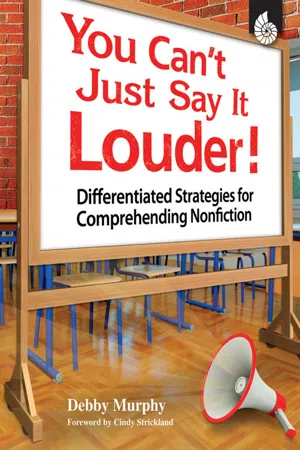
You Can't Just Say It Louder!
Differentiated Strategies for Comprehending Nonfiction
- 298 pages
- English
- PDF
- Available on iOS & Android
eBook - PDF
About this book
This dynamic book provides the foundation you need to confidently and successfully teach comprehension to a diverse population of students. Filled with innovative, classroom-tested models for differentiating instruction, this professional development resource will leave you feeling empowered, equipped, and excited to implement the strategies! The classroom-tested strategies from acclaimed professional development specialist Debby Murphy and easy-to-read conversational style make this a "must-have" resource for any PreK-12 teacher. The model lessons feature concrete examples with sample texts from award-winning resources.
Information
Table of contents
- Cover
- Credits
- Page 3 - Table of Contents
- Page 4 - Table of Contents Cont.
- Page 5 - Table of Contents Cont.
- Page 6 - Table of Contents Cont.
- Page 7 - Foreword
- Page 11 - Acknowledgements
- Page 13 - Introduction
- Page 14 - Overview of Chapters
- Page 16 - STAR (Strategic Thinker and Reader) Model Lessons
- Page 17 - Features of this Book
- Page 19 - Chapter 1: Constructing a Personal Theory About Learning
- Page 19 - Considerations from Research
- Page 21 - The Critical Role of Language in Teaching for Comprehension
- Page 22 - The Zone of Proximal Development
- Page 27 - The Gradual Release of Responsibility Model
- Page 29 - Phases of the Gradual Release of Responsibility Model
- Page 29 - I Do—Modeled Strategy Use
- Page 29 - We Do—Shared Strategy Use
- Page 30 - You Try—Guided Strategy Use
- Page 31 - You Do—Independent Strategy Use
- Page 32 - The Importance of Rich Input in Brain-Compatible Instruction
- Page 35 - Summary
- Page 37 - Chapter 2: Moving from Strategies to Skills: You Can’t Just Say It Louder!
- Page 37 - Considerations from Research
- Page 39 - Teaching for a Strategy
- Page 43 - Moving from a Strategy to a Skill
- Page 43 - Summary
- Page 45 - Chapter 3: Different Rules
- Page 45 - Considerations from Research
- Page 46 - Content—What Students Learn
- Page 54 - Process—How Students Learn
- Page 55 - Summary
- Page 59 - Chapter 4: Preparing Students to Read with Meaning—Activating Student Thinking Through Text Introductions
- Page 59 - Considerations from Research
- Page 62 - A Structure for Planning Before-Reading Activities
- Page 62 - Book
- Page 71 - Brain
- Page 71 - Build
- Page 72 - Before-Reading Strategies
- Page 73 - Sketch the Scene
- Page 78 - Act it Out
- Page 82 - Models, Artifacts, Primary Sources, Demonstrations and Experiments, and Other Visuals
- Page 84 - Tiny Texts
- Page 84 - Concept Chorals
- Page 87 - Packing Up Word Bags
- Page 90 - Making “Sense” of It
- Page 92 - Brain Boxes
- Page 96 - Summary
- Page 97 - Chapter 5: Understanding Word Meaning in Texts
- Page 97 - Considerations from Research
- Page 98 - The Role of Context
- Page 101 - The Role of Word Structure
- Page 101 - Activities with Word Parts
- Page 103 - Word Magician Strategy
- Page 105 - STAR Model Lessons
- Page 107 - STAR Model Lesson 1: Word Magician—Cell Phone Agreement
- Page 115 - STAR Model Lesson 2: Word Magician—A Visit to a Publisher
- Page 117 - STAR Model Lesson 3: Word Magician—Volcanoes
- Page 119 - Summary
- Page 121 - Chapter 6: Using Text Features to Determine Importance, Develop Main Ideas, and Create Text Summaries
- Page 121 - Considerations from Research
- Page 124 - Familiarizing Students with the Text Walk Strategy
- Page 128 - STAR Model Lessons
- Page 130 - STAR Model Lesson 1: Taking a Text Walk to Preview a Text for Main Ideas
- Page 139 - STAR Model Lesson 2: Using a Text Walk Puzzle to Preview Text Organizers and Develop a Main Idea Statement
- Page 145 - Read a Little, Think a Little Strategy
- Page 148 - STAR Model Lesson 3: Read a Little, Think a Little
- Page 156 - Using Annotation to Support Read a Little,Think a Little
- Page 158 - STAR Model Lesson 4: Pluses, Lines, and Stars
- Page 167 - Summary
- Page 169 - Chapter 7: Visualizing the Text
- Page 169 - Considerations from Research
- Page 172 - STAR Model Lessons
- Page 173 - STAR Model Lesson 1: Framing a Mind Picture
- Page 182 - STAR Model Lesson 2: Sketching Mind Pictures
- Page 186 - STAR Model Lesson 3: Read It, See It
- Page 194 - Summary
- Page 195 - Chapter 8: Asking Questions and Making Inferences
- Page 195 - Considerations from Research
- Page 201 - STAR Model Lessons
- Page 202 - STAR Model Lesson 1: On-the-Lines/Between-the-Lines Reading Detectives
- Page 212 - STAR Model Lesson 2: Tell Me What You See/Tell MeWhat You Think
- Page 215 - STAR Model Lesson 3: Think It Through Chart
- Page 221 - STAR Model Lesson 4: Ask Me
- Page 223 - Summary
- Page 225 - Chapter 9: Recognizing Nonfiction Text Structures and Author’s Purpose
- Page 225 - Considerations from Research
- Page 227 - Knowing About Text Structures
- Page 230 - Descriptive Text Structure
- Page 232 - Chronological or Sequenced Text Structure
- Page 233 - Cause-and-Effect Text Structure
- Page 235 - Problem-and-Solution Text Structure
- Page 237 - Proposition-and-Support Text Structure
- Page 238 - Compare-and-Contrast Text Structure
- Page 240 - STAR Model Lesson
- Page 241 - STAR Model Lesson: Determining a Text Structure
- Page 251 - A Problem-and-Solution Graphic Organizer
- Page 253 - A Cause-and-Effect Graphic Organizer
- Page 256 - Summary
- Page 259 - Chapter 10: Monitoring Comprehension: The Ongoing Orchestration of Meaning
- Page 259 - Considerations from Research
- Page 262 - Learning from a Skilled Reader: The Teacher
- Page 262 - Knowing How to Deal with Comprehension Confusion
- Page 263 - Dealing with the “Tricky Parts”
- Page 264 - Making Connections Between Self and the Text
- Page 266 - Maintaining Comprehension During Reading
- Page 270 - Summary
- Page 273 - Conclusion
- Page 277 - Appendix
- Page 283 - References Cited
- Page 293 - Instructional Resources and Children’s Literature
- Thank You Page
Trusted by 375,005 students
Access to over 1.5 million titles for a fair monthly price.
Study more efficiently using our study tools.
Frequently asked questions
Yes, you can cancel anytime from the Subscription tab in your account settings on the Perlego website. Your subscription will stay active until the end of your current billing period. Learn how to cancel your subscription
No, books cannot be downloaded as external files, such as PDFs, for use outside of Perlego. However, you can download books within the Perlego app for offline reading on mobile or tablet. Learn how to download books offline
Perlego offers two plans: Essential and Complete
- Essential is ideal for learners and professionals who enjoy exploring a wide range of subjects. Access the Essential Library with 800,000+ trusted titles and best-sellers across business, personal growth, and the humanities. Includes unlimited reading time and Standard Read Aloud voice.
- Complete: Perfect for advanced learners and researchers needing full, unrestricted access. Unlock 1.5M+ books across hundreds of subjects, including academic and specialized titles. The Complete Plan also includes advanced features like Premium Read Aloud and Research Assistant.
We are an online textbook subscription service, where you can get access to an entire online library for less than the price of a single book per month. With over 1.5 million books across 990+ topics, we’ve got you covered! Learn about our mission
Look out for the read-aloud symbol on your next book to see if you can listen to it. The read-aloud tool reads text aloud for you, highlighting the text as it is being read. You can pause it, speed it up and slow it down. Learn more about Read Aloud
Yes! You can use the Perlego app on both iOS and Android devices to read anytime, anywhere — even offline. Perfect for commutes or when you’re on the go.
Please note we cannot support devices running on iOS 13 and Android 7 or earlier. Learn more about using the app
Please note we cannot support devices running on iOS 13 and Android 7 or earlier. Learn more about using the app
Yes, you can access You Can't Just Say It Louder! by Debby Murphy in PDF and/or ePUB format, as well as other popular books in Education & Professional Development. We have over 1.5 million books available in our catalogue for you to explore.