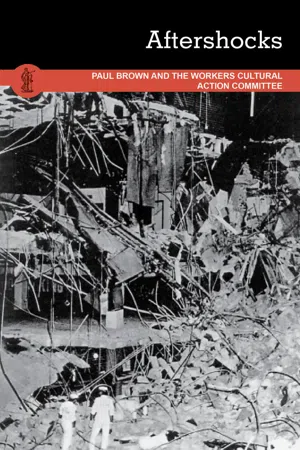
A moving documentary play drawn from the traumatic recollections of members of the Newcastle Workers' Club, which was destroyed in the 1989 earthquake.
- English
- ePUB (mobile friendly)
- Available on iOS & Android
eBook - ePub
Aftershocks
About this book
Information
Subtopic
DramaIndex
LiteratureACT TWO
SCENE THIRTEEN: JUMP CLUB
MELBA, STEFO, HOWARD, ELAINE, EDDIE, KERRY.
Actors enter as sounds of the Club fade out. Focus on MELBA alone.
MELBA: My name is Melba Middleby. I was a foundation member of the Club. 1948. And in 1949, I became the first woman on the Club’s Board. I used to play piano with them to sing the… what… community singing, you know. And of course my husband Bob used to play the drums. Reg Abraham, he used to be in the… in the Fire Brigade. I don’t know whatever happened to him. But he was the one who used to show the words, you know, the slides with the words… Elsie Anderson and Margaret Jeffries, they were the main two female singers. They had lovely voices. And Alan Williams, he lived at Boolaroo then, and he used to be the Secretary of the Plumbers, and he was another singer… he had a beautiful harmonising voice, Alan. Elaine Richards, she used to work at the Club… one of the… like the barmaids, you know, and she had a lovely voice. Tex Smith… he was a funny little fellow… used to play an accordion, and Lora Strurl, she had a great voice too. She lived at Wickham. Don’t know whether she still lives there. But then there was this other chap, I can’t think of his… Barney Freeman… it just came to my mind… Barney Freeman. Oh, he was funny. He was a really… wonderful comedian, Barney Freeman…
When they gave us this commemorative membership badge, in April, 1989, it was lovely. You were all assembled, like you’re all sitting down at these long tables. And I was thinking how lovely it was. And then we went out and we played the pokies for a while, and had a look around, and then… I think they had dancing on and that, you know, that night too. I was thinking how lovely it was, you know. And to think that that’s all rubble…
All come into focus.
STEFO: [with great enthusiasm] Everyone went to the Club… basically it had the nicest atmosphere.
MELBA: I felt that I could walk in and… that everybody was friendly, and nice… If you wanted to put a few bob in the pokies, you could do it.
STEFO: Had good grog. Had good beer. You ask a Novocastrian… they’re very fussy about their beer, right. So they had good beer.
HOWARD: But it felt safe. No aggro. I never saw anyone tossed down the stairs, but I know there was. I know there were people tossed down the stairs.
KERRY: One guy, this was years ago at the Club, and he’s looking at me really seductive, and I said, ‘Are you right there?’, and he said, ‘Can of draught’. And next thing you know, one of the bouncers come up, ‘Don’t give him that beer’. I said, ‘What’s the matter?’ They picked him up both arms and he’s got his dick hanging out… he was pissing up the bloody bar wall.
EDDIE: It was everybody’s central meeting place and office in the same place. Union delegate work, Trades Hall meetings, social life… How I got to know the place, because I used to show films there, and running round and finding out all… where all the power points were in these little rooms. We showed films about nuclear disarmament, and yeah, stuff like that, and held meetings there, and we had State Conferences there, and all that stuff.
MELBA: I knew one woman who signed up as a boy in the early days. And she was on the roll as a boy for three years. Why? So they’d let her go on all the fishing trips up to the Club’s hut at Fingal Bay.
HOWARD: I’ve been a member of the Workers Club for twenty-five years. I’ve worked there for twenty-three. It goes back to the period when I was a very young person, and the Vietnam era. And I saw… I come from a conservative background, but I saw the activity within the Club… the action against the Vietnam War. And I sought out further to find out what was going on, and what made these people tick… And here’s… here’s, well… a Club full o’ lefties… a club emanating from the trade union movement and the working class. And they’re… you know… people who march on the street.
STEFO: All the sort of lefty functions. They always happened there. Nowhere else.
EDDIE: After the rallies we all used to go back to the Club for a drink, and May Days ’n’ all that.
ELAINE: They all said it was wonderful, from a social aspect… dances of a Wednesday, Friday night, Saturday night sometimes.
HOWARD: As a matter of fact, when it was used for a private dance, they used to call it the ‘Home Wreckers’.
KERRY: And later the Jump Club, the Parachute Club… all the divorcées used to go there and they used to pick up a one-night stand… One night, years ago, when I was a casual, I was upstairs in Bar Five. This fellow come in, what, in his mid-fifties. He was looking for his ‘daughter’, and I said, ‘Oh, if she comes in, she would be downstairs’. So he got his drink and he went over and he was looking over the balcony to see if he could find his ‘daughter’. I was talking to some people I haven’t seen in a long time, and having a yabba… and looked out and broke up with laughter. All I could see was the sole of his shoes, like this, going over the balcony. He bent over too far. And I’m going, ‘No wonder they call it the bloody Jump Club… check him out’.
ELAINE: A few years ago, the Club was constantly under quite subtle attacks from, from… you know, from outside. There was anti-communism, and anti-left, and pro-Christian. They got together and set about to try and destroy the Club. They never could… And we just couldn’t imagine Newcastle without the Newcastle Workers Club. My dad was a foundation member of the Club. And I was always on the May Day floats… For the whole year after the quake, you could go down and see an empty thing. I wonder what Dad’d think. It was his whole life.
MELBA: It’s maybe foolish to say, but it’s like losing a loved one, a great friend, or a loved member of your family, or something like that. It was a tremendous loss, and still is. You know the old saying, you never miss anything ’til you lose it.
SCENE FOURTEEN: BARRIERS
EDDIE, JULIE.
EDDIE: I was in Fremantle… at the time of the quake, and we were loading a ship… with sheep of all things, and one of the other wharfies on the wharf said to me… who knew I was from Newcastle… said, ‘Eddie, there’s been an earthquake in Newcastle’. And I just… ‘Oh well, oh yeah, okay, it’s a tremor’. You don’t worry about those things.
So after lunch we all went back to work. Another guy comes up to me and says, ‘There’s people trapped in the Workers Club’, and I said, ‘I’m gone. I’m outta here.’ And so I went and seen the foreman, and he’s aware of my situation… you know, I was connected to the Workers Club and I had friends and… relatives in Newcastle.
I got my mate to take me out to the airport… very agitated, didn’t know what was going on. I burst into tears at Perth Airport, and the airline had to fix me up, the whole bit… then [laughing] the plane broke down on the tarmac for four bloody hours. So in the interim I’m ringing up Newcastle and I got through to Elaine Gibson, Howard’s wife. And she told me about Lenny and Barry being missing. And Lenny’s been an old waterfront watchman… he’s pretty close. I’d worked with him quite a bit. And Barry… I’ve got a lot of affection for… and, as a good bloke.
So eventually I got away from Perth, and by this time it was obvious that I was going to miss my connecting flight… there was no other flights to Newcastle, so I tried to hire a car… every car company refused me a car to go to Newcastle… which really shitted me off… because of the earthquake. They wouldn’t allow a car to go.
The trains weren’t running, as I found out… so I stayed at Mum’s place that night. Next morning I flew up… and… I don’t know… crazy me asked the pilot to fly over Newcastle, [chuckling] but he wouldn’t. I said, ‘Do us a favour and have a look’, but he wouldn’t.
He takes a deep breath.
Tried to get around to the Workers Club… They wouldn’t let me. Even though I told them who I was, they said, ‘Bad luck’. Rang other people, got filled in on what was happening. Barry and Lenny was still missing. I think by that time the death toll out of the Club was about seven. I think.
I was sort of in no man’s land… just kept lookin’ down towards the Club… couldn’t realise it.
JULIE: I heard on the radio that you weren’t allowed to enter the city. I was annoyed by that, and I can understand reasons for that, but I… it’s like being cut off from someone who’s ill… that you want to see, and you know that your presence might help them some way, and you’re just not allowed to.
I went round all the side streets that I could, stupidly thinking… and then I drove as far into town as I could and got stopped before the Club… They were saying it wasn’t at all safe, and I’d have to go back, and they’d be really pleased if I turned around and went the other way.
It was like having a wide shot of something, and what you really want is a close-up, you know. And all I could really think of was little bits of buildings in my head visually, like corners of windows, and I just wanted to be closer…
EDDIE: I was walking along Hunter Street and there was no one around… The next minute this bum wagon pulls up and the copper’s a bit aggro, and I said, ‘It’s all right, I’m just goin’ for a walk’, and he said, ‘You’ve got to go back’.
JULIE: I’d start photographing from a few feet outside a barrier, and then get closer and closer and closer, and then sort of look around and see if I could jump inside the barrier and then see how far I could go until someone came. So for quite a long time there was the feeling of… yeah, being shut out, and also sneaking around like a kid and sort of… you know, going under fences and going over things. There was this… yeah, just a constant thing of no-go areas, which to me reminds me of childhood things a lot.
EDDIE: I was staying in the Cricketers Arms because my own place had been sub-let, and I’d booked in there and one day I went downstairs and immediately ran into a table of people that I knew and they started tellin’ me some of the stories which… blew me out of my tree actually… about the Workers Club, and by that time a lot more information had been revealed about what the staff did on the day of the quake.
SCENE FIFTEEN: SERVICE INDUSTRY
WAYNE, JOHN, LYN, KERRY, MARG.
WAYNE: ‘It has become apparent to me that amongst other things I’ve done in m...
Table of contents
- Title Page
- Table of Contents
- Copyright Page
- Playwright’s Biography
- First Production of the Play
- Characters
- Setting
- Playwright’s Note
- Act One
- Act Two
Trusted by 375,005 students
Access to over 1.5 million titles for a fair monthly price.
Study more efficiently using our study tools.
Frequently asked questions
Yes, you can cancel anytime from the Subscription tab in your account settings on the Perlego website. Your subscription will stay active until the end of your current billing period. Learn how to cancel your subscription
No, books cannot be downloaded as external files, such as PDFs, for use outside of Perlego. However, you can download books within the Perlego app for offline reading on mobile or tablet. Learn how to download books offline
Perlego offers two plans: Essential and Complete
- Essential is ideal for learners and professionals who enjoy exploring a wide range of subjects. Access the Essential Library with 800,000+ trusted titles and best-sellers across business, personal growth, and the humanities. Includes unlimited reading time and Standard Read Aloud voice.
- Complete: Perfect for advanced learners and researchers needing full, unrestricted access. Unlock 1.5M+ books across hundreds of subjects, including academic and specialized titles. The Complete Plan also includes advanced features like Premium Read Aloud and Research Assistant.
We are an online textbook subscription service, where you can get access to an entire online library for less than the price of a single book per month. With over 1.5 million books across 990+ topics, we’ve got you covered! Learn about our mission
Look out for the read-aloud symbol on your next book to see if you can listen to it. The read-aloud tool reads text aloud for you, highlighting the text as it is being read. You can pause it, speed it up and slow it down. Learn more about Read Aloud
Yes! You can use the Perlego app on both iOS and Android devices to read anytime, anywhere — even offline. Perfect for commutes or when you’re on the go.
Please note we cannot support devices running on iOS 13 and Android 7 or earlier. Learn more about using the app
Please note we cannot support devices running on iOS 13 and Android 7 or earlier. Learn more about using the app
Yes, you can access Aftershocks by Paul Brown,Workers’ Cultural Action Committee in PDF and/or ePUB format, as well as other popular books in Literature & Drama. We have over 1.5 million books available in our catalogue for you to explore.