![]()
I
Why Jedda?
A filmic earworm
The authors of this series are asked to choose a film they feel passionate about. They do not have to like the film, however. The series seeks passion. I am not going to claim that I passionately dislike Charles Chauvel’s Jedda, but I do want to make it clear from the start that I do not love it.
Nor am I going to claim that it is brilliantly made. The story of a black baby who is adopted by a white woman in the Northern Territory’s outback, and who grows up expecting to marry a mixed-race stockman only to be abducted by the bad, mad and ‘primitive’ Marbuk who lures her to her death, delivers a bastardised melodrama. Technologically, there is some clunky editing and the ‘day for night’ technique, which is supposed to make sunlight look like moonlight, largely fails to convince. The acting from both the white professionals and the Indigenous amateurs is frequently wooden, and much of the dialogue sounds as if it escaped from a Year 7 textbook on race relations. For now, I’ll say no more about the film’s politics other than that when I first saw it, I thought I had never before in my life seen a film quite as racist.
For any reader who is put off by my initial reaction, I also want to say that Jedda is infinitely more fascinating than I first realised. There are film classics that are overtly and irretrievably racist—Leni Riefenstahl’s Nazi-sponsored documentaries, Triumph of the Will and Olympia, D.W. Griffith’s Birth of a Nation and Phil Walsh’s Birth of White Australia, for example. Jedda’s treatment of race is not like these.
Perhaps the best way of describing the hold this film has over me is to say that it is the filmic equivalent of a musical earworm burrowing in my head—I cannot stop viewing and re-viewing it, nor can I work out if that is because it is attached to me, or I am attached to it. Either way, my passion for Jedda is not a passionate hatred. Partly, my fascination lies in how it constantly changes: I have seen Jedda more times than I can recall and it is never the same movie twice. I constantly watch it because I want to discover what more it has to show and tell me. It never fails me in this.
For the intense two-week period when I visited the main locations in the Northern Territory, I saw the film each night after I had visited the film’s landscapes. I thought this would be hard to do. Each time I put the DVD on my laptop player in one or other motel or campsite (and once in the middle of the desert) as I travelled south from Darwin to central Australia, I thought the next 90 minutes would stretch halfway to eternity and back. Within the very first few seconds I was always sucked back in: that filmic mindworm starts burrowing in my head again and refuses to let me go.
A classic
I have no doubts whatsoever about Jedda’s status as a classic. There are many reasons why a film gets called a classic. For some, the term means a Hollywood movie made in the 1930s and ’40s, in the heyday of the studio system. This explains why, for many Australian critics and audiences, an Australian classic is a film that successfully mimics a classic Hollywood movie. For contrarians, of course, a classic Aussie film is one that is decidedly unlike a Hollywood movie. Aussie films tend to get damned for copying Hollywood styles and genres and, at the same time, damned for failing to live up to Hollywood’s high standard of professionalism—the latter often being the result of enormous budgets.7 Another definition of a classic film is one that has received wide critical acclaim—whether or not it earned much, or any, popular acclaim. Alternatively, it might be one that adheres to certain standards, embodies widely accepted qualities of high art, or has a long-established reputation for excellence or controversy.
Where does Jedda fit in these criteria? The film’s relationship to Hollywood is complex: it takes a popular genre of the period, melodrama, to a completely new place, and it is hard to say whether it is too Hollywood or not Hollywood enough. Perhaps the film is telling us that this distinction is pointless. It gained a fair amount of popular and critical acclaim (probably more of the former than the latter) when it was released, but its critical success has not endured. It has certainly created a lot of controversy. I have heard of screenings at which Indigenous people walked out, leaving many white audiences staying put, uncomfortably determined to learn about 1950s race politics. And I have been at a screening where white people protested the depiction of Indigenous people while the Indigenous audiences stayed because they loved it.
So yes, Jedda is an Australian classic for a number of reasons. It is the first Australian-made film to have Indigenous characters at the centre of the narrative and, importantly, to cast Indigenous actors in these roles rather than have white actors in blackface, as many Australian films before and since have done. It is the first Australian-made film to be shot in colour and the first Australian film to be invited to the prestigious Cannes Film Festival.8 As the National Film and Sound Archive website tells us, Jedda is historic (historic in the sense of being historically important) ‘because it is arguably the first Australian film to take the emotional lives of Aboriginal people seriously’.9 But Jedda is also much more than all this.
Most attempts to construct a list of criteria for a classic are flawed because fundamentally, all criticism is a matter of personal taste—and, often, prejudice. What makes Jedda a classic for me has a lot to do with how its meaning is not fixed. This intrigues me. I find little mysteries embedded in its story, soundtrack and images that make me want to see the film again. And again. What intrigues me most of all is the way the land is filmed and framed. I am seduced by this film, at least partly because it is so much about a land that is so obviously loved by its filmmaker.
Locationism
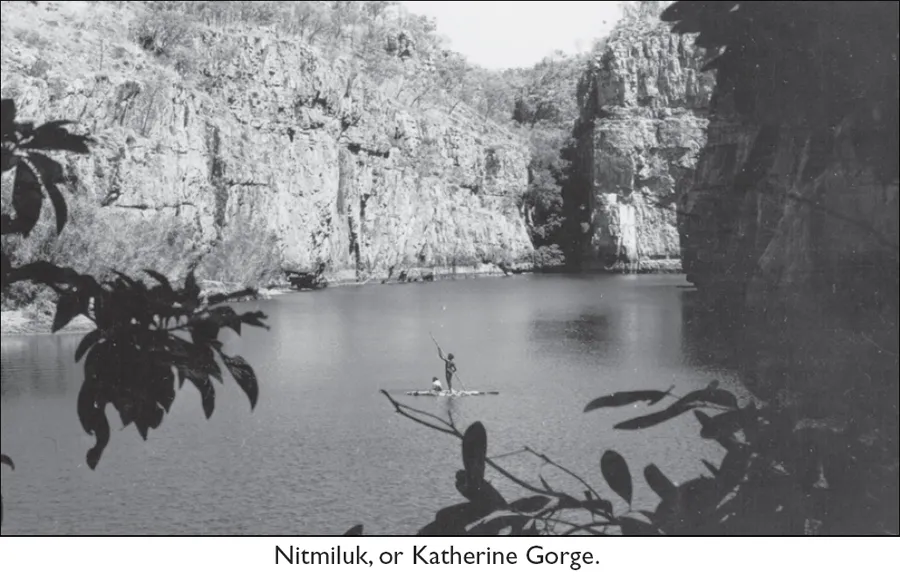
It is impossible to ignore the land in Jedda. Chauvel makes it possible for us to see his ideas about nature, culture and civilisation by the way in which he films the land. The film shows nature in terms of the land and the native people being indivisible parts of each other. This is true not only of Jedda, but of all his films. It is impossible to avoid seeing Chauvel’s love of the Australian land in every film that he made.
His very first film, a silent western of sorts entitled The Moth of Moonbi (1926), led the way for all his future films. It tells of a young country girl who is attracted by the big, bad city, but who eventually learns that she belongs on the land, as a good girl should. At a time when most feature films were filmed in studios, especially a melodrama like this, Chauvel’s daughter, Susanne Chauvel Carlsson, tells us:
Three main location camps were set up – near Spicer’s Peak at Franklyn Vale cattle station and under the Sleeping Assyrian, a mountain in the Rosevale Valley. The little film unit … struggled up Spicer’s Gap, one of the highest point in Queensland, with tents, provisions and film equipment carried by packhorses, on a trail which was notoriously inaccessible … This seemed to set the pattern of all the arduous film safaris to follow.
Indeed it did. Without exception, all Chauvel’s films involved location shoots, often in very rugged country, and the landscape and would repeatedly play a leading role. Coining the word ‘locationism’, Stuart Cunningham, one of Australia’s foremost film academics and author of Featuring Australia: The Cinema of Charles Chauvel, describes Chauvel’s films as a mixture of documentary, or social realism, resulting from ‘his passion for, indeed obsession with, location shooting’. Cunningham admits that ‘locationism’ ‘is an ugly word, but I can think of no better one to catch Chauvel’s intense commitment – despite the massive technical and financial obstacles – to shooting the “true” country’. He’s right: ‘locationism’ is the perfect word for it.
Reality, authenticity
‘Location’, in the filmmaker’s lexicon, refers to the place where you set up your camera; specifically, a place outside the studio. Going ‘on location’ involves expense (all those people travelling to, being accommodated and fed in, places often a long way from home base) and time, always an expensive item in a filmmaker’s budget. How much easier, cheaper—and often just as convincing—to shoot a film in the city studios. Or almost as convincing. ‘Location’ also refers to the place where the film story is set. This can be an imagined place but when it’s an actual place, it give a sense of reality to a fictional story and helps audiences suspend their disbelief.
Few cinema publicists can resist telling audiences when a film has been shot on location, and the more exotic or foreign, the better. Authentic landscapes don’t come cheap, but they are widely judged by film producers to be worth the expense. Seeing a real place and an actual landscape on the screen adds the spice of authenticity and a sense of being valued. After all, if the producers thought it worth spending so much money on actual locations, they presumably think that we, the audience, are worth it. When a filmmaker wants to create a strong impression of reality and authenticity, landscape—the sort of landscape you can only get by being on location—is invaluable. As a poster for Jedda boasted, ‘If you took a £500 tour of Australia, you couldn’t see such wondrous scenes of rugged magnificence as Jedda shows.’
Australia the star
Chauvel’s locationism meant that he filmed not only outside the studio, but also outdoors and, often, outback. He was no stranger to the land, having been brought up in the tradition of the landed gentry in the Northern Rivers district of New South Wales and south-eastern Queensland. By first studying art, then acting and finally becoming a filmmaker, he disappointed his father, who had groomed him for life on the land. But Charles never lost his love for the soil or his support for the core national values of the land-owning class. All his films, especially Sons of Matthew, Jedda and the 13-part television travelogue series, Australian Walkabout, make this clear.
His daughter Susanne thought her father’s taste for filming in outdoor locations was
an extension of his boyhood fantasies, when he read every available travel or adventure book, itched to see what lay beyond the mountains encircling his valley and watched the lantern slides shown him by a German settler who had hunted big game in Africa.
She thought the Australian actor Chips Rafferty, who appeared in several of Chauvel’s films, put it more bluntly: ‘He’s a bloody frustrated explorer.’
Looking at Jedda I can think only that Chauvel wanted to cast Australia at the centre of his film. As Cunningham writes, ‘the concept of locationism engages with Chauvel’s nationalist desire to make Australia a film star.’ Landscape in Jedda is both the location and the setting; it serves aesthetic and narrative purposes and sometimes threatens to overwhelm the story. Jedda is very much about place—not just places themselves, but also about who is placed, displaced and replaced where and by whom. Location raises issues of dislocation and relocation that lay at the heart of discussions about Indigenous peoples in white Australia in the 1950s. It still does today.
A place to start
Chauvel’s locationism, the settings for the film’s narrative, and the beauty of the carefully framed images of the Northern Territory landscape fascinate me. As does the idea that by showing so much actual landscape, rather than show reality, the film tries to hide it—and I think it almost succeeds. It is this tension that makes a film interesting for me: for a film to be a classic, there has to be something more to it, or about it, than how the images and sounds tell the story. A film that does not make its audiences look under the surface of its celluloid skin is probably not going to be considered a classic by very many critics or audiences. One of the essential ingredients of a classic is its ability to make audiences in each subsequent generation stop, admire and find relevance. Jedda has this ability.
I had been trying to write about this film ever since I first saw it, which was within a month of arriving to live in Australia in the early 1990s. I had always found an excuse not to, but was never able to identify why. I once showed a version of what I had written to a good friend an...