LGBTQI Workbook for CBT
eBook - ePub

LGBTQI Workbook for CBT

  1. 122 pages
  2. English
  3. ePUB (mobile friendly)
  4. Available on iOS & Android
eBook - ePub

LGBTQI Workbook for CBT

About this book

Cognitive-Behavioral Therapy (CBT) is one of the most popular evidence-based interventions in the world, but little has been done to explore how it affects different groups of people, such as the lesbian, gay, bisexual, transgender, queer, and intersex (LGBTQI) community. The LGBTQI Workbook for CBT is filled with hands-on, practical perspectives for readers who are seeking a new point-of-view or for clinicians and students seeking additional tools, competence, and humility when working with sexual and gender minorities.

The workbook focuses on skill building and addresses techniques for personal selfassessment, cognitive and behavioral activation, psychoeducation, and therapist resources. Incorporating structured learning tools to promote professional responsibility as well as ethically driven and evidence-based practices, this text aims to promote empowerment. Applied activities are available in multiple reproducible worksheets and handouts to utilize in session, in the classroom, in the field, and in life.

The LGBTQI Workbook for CBT is an invaluable resource for interested members of the LGBTQI community, beginner or experienced clinicians, and students working with sexual and gender minority clients. It is an excellent supplementary text for graduate students in social work, psychology, nursing, psychiatry, professional counseling, marriage and family therapy, and other healing professions such as medicine, acupuncture, or physical therapy.
Frequently asked questions

Yes, you can cancel anytime from the Subscription tab in your account settings on the Perlego website. Your subscription will stay active until the end of your current billing period. Learn how to cancel your subscription.
At the moment all of our mobile-responsive ePub books are available to download via the app. Most of our PDFs are also available to download and we're working on making the final remaining ones downloadable now. Learn more here.
Perlego offers two plans: Essential and Complete
  • Essential is ideal for learners and professionals who enjoy exploring a wide range of subjects. Access the Essential Library with 800,000+ trusted titles and best-sellers across business, personal growth, and the humanities. Includes unlimited reading time and Standard Read Aloud voice.
  • Complete: Perfect for advanced learners and researchers needing full, unrestricted access. Unlock 1.4M+ books across hundreds of subjects, including academic and specialized titles. The Complete Plan also includes advanced features like Premium Read Aloud and Research Assistant.
Both plans are available with monthly, semester, or annual billing cycles.
We are an online textbook subscription service, where you can get access to an entire online library for less than the price of a single book per month. With over 1 million books across 1000+ topics, we’ve got you covered! Learn more here.
Look out for the read-aloud symbol on your next book to see if you can listen to it. The read-aloud tool reads text aloud for you, highlighting the text as it is being read. You can pause it, speed it up and slow it down. Learn more here.
Yes! You can use the Perlego app on both iOS or Android devices to read anytime, anywhere — even offline. Perfect for commutes or when you’re on the go.
Please note we cannot support devices running on iOS 13 and Android 7 or earlier. Learn more about using the app.
Yes, you can access LGBTQI Workbook for CBT by Erik Schott in PDF and/or ePUB format, as well as other popular books in Psychology & Cognitive Behavioral Therapy (CBT). We have over one million books available in our catalogue for you to explore.

Information

Part 1

Self-Assessment Handouts and Worksheets
Image
inline image
inline image
inline image

Firsthand Self-Assessment

Directions:
  • Trace an outline of your hand in the open space below (or place five images inspired by the questions below);
  • Record your responses to the following questions in the spaces created from each finger within the traced outline (or record your response next to the five images).
Image
Image
Image

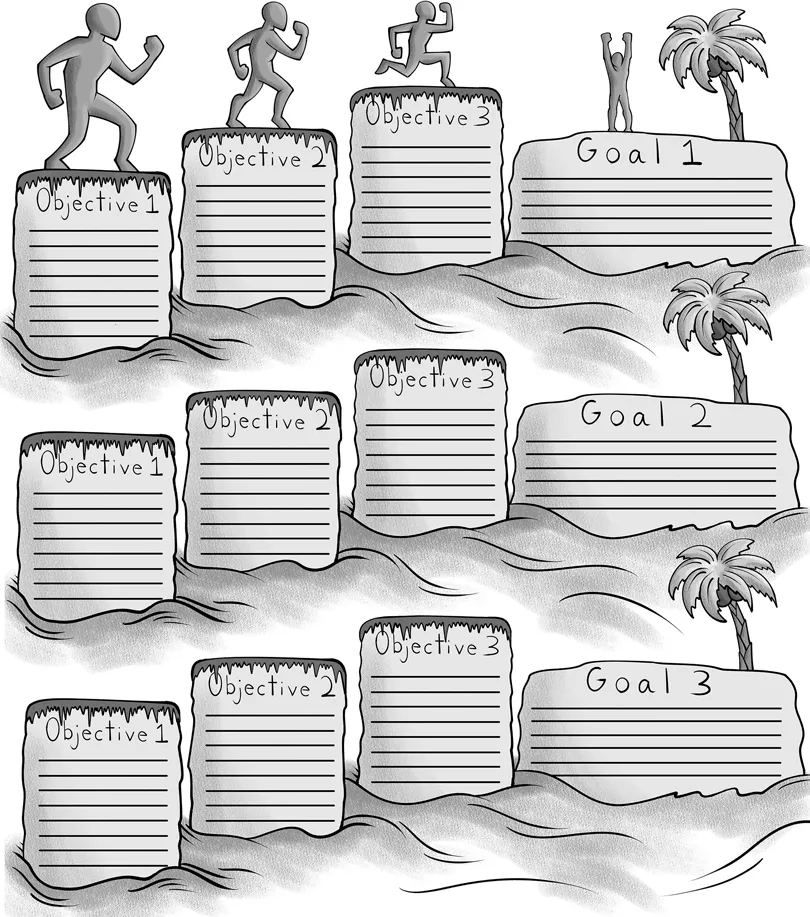
Islands and Stones Goal Setting

Directions: Select three goals you wish to address, and write them down on the ā€œislandsā€ below. These ā€œislandsā€ in this metaphor are what you are working or hopping towards. For each goal, break down how you will achieve this goal into three objectives. Objectives are smaller bite-sized steps that will get you to your goal or the island. Objectives are the ā€œhopping stonesā€ you will take to get to your ā€œisland.ā€
Image
Image

Intersectionality Gem

Intersectionality is a framework and tool for assessment (Crenshaw, 1989). It supports conceptualizing a person, community, or social problem as distressed by a multitude of discrimination and oppression. It simultaneously considers human beings as being dynamic gemstones with multiple facets of identity. It is these facets or overlapping identities and experiences that must be assessed for in order to understand the complexity of prejudices individuals and communities face every day. For the LGBTQI community, intersectionality provides a framework to address sexual identity, gender, sex, and assigned sex at birth, but incorporates all facets of identity when considering the entire person in any given context.
Intersectional theory asserts that people are often disadvantaged by multiple sources of oppression: skin color (race), socio-economic status (SES), gender identity, sexual identity (orientation), religion and spirituality, sex, assigned sex at birth, first language, national origin, culture and ethnicity, ability, and age, to just mention a few identity markers. Intersectionality recognizes that identity markers (e.g., ā€œfemaleā€ and ā€œblackā€ and ā€œlesbianā€ and ā€œmotherā€) do not exist independently of each other. Please go back and view the Audrey Lorde illustration; she held all these identities to be her own simultaneously and dynamically. Crenshaw (1989) in the seminal work defining the theory, postulates that each identity marker informs the others, often creating a complex convergence of oppression and marginalization.
Who are you? What kind of gem are you? Ruby, Sapphire, or Emerald?
Directions: Write out your identities on the gem outline and answer the four questions:
Image
Image

Superhero Miracle Question

Comic books and graphic novels have always given the LGBTQI community icons and heroic stories to escape within. For many in the community, superheroes model the idea that being different is OK; the fantasy world created allows for these differences.
It was not until 1992 that there was an openly gay comic book character. Since 1954, there had been an authority that controlled strict guidelines forbidding any LGBTQI representation in comics. Queer comics have been historically underground operations. Sexual identity (orientation) has been debated for many superheroes over time and historical campiness fits well with superheroes generalizability for being colorful, nonconformist, powerful, living with double identities, and always struggling to be accepted. The connection between superheroes and the LGBTQI community is compelling. Visualizing your own superpowers will be an inspiration to help power you up for your next goal to achieve (Pagan, 2018).
The Miracle Question is a self-assessment technique frequently used in Solution-Focused Brief Therapy (SFBT) developed by DeJong and Berg (1998). It is a powerful CBT-informed tool. It helps get us into a solution orientation mind-frame or thinking pattern. The Miracle Question allows us to begin small steps toward finding solutions to challenges we have set as goals requiring attention. Below are two self-assessment exercises using the Miracle Question. The first is the traditional Miracle Question as initially designed by DeJong and Berg (1998). The second example is a LGBTQI Superhero Miracle Question.
For further reading about LGBTQI inclusion and representation in comic books, visit the New York Public Library’s blog post Power Up for Pride With LGBTQ+ Superheroes (June, 2018).
The Traditional Miracle Question (DeJong & Berg, 1998):
Now, I want to ask you a strange question. Suppose that while you were sleeping tonight and the entire house is quiet, a miracle happens. The miracle is that the problem which brought you here is solved. However, because you’re sleeping, you don’t know that the miracle has happened. So, when you wake up tomorrow morning, what will be different that will tell you a miracle has happened...

Table of contents

  1. Cover
  2. Half Title
  3. Title Page
  4. Copyright Page
  5. Dedication
  6. Table of Contents
  7. About the Author
  8. Disclaimer
  9. Current Life Selfie
  10. Introduction
  11. Part 1: Self-Assessment Handouts and Worksheets
  12. Part 2: Cognitive Handouts and Worksheets
  13. Part 3: Behavioral Handouts and Worksheets
  14. Part 4: Psychoeducational Handouts and Worksheets
  15. Part 5: Therapist Handouts and Worksheets
  16. Appendix A AT Progress Note
  17. Appendix B Biological-Psychological-Social AT Assessment
  18. Appendix C Resources
  19. Future Life Selfie
  20. References
  21. Index