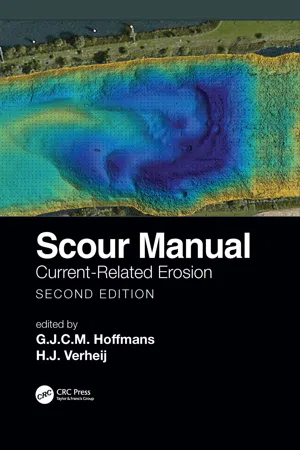
Scour Manual
eBook - ePub

Scour Manual

Current-Related Erosion

  1. 278 pages
  2. English
  3. ePUB (mobile friendly)
  4. Available on iOS & Android
eBook - ePub

Scour Manual

Current-Related Erosion

About this book

Ever since the publication in 1997 the original Scour Manual has helped many practising hydraulic engineers to deal with scour processes near hydraulic structures. In recent years new insights, such as probabilistic calculations, offered new opportunities to design structures more economically. These new insights are included in this update of the original Scour Manual, which is focussing entirely on current-related scour. This manual provides the engineer with useful practical methods to calculate the dimensions of scour holes in the pre-feasibility and preliminary stages of a project, and gives an introduction to the most relevant literature.

This updated Scour Manual contains guidelines that can be used to solve problems related to scour in engineering practice and also reflects the main results of all research projects in the Netherlands in recent decades. The so-called Breusers equilibrium method has a central role, which can basically be applied to all situations where local scour is expected. The method allows to predict the scour depth as a function of time, provided that the available knowledge about scour at the specific structure is sufficient. For structures with insufficient knowledge available, alternative scour prediction rules are presented.

The treatment of local scour is classified according to the different types of structures. Each type of structure is necessarily schematised to a simple, basic layout. The main parameters of a structure and the main parts of the flow pattern near a structure are described briefly insofar they are relevant to the description of scour phenomena. New scour formulas for the equilibrium scour have been elucidated. Evaluating a balance of forces for a control volume, it is possible to develop scour equations for different types of flow fields and structures, i.e. jets, abutments and bridge piers.

As many scour problems are still not fully understood, attention is paid to the validity ranges and limitations of the formulas, as well as to the accuracy of the scour predictions. This information can also be used to carry out a risk assessment using a safety philosophy based on a probabilistic analysis or an approach with a safety factor. Moreover, the information on the strength of soils is extended and aspects are addressed such as scour due to shear failures or flow slides, that can progressively damage the bed protection which might lead to the failure of hydraulic structures.

This updated Scour Manual presents scour prediction methods and deals with practically related scour problems. Consultants and contractors were invited to provide case studies of realized projects, including the methods that were followed. These case studies will help with grasping the concept of scour by the flow of water. This manual provides the engineer with the latest knowledge and with case studies that show how to apply the formulas and their limitations.

Trusted by 375,005 students

Access to over 1.5 million titles for a fair monthly price.

Study more efficiently using our study tools.

Information

Publisher
CRC Press
Year
2021
eBook ISBN
9781000347302

Chapter 1

Introduction

1.1 General

A hydraulic structure is generally intended to provide a practical measure to solve an identified problem. After problem identification, subsequent stages are determined by a series of decisions and actions culminating in the creation of a structure or structures to resolve the problem. Aspects that may affect the eventual outcome of the design process have to be assessed. In addition to hydraulic, geotechnical and engineering characteristics, aspects such as social conditions, economics, environmental impact and safety requirements also influence the design process.
Within the scope of the Dutch Delta works, the Dutch Ministry of Transport, Public Works and Water Management and Delft Hydraulics (now merged into Deltares) conducted systematic research with respect to the prediction of the formation of scour holes. After the catastrophic flood disaster in 1953, the Delta Plan was formulated to protect the Rhine-Meuse-Scheldt delta against future disasters. Dams with large-scale sluices were planned in some estuaries. The expected severe scour necessitated acquiring a better understanding of the scour process.
To obtain detailed information about the physical processes playing a role in scour development, Delft Hydraulics (Deltares) carried out many experiments in which several parameters of the flow and the scoured material varied. From the results of experiments in flumes, with obvious difficulties of scale effects and limitations in instrumentation, some semi-empirical relations were obtained that describe the erosion process as a function of time and position (Breusers, 1966, 1967; van der Meulen & Vinjé, 1975). In addition, design criteria were deduced for the length of bed protection. These were based on hundreds of shear failures and flow slides that occurred along the coastline in the south-western part of the Netherlands.
Understanding of the physical processes and mathematical modelling of the water and sediment movement in rivers, estuaries and coastal waters have made much progress in recent years. This has led to a number of more or less ready-to-use mathematical model systems, but it has also raised many new research questions. In the early 1990s, a morphological model for the generation of scour holes behind hydraulic structures was developed. This morphological model was based on the 2D Navier-Stokes and convection-diffusion equations and used for the calibration and verification of semi-empirical relations that predict the scour process. Nowadays sophisticated CFD (Computational Fluid Dynamic) models are available for scour computations.
This manual highlights the so-called Breusers method which describes the maximum scour depth as a function of time, including the practical equilibrium value near hydraulic structures. Scour due to three-dimensional flow can easily be predicted when this method is applied in combination with computational results of depth-averaged hydrodynamic models or with measurements obtained from scale models. The accuracy of the scour computation depends mainly on the accuracy of the flow velocities and the turbulence intensities just above the protected bed. According to Breusers (1966), the development of the scour process depends entirely on the average flow velocity and depth-averaged relative turbulence intensity at the transition from the fixed to the erodible bed. Applying this concept restricts the scour prediction to a single computation. No information is needed concerning the near-bed velocities and bed turbulence in the scour hole.
This manual is an update of the original book published in 1997. However, it deals only with scour due to currents. Scour due to waves is not addressed in this update. This manual addresses various new aspects, such as risk assessment, scour of rock and new theory-based formulas for the prediction of scour at hydraulic structures but also an update of the available mathematical scour and erosion models. Last but not least, a fully renewed chapter has been added with recent experiences of consultants and contractors with scour design.

1.2 Scope of this manual

The purpose of this scour manual is to provide the civil engineer with useful practical methods to calculate the dimensions of scour holes in the prefeasibility and preliminary stages of a project, and to furnish an introduction to the most relevant literature. The manual contains guidelines which can be used to solve problems related to scour in engineering practice and also reflects the main results of all research projects in the Netherlands in recent decades. A complete review of all the available references on scour is beyond the scope of this manual. The most relevant manuals are Breusers and Raudkivi (1991), Melville and Coleman (2000) and May et al. (2002). Furthermore, the International Conference on Scour and Erosion provides relevant information and is important for the most recent developments.
The scour depth as a function of time can be predicted by the so-called Breusers equilibrium method. Basically, this method can be applied to all situations where local scour is expected. However, the available knowledge about scour is not sufficient for applying the method to scour at each type of structure. Structure-specific scour prediction rules are presented then. The treatment of local scour is classified according to different types of structures. Each type of structure is necessarily schematised to a simple, basic layout. The main parameters of a structure and the main parts of the flow pattern near a structure are described briefly insofar as they are relevant to the description of scour phenomena. Detailed and theoretical descriptions of the flow phenomena are not included because at this stage, the consequences of such descriptions are minimal in relation to engineering practice. Nonetheless, Hoffmans (2012) developed new formulas for equilibrium scour. Evaluating a balance of forces for a control volume, he was able to develop scour equations for different types of flow fields and structures, i.e. jets, abutments and bridge piers.
As many scour problems are still not fully understood, attention is paid to the validity ranges and limitations of the formulas, as well as to the accuracy of calculations of the maximum scour depth during the lifetime, the upstream scour slope and the failure length. Due to shear failures or flow slides, the scour process can progressively damage the bed protection. This will lead to the failure of hydraulic structures.
The presented Breusers equilibrium method can be applied directly in engineering practice for nearly all types of structures. Accurate local flow velocities and turbulence intensities resulting from three-dimensional flow models can act as inputs for the Breusers equilibrium method, which can be considered as a continuation and an expansion of the work of Breusers (1966). In other words, one may speak of a revitalisation of the Breusers formula, with which a lot of experience has been gained, mainly in the Netherlands but also abroad.

1.3 Reading guide

The manual is divided into seven parts. The first three parts give a general introduction to the subject. The next four parts deal with calculation methods for predicting scour near hydraulic structures and, in the final part, some cases of scour at prototype scale are described. A brief summary of each chapter follows.

Chapter 2 – Design process

It is crucial to design hydraulic structures that are reliable and safe during their life cycle. To ensure safe long-term functioning of hydraulic structures, it is necessary to consider boundary conditions, risk assessment and measures to prevent scour. After having addressed the boundary conditions, we discuss the risk assessment and the fault tree analysis. Two methods are treated: one based on safety factors and the other on failure probability. When applying these techniques, one should keep in mind what the goal is of the design: a pre-feasibility study or a final design. Examples show how to deal with these methods. Furthermore, protective measures are mentioned.

Chapter 3 – Design tools

The total scour which may occur at the site of a structure can be estimated with mathematical scour and erosion models. An overview is given of available tools. In principle, scour may be considered as a combination of general scour and local scour resulting from different processes. In addition, time phases can be distinguished in the scour process. We present these phenomena for currents.
A more or less continuous scouring process may suddenly be disturbed by the occurrence of geotechnical instabilities along the upstream scour slope. Shear failures and flow slides influence the stability of hydraulic structures. In the extreme case, these instabilities involve large masses of sediment and cause a major change of the shape of the upstream side of the scour hole in a relatively short period of time. Some design criteria based on storage models are presented.

Chapter 4 – Initiation of motion

Scour results from transport of bed materials. The non-uniform flow is responsible for this, which is usually expressed by either a turbulence coefficient or a dominating flow velocity, or by both. Turbulence is the most important phenomenon determining erosion. Relations for the turbulence intensity and the critical flow velocity are presented for various situations. The design graphs of Shields are presented for non-cohesive bed materials, such as sand and rock. For cohesive soils such as clay and peat, the method of Mirtskhoulava and also empirical relationships based on the plasticity index are given. In addition, erosion rate formulas are also presented.

Chapter 5 – Jets

We discuss scour due to several jet forms, such as plunging jets, submerged jets, horizontal and vertical jets, and two- and three-dimensional jets. In addition, we treat the complex flow pattern of jets. We also address scour by ship-induced currents, scour due to propellers and scour due to jets in the case of broken pipelines. Semi-empirical and theory-based relations for the scour process behind a short-crested sill are presented. The semi-empirical relations are often used for grade-control structures, where the flow above the structure is supercritical, and for the time-dependent development of the maximum scour depth downstream of a hydraulic jump. The structure of the semi-empirical relations shows a good similarity with the Breusers approach. The new relations have a theoretical base as they have been derived using the balance of forces. However, both semi-empirical and theory-based relations must be clearly understood prior to any attempt to use them for design purposes.

Chapter 6 – Sills

We summarise calculation methods for sills. A distinction is made between sills with a broad or a sharp crest and between sills with and without bed protection. Usually, the flow above a sill is subcritical, but depending on the downstream water level, the flow may become supercritical. We discuss the time-dependent and equilibrium behaviour of scour holes in sandy beds in relation to closure works (broad-crested sills) in tidal channels. Special attention is paid to the effects of turbulence and flow pattern on the scour process.
We describe an approximate method (reduction method) for calculation of the maximum scour depth. This takes the influence of upstream sediment supply into account. In addition, we present a method to adjust this calculation method for unsteady flow, especially tidal flow. These methods were successfully applied during the design of the Eastern Scheldt Storm Surge Barrier. The upstream scour slope determines the stability of the upstream part of the scour hole and the adjacent bed protection. A relation for the upstream scour slope, based on a probabilistic model for bed load transport, is presented. Relations derived from systematic scour investigations are verified by two field experiments, among which the scour at the Eastern Scheldt Storm Surge Barrier.

Chapter 7 – Abutments and groynes

Relations are presented for predicting local scour at the head of abutments, for which several names are used (spurs, groynes, guide or river bunds) in the literature. We also present recently developed formulas based on a balance of forces. We briefly discuss the flow characteristics around blunt and streamlined abutments. Attention is also paid to the time scale of the scour process and to combined scour (e.g. local scour and bend scour or constriction scour). Since the literature contains many scour relations, a number of generally acceptable predictors have been selected for this manual. Finally, attention is paid to failure mechanisms and measures to mitigate scour near abutments.

Chapter 8 – Bridge piers

After discussing the flow characteristics at the pier and in case of a submerged bridge, relations for estimating scour around bridge piers are summarised. These relations are mostly empirical, but we also present a theoretical relation based on a balance of forces. Correction factors and design graphs for the equilibrium scour depth are discussed. Attention is paid both to the equilibrium scour depth and to the time scale of the scour process. Methods are given to predict scour at bridge piers with a footing or pile cap and for pressure scour. Indications are provided for determining the area to protect against scour.

Chapter 9 – Realised case studies on prototype scale

Nine realised case studies on the prototype scale, based on feasibility studies or design studies, are evaluated in order to determine the practical use of the scour relations in this manual. These cases are as follows:
  • Four cases about bridge pier scour: Camden motorway bypass, crossing of a high-voltage power line, pier scour in bypass channel, and pressure scour;
  • Two cases about culvert scour: Waterdunen proj...

Table of contents

  1. Cover
  2. Half Title
  3. Title Page
  4. Copyright Page
  5. Table of Contents
  6. Foreword
  7. Acknowledgements
  8. List of main symbols
  9. List of main definitions
  10. 1 Introduction
  11. 2 Design process
  12. 3 Design tools
  13. 4 Initiation of motion
  14. 5 Jets
  15. 6 Sills
  16. 7 Abutments and groynes
  17. 8 Bridges
  18. 9 Case studies on prototype scale
  19. References

Frequently asked questions

Yes, you can cancel anytime from the Subscription tab in your account settings on the Perlego website. Your subscription will stay active until the end of your current billing period. Learn how to cancel your subscription
No, books cannot be downloaded as external files, such as PDFs, for use outside of Perlego. However, you can download books within the Perlego app for offline reading on mobile or tablet. Learn how to download books offline
Perlego offers two plans: Essential and Complete
  • Essential is ideal for learners and professionals who enjoy exploring a wide range of subjects. Access the Essential Library with 800,000+ trusted titles and best-sellers across business, personal growth, and the humanities. Includes unlimited reading time and Standard Read Aloud voice.
  • Complete: Perfect for advanced learners and researchers needing full, unrestricted access. Unlock 1.5M+ books across hundreds of subjects, including academic and specialized titles. The Complete Plan also includes advanced features like Premium Read Aloud and Research Assistant.
Both plans are available with monthly, semester, or annual billing cycles.
We are an online textbook subscription service, where you can get access to an entire online library for less than the price of a single book per month. With over 1.5 million books across 990+ topics, we’ve got you covered! Learn about our mission
Look out for the read-aloud symbol on your next book to see if you can listen to it. The read-aloud tool reads text aloud for you, highlighting the text as it is being read. You can pause it, speed it up and slow it down. Learn more about Read Aloud
Yes! You can use the Perlego app on both iOS and Android devices to read anytime, anywhere — even offline. Perfect for commutes or when you’re on the go.
Please note we cannot support devices running on iOS 13 and Android 7 or earlier. Learn more about using the app
Yes, you can access Scour Manual by G.J.C.M. Hoffmans, H.J. Verheij, G.J.C.M. Hoffmans,H.J. Verheij in PDF and/or ePUB format, as well as other popular books in Technology & Engineering & Civil Engineering. We have over 1.5 million books available in our catalogue for you to explore.