This book reviews the full coaching outcome research literature to examine the arguments and evidence behind the use of executive coaching. Erik de Haan presents the definitive guide to what works in coaching and what changes coaching brings about, both for individual coaches and for organisations and commissioners.
Accessibly written and based on contemporary quantitative research into coaching effectiveness, this book considers whether we know that coaching works, and, if so, whom it works for, and what it offers to those involved. What Works in Executive Coaching considers the entire body of academic literature on quantitative research in executive and workplace coaching, assessing the significant results and explaining how to apply them. Each chapter contains direct applications to coaching practice and clearly evaluates the evidence, defining what really works in executive coaching.
Alongside its companion volume Critical Moments in Executive Coaching, this book is an essential guide to evidence-based effectiveness in coaching. It will be a key text for all coaching practitioners, including those in training.
Before writing about outcomes and coaching let me come clean about my own most memorable outcomes as a coach. They have mostly taken place in ‘remedial’ work, where after all making a measurable difference is an essential part of the coaching contract. I have worked with a few clients under pressure of losing the board or of losing their jobs, and effectiveness was always more critical and apparent in those ‘remedial’ contracts. In fact, high effectiveness could be demonstrated by just keeping the job my client was in. The ‘remedial’ clients usually needed to change something about their behaviour as perceived by their teams and bosses. They were told either to deliver more promptly, to be less critical or aggressive in the workplace, to become ‘pro-active’ or ‘strategic’ in their contributions,1 or simply to be more available and helpful to their colleagues – and sometimes all four of those.
Jacob was one of these clients.
The very first ‘chemistry’ meeting with him already went very well – unusual for me since I am usually seen as too serious or too challenging in chemistry meetings. Here I was chosen from a competitive field. Jacob phoned me up and said,
You observed so many things that made me think; so, in the past week I have spent a lot more time thinking through my questions for coaching. When you asked me the question ‘what is this worth for you?’ I realised I had never asked that question myself. And I had to conclude that so far, I have been able to get away with not changing, so it probably wasn’t worth enough for me up to this point. That question really made me reflect.
I met Jacob’s boss next and heard a litany of problems and also, between the lines, that the boss’s preference was to fire him but he felt he could not do that without the full consent of the Canadian holding company. Coaching for Jacob seemed very much a ‘second best’ solution. Then the three of us met and Jacob made clear that he wanted to take this option seriously and not with the irony and even cynicism that he was known for in the workplace. He realised that he had let things slip and that most of his relationships with his direct reports could be improved. I interviewed the direct reports and several of the other board members, after which we had a very sobering first coaching session, where we managed to go over many of the hopes, expectations, and even ‘demands’ regarding this executive coaching contract on the part of Jacob’s colleagues and direct reports. His boss had even requested two further conversations with me telling me all the many things that he had picked up from staff and that he had mostly never told Jacob himself. I had let everyone know that I would be open with Jacob about their grievances, and I was. From the start Jacob seemed to be listening attentively and although he defended himself occasionally, he did confirm that he ‘was not good at reading people,’ that he ‘was not very polite and could be challenging of others,’ that he ‘always took the direct route to his goal,’ and that people found his behaviour sometimes upsetting, so he must have ‘annoyed’ several of his Board colleagues with, for example, blunt ideas for improvement in their departments. By the time we had worked together for some four sessions, Jacob told me that one of his direct reports was occasionally saying ‘thank you’ to him for positive changes made – but that she had cheekily phrased it as ‘thank you Erik’ to him, remembering me from the interview she had had with me. I could not think of a better outcome of our coaching work than that a direct report of Jacob sincerely thanked me through him in this manner.
After some eight sessions of coaching his boss the CEO agreed that Jacob had turned around completely and had really seen the benefit of contributing in a more thoughtful and less challenging way, to such an extent that the CEO in his final triangular meeting with us, before the final coaching session, said, ‘I don’t think I could have undertaken something like this myself. It would feel like too much of a humiliation to me. But you, Jacob, grasped the nettle admirably and are now experienced very differently by your Board colleagues.’
Even after such a speech I tend to remain cautious and pessimistic. And in fact with this particular client, when I met his HR Director on an unrelated assignment nearly a year later, he sighed and said that Jacob was just ‘the wrong person on the job’ and that the coaching had probably come too late to do anything for him. I was left wondering whether these were just two different opinions representing different perspectives within the wider executive team, or whether there had been a reversal of all that great progress that we were celebrating towards our final session. I shall never know.
As Raymond Corsini beautifully illustrates in the introduction of his book on current psychotherapies, important outcomes can often be found in marginal moments or unexpected places. Think of the coach who picked up from an initial conversation with the commissioner that her new client was described as an ‘unguided missile.’ Then she noticed that the client turned out quite intense in the conversations, with little focus, so she mentioned the feedback she had heard, gently inquiring into the client’s working style. And made a link to something the client had brought to the session about their children being very unfocused and having some concentration problems. The client became thoughtful, went away, spoke with friends, went to the general practitioner, did a test for ADHD, had a high score, and eventually came up with a diagnosis and prescription for the children which vastly improved their results and behaviour at primary school. This is just one example of the major, unintended positive benefits that simple coaching interventions can sometimes have.
Note
1This can be a real killer for executives: asking someone to be more ‘strategic’ or ‘proactive.’ It means asking them at the same time to obey you and follow your lead, and to be more spontaneous and follow their own best insight. It will be impossible to satisfy the internal contradictions in that request so that usually the coachee gets stuck in what is technically called a ‘paradoxical injunction,’ an instruction to do something that is rendered impossible by the instruction itself.
Chapter 1
Does executive coaching work? Is coaching worth the effort?
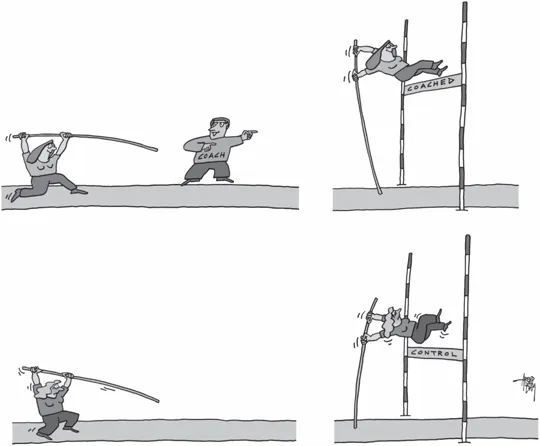
In this first chapter we will look both at the practice of doing quantitative research in coaching, and at the findings of quantitative research in coaching up to this point, after exactly 30 years of empirical research in workplace and executive coaching (since Miller, 1990). We will discover, through the lens of some 35 Randomised Controlled Trials (RCTs), that we can now be fairly certain that executive coaching does make a significant difference, that it is likely to be an effective intervention which after some six sessions builds to an effect size δ around 0.6. This means that coachees would be better off on average than about 72% of the control group that has not received coaching over the same period (De Haan et al., 2019).
Part A: some controversies
Quantitative research is about the pursuit of ‘truth,’ so its methods and findings are understandably hotly debated. And in accordance with our troubled times, there is quite a bit of ‘fake news’ around, including a disturbing number of ‘alternative facts.’ Some researchers are better able to market their ‘truths’ than others, which leads to a skewed reception of their findings. Some researchers are more modest and circumspect than others, in reporting only what they can truly demonstrate in their sample. Some researchers have a better understanding than others of the statistical power (or lack of it) in their findings. All of this affects their ability to report on the ‘truth’ of their experiment and to limit themselves to the truth only. In my view, we as readers of research reports should try to modestly inquire into, check, and newly establish in our minds the facts behind the main messages of scientific articles. We as readers need to be open and curious, yet also alert and slightly suspicious with every new research publication. We need to keep relying on and making use of fine research traditions such as ‘peer reviews’ and the testing of experiments by replicating them under slightly changed conditions.
Controversy 1: how universal and generalisable are the results?
Where qualitative research is essentially narrative and tells a story about a coaching relationship which is highly personal and unique (see, for a recent summary of the qualitative research tradition in coaching, De Haan, 2019b), quantitative research is all about generalisability. In other words, will we find the same effects if we repeat the study with a new sample? Could this result be universal? That is, could it be relevant and true in the vast array of all similar situations? Could this coaching research that I am reading about now therefore be relevant for me and my coachees: now, tomorrow, and onwards?
Any quantitative results that are worth noticing have to be ‘significant,’ so they have to stand out clearly above the background noise and the diversity within the sample, which gives them a decent probability to occur again in any similar samples worldwide. Significant results have the potential to be replicated (with a small likelihood that they will be falsified) by other researchers, so they gradually become respected ‘truths’ for the whole profession, and remain generalisable over time (which means that they provide a reliable prediction for the future) and space (namely to any coaching conversation in any country or culture that is assumed to be similar enough to one of the samples where the result has already been demonstrated). The fact that quantitative results have this potential of being true anywhere and at any time makes them so powerful and so hotly debated, and frankly, so controversial as well. Unless of course they are demonstrated with at least ‘five sigma accuracy.’ Five sigma accuracy means that we can trust that the result is true for this population with a probability of 99.99997% and so we know that this is generalisable to hundreds of thousands of similar populations. Five sigma accuracy is very rarely achieved in the social sciences.1 This means that there is always some interesting and possibly unsettling room for doubt and debate. Most results in the social sciences are reported with 95% (p < 0.05) or 99% (p < 0.01) accuracy; i.e. two or three sigma only. Lower accuracies give at least a one-in-twenty chance that the result was a fluke, so they will not be recognised in the research literature, nor in this book.
In every chapter of this book I will first report on the controversies before reporting on the results, to underline that all results that I write about are still open to debate, and that no findings are above or beyond debate at this point in time. The strongest finding at the moment is that coaching seems to be an effective intervention, but even this is only known from just over 30 small-scale experiments and never with an accuracy greater than p < 0.01, so still a one-in-a-hundred chance (or perhaps one thirtieth of a one-in-a-hundred chance) that we are mistaken to assume such effectiveness and a much bigger chance that we are actually over-estimating coaching effectiveness, i.e. that there is an effect but not such a large one.
Historically, there have always been powerful voices to say that the helping professions are not effective at all, the most famous of which comes from Professor Hans Eysenck, who was a leading psychologist in the twentieth century. To be fair to him his doubts were expressed when we still had very little evidence (Eysenck, 1952), and moreover, he had many other unsubstantiated, non-mainstream views, e.g. the conviction that parapsychology and astrology were indeed empirically supported. It is nevertheless easy to find many articles online that argue that coaching is not effective, or that particular approaches to coaching are not effective, or that there are real dangers in the hiring of coaches (see, e.g., Berglas, 2002; Nowack, 2003; Briner, 2012); however, it is harder to find peer-reviewed, academic articles nowadays, that argue against the (general) effectiveness of coaching, mentoring, counselling, and psychotherapy. The accumulated evidence over decades of doing research is simply too hard to argue against. Still, in the interest of protecting the quality of our generalisable results, it must be argued against, again and again.
Controversy 2: choice-supportive biases skewing the results towards false positives
One deeper problem – and controversy – with coaching outcome research, something we will encounter in the description of the research done to date, is that most variables in most of the research experiments were self-scored. From a scientific (i.e. quantitative-research) point of view, the coachee and the coach are the least appropriate people to ask whether coaching was effective or not. After all, they already have a biased view of and a stake in the matter, so they are expected to suffer ‘choice-supportive’ biases. A coach has spent many hours learning about coaching, and both coach and coachee have spent many hours together in their sessions. So, they are already ‘wedded’ to the coaching by the simple act of spending time and energy and money on it, and thus arguably preferring it to something else that they equally could spend their resources on. So, from a standpoint of post-hoc rationalisation, coach and coachee will have a positive view of coaching and may attribute their luck or their career success, e.g. wise decisions or promotions, to the coaching sessions, even if that link is rather tenuous and one cannot (by definition) know what would have happened if the sessions had not taken place. This positive view of those who have already invested in coaching does not mean that coaching is effective in an ‘objective’ way, i.e. for a general target group which includes colleagues and clients of the coachees, or from the viewpoint of others in the organisation of the coachee.
More than just developing a positive bias by spending time on the intervention, there may be other reasons for positive scores that are not related to ‘effectiveness’ as we would define it (i.e. effectiveness in helping to achieve goals, to overcome obstacles, and to become more competent and successful in the work role). Coaches give their coachee full and undivided attention and try to help them during the conversations (following from the idea of a ‘helping conversation’). That does not just sway the coach towards a positive view of his or her own profession, through the dynamics of ‘hope’ and ‘charity’ or even simply because naturally they try to be positive to the coachee; but it will also sway the coachee towards experiencing coaching as positive. It is completely natural for the coachee to think, ‘Here is someone who takes time for me, who listens to me, tries to help me, someone that must be a valuable resource, even if just because I know that my organisation is paying good money to hire them,’ etcetera. Therefore, coaching sessions not only feel good and precious, but they also come with an aura of being good and valuable. Increasingly, coaching has become a veritable status symbol in organisations; I have written about this under the caption ‘Coaching – from stigma to status’ (De Haan, 2005). This positive connotation emerges independently from any good ideas or new decisions being developed in the sessions, let alone performance being enhanced or contractual objectives being achieved. Finally, there may be so-called ‘gamma’ change where the coachee (through coaching) becomes more familiar with one of the concepts on the questionnaire, such as ‘resilience’ or ‘leadership,’ so that a higher score is produced on the second, post-coaching questionnaire, even if there was no actual change in, say, the coachee’s resilience or leadership abilities.
Unfortunately, and similar to other disciplines, most other people who tend to be involved with the research also already have a stake in coaching, in such a way that they are already positively disposed before they give their contribution to the research. Firstly, of course, the researchers themselves: the overwhelming majority of researchers tend to be coaching professionals, so again they have spent time and money ...
Table of contents
Cover
Half Title
Title
Copyright
Dedication
Contents
Highlights of the book
Introduction
An interlude before Chapter 1
An interlude before Chapter 2
An interlude before Chapter 3
An interlude before Chapter 4
An interlude before Chapter 5
An interlude before Chapter 6
References
Subject index
Author index
Trusted by 375,005 students
Access to over 1.5 million titles for a fair monthly price.
Study more efficiently using our study tools.
Frequently asked questions
Yes, you can cancel anytime from the Subscription tab in your account settings on the Perlego website. Your subscription will stay active until the end of your current billing period. Learn how to cancel your subscription
No, books cannot be downloaded as external files, such as PDFs, for use outside of Perlego. However, you can download books within the Perlego app for offline reading on mobile or tablet. Learn how to download books offline
Perlego offers two plans: Essential and Complete
Essential is ideal for learners and professionals who enjoy exploring a wide range of subjects. Access the Essential Library with 800,000+ trusted titles and best-sellers across business, personal growth, and the humanities. Includes unlimited reading time and Standard Read Aloud voice.
Complete: Perfect for advanced learners and researchers needing full, unrestricted access. Unlock 1.5M+ books across hundreds of subjects, including academic and specialized titles. The Complete Plan also includes advanced features like Premium Read Aloud and Research Assistant.
Both plans are available with monthly, semester, or annual billing cycles.
We are an online textbook subscription service, where you can get access to an entire online library for less than the price of a single book per month. With over 1.5 million books across 990+ topics, we’ve got you covered! Learn about our mission
Look out for the read-aloud symbol on your next book to see if you can listen to it. The read-aloud tool reads text aloud for you, highlighting the text as it is being read. You can pause it, speed it up and slow it down. Learn more about Read Aloud
Yes! You can use the Perlego app on both iOS and Android devices to read anytime, anywhere — even offline. Perfect for commutes or when you’re on the go. Please note we cannot support devices running on iOS 13 and Android 7 or earlier. Learn more about using the app
Yes, you can access What Works in Executive Coaching by Erik de Haan in PDF and/or ePUB format, as well as other popular books in Business & Mentoring & Coaching. We have over 1.5 million books available in our catalogue for you to explore.