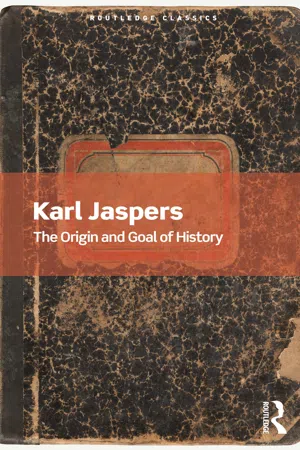
Karl Jaspers (1883–1969) was a German psychiatrist and philosopher and one of the most original European thinkers of the twentieth century. As a major exponent of existentialism in Germany, he had a strong influence on modern theology, psychiatry and philosophy. He was Hannah Arendt's supervisor before her emigration to the United States in the 1930s and himself experienced the consequences of Nazi persecution. He was removed from his position at the University of Heidelberg in 1937, due to his wife being Jewish.
Published in 1949, the year in which the Federal Republic of Germany was founded, The Origin and Goal of History is a vitally important book. It is renowned for Jaspers' theory of an 'Axial Age', running from the 8th to the 3rd century BCE. Jaspers argues that this period witnessed a remarkable flowering of new ways of thinking that appeared in Persia, India, China and the Greco-Roman world, in striking parallel development but without any obvious direct cultural contact between them. Jaspers identifies key thinkers from this age, including Confucius, Buddha, Zarathustra, Homer and Plato, who had a profound influence on the trajectory of future philosophies and religions. For Jaspers, crucially, it is here that we see the flowering of diverse philosophical beliefs such as scepticism, materialism, sophism, nihilism, and debates about good and evil, which taken together demonstrate human beings' shared ability to engage with universal, humanistic questions as opposed to those mired in nationality or authoritarianism.
At a deeper level, The Origin and Goal of History provides a crucial philosophical framework for the liberal renewal of German intellectual life after 1945, and indeed of European intellectual life more widely, as a shattered continent attempted to find answers to what had happened in the preceding years.
This Routledge Classics edition includes a new Foreword by Christopher Thornhill.
By virtue of the extent and depth to which it has transformed human life, our age is of the most incisive significance. It requires the whole history of mankind to furnish us with standards by which to measure the meaning of what is happening at the present time.
A glance at the history of mankind leads us, however, into the mystery of our humanity. The fact that we possess a history at all, that history has made us what we are and that the duration of this history up to now has been comparatively short prompts us to ask: Where does it come from? Where does it lead? What does it mean?
Since the earliest times man has attempted to picture the whole to himself: first in mythical images (in theogonies and cosmogonies, in which man had his appointed place), then in the image of divine activity operating through the decisive events of world politics (the historical vision of the prophets), then as a process of revelation running through the whole course of history, from the creation of the world and the fall of man to the end of the world and the last judgement (St. Augustine).
The historical consciousness is fundamentally altered when it bases itself on empirical foundations and on these alone. The accounts of a natural genesis of civilisation, such as were devised everywhere, from China to the West, though still in fact legendary, were already empirical in intent. Today the real horizon has become immensely wider. Temporal limitations—such, for example, as the Biblical belief in a world 6,000 years old—have been broken through. Something endless opens up into the past and into the future. Within it research adheres to historical remains, documents and monuments of the past.
Confronted by limitless multiplicity, this empirical conception of history must either restrict itself to the demonstration of single regularities and never-ending descriptions of the manifold: the same happenings repeat themselves; the analogous recurs within the diverse; there are orders of power-politics in typical series of forms, and there are chaos and confusion; there are regular sequences of styles in the realm of the spirit, and there is levelling-down into that which endures without any regular pattern.
Or the endeavour is made to achieve a unified and integrating overall view of the history of mankind: the factual cycles of civilisation are seen in their development and decline—first in isolation and then in mutual interaction; the common element underlying the problems of meaning and mutual comprehensibility is apprehended and leads finally to the concept of a single meaningful pattern, in which all diversities have their appointed place (Hegel).1
Whoever turns to history involuntarily adopts one of these universal viewpoints, which reduce the whole of history to a unity. These viewpoints may be accepted uncritically, may even remain unconscious and therefore unquestioned. In the modes of historical thought they are usually taken as self-evident presuppositions.
Thus in the nineteenth century world history was regarded as that which, after its preliminary stages in Egypt and Mesopotamia, really began in Greece and Palestine and led up to ourselves. Everything else came under the heading of ethnology and lay outside the province of history proper. World history was the history of the West (Ranke).
As against this view nineteenth-century positivism aimed at according equal rights to all men. Where there are men there is history. World history embraces, in time and space, the entire globe. It is arranged geographically on the basis of its distribution in space (Helmolt). It took place everywhere on earth. Battles between negroes in the Sudan were on the same historical plane as Marathon and Salamis—or were even, by virtue of the greater numbers involved, of superior importance.
Hierarchy and structure seemed once more to be perceptible in history as a result of the conception of integral cultures.2 From the undifferentiated mass of mere primitive existence, cultures—so it was thought—develop like organisms, as independent life-forms having a beginning and an end, being of no concern to one another but capable of meeting and interfering with each other. Spengler recognises eight such historical organisms, Toynbee twenty-one. Spengler ascribes to them a life-span of one thousand years, Toynbee an indefinite one. Spengler sees the necessity for a mysterious total process to be accomplished by any given culture-organism: a metamorphosis governed by natural laws which he claims to perceive morphologically, from analogies between the phases of the various organisms. In his physiognomic conception everything assumes the character of a symbol. Toynbee undertakes a multiple causal analysis from sociological points of view. Beyond that he finds room for the free decisions of individuals, but in such a way that, in his view too, the whole appears in the guise of a currently necessary process. Both, therefore, make predictions for the future on the basis of their overall conceptions.3
In our time, apart from Spengler and Toynbee, Alfred Weber has evolved a great independent conception of history. In spite of his disposition to make the totalities of cultures the object of knowledge, his universal conception of history—his sociology of civilisation—remains, in fact, remarkably open. Guided by his clear-sighted historical intuition and gifted with an unerring feeling for the status of spiritual creations, he adumbrates the historical process in such a manner that neither dispersal into unrelated culture-organisms nor the unity of human history as such becomes a principle. In fact, however, he finds himself confronted by the shape of a universal historical process, which divides itself up into primary civilisations, secondary cultures at the first and second stage, and so on down to the history of the expanding West after 1500.
I shall not devote any further time to the discussion of these conceptions, but shall attempt, in my turn, to outline the schema of a total conception.
My outline is based on an article of faith: that mankind has one single origin and one goal. Origin and goal are unknown to us, utterly unknown by any kind of knowledge. They can only be felt in the glimmer of ambiguous symbols. Our actual existence moves between these two poles; in philosophical reflection we may endeavour to draw closer to both origin and goal.
All men are related in Adam, originate from the hand of God and are created after His image.
In the beginning was the manifestness of Being in a present without consciousness. The fall set us on the path leading through knowledge and finite practical activity with temporal objectives, to the lucidity of the consciously manifest.
With the consummation of the end we shall attain concord of souls, shall view one another in a loving present and in boundless understanding, members of a single realm of everlasting spirits.
All these are symbols, not realities. The meaning of universal history, so far as it is empirically accessible—whether it possesses such a meaning, or whether human beings only attribute one to it—we can only grasp when guided by the idea of the unity of the whole of history. We shall examine empirical facts in order to see to what extent they are in accordance with such an idea of unity, or how far they absolutely contradict it.
In so doing we shall evolve a conception of history which ascribes historical significance to that which, firstly, stands unmistakably in its place within one single overall process of human history, as a unique event, and which, secondly, possesses the qualities of reality and indispensability in the communication or continuity of humanity.
We shall now proceed, by an analysis of the structure of world history, to adumbrate our schema, whose aim is the greatest inclusiveness and the most categoric unity of human history.
Notes
1 (Page 4): Of imperishable importance to the philosophy of history are the relevant writings of Vico, Montesquieu, Lessing, Kant, Herder, Fichte, Hegel, Marx, Max Weber. A general view is given by: Johannes Thyssen, Geschichte der Geschichtsphilosophie, Berlin 1936. R. Rocholl, Die Philosophie der Geschichte, Band I, Göttingen 1878.
2 (Page 4): O. Spengler, Der Untergang des Abendlandes, 1918. Alfred Weber, Kulturgeschichte als Kultursoziologie, Leiden 1935. Das Tragische und die Geschichte, Hamburg 1943. Abschied von der bisherigen Geschichte, Hamburg 1946. Toynbee, A Study of History, London 1935 ff.
3 (Page 5): Toynbee is careful about this. He breaks through or arches over his conception with a Christian outlook. In his view it is fundamentally possible for a culture to continue to exist without going under. It is not subject to the blind necessity of biological old age and death. What will happen is also dependent upon human freedom. And God may help.
Spengler claims that he—the first to do so in his opinion—formulates an historical prognosis methodologically with the certitude of an astronomer. He predicts the decline of the West. Many people found in his book the corroboration of a state of mind which they brought with them to the reading of it.
Two insights are, in principle, to be set in opposition to the dictatorial certitude of his brilliant conception of the play of relationships, which fluctuates between arbitrariness and plausibility: Firstly, Spengler’s interpretation in comparisons and analogies is frequently appropriate to the characterisation of a ‘spirit’, of an atmosphere, but it pertains to the nature of all physiognomic definition that it involves not the methodological recognition of a reality, but an interpretation extending to the infinite in terms of possibilities. In the process, the imperious idea of the ‘necessity’ of events becomes confused. Morphological form-sequences are construed causally, the evidence of the senses as a real necessity of events. Spengler is methodologically untenable where he gives more than a characterisation of phenomena. If real problems very often lie hidden in his analogies, they come to light only when it becomes possible to test his statements causally and particularly by investigation, and not simply in the physiognomic view as such. The playful approach, which, in the particular, always supposes itself to have the total within reach, must be transmuted into definiteness and demonstrability; this calls for renunciation of insight into the whole.
The substantialisation or hypostasisation of cultural totalities will then cease. There will then be only ideas of a relative spiritual whole and schemata of such ideas in ideal-typical constructions. These are able to bring a great multiformity of phenomena into context through the application of principles. But they always remain within the comprehensive whole; they are not capable of taking a total grip of any such whole, as though it were a circumscribed body.
Secondly, in opposition to Spengler’s absolute separation of cultures standing side by side without relations, we must point to the empirically demonstrable contacts, transferences, adaptations (Buddhism in China, Christianity in the West), which for Spengler lead only to disturbances and pseudomorphoses, but are in fact indications of a common fundament.
What this fundamental unity is, remains for us a task both of cognition and of practical implementation. No definitely construed unity—such as biological make-up, the universally valid thinking of the intelligence, common attributes of humanity—is unity per se. The presupposition that man is the potentiality for being the same everywhere, is just as correct as the contradictory assumption that man is everywhere disparate, differentiated down to the particularity of the individual.
In any case, the capacity for understanding pertains to unity. Spengler denies this capacity: the various cultural realms are irreconcilably diverse, incomprehensible to one another. We, for example, do not understand the Ancient Greeks.
This side by side coexistence of the everlastingly alien is contradicted by the possibility, and the partial reality, of understanding and adoption. Whatever men think, do and create concerns the rest; ultimately it somehow or other involves the same thing.
1
The Axial Period
In the Western World the philosophy of history was founded in the Christian faith. In a grandiose sequence of works ranging from St. Augustine to Hegel this faith visualised the movement of God through history. God’s acts of revelation represent the decisive dividing lines. Thus Hegel could still say: All history goes toward and comes from Christ. The appearance of the Son of God is the axis of world history. Our chronology bears daily witness to this Christian structure of history.
But the Christian faith is only one faith, not the faith of mankind. This view of universal history therefore suffers from the defect that it can only be valid for belie...
Table of contents
Cover
Half Title
Series Page
Title Page
Copyright Page
Table of Contents
Foreword to the Routledge Classics Edition
Part 1: World History
Part 2: Present and Future
Part 3: The Meaning of History
Other Works
Index
Trusted by 375,005 students
Access to over 1.5 million titles for a fair monthly price.
Study more efficiently using our study tools.
Frequently asked questions
Yes, you can cancel anytime from the Subscription tab in your account settings on the Perlego website. Your subscription will stay active until the end of your current billing period. Learn how to cancel your subscription
No, books cannot be downloaded as external files, such as PDFs, for use outside of Perlego. However, you can download books within the Perlego app for offline reading on mobile or tablet. Learn how to download books offline
Perlego offers two plans: Essential and Complete
Essential is ideal for learners and professionals who enjoy exploring a wide range of subjects. Access the Essential Library with 800,000+ trusted titles and best-sellers across business, personal growth, and the humanities. Includes unlimited reading time and Standard Read Aloud voice.
Complete: Perfect for advanced learners and researchers needing full, unrestricted access. Unlock 1.5M+ books across hundreds of subjects, including academic and specialized titles. The Complete Plan also includes advanced features like Premium Read Aloud and Research Assistant.
Both plans are available with monthly, semester, or annual billing cycles.
We are an online textbook subscription service, where you can get access to an entire online library for less than the price of a single book per month. With over 1.5 million books across 990+ topics, we’ve got you covered! Learn about our mission
Look out for the read-aloud symbol on your next book to see if you can listen to it. The read-aloud tool reads text aloud for you, highlighting the text as it is being read. You can pause it, speed it up and slow it down. Learn more about Read Aloud
Yes! You can use the Perlego app on both iOS and Android devices to read anytime, anywhere — even offline. Perfect for commutes or when you’re on the go. Please note we cannot support devices running on iOS 13 and Android 7 or earlier. Learn more about using the app
Yes, you can access The Origin and Goal of History by Karl Jaspers in PDF and/or ePUB format, as well as other popular books in Historia & Teoría y práctica de la educación. We have over 1.5 million books available in our catalogue for you to explore.