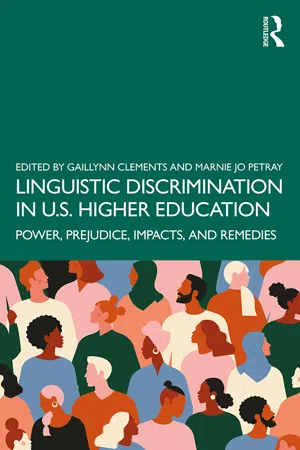
This volume examines different forms of language and dialect discrimination on U.S. college campuses, where relevant protections in K-12 schools and the workplace are absent. Real-world case studies at intersections with class, race, gender, and ability explore pedagogical and social manifestations and long-term impacts of this prejudice between and among students, faculty, and administrators. With chapters by experts including Walt Wolfram and Christina Higgins, this book will be useful for students in courses in language & power and language variety, among others; researchers in sociolinguistics, education, identity studies, and justice & equity studies; and diversity officers looking to understand and combat this bias.
eBook - ePub
Linguistic Discrimination in US Higher Education
Power, Prejudice, Impacts, and Remedies
- 208 pages
- English
- ePUB (mobile friendly)
- Available on iOS & Android
eBook - ePub
Linguistic Discrimination in US Higher Education
Power, Prejudice, Impacts, and Remedies
About this book
Information
1
An Unexpected Irony
Lifting the “Diversity” Wool from our Eyes
Being unique is about as close to an American’s heart as a set of lungs is. “Americans are extremely independent, individualistic, and like to be different from each other” (University of Michigan 2019; Gao 2015). We like thinking we are different from any other and believe in some intrinsic value that uniqueness makes us special, so we, like Thoreau, march to the beat of our own drum. The more modern phrases capture Thoreau’s unique drumbeat: I’ll “do my thing,” “no one does me like I do me,” and “you do you.” These modern mantras have a borderline, which lies fairly close to the physical body’s heart, the mouth. The place from which Rhett Butler uttered that famous line, “Frankly, my dear, I don’t give a damn!,” from which we say “I love you” or “I can’t stand you,” from which “groovy,” “as if,” or “lit” shows someone’s age, from which “ya’ll,” “youse,” “you guys” or “yourn” shows from where you hail, and from which we show much more.
Uniqueness in language would seem to be very American, so English is mine to do with what I like, and it’s yours to do with what you like. Or is it? Frederic Cassidy said it best in American Tongues, “I don’t want to sound like someone from some other part of the country. I don’t know what’s wrong with my own speech. We don’t have to all talk alike.” In reality, English is mine to do with what I like, and yours to do with what you like in certain locations, at certain times, and with certain people. In other contexts and with particular interlocutors and listeners, we are free to do what we like with English, but there are consequences.
This text introduces major points of language stigmatization and subordination and filters it through the traditional power structure and ideologies of university campus culture. This introduction interweaves the topics of the coming chapters.
Linguistic Freedom?
I sound Southern, sometimes. I sound like a woman, sometimes, probably most of the time. I sound middle-class, educated, and White, sometimes. I sound 44 years old, sometimes (“much of the time” my students might argue). The way I speak, the way we all speak is impacted by extra-linguistic factors; many we have little control over at birth (region or country of birth, socioeconomic status of parents, and race/ethnicity). These impact our speech, and often stereotypes connected with these factors are socially encoded or perceived by listeners in our speech. This encoding occurs through linguistic labels.
Linguistic labels function as verbal tags for social stereotypes, basically they are linguistic shortcuts in processing (Mullen 2001; Beukeboom & Burgers 2019). They first convey meaning and then become associated with a set of stereotypic characteristics. For example, if a group is referred to with a label, such as immigrant, often enough, then the group gains entitativity, a single entity lacking any individual within the group. Hearing or reading a given linguistic category label can, in turn, prime the stereotype content that has become associated with this label (Dijksterhuis & Van Knippenberg, 1996). This in turn facilitates stereotype formation (Beukeboom & Burgers 2019: 12–13). Differing labels attached to the same category may thus be associated to a different cognitive representation (i.e., stereotype content) and may convey different affective evaluations (Mullen, 2001; Mullen & Johnson, 1993). For example, when speaking English, French accents are often viewed positively by most Americans, while Asian accents or a dialect like African-American English is viewed negatively. These accents and dialects are sifted through our language ideology1 filters (Lippi-Green 2012: 73).
At times, we are taught to speak a particular way in certain situations; other times, we see and hear how people react, either positively or negatively, to some language or dialect. These “lessons” teach us that our way of speaking encodes certain extra-linguistic ideas or stereotypes about ourselves and the people who speak like we do. Because of these stereotypes, we might decide to change our speech to accommodate to others and to mitigate any negative stereotypes as we age. In addition, other factors we have control over as we become older affect our way of speaking, such as selecting friends or a partner(s), attending college/university, choice of career, and so on. Other decisions also lead to environments in which speakers are not so free to do what they like in regards to English and to be completely accepted: Moving to a new place and starting a new job. We change our speech in an effort to accommodate to and be accepted by the new group(s).
Speakers adopt some new features quickly, such as lexical items. My Northern U.S., Western U.S., and non-native English speaking students are always surprised how quickly they start using “y’all.” One student at university said, “I was only here for a month, and when I was talking to my mom in Korean, I switched and used y’all. My mom asked me what that was.” Almost every non-Southern U.S. student in my Fall 2019 classes at two universities reported using “y’all” very quickly after arriving in North Carolina. This happens semester after semester. Speakers also adopt phonological, morphological, and grammatical features, but these are not as quickly adopted as lexical items. Accommodating speech or adopting verbal behavior to fit in is nothing new (Giles & Powesland 1975). This happens everywhere, all the time, so is it a bad thing? Not usually. Speakers are free to switch from formal to casual, from one dialect to another, and even from one language to another. If you know it and are happy to do it, then there is no issue. A problem can develop if you don’t want to sound like others, so you don’t switch. If you are treated differently or not given certain opportunities solely because you don’t sound a certain way, then, it definitely is a problem.
Whether students and faculty/staff are from a small, rural, Southern town, a large Northern or Midwestern city, or another country; whether students are of different races, creeds, and social classes; whether students have differing genders and sexualities; all access and are judged by standard language ideology.2 Standard language is introduced by the schools (and some families or communities before school entry). It is promoted by media, news outlets and many entertainment forms. As young people continue through high school, the agreed upon Standard or Academic English becomes more important; this continues and is ever more heightened in university communities. This is another environment in which speakers are not so free to do what they like in regards to English.
As a matter of fact, choosing not, or not being able, to speak a standard variety of English (dialect or accent) in a U.S. university classroom, office, faculty meeting, professional conference, and more can impair student and professor opportunities. Some universities, such as Gallaudet University, do not prescribe to only one mode of communication. Gallaudet is “the world’s only university designed to be barrier-free for deaf and hard of hearing students” (Gallaudet University 2020). At other colleges, some courses within the larger university structure, such as foreign or world languages classes and programs, have begun to shift, a bit. For example, some U.S. colleges are moving from Standard European Spanish to Standard Mexican Spanish in classes. While this trades one standard for another, it does show flexibility in the preferred variety due to location and local communicative usefulness. This trend does not seem to be the case with French though, which does not seem to be shifting to a preference for Canadian or Louisianan French in textbooks or classes in U.S. classrooms. This could be due to continued preference in the French world language community that Parisian or Metropolitan French is “proper French.” This is undoubtedly influenced by the L’Académie Française. In many world language classes, teachers almost expect native languages to influence some phonological or syntactic features on the students in their classes. They work on oral and written skills in various ways, but speaking French with a New York City accent in New York City is okay or speaking Spanish with a Southern accent in Alabama is okay. As one moves to university, continued oral practice in the language classroom and approximating a native-like accent in a world language class is an achievement, no different than acquiring and deftly using Standard or Academic English is expected. Yet again, English is mine to do with what I like as long as I desire to be or speak just like every other academic.
The fact that much language discrimination occurs in the very liberal, progressive environment, where -isms are quelched (this should be “squelched” but my family and community says quelch) and in which everything seems idealistic, is subversive and often undermines the diversity statements and missions of the exact universities where this discrimination takes place. Many who identify as democratic, even-handed, and “free of prejudice hold on tenaciously to a standard language ideology which attempts to justify restriction of individuality and rejection of the other (Lippi-Green 2012: 73). The initial act of labeling one variety as standard, correct, or preferred automatically labels “the other” or “others” as “non-standard”, not worthy, inappropriate, not proper, and not useful.
Of course, universities set a medium of instruction, Standard or Academic English as an academic lingua franca, which is necessary for idea sharing (including publishing), project development and research, classroom discussions and assignments within the United States, but also vital for communication between scholars around the world. This is the catch-22 or double-edged sword with linguistic discrimination.
Does the color of your skin, religious view, or place of birth impair your ability to perform some research function, excel in a lab, or analyze a line of poetry? No. Do those same things impair your ability to communicate the methodology of your research, the bacteria you found in the lab assignment, or what that Dickenson line really means? No. Or possibly, at first, because the listener or reader developed those stereotypes about that entitativity group, because we do not always want to understand each other, because we want content in the way we expect it. There it is, the truth of linguistic discrimination. None of those things impair a person’s ability to communicate in English, but it may not be packaged the way the listener or reader wants it packaged.
From my dissertation’s abstract:
Through comparing this variety to varieties researched in previous Southern studies, it is concluded that the specific settlers and population demographics of Whites and Blacks in the area greatly influence male speech in the community, while more recent changes in household position and marital status affect female speech. The analysis indicates that zero be and plural was/is are the most stable variants network-wide, and a new variant has been adopted, uninflected be.
I could have written:
I compared one community to other researched communities and concluded that the people who settled this area and the modern population changed White male speech in this community. Female speech in this community has changed because more women are divorcing and working outside of the community. My study shows two features of the community’s speech are stable: zero be and plural was/is. Speakers have started using a new feature: uninflected be.
This version, while still in Standard English, uses less academic lingo, such as “study” instead of “analysis,” “population” instead of “demographics,” “community” instead of “network-wide,” and so on. While the syntax in this version still utilize...
Table of contents
- Cover
- Half Title
- Title Page
- Copyright Page
- Dedication
- Table of Contents
- List of illustrations
- List of contributors
- Preface
- Acknowledgements
- 1. An Unexpected Irony Lifting the “Diversity” Wool from our Eyes
- 2. Linguistic Bias against ESL Writing?
- 3. “If We Don’t Teach Them, Who Will?”: Standard Language Ideology in the University English Classroom
- 4. Conflicting Ideologies: Language Diversity in the Composition Classroom
- 5. International Teaching Assistants: Increasing Communicative Awareness and Understanding
- 6. Signs of Oppression in the Academy: The Case of Signed Languages
- 7. “Men Could Get Up in Front of a Classroom and Say Any Old Thing …”: Faculty Perceptions of Language and Gender in Higher Education
- 8. Country, Color, and Class: Talking Right, Talking White in the Academy
- 9. Linguistic Inequality and Sociolinguistic Justice in Campus Life: The Need for Programmatic Intervention
- 10. Promoting Pidgin at the University of Hawai‘i at Mānoa
- 11. Languaging Matters
- Index
Trusted by 375,005 students
Access to over 1.5 million titles for a fair monthly price.
Study more efficiently using our study tools.
Frequently asked questions
Yes, you can cancel anytime from the Subscription tab in your account settings on the Perlego website. Your subscription will stay active until the end of your current billing period. Learn how to cancel your subscription
No, books cannot be downloaded as external files, such as PDFs, for use outside of Perlego. However, you can download books within the Perlego app for offline reading on mobile or tablet. Learn how to download books offline
Perlego offers two plans: Essential and Complete
- Essential is ideal for learners and professionals who enjoy exploring a wide range of subjects. Access the Essential Library with 800,000+ trusted titles and best-sellers across business, personal growth, and the humanities. Includes unlimited reading time and Standard Read Aloud voice.
- Complete: Perfect for advanced learners and researchers needing full, unrestricted access. Unlock 1.5M+ books across hundreds of subjects, including academic and specialized titles. The Complete Plan also includes advanced features like Premium Read Aloud and Research Assistant.
We are an online textbook subscription service, where you can get access to an entire online library for less than the price of a single book per month. With over 1.5 million books across 990+ topics, we’ve got you covered! Learn about our mission
Look out for the read-aloud symbol on your next book to see if you can listen to it. The read-aloud tool reads text aloud for you, highlighting the text as it is being read. You can pause it, speed it up and slow it down. Learn more about Read Aloud
Yes! You can use the Perlego app on both iOS and Android devices to read anytime, anywhere — even offline. Perfect for commutes or when you’re on the go.
Please note we cannot support devices running on iOS 13 and Android 7 or earlier. Learn more about using the app
Please note we cannot support devices running on iOS 13 and Android 7 or earlier. Learn more about using the app
Yes, you can access Linguistic Discrimination in US Higher Education by Gaillynn Clements, Marnie Jo Petray, Gaillynn Clements,Marnie Jo Petray in PDF and/or ePUB format, as well as other popular books in Education & Education General. We have over 1.5 million books available in our catalogue for you to explore.