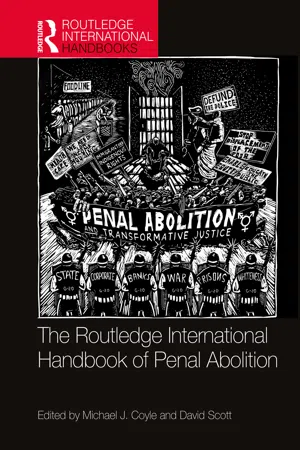
The Routledge International Handbook of Penal Abolition
eBook - ePub

The Routledge International Handbook of Penal Abolition

  1. 476 pages
  2. English
  3. ePUB (mobile friendly)
  4. Available on iOS & Android
eBook - ePub

The Routledge International Handbook of Penal Abolition

About this book

The Routledge International Handbook of Penal Abolition provides an authoritative and comprehensive look at the latest developments in the 21st-century penal abolitionism movement, both reflecting on key critical thought and setting the agenda for local and global abolitionist ideas and interventions over the coming decade.

Penal abolitionists question the legitimacy of criminal law, policing, courts, prisons and more broadly the idea of punishment, to argue that rather than effectively handling or solving social problems, interpersonal disputes, conflicts and harms, they actually increase individual and societal problems. The Routledge International Handbook of Penal Abolition is organized around six key themes:

  • Social movements and abolition organizing
  • Critical resistance to the penal state
  • Voices from imprisoned and marginalized communities
  • Diversity of abolitionist thought
  • International perspectives on abolitionism
  • Building new justice practices as a response to social and individual wrongdoing.

A global-centred and world-encompassing project, this book provides the reader with an alternative and critical perspective from which to reflect and raises the visibility of abolitionist ideas and strategies in a time when there is considerable discussion of how we will move forward in response to what has given rise to the criminalizing system: white supremacy, racial capitalism and human wrongdoing. It is essential reading for all those engaged with punishment and penology, criminology, sociology, corrections and critical prisons studies. It will appeal to any reader who seeks an innovative response to the calamitous failures of the modern criminalizing system.

Trusted by 375,005 students

Access to over 1.5 million titles for a fair monthly price.

Study more efficiently using our study tools.

Information

Publisher
Routledge
Year
2021
eBook ISBN
9780429756788

Part 1
Abolition now

Social movements in abolitionism

1
Escaping the carceral state

Felix Rosado
My first image of prison came from a 1970s Clint Eastwood flick, Escape from Alcatraz. I got around to seeing it in the1980s at some point in my elementary years. I still remember sitting on the worn red carpet of my living room floor in our Elm Street first floor apartment, step-pop racing back and forth past the TV every half hour to relieve his bladder of the Budweiser. Outside the window, the typical sounds filled the night: sirens, yelling, car woofers, the latest dope brands, all just background noise. On my side of the window, I sat captivated, eyes stuck to our hand-me-down Zenith tube, hanger contorting out the back pulling in a handful of channels.
Escape, a color flick, might as well have been black and white, the scenery drab, gray, lifeless, the pace painfully slow and methodical, silence interrupted by keys clanging, a guard’s heels pacing the tier, carefully worded dialogue. But something about it all fascinated my young mind. The intense interactions, the thought placed into each word, action, movement.
Then there was the pivotal scene, Clint revealing his plot at the table over trays of slop. He laid it out step by step, eyes darting about the chow hall. One guy would have to gather hair from the barber shop to put on the dummy heads, another the materials from makeshift life preservers.
“Who’s in?” The Eastwood stare.
“What are the odds?” One of the guys.
“Slim,” like only Clint could say it.
One by one, they went around the table: “I’m in, I’m in, me too.”
See, they weren’t so much asking about the chances of making it out of the building but whether they’d emerge from the dangerous San Fran Bay and onto land somewhere alive. Slim, according to these men, was better than life on that rock. A fate worse than death.
A decade or so later, I’d find myself inside a rock, Graterford State Prison’s 30-foot-high concrete wall.
At age 18, I was sentenced to death by incarceration, more commonly referred to as life without parole. In the mid-90s, Graterford wasn’t as quiet or drab as I expected, large windows, skylights, sunshine pouring in from every angle, green trim everywhere, guys in street clothes, mostly athletic gear, lots of reds, blues, yellows. Masked pain. I masked mine too, trying to stay afloat at first, believing if I kept out of trouble the cage door would one day open. It’s impossible to fathom, until you step foot in a Pennsylvania prison, that life means death.
It wasn’t long before despair stomped out hope and I returned to the marijuana habit I’d picked up in junior high and that multiplied until my arrest. It got me sent to prisons within the prison several times. Mostly it was my attempt to escape from Graterford, to avoid the thought of possibly never seeing the other side of that menacing, nine-sided rock.
After about a decade of attempted escapes, I had what I call my awakening. Laying on a thin sponge mattress atop a concrete slab midway through a 90-day stint in the hole, I started asking myself some previously elusive questions. I began to wonder about things like legacy and the meaning of life, the stuff of midlife crises – at 27. One afternoon, while most of the wing was sound asleep, I asked myself – for the first time – how I’d gotten there. How’d I gotten from straight A’s to sitting in the furthest place from freedom a human can be, from deemed gifted and college prep to deemed irredeemable?
I emerged from that three-month burial determined to make it my last and to make something of myself – despite prison. I stopped getting high, even quit cigarettes and coffee. I jumped into my law work with a new enthusiasm and in a couple of years found my way back into court. I busted out of my comfort zone and caught the tail end of a program speaking with boys from a nearby juvenile hall that the Department of Corrections (DOC) abruptly shut down not long after my entry. Sharing my story and getting the response I got from those few groups of boys launched me into a life of service and purpose that I’d never look back from. I enrolled in a college program run independent of the DOC and earned a bachelor’s degree over the course of 17 semesters, stretching almost nine years. I also cofounded a restorative justice project and began coordinating alternatives to violence workshops. Despite prison.
My journey has been exceptional, unfortunately proving the rule that prisons are not only an effect of crime but a cause. Graterford, the offspring of Eastern State Penitentiary, only 30 miles from Philadelphia, enjoyed a long history of progressive administrations and that valued education and peer-created and -led programming. Any given year, hundreds of volunteers and visitors were granted entry into the Ford to provide a myriad of services. The opportunities there were unlike anything in the other couple dozen Pennsylvania prisons know as “The Mountains,” where racist staff would rather see us in striped suits chained to steal balls and fed bread and water through the slit beneath our cage doors.
My education, both scholastic and experiential, radicalized me. I began to see my individual freedom fight as inextricably tied with a larger struggle for collective liberation. One class in particular got me thinking for the first time about the purpose of prisons. What are prisons for?
There was a time I blamed everyone and thing for my incarceration: The cops, the DA, the two who told, the White Man, my absentee dad, everyone but me. At some point I 180ed to placing the blame squarely on my back and shoulders. Eventually I found myself somewhere in between systems and personal responsibility. But the question of whether prisons are necessary persisted.
Over time my abolitionism grew, but not without extended and critical thought, study, dialogue, and observation. I didn’t arrive at my position of prison abolition lightly or simply because I’m trapped inside one and wish I weren’t – though that’s certainly true. Rather, it’s based on the reality that nothing I’ve seen, heard, or lived in over 23 years has given me any hope that we can somehow trim around the edges, reduce this or that sentence, rename a few things here and there and “reform” an inherently dehumanizing and disempowering machinery into a healthy, life-giving bearer of fruit.
We can call them jails, penitentiaries, prisons, correctional institutions, change the titles of those who work there from wardens to superintendents, guards to correctional officers, surround them with walls or fences, re-create the architecture from spoke and wheel to long cell blocks to stacked tiers to clusters of cross-shaped units to whatever’s next. At the end of the day, we’re caging humans.
Since Walnut Street Jail opened in 1773 and Eastern in 1829, we’ve been “reforming” – a term that has returned with a vengeance in recent years. The idea of locking people in solitary so they can find God and their better selves was itself supposed to reform. After two and a half centuries, the results are clear. There hasn’t been a single year since the first men walked out of Eastern that recidivism was anything other than two-thirds, a number that continues to hang on today despite all the hoopla and funding for “reentry.”
The problem is, we’re lacking imagination. We carry access to the world in our back pockets. We talk in our phones and electronics act, questions get answered. We drop bombs on the other side of the planet without a human ever stepping foot in an aircraft. Yet we can’t – or won’t – imagine a more creative, effective way to deal with humans harming humans, the inevitable consequence of sharing a planet.
Should people who hurt others be separated? Maybe. Sometimes a period of separation might be necessary to the healing process. The person who caused the harm might need time to reflect. The harmed person might need to feel safe and can only achieve that in the absence of the one who caused the hurt. But are concrete and steel human warehouses where most leave worse than they came in the best way to accomplish this? We can do better. We must.
Imagine if people went to some humane location for a reasonable period of time where they weren’t numbered, caged, and infantilized but instead could work for a normal wage, pay taxes and their own bills, purchase and prepare their own meals. What if they could talk with their loved ones on their own phones for the same price the rest of the world pays instead of a day’s pay for each 15-minute monitored call in the middle of a noisy cell block?
Imagine if instead of being trapped in festering, bitterness, and anger at an oppressive, unjust system for years on end, people could focus on the harm they caused and to whom and be inspired to be accountable. Some equate accountability with prison, paying the proverbial debt to society. But who’s really paying, what are they paying, and who’s receiving said payment?
Imagine if people, instead of spending years and decades stashed behind walls, fences, and razor wire high in mountaintops, had to actually face those they hurt, answer real questions not drowned in abstract legalese.
Imagine it, instead of taxpayers footing 40k a year to ensure each incarcerated person remains unaccountable, people who cause harm had the opportunity to put things “more right” through concrete action, whether its working directly for those harmed or indirectly through any number of community vitalization projects. I know if someone harmed me, I’d want them to know about it and then do something about it. I wouldn’t want to pay for them to be hidden somewhere.
Agree or disagree with locking people up; unless you’re a prison profiteer, it’s hard to deny that the current process of administering justice is producing more harm than good.
And just think, the penitentiary model (whatever the name) has only been around over two centuries. People for thousands of years before the end of the 18th century had to and did come up with other ways of dealing with harm. So can we. It’ll require a radical departure from our dominant capitalist paradigms. We’d have to put people over profit and politics.
Now, 1 in 30 or so adults is smothered by the giant thumb of the criminal legal system, either from behind bars or under community service. The US can no longer claim to be the land of the free. Unless we rethink incarceration and whether it’s the only or even best way to address every social ill, we’ll be a nation of jailed and jailers.
Is a fate worse than death the best we can do in the name of justice? To escape from mass incarceration will require a plan much more elaborate than dummy heads and life jackets. Abolition might seem utopian, but only because we’ve been conditioned to view the caging of humans – certain humans, that is – as necessary, normal, and OK. We must change the narrative, our hearts, our senses. A good start would be for more of us to pull up to the table and say “I’m in.”
2
Musselman

Katherine Anne Thomas
Musselman is a term used to describe those who have died mentally, emotionally, psychically, and spiritually. Those who no longer had any hopes or dreams or cared anymore for the survival of their physical being.
Their wait was not for a continuation of life, but rather for an ending to the pain and misery of existence, the surcease of living in the longing for its end.
The term Musselman was first used by the inmates of the Nazi concentration camps to describe inmates who had lost their will to survive. These are the words of one such Musselman: “It wasn’t so, until it became easier for me to be as they thought or wanted me to be, than to be the self I knew myself to be.”
The concept of self-awareness dying somewhere and somewhen, in the endless days of sadness and emptiness, amid the wastelands of misery and pain! When did the joy of life flee and death become a lover, to be embraced, and not a specter to flee in terror from?
How did I arrive at a point where the only joy is not in living or dying, but in the release from the inhumanity of my fellow men, who see nothing of my humanity, while condemning me for what they are themselves?
Those whom believe that I should be grateful to wear the fetters of slavery, thinking it a boon, as opposed to the taking of my life. The difference being, that rather than dying of a piece, instead dying a piece at a time, in a death deferred for the imposition of a lifetime of humiliation, degradation, and inhumane abuse. Trading a quality to life, in exchange for a quantity of days. To eke out life not as a person, but as a chattel, for the whims and caprice of the inadequate.
Flung into the pit of institutions, dependent upon the kindness of my fellow sojourners, within society’s Hades, for the simplest of needs, in a time and place where the milk of human kindness has curdled beneath the need to endure and to survive their own passage through the many levels of the inferno whose only reward is survival? Where the striving of the many is not for life, but for emptiness. The passage of time meaningless, for it carries you from nowhere to no when.
The system is manipulating us for their own convenience, while convincing the rest of society that, “A sow’s ear, is a silk purse.” And that the fetters that bind me are not those of slavery. While meeting the needs of the society for scapegoats, upon which to foist off all the ills of society. In saying that any life is better than no life at all. The quantum of exchange being quality of life vs. a quantity of days.
The system knows that it has no intention of ever releasing its hold on those they have ensnared; they proffer the fool’s illusion that perhaps one day I could be free of them and have a life of my own. If I but cooperate with my own enslavement. This to motivate me to stand upon the treadmill of servitude, to chase the illusion of freedom, while serving the interests of the system.
With the passage of time, the realization that this is all there ever was to be caused the illusion to fade, my secret hopes and dreams of freedom, cherished within the heart, began to die strangling life until each day to become another in a slow progression of gray, as the brilliant and vibrant colors of living leached out and life of the camps began to weave tapestries of bleak and desolate landscapes, until the inner matched the outer and then “I” was no more.
The illusions faded into nothingness. Hope and dreams died. The vessel of self is empty, never to be filled again. I desire nothing! No hopes or dreams to carry me to neverwhere and never when. For I have arrived at the station of desolation and emptiness and intend not...

Table of contents

  1. Cover
  2. Half Title
  3. Title Page
  4. Copyright Page
  5. Dedication Page
  6. Contents
  7. List of contributors
  8. Foreword
  9. Preface
  10. Introduction: the six hues of penal abolitionism
  11. Part 1 Abolition now: social movements in abolitionism
  12. Part 2 Resisting penal subjugation
  13. Part 3 Abolitionism is for the oppressed
  14. Part 4 Abolitionism: decolonizing, decriminalizing and decarcerating
  15. Part 5 Abolitionist reimaginings
  16. Part 6 Activist toolbox: abolitionist campaign tools, manifestos and statements
  17. Index

Frequently asked questions

Yes, you can cancel anytime from the Subscription tab in your account settings on the Perlego website. Your subscription will stay active until the end of your current billing period. Learn how to cancel your subscription
No, books cannot be downloaded as external files, such as PDFs, for use outside of Perlego. However, you can download books within the Perlego app for offline reading on mobile or tablet. Learn how to download books offline
Perlego offers two plans: Essential and Complete
  • Essential is ideal for learners and professionals who enjoy exploring a wide range of subjects. Access the Essential Library with 800,000+ trusted titles and best-sellers across business, personal growth, and the humanities. Includes unlimited reading time and Standard Read Aloud voice.
  • Complete: Perfect for advanced learners and researchers needing full, unrestricted access. Unlock 1.5M+ books across hundreds of subjects, including academic and specialized titles. The Complete Plan also includes advanced features like Premium Read Aloud and Research Assistant.
Both plans are available with monthly, semester, or annual billing cycles.
We are an online textbook subscription service, where you can get access to an entire online library for less than the price of a single book per month. With over 1.5 million books across 990+ topics, we’ve got you covered! Learn about our mission
Look out for the read-aloud symbol on your next book to see if you can listen to it. The read-aloud tool reads text aloud for you, highlighting the text as it is being read. You can pause it, speed it up and slow it down. Learn more about Read Aloud
Yes! You can use the Perlego app on both iOS and Android devices to read anytime, anywhere — even offline. Perfect for commutes or when you’re on the go.
Please note we cannot support devices running on iOS 13 and Android 7 or earlier. Learn more about using the app
Yes, you can access The Routledge International Handbook of Penal Abolition by Michael J. Coyle, David Scott, Michael J. Coyle,David Scott in PDF and/or ePUB format, as well as other popular books in Social Sciences & Social Policy. We have over 1.5 million books available in our catalogue for you to explore.