eBook - ePub
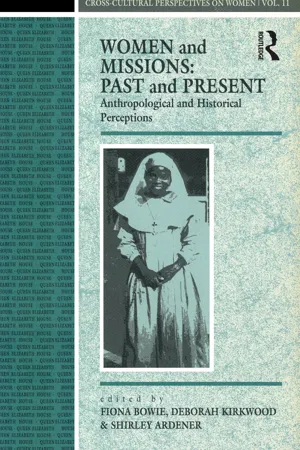
Women and Missions: Past and Present
Anthropological and Historical Perceptions
- 304 pages
- English
- ePUB (mobile friendly)
- Available on iOS & Android
eBook - ePub
Women and Missions: Past and Present
Anthropological and Historical Perceptions
About this book
This collection of essays by eminent anthropologists, missiologists and historians explores the hitherto neglected topic of women missionaries and the effect of Christian missionary activity upon women. The book consists of two parts. The first part looks at 19th century women missionaries as presented in literature, at the backgrounds and experience of women in the mission field and at the attitudes of missionary societies towards their female workers. Although they are traditionally presented as wives and support workers, it becomes apparent that, on the contrary, women missionaries often played a culturally important role. The second and longest section asks whether women missionaries are indeed a special case, and provides some fascinating studies of the impact of Christian missions on women in both historical material and a wealth of contemporary material.Of particular value is the perspective of those who were themselves objects of missionary activity and who reflected upon this experience. Women actively absorbed and adapted the teachings of the Christian missionaries, and Western models are seen to be utilized and developed in sometimes unexpected ways.
Information
1 Introduction: Reclaiming Women's Presence
Fiona Bowie
Making Women Visible
To be pleasing in his sight, to win his respect and love, to train him in childhood, to tend him in manhood, to counsel and console, to make his life pleasant and happy, these are the duties of woman for all time. (Rousseau)1
1. Quoted in M. Eichler, ‘The origin of sex inequality’, Women’s Studies International Quarterly (Vol. 2, No. 3,1979-343), in Borrowdale, 1989.
In being seen as adjuncts to men, rather than as historical protagonists in their own right, women have been systematically written out of historical and anthropological records.2 Valentine Cunningham, referring to the early work of the London Missionary Society (LMS), notes that: ‘missionary work... was clearly perceived as a task performed by men that women merely supplemented. Missionary was a male noun; it denoted a male actor, male action, male spheres of service’ (p. 89). Reports from the field to head office commonly began ‘Dear Fathers and Brethren’, and womanly details were edited out of letters when prepared for publication (ibid.). In many cases we know little of the roles played by women in the mission field. Deborah Kirkwood tells us that although Bishop A. W. Lee dedicated his book Once Dark Country to his wife ‘Without whom the life portrayed in these pages could not have been lived, nor the pages themselves written’, he says virtually nothing about Mrs Lee or what she did (p. 28). Even the gravestone of the Rev. Neville Jones, commemorating his missionary work, is twice the size of that of his wife who shared his labours (ibid.). James Hudson Taylor (1832-1905), founder of the interdenominational China Inland Mission, was virtually a lone voice when he wrote to mission candidates: ‘Unless you intend your wife to be a true missionary, not merely a wife, homemaker and friend, do not join us’ (Williams, p. 64 below).
2. From the anthropological perspective, see Ardener, 1977a, b.
The invisibility of women in history, scripture, anthropology and other literary sources and academic disciplines has become a commonplace, and recent publications, especially from the 1970s onwards, have attempted to rectify this situation.3 Women and Missions: Past and Present is one such contribution to this important task of reclaiming women’s history and highlighting women’s experience. It brings together a variety of disciplines (social anthropology, history, religious studies, literature) and of perspectives, with papers looking at both women missionaries and the impact of missionary activity on women. The timescale stretches from the beginning of the modem missionary movement in the late eighteenth and early nineteenth centuries to the present, and contributors come from both mission-sending and mission-receiving countries.
3. In anthropology see, for example, the numerous publications of the Centre of Cross-Cultural Research on Women (Queen Elizabeth House, Oxford). In the biblical sphere Elizabeth Schiissler Fiorenza’s In Memory of Her (1983) has been a seminal work. The recent interest in women’s history is testified to by titles such as Discovering Women’s History (Beddoe, 1987), The Women’s History of the World (Miles, 1990) or the two volume A History of their Own (Anderson and Zinsser, 1990).
No attempt has been made in this volume to cover all geographical areas, denominations or periods of time. It should also be made clear that our focus is exclusively on Christian missions. The papers reflect the authors’ own expertise, with nineteenth-century Protestant missions and sub-Saharan Africa receiving particularly detailed attention. The dual approach to women as missionaries and the effects of missionary activity upon women, with contributors from both the traditional mission-sending, as well as mission-receiving countries, enables us to draw parallels between Western attitudes to women as missionaries and the attitude of missionaries towards women in the cultures in which they worked. This connection between women’s roles at home and abroad is illustrated in Valentine Cunningham’s analysis of Charlotte Bronte’s novel Jane Eyre: ‘[She] does not have literally to go out east to aid the cause of women’s emancipation. That particular eastern missionary work is, metaphorically speaking, required to be done also at home’ (p. 100). Questions of power and authority, the contextualisation of the gospel message and of the different nuances in women’s experience according to particular circumstances, are also raised in various ways by all the papers in this volume.
A Liberating Gospel or a Colonial Conspiracy?
When I returned to Britain from conducting fieldwork on missionaries in Cameroon, a frequent question put to me was, ‘Well, what’s the answer? Is the effect of the missions good or bad?’ The question didn’t make sense; it was the wrong question. A few sentences could in no way express the experience of being a missionary, their motivation and dedication, the multifaceted effects of missionary activity, or Cameroonian perceptions of their Western visitors. I usually replied by quoting what many Bangwa had said to me on numerous occasions when asked about the effect on their lives of the presence of a mission station.4 Their rather puzzled answer was invariably, ‘We have suffered.’ If I asked for elaboration my respondents would add, ‘Before the mission came our children died’; ‘When we were sick we had to walk for three days to the nearest hospital’; ‘Our people were dying of malaria’; ‘Our people were left behind because we had no secondary school’; and so on. The benefits of mission education and medicine, the development of craft industries, and also the less material aspects of the missionaries influence - their honesty and their care and concern for individuals were obvious to and appreciated by almost all the people I spoke to. As far as the Bangwa were concerned, any considerations of cultural disruption, clashes with mission power and authority and arguments over ownership of land were outweighed by the improved standards of living and the political recognition which having a permanent mission entailed. On the other hand, Western missions in Africa and elsewhere have been evaluated negatively by recipients of their activity. Ngugi wa Thiong’o, in his essay Church, Culture and Politics (1972),5 for instance, put the case that:
4. The Bangwa, of South West Province in Cameroon, have had a permanent mission station, run by the Focolare Movement, since 1965.1 conducted fieldwork in this area in 1980-1.
5. Quoted in Dinwiddy, 1978-39.
The European missionary had attacked the primitive rites of our people, had condemned our beautiful African dances, the images of our gods, recoiling from their suggestion of satanic sensuality. The early African convert did the same, often with even greater zeal, for he had to prove how Christian he was through his rejection of his past roots.
So that in Kenya, while the European settler robbed people of their land and the products of their sweat, the missionary robbed people of their soul. Thus was the African, body and soul, bartered for thirty pieces of silver and the promise of a European heaven.
Both perspectives, that of the Bangwa and of Ngugi, are in some sense ‘true’. The reactions of different ethnic groups and geographical entities, of various sections of a population (chiefs or commoners, converts or traditionalists, young or old), of women and of men, of missionaries and of their hosts, will often vary. Missionary societies also employ contrasting strategies. The fundamentalist evangelical churches (including, it is sometimes claimed, the Summer Institute of Linguistics - the main translators of the Bible into vernacular languages),6 which are particularly active at present in South America, adopt a largely negative view of native societies, with considerable emphasis on the spiritual and material values of (Western) Christianity and need for conversion. In this respect they resemble their nineteenthcentury predecessors rather more than they do other contemporary missionaries from mainstream Churches. Also in South America, Maryknoll Missionaries from the United States, for example, adopt a more liberal strategy which stresses the need to work with the people, enabling them to reach their own goals, which may not include embracing the Christian faith - an approach influenced by liberation theology.7
6. See Jonathan Benthall’s interview with William R. Merrifield in Rain, December 1982, No. 53, pp. 1-5, and subsequent correspondence from Brian Moser (Rain, February 1983, No. 54, pp. 10-11) and Theodore Macdonald, Jr and Robert Armstrong (Rain, April 1983, No. 55, pp. 12-13). SIL are also known as the Wycliffe Bible Translators. They are interdenominational but primarily recruit from Protestant Evangelical circles.
7. Cf. Salamone’s description (1987) of Dominican Sisters in Nigeria and S. Ardener’s account (1968) of early Baptist missionaries in Cameroon for a similar contrast in mission approaches.
The same denominations or missionary societies generally change their tactics over time as self-understanding develops and outside influences, such as the Second Vatican Council or the women’s movement, make themselves felt.8 As Schreiter (1985: 150) has made clear, there is a dialectical relationship between the preaching of the gospel and culture. The Church is challenged by, and has to come to terms with, its host culture, which in turn is affected by and must react to and accommodate the changes wrought by Christian preaching. An example of this is the way in which the Aladura healing churches in Nigeria have combined elements of traditional and mission teaching.9 On the other side of the equation, Stanley (1990: 174) makes the point that:
8. Some of these changes, as well as the continuities, are documented in Michael Nazir-Ali (1990) and in Bowie (1985).
9. Wessels (1990: 114-15) refers to an essay by J. M. Schoffleers in which Christ as nganga (healer) is seen ‘as the paradigm par excellence for an African Christology’. For Wessels, ‘The excitement implicit in the idea of using the nganga as model for the image of Christ lies precisely in the fact that the nganga or medicine man was viewed by Protestant and Catholic missionaries alike as the adversary of Christ’.
Missionary experience has now compelled Western Christians to re-examine their rationalistic presuppositions, and to recognise that non-Western attitudes to such phenomena as spirit possession may be much closer to biblical conceptions than previous missionary generations have been prepared to admit.
One of the strengths of the papers in this volume is their avoidance of over-simplistic generalisation through their attention to detail and to the nuances of particular missionary periods and cultural situations. To return to the question, ‘Is the gospel liberating and, in particular, is it liberating both for women missionaries and for women influenced by missionary teaching, or is it oppressive (colonialist/imperialist)?’ one must answer that it can be both. It all depends on your standpoint and on whether one wishes to view missionaries within their own cultural context or through the lens of the 1990s. The wealth of data presented in these papers will enable readers to form their own opinion. I will mention here some examples which illustrate the ambiguity of the mission experience in relation to women.
Women as Missionaries
Opportunities for worthwhile careers were limited for middle-class women in Victorian Britain (and America). Marriage and motherhood or genteel but poverty-stricken and indolent spinsterhood were the options open to many women. Swaisland quotes an article in Frazer’s Magazine from 1860 in which this dilemma is spelled out (p. 71 below):
...cramped and depressed in their narrow circle of duties to which they are confined. They are conscious of power and may not exert it; of ambition and must stifle it. The disenchantment of life has fallen upon them, they cannot take refuge in active occupation to forget it.
Protestant missionary societies argued about the desirability of sending out women to ‘heathen lands’, whether as single women or as wives of male missionaries. In either case, it was middle-class women of suitable character, in good physical health and ideally with some training, who were recruited. Speaking of the mid-1800s, Swaisland notes that nine out of ten women who applied to emigration societies, though not necessarily as missionaries, were rejected. For missionary work criteria were certainly strict. A member of the SPG Committee for Women’s Work stated: ‘Far too large a proportion of people who are seriously pathological, or at least queer are offering’ (Kirkwood: 34). For those who were accepted there were opportunities for independent action and challenges which would stretch the woman missionary’s abilities. Learning new languages, Bible translation, setting up schools a...
Table of contents
- Cover
- Half Title
- Title Page
- Copyright Page
- Contents
- Acknowledgments
- Abbreviations
- List of photographic plates
- Preface
- 1. Introduction: Reclaiming Women’s Presence
- PART I: WOMEN MISSIONARIES
- PART II: MISSION IMPACT ON WOMEN
- Index
Trusted by 375,005 students
Access to over 1.5 million titles for a fair monthly price.
Study more efficiently using our study tools.
Frequently asked questions
Yes, you can cancel anytime from the Subscription tab in your account settings on the Perlego website. Your subscription will stay active until the end of your current billing period. Learn how to cancel your subscription
No, books cannot be downloaded as external files, such as PDFs, for use outside of Perlego. However, you can download books within the Perlego app for offline reading on mobile or tablet. Learn how to download books offline
Perlego offers two plans: Essential and Complete
- Essential is ideal for learners and professionals who enjoy exploring a wide range of subjects. Access the Essential Library with 800,000+ trusted titles and best-sellers across business, personal growth, and the humanities. Includes unlimited reading time and Standard Read Aloud voice.
- Complete: Perfect for advanced learners and researchers needing full, unrestricted access. Unlock 1.5M+ books across hundreds of subjects, including academic and specialized titles. The Complete Plan also includes advanced features like Premium Read Aloud and Research Assistant.
We are an online textbook subscription service, where you can get access to an entire online library for less than the price of a single book per month. With over 1.5 million books across 990+ topics, we’ve got you covered! Learn about our mission
Look out for the read-aloud symbol on your next book to see if you can listen to it. The read-aloud tool reads text aloud for you, highlighting the text as it is being read. You can pause it, speed it up and slow it down. Learn more about Read Aloud
Yes! You can use the Perlego app on both iOS and Android devices to read anytime, anywhere — even offline. Perfect for commutes or when you’re on the go.
Please note we cannot support devices running on iOS 13 and Android 7 or earlier. Learn more about using the app
Please note we cannot support devices running on iOS 13 and Android 7 or earlier. Learn more about using the app
Yes, you can access Women and Missions: Past and Present by Shirley Ardener,Fiona Bowie,Deborah Kirkwood in PDF and/or ePUB format, as well as other popular books in Theology & Religion & Christian Ministry. We have over 1.5 million books available in our catalogue for you to explore.