- 260 pages
- English
- ePUB (mobile friendly)
- Available on iOS & Android
eBook - ePub
About this book
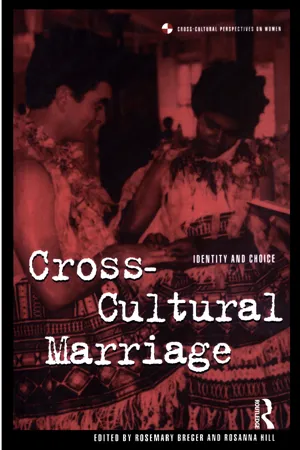
As societies world-wide become increasingly multicultural, so the issues of identity, belonging, tolerance and racism become imperative to understand in their various forms. This book adds to the discussion by examining the interface between the lived, personal experiences of people in cross-cultural marriages and wider socio-political issues. One major contribution this book offers is that the marriages discussed are from a very broad range of cultures and classes. Amongst other issues, contributors examine: the legal and social factors influencing cross-cultural marriages; the personality factors and positive or negative stereotypes of otherness that influence spouse choice; notions of identity, gender and personhood, and definitions of difference, and how these are often tied up in emotive stereotypes; how all these factors affect the ongoing process of living together and the ability to cope; and how the children of such marriages come to terms with identity choices. This book should be highly relevant to the growing number of people in cross-cultural marriages, as well as to professionals in the fields of marriage guidance, child welfare and academics interested in ethnicity and kinship.
Information
1 Introducing Mixed Marriages
Rosemary Breger and Rosanna Hill
A Parable on the Nature of Difference
A Jewish woman from Scotland had three sons. She was delighted when, in the 1960s, the third one got engaged because at last one of her sons was going to marry a Jewish girl. The wives of the other two were both Christians (one Scottish and one English) and she felt that two cross-cultural marriages in the family were more than enough. She would welcome with open arms this latest daughter-in-law from New York, whom she felt would understand and share her son’s cultural background. However, once the couple was married and living in a tiny two-room flat in England, things did not go so smoothly. First the Scottish mother-in-law came to stay and it was not long before she was asking her son, ‘What sort of woman have you married? She doesn’t even know how to serve afternoon tea and cakes!’ The daughter-in-law dutifully undertook to get to grips with the intricacies of British meals, guided by her mother-in-law. She had mastered the system when her own mother came on a visit from New York, only to be shocked and horrified to find her daughter serving her husband a cup of tea and chocolate biscuits when he came in from work. ‘A man must be fed properly at the end of the day. What sort of wife are you to serve your husband candy when he comes in from work?’ The new bride felt lost somewhere in between the two older women, but in this case she had enough confidence in herself and in her marriage to let the mothers fight it out between themselves.
Through the rituals around food and eating, this true anecdote serves to highlight some of the intriguing problems and conundrums that arise from the subject of cross-cultural marriage: for example, what makes a marriage cross-cultural, especially to the people most intimately concerned? What are the differences between expectations and reality, for the couple who marry and also for their relatives? In what ways do visions of exotic foreigners seduce or repel? How do people, women in particular, cope with the lived experience of these differences - as an enrichment, a palette offering diversity and freedom to change, or as a feeling of cultural dispossession and alienation? How do people negotiate any perceived gulf between Self and Other, or even Self constructed as Other in a foreign society?
Overview of the Contributions
The questions outlined above, among many others, are addressed in the chapters that follow. We were particularly interested in examining the interface between lived personal experiences and broader social factors in cross-cultural marriages. Earlier anthropological and sociological work on marriage, written mostly by men, has already given us men’s ideas on marriage, often rationalizing the experience through functionalist-type rules, laws and affiliation patterns, such as the work of Malinowski (1927), Evans-Pritchard (1951) and Radcliffe-Brown (eg. 1952; see also Goody 1971 for a collection of writings). Even later anthropological work, such as by Needham (1962), Levi-Strauss (1966) and Fox (1967), tended to centre on marriage rules and rationalized exchanges, while sociology tended to look at explaining changing family or household patterns (e.g. Young and Willmott 1957, 1975; Goode 1963;Bott 1971; Laslett 1972), neglecting the actual people involved. One of the breakthroughs of some feminist work on the family since the mid-1970s has been, firstly, the recognition paid to the structuring role of gender in all aspects of life (cf. Ardener 1975), and also its focus on individuals’ very different lived experiences of marriage and family life, showing how experiences differ according to gender and age, and building up from there to general models (eg. Friedan 1963; Oakley 1974; Thome 1982; see also the overview in Abbott and Wallace 1990). It therefore presents a challenge to incorporate into the study of marriage the interaction between wider social processes and the individual’s personal lived experiences, such as the idea of individual romance, the attraction to a foreign partner that surmounts custom and hostility, what Kohn in this volume calls ‘the reckless anti-strategy of love’.
Most of the chapters here tend to look primarily at women’s experiences. One reason for this is that all but one of the contributors are women, and their informants are mostly women, so that the experiences related reflect the gendered nature of informants’ worlds. There are, of course, many areas where these experiences are similar in form, but different in content, to those of the husbands involved, and our book does not entirely neglect male concerns.
The experiences related below show that there are features common to almost all cross-cultural marriages, despite the very different cultural situations described, so that many core issues weave in and out of the experiences related in all the following chapters. Briefly and simplistically, these central threads within ongoing, changing lives revolve around three main, related fields of action: firstly, what ‘out’-marriage means; secondly, who does or does not marry out, and why; and thirdly, what happens within such marriages. The following chapters examine in various ways the entwined factors influencing choice of spouse; identities and perceived differences, romanticized or otherwise; differing definitions and expectations of marriage and family; and how people in such families perceive and cope with mismatched expectations and cultural diversity. They relate the resourcefulness with which daily situations are acted on, affecting the lives and lifestyles of those involved in mixed marriages. These themes provide a rough chronology of events according to which the chapters in this volume are ordered. In this way, each chapter contributes to parallel discussions in other chapters. At the expense of oversimplification and some repetition later in the Introduction, the following paragraphs give a broad overview of the chapters in order to help the reader find her or his way around the book.
Central to all our discussions are perceptions of difference - what makes a marriage mixed not only for outsider professionals, but also for the people in it. It is therefore appropriate to start this collection with Waldren’s chapter, ‘Crossing Over: Mixing, Matching and Marriage in Mallorca’, which discusses in particular what ‘marrying out’ means to the people involved. She shows how ideas of what constitutes ‘mixed’ marriage have changed following national and regional sociopolitical changes in Spain over the last two hundred years.
The second chapter, ‘Chance, Choice and Circumstance: A Study of Women in Cross-Cultural Marriages’, is a preliminary study of what sort of person marries out, and why some people should choose an outsider as spouse. Khatib-Chahidi, Hill and Paton found that as a group, outmarrying women resembled each other more than would be expected by chance.
From looking at what ‘out’-marriage means, and who does it, it seems appropriate to examine how choices of spouse are constrained by a variety of factors, some social, some formally legalized. A central agent in this process is the formation and propagation of both positive and negative stereotypes of the foreign Other, a topic discussed at length in most chapters. In ‘The Seduction of the Exotic: Notes on Mixed Marriage in East Nepal’, Kohn discusses how seductive, romanticized stereotypes of a foreign Other predispose young women to many out of their cultural group. She criticizes the long convention in anthropology in which marriage with exotic outsiders is explained only in structural and functional terms, without considering the choices and perceptions of difference held by those involved in the act of courtship (particularly those of young women).
In ‘Crossing Racialized Boundaries: Intermarriage between “Africans” and “Indians” in Contemporary Guyana’ Shibata continues this discussion, but looking at the role of negative stereotypes this time. She illustrates how the propagation of negative discourses about each group and their accompanying stereotypes are deeply embedded in the political and economic history of the area, and are therefore highly emotionally charged, especially those concerning the out-marriage of ‘Indian’ women. She documents through her poignant case-study that although these stereotypes change over time, they nevertheless may have a tragic impact on the lives of people involved in ‘Indian’-’African’ mixed marriages.
But of course, stereotypes are not the only factor restricting choice of spouse. The state, and its laws regarding what constitutes a marriage, who can many whom, and its immigration policies also play a great, but often overlooked, role in limiting choice of spouse. Public discourses about different groups of foreigners may also find their way into how immigration officials interpret discretionary laws. Alex-Assensoh and Assensoh discuss how immigration laws and both positive and negative stereotypes affect marriages between African-Americans and Africans from Ghana, in ‘The Politics of Cross-Cultural Marriage: An Examination of a Ghanaian/African-American Case’. They document how perceptions of differences between African-Americans and Black Ghanaians tend to be reduced to racialized oversimplifications, in the assumption that Blacks from all over the world are more similar to each other than to American Whites merely on the basis of colour. In some cases, this blinds partners or extended family to the extent of cultural differences in marriages between African-Americans and Africans.
In ‘Freedom of Choice or Pandora’s Box: Legal Pluralism and the Regulation of Cross-Cultural Marriages in Uganda’ Semafumu continues the discussion of the role of the state in marriage patterns in her findings on plural marriage forms between various ethnic and religious groups. Uganda, as many other African countries, has a plurality of marriage forms, reflecting the multicultural nature of its citizens, each with its own distinct regulations regarding polygamy, inheritance and communal property. She shows how some women deliberately subvert the law and marry illegally under several of these laws to maximize the social acceptabilities of their mixed marriages as well as to guarantee their personal interests.
Breger also considers the role of the state in restricting cross-national marriages, using case-studies from Germany, in ‘Love and the State: Women, Mixed Marriages and the Law in Germany’. She shows how the state can restrict entry and residence visas and work permits of some foreign spouses, or even refuse mixed couples permission to marry in Germany. The state’s unwillingness to give foreign spouses civil or political rights is related to definitions of national identity and citizenship embedded in long-standing negative discourses towards foreigners that are also apparent in the media.
The following chapters relate how mixed families structure their daily lives. In a mixed marriage, there may be various degrees of awareness of difference, with some differences being celebrated, whilst others may become points of conflict. This awareness and evaluation of difference is not only on the part of the immediate family, but also on the part of the larger extended family, and the community in which it lives. Family bonds can be strengthened if there is something larger, beyond the awareness of difference, to unite the family. Yamani, in ‘Cross-Cultural Marriage within Islam: Ideals and Reality’, looks at the role of religion in unifying a cross-national marriage. She documents how moving to a new locality, away from extended kin influence and public intolerance of outsiders, can help maintain the marriage. Where a mixed couple lives seems to play a significant role in the flexibility they have in negotiating around their different cultural expectations, and escaping many negative effects of public and private ethnic stereotyping. But this is an option generally open only to the relatively wealthy.
But in many cases, those involved in a mixed marriage may not at first be aware of quite how divergent their beliefs and practices are, which results in mismatched expectations and a growing sense of frustration. Sissons Joshi and Krishna, in ‘English and North American Daughters-in-Law in the Hindu Joint Family’, analyse the intimate workings of life within a patrilaterally extended family. They note how differences in everyday rituals revolving around, for example, attention, conversation, the use of space and privacy, and food are strongly related to familial structures of power and hierarchy, role expectations, and culturally divergent notions of personhood. These often conflict with the expectations and experiences of the incoming daughters-in-law. Within a close extended kin group, it can be very difficult for dissenting voices to be heard, especially the voices of the traditionally powerless: the new, incoming bride.
Refsing looks at mismatched gender role expectations, addressing the issue of how gender identity is negotiated between partners from two cultures with very different perceptions of gender roles, in ‘Gender Identity and Gender Role Patterns in Cross-Cultural Marriages: The Japanese-Danish Case’. Her work shows how the wider socio-economic environment strongly influences the adaptability of gender roles. She shows that where these role expectations are completely mismatched, then there is a greater likelihood of these marriages to break down.
The final chapter, ‘Not all Issues are Black or White: Some Voices from the Offspring of Cross-Cultural Marriages’, refocuses the reader on the vexed question of identity, by looking at the diversity and choice of identities available to children of mixed marriages. Maxwell, herself a child of very mixed parentage and grand-parentage, lets the reader hear their voices as they relate their experiences. Common to them all is how their feelings of belonging and identity change not only as they grow up and move through significant life-cycle phases, but also closely reflect changing relationships at and outside home.
Mixed Marriage
Defining Marriage and Family
At the heart—both literally and figuratively—of cross-cultural marriages there is the issue of what is defined as a valid, legally and socially legitimate marriage. This of course also relates to the gendered roles, norms, and access to resources within the marriage. Even within Europe, in medieval England, the Church faced great difficulties in defining marriage (Leyser 1996:106). Given that our contributions include such a variety of cultures, a central theme is concerned with different definitions of marriage and family, and the involvement of and responsibilities towards extended kin, since in many cultures marriage is not seen as a joining together of two individuals, but as a union between two families continuously reinforced through mutual obligations.
As with any institution or, indeed, any word, finding a cross-cultural definition is always problematic, and editing this volume has reminded us of the dangers of ethnocentricity when talking about ‘marriage’. As Leach (1982) points out, in English alone the word has at least four general meanings. The first has to do with the legal aspect, dealing with rights, legitimacy of children and so forth. The second describes the actual, practical household, the routine of marriage. The third concerns the ceremonial aspect, the wedding and other ceremonies which may precede or follow it, and fourthly there is the joining of families, the affinal relationships which ...
Table of contents
- Cover
- Half Title
- Series Page
- Title Page
- Copyright Page
- Dedication Page
- Table of Contents
- Preface
- Acknowledgments
- Notes on Contributors
- 1 Introducing Mixed Marriages
- 2 Crossing Over: Mixing, Matching and Marriage in Mallorca
- 3 Chance, Choice and Circumstance: A Study of Women in Cross-Cultural Marriages
- 4 The Seduction of the Exotic: Notes on Mixed Marriage in East Nepal
- 5 Crossing Racialized Boundaries: Intermarriage between ‘Africans’ and ‘Indians’ in Contemporary Guyana
- 6 The Politics of Cross-Cultural Marriage: An Examination of a Ghanaian/African-American Case
- 7 Freedom of Choice or Pandora’s Box? Legal Pluralism and the Regulation of Cross-Cultural Marriages in Uganda
- 8 Love and the State: Women, Mixed Marriages and the Law in Germany
- 9 Cross-Cultural Marriage within Islam: Ideals and Reality
- 10 English and North American Daughters-in-Law in the Hindu Joint Family
- 11 Gender Identity and Gender Role Patterns in Cross-Cultural Marriages: The Japanese-Danish Case
- 12 Not all Issues are Black or White: Some Voices from the Offspring of Cross-Cultural Marriages
- Index
Trusted by 375,005 students
Access to over 1.5 million titles for a fair monthly price.
Study more efficiently using our study tools.
Frequently asked questions
Yes, you can cancel anytime from the Subscription tab in your account settings on the Perlego website. Your subscription will stay active until the end of your current billing period. Learn how to cancel your subscription
No, books cannot be downloaded as external files, such as PDFs, for use outside of Perlego. However, you can download books within the Perlego app for offline reading on mobile or tablet. Learn how to download books offline
Perlego offers two plans: Essential and Complete
- Essential is ideal for learners and professionals who enjoy exploring a wide range of subjects. Access the Essential Library with 800,000+ trusted titles and best-sellers across business, personal growth, and the humanities. Includes unlimited reading time and Standard Read Aloud voice.
- Complete: Perfect for advanced learners and researchers needing full, unrestricted access. Unlock 1.5M+ books across hundreds of subjects, including academic and specialized titles. The Complete Plan also includes advanced features like Premium Read Aloud and Research Assistant.
We are an online textbook subscription service, where you can get access to an entire online library for less than the price of a single book per month. With over 1.5 million books across 990+ topics, we’ve got you covered! Learn about our mission
Look out for the read-aloud symbol on your next book to see if you can listen to it. The read-aloud tool reads text aloud for you, highlighting the text as it is being read. You can pause it, speed it up and slow it down. Learn more about Read Aloud
Yes! You can use the Perlego app on both iOS and Android devices to read anytime, anywhere — even offline. Perfect for commutes or when you’re on the go.
Please note we cannot support devices running on iOS 13 and Android 7 or earlier. Learn more about using the app
Please note we cannot support devices running on iOS 13 and Android 7 or earlier. Learn more about using the app
Yes, you can access Cross-Cultural Marriage by Rosemary Breger,Rosanna Hill in PDF and/or ePUB format, as well as other popular books in Social Sciences & Anthropology. We have over 1.5 million books available in our catalogue for you to explore.