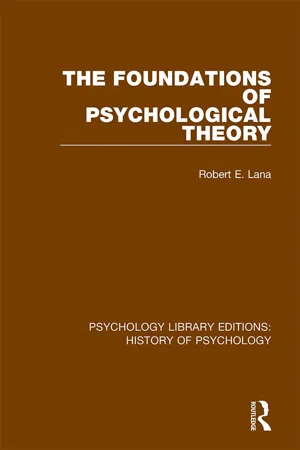
Over the previous decade, Robert E. Lana had attempted to understand the enterprise of psychology as a totality. Such an attempt was unpopular in the 1930s, 1940s and 1950s but had become increasingly more popular to psychologists in the 1970s. After considerable study, he became convinced that the twin vehicles for such a task were the history of the field and the epistemological contexts into which psychological theories fit. Originally published in 1976, the initial chapters in this volume are devoted to explaining, through history, the major epistemological ideas either implicit or explicit in modern psychological theory. Later chapters are studies of the epistemological contexts that, in part, yield modern psychological theory.
- 190 pages
- English
- ePUB (mobile friendly)
- Available on iOS & Android
eBook - ePub
The Foundations of Psychological Theory
About this book
Information
Topic
Psychologie1
A Selective History of Psychological Thought from the Greeks to the Early Behaviorists
Pre-Socratic Greek thinkers set the first problem for the Western intellectual, namely, to discover the basic material out of which the universe was formed. The philosophers Leucippus and Democritus offered hypotheses about the nature of the universe that, superficially at least, sound like the atomic theories of today. They believed that the world was composed of small particles, which combined to form various objects, including human beings, in space. This kind of analytic thinking reduced what was to be explained to its component parts and focused early Greek science on the physical or material basis of the universe.
At the time, other philosophers rejected the ultimate validity of the changing physical world and found reality in the permanent nature of ideas, particularly through the use of mathematics. Finally, during the Aristotelian era, there was an attempt to combine the material science of the pre-Socratics with the metaphysics of Plato. Plato and his followers separated the physical from the psychical, that is, body from mind, denegrating the former. This separation permeated Western thought until modern times.
After Plato, the intellectual life of Europe was dominated by attention to man’s spiritual and metaphysical nature. For 1500 years, the investigation of man’s power to create, develop, and understand ideas was more impressive to Europeans than was an empirical analysis of the world around them. What man was and how he thought took a central place in intellectual life. How objects in the world acted as they did was not as interesting. In short, we may say that the Greeks had developed the two principal Western intellectual proclivities, namely, to look outward and relate human beings and their activities to the activity of objects and to look inward at the nature of self and at the nature of thought.
The Platonic influence on Judeo-Christian thought resulted in the intellectual life of the medieval period being characterized by the idea that man’s essential self or spirit was an emanation from a God who was both external to and part of the human being. God was the motive force in man — the final referent. Scholastic philosophy attempted to relate man to God. Because God was seen as ethereal, the most important aspects of man were also ethereal. Hence, man’s noncorporeal processes such as thinking, believing, and willing were considered more important than man’s bodily processes, which he shared with the lower animals. With the Renaissance in Italy and with the reintroduction of the previously neglected aspects of classical thinking, there began a turning toward the external world once again. This turn laid the framework for the reintroduction of analytic materialistic thinking into Western civilization, such that science took hold in the form in which we know it today. The initial successes of science were in physics and mathematics; the psychology of the day was not yet separable from scholastic theology. The discoveries of Galileo, Kepler, Copernicus, Brahe, and others enabled scientists to predict the movement of earthly and heavenly bodies. By the seventeenth century, mechanical physics was well-established and virtually complete. It was during this century that the first significant modern philosopher emerged. His work contained the two major epistemologies, suggested by the Greeks, that were to become the basis for modern psychology.
DESCARTES (1590–1650)
Both classical Greek and scholastic theories about the nature of human beings placed the primary aspects of existence outside of individuals themselves, although the theories differed as to the nature of these aspects. For Socrates, Plato, and Aristotle, abstract concepts of truth and beauty had an existence separate from the human being, although he was capable of comprehending these ideas and thus elevating his own life. For the scholastic philosophers, an individual gained meaning from his relationship to God. René Descartes changed the shape of Western philosophical thought by the manner in which he turned inward in his inquiries concerning the nature of humanity. His insights allowed successive thinkers to frame questions about the nature of existence in ways that made the human being the center of his own world as Copernicus had discovered the sun to be the center of the physical universe. We may say that psychology begins with Descartes and the questions he framed about human beings. However, there is no sense in which psychology emerges as science and disappears as philosophy. Psychology has always been a product of total thought. This was never more pronounced than in the philosophy of Descartes.
By the seventeenth century it was possible for a philosopher to insist on a logico-mathematical methodology as the means by which one would develop his conceptions of human beings. Descartes discovered the analytical form of geometry and was sufficiently impressed with its power to believe that he could base a theory of humanity upon it. From this beginning it was a simple matter to derive the idea that mathematics is the principal language of understanding, since mathematics could be completed ideationally without reference to either empirical events or concepts such as God. This supposition, common among philosophers of the seventeenth century, led Descartes to depend upon his own processes of rational thought to discover answers to questions concerning the nature of human beings.
Descartes began by eliminating those ideas of which he could not be certain. It was clear to him that any information received through his senses was suspect, since there was abundant evidence to indicate that the senses often deceive us as with hallucinations, illusions, and the ordinary vagaries of daily perception. During sleeping and waking it was possible to have equally vivid impressions of a sensual or emotive kind, but reasoning was more often possible in a waking than a sleeping state. After having eliminated the data of perception and emotion from the area of ontological certainty, Descartes came to a conclusion that was of great significance for Western thought from that point forward. Knowing that the validity of any information could be doubted, Descartes concluded that he could be certain only of the fact of his doubting. He was assured of his own existence by his very thought processes (cogito ergo sum). He was confident that reasoning in itself was the method whereby he would come to know, since the act of reasoning rather than information from his senses had brought him to this indisputable knowledge.
This conclusion placed the center of the universe in the human being himself. If the Cartesian cogito is true, it would follow that internal subjective processes are the proper study of one who wishes to understand his nature. Actually, whether the cogito is true does not disturb the fact that Descartes’ influence on later Western thought was enormous, and hence systems derived from his theoretical context must be examined beginning with this subjective premise.
Descartes reasoned as follows: I can imagine that I have no body; that is, I can separate thinking from other processes that “belong” to me, such as the movement of my limbs, the beating of my heart, and so forth. I can also imagine that the world around me does not exist; that is, I could be deceived into thinking it is one thing while it is plainly something else, as one is systematically deceived when he watches the performance of a stage magician. What I cannot imagine is that my thought itself does not exist, because I must be thinking to imagine what is not certain. This also allows me to conclude that whatever else I believe, I think. Therefore, I may also conclude that I am thought—a conclusion that is similar to that reached by Plato centuries before.
The Platonic position of the centrality of thought in human existence made categories of thought independent of the thinker. The abstract existence of forms of ideas were to be recalled or reconstructed. Plato believed that all men were capable of coming to the same ideas with some effort. Descartes’ conclusion stressed the personal character of thought rather than its abstract qualities, which existed independent of the thinker. Because an individual thinks anything at all he is certain of his own existence. Coming at a time when science had severely disturbed the centrality of man’s position in the universe via the Copernican discoveries and the weakening of the credibility of church dogma as an interpretation of the meaning and scope of life, this conclusion offered seventeenth century man a potential meaning base for his own existence, which he had never really considered before, namely, himself. Bertrand Russell (1945) contended that this was the beginning of modern man’s subjective madness, which culminated in various forms of romanticism, some of which are still among us.
In any case, it is clear that Descartes’ thinking opened the possibility for a new posture toward the study of the human being’s role in the universe. The Platonic Greeks believed in the abstract quality of truth, beauty, and courage, knowledge of which was available to anyone under certain conditions. The scholastic philosophers conceived of human beings in relation to God. Descartes presented the possibility that human beings could examine themselves with their own epistemological processes, since that was all they were certain about in any case.
THE SEPARATION OF MIND AND BODY:
THE ROLE OF SCIENCE
Having established that cogito ergo sum, Descartes spent a great deal of time in his meditations attempting to demonstrate the existence of God, which need not detain us since we are principally concerned with his epistemology. In the course of his analysis, he came to a conclusion that anticipated the later position of Immanuel Kant regarding understanding: sense data cannot give us all the knowledge that is available to us; understanding, or thought, is necessary to interpret sense data. In this way, he anticipated Kant’s categories of mind. His position is simply that there are native proclivities in human beings to classify sense data in a way that is not determined by the sense data. The full impact of this idea will become clear later when we discuss the contribution of Kant. Having established, to his satisfaction, the separation of the understanding from sense data, Descartes concluded that mind and body are separate. His insistence on the separation of mind and body was largely based on his observation that thought processes were clearly different from sensory processes, which were connected to external elements in the environment. His distinction was not a flight of scholastic fancy, but rather set the groundwork for differences that were to continue for the next several hundred years. He was keenly aware that men could create machines that responded superficially the way man himself did. That is, one could build a machine to emit vocables that were very similiar to those emitted by humans, but under no circumstances could the machine be built so as to reply coherently to what was said in its presence. In more modern terms, one could build a machine that was programmed to solve problems, but not a machine that could solve problems with lines of solution that were not already contained within its structure.
Thus Descartes believed that animals and the human body are governed by mechanical principles. These mechanical principles of body interact with the more abstract logico-mathematical principles of mind. He did not question that without body human beings could not function and that the body interacted with the processes of thought. His belief in God led him to the idea that mind or soul was, after death, immortal. However, within life, mind and body are inextricably connected. He considered the nature of the connection and developed a concept of mind – body dualism that has come to be known as interactionism. He speculated that mind – body interaction took place in the central core of the brain, particularly in the pineal gland.
It is clear that if one were to accept Descartes’ analysis to this point, there are at least two avenues of study that are possible: one might pursue the nature of the understanding (cognition), that is, one might examine the internal subjective processes of self, or one might pursue the mechanical nature of the body. In a pursuit of knowledge concerning the mechanical nature of the body, one would be bound to compare it with external objects in the environment, since they are also considered to be governed by mechanical processes. In the Western world, these are precisely the two alternatives that were chosen by philosophers and scientists from Descartes’ time to the present. One might say that the major Western ideas about human beings can be roughly divided into a pursuit of the subjective or objective character of human beings. Thinkers in non-Western societies have not necessarily reached the bifurcation of Descartes. However, Descartes and those who followed were to become entranced in one way or the other with paths of knowledge that would either turn inward to examine the nature of one’s self or turn outward to examine objects in one’s environment, with the idea of eventually interpreting the processes of humans themselves in terms of those objects.
LEIBNIZ (1646–1716)
Gottfried Leibniz, like Descartes, believed both in the perfection of God and in mathematics and rationality as the highest forms of human existence. Leibniz’s God is rational as are human beings. Since God is rational, He does everything in a most desirable way and the world He created is the best of all possible worlds. This follows from His supreme rationality. All in the world is ordered, nothing is arbitrary; it remains for man to discover the rules by which God has made the world orderly. God and His presumed characteristics were the initial assumptions in Leibniz’s thinking as they were for virtually all philosophers to that time. The quality of Leibniz’s system may be judged independently of these assumptions, although they are included in our discussion to present a complete idea. His system is perceptual as well as epistemological. With this in mind, the reader need not be detained by the references to God, if they appear outmoded.
Contained in every individual substance or event is the trace of everything that has happened and will happen in the universe. That is, every single substance or object mirrors the entire universe. To explain fully the existence of any single observable or possible energy, one eventually must explain everything in the universe. This position both reflects belief in God’s complete sovereignty over existence and anticipates a later philosophical position more in keeping with modern science that knowledge of all events is interactively linked in a logical and empirical manner. To know and understand one object or event requires that one know all those objects and processes that are part of the first and so on until, through an infinite regress, one gains a knowledge of the entire universe of events and objects.
Leibniz, like Descartes, placed thought or cognition in the center of human existence. All of our conceptions do not come from the senses. Thoughts of being, identity, substance, and action, among others, come from an inner subjective experience. That is, human central processes are not able to function independently of the influence upon them of external objects, but bring to the perception of external objects a form that they would otherwise not have. Unlike Descartes, Leibniz did not believe in interaction of body and soul or mind, but rather in a parallelism of the two. His classical analogy was that of two clocks that tell the same time but do not influence one another in any way. Thus, the mechanical aspects of body and the rational aspects of mind, although apparently related, do not influence one another. This separation of mind and body by Leibniz indicated his tacit support of the Cartesian position of separating subjective from objective processes.
MONADOLOGY
For Leibniz, existence was composed of monads; that is, all physical objects and all human processes were thought to be composed of simple substances. Superficially, these substances seem to be atoms similar to those discussed by Leucippus and Democritus in pre-Socratic times. However, the monad is not a structure in the atomic sense, but rather is a process, which can include structures. Monads come together to form composites, which are complex structures. They have neither extension nor form nor divisibility, and they are indestructable. Each monad is different from every other, and any change in a monad comes from its internal principles. They are, therefore, uninfluenced by each other. Because these monads are all a reflection of a central universal monad, which is God, knowing any one of them implies knowing all of them, or the true and complete nature of the universe. The Western God requires a human being with freedom of decision and a central subjective self, which is superordinate to any objective qualities that He may possess.
God apparently has a central position in both the systems of Descartes and Leibniz and is linked with emphasis on subjective processes. However, we have seen with Descartes that, although God still exists in his system, the emphasis has decidedly been placed on the human being as the center of the cognitive universe. Thus we find that although God appears to be central in the system, His role has already been considerably diminished by Descartes’ time, and this trend is continued in Leibniz’s theories. The active element of the monad is that part given to action that is determined by its own internal principles. The active principle of the substance of existence is perception. Perception itself is a continuous process whereby monads aggregate to form a total entity that forms the process of consciousness (and hence, also, subconsciousness). That is, the processes whereby an unconscious entity becomes conscious are the processes whereby monads, or perceptual entities unconscious in themselves, aggregate to pass the threshold of consciousness.
When perception is accompanied by memory, the resulting substance is called soul (mind). It is clear at this point that Leibniz departed from his analysis of existence into monads with their perceptual qualities and added another ingredient, memory, in order to account for what he considered to be the uniqueness of a human being with a soul (or mind) and, of course, to acount for God Himself, Who must be different from any single monad. The system is weakened by this addition, since memory is present only in human beings and that requires an assumption beyond those related to perception. Nevertheless, Leibniz more specifically than his predecessors, isolated the perceptual process from other processes that could have been placed at the center of the theory of human existence. He also accounted for the gradual shift of ideas from subconsciousness to consciousness in a manner more or less consistent with current interpretations. His system was determined by the properties of God rather than by those inherent in physical objects or human beings. If one discounts the ideas of God, then the deterministic aspects of the system are reduced to the essentially subjective elements that are the unique active principles of human beings. These principles are different from those go...
Table of contents
- Cover
- Half Title
- Title Page
- Copyright Page
- Original Title Page
- Original Copyright Page
- Dedication
- Contents
- Preface
- Original Half Title
- Introduction
- 1. A Selective History of Psychological Thought from the Greeks to the Early Behaviorists
- 2. A Selective History of Social and Motivational Concepts in Psychology
- 3. Phenomenology and Psychology
- 4. Subject and Object Fused
- 5. The Nature of Data
- 6. Personality Theory
- 7. Social Theory
- 8. Developmental Theory
- 9. Physiological Theory
- 10. Values and Psychology
- References
- Author Index
- Subject Index
Trusted by 375,005 students
Access to over 1.5 million titles for a fair monthly price.
Study more efficiently using our study tools.
Frequently asked questions
Yes, you can cancel anytime from the Subscription tab in your account settings on the Perlego website. Your subscription will stay active until the end of your current billing period. Learn how to cancel your subscription
No, books cannot be downloaded as external files, such as PDFs, for use outside of Perlego. However, you can download books within the Perlego app for offline reading on mobile or tablet. Learn how to download books offline
Perlego offers two plans: Essential and Complete
- Essential is ideal for learners and professionals who enjoy exploring a wide range of subjects. Access the Essential Library with 800,000+ trusted titles and best-sellers across business, personal growth, and the humanities. Includes unlimited reading time and Standard Read Aloud voice.
- Complete: Perfect for advanced learners and researchers needing full, unrestricted access. Unlock 1.5M+ books across hundreds of subjects, including academic and specialized titles. The Complete Plan also includes advanced features like Premium Read Aloud and Research Assistant.
We are an online textbook subscription service, where you can get access to an entire online library for less than the price of a single book per month. With over 1.5 million books across 990+ topics, we’ve got you covered! Learn about our mission
Look out for the read-aloud symbol on your next book to see if you can listen to it. The read-aloud tool reads text aloud for you, highlighting the text as it is being read. You can pause it, speed it up and slow it down. Learn more about Read Aloud
Yes! You can use the Perlego app on both iOS and Android devices to read anytime, anywhere — even offline. Perfect for commutes or when you’re on the go.
Please note we cannot support devices running on iOS 13 and Android 7 or earlier. Learn more about using the app
Please note we cannot support devices running on iOS 13 and Android 7 or earlier. Learn more about using the app
Yes, you can access The Foundations of Psychological Theory by Robert E. Lana in PDF and/or ePUB format, as well as other popular books in Psychologie & Histoire et théorie en psychologie. We have over 1.5 million books available in our catalogue for you to explore.