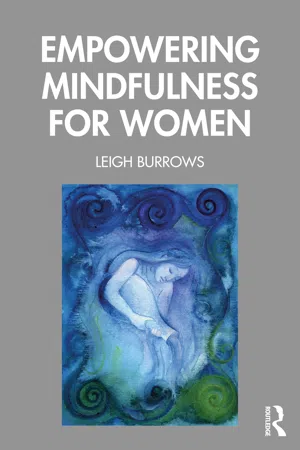
Empowering Mindfulness for Women
eBook - ePub

Empowering Mindfulness for Women

  1. 158 pages
  2. English
  3. ePUB (mobile friendly)
  4. Available on iOS & Android
eBook - ePub

Empowering Mindfulness for Women

About this book

Empowering Mindfulness for Women is centred around a a 5-day intensive mindfulness course attended by eight women from different backgrounds. The reader is invited to imagine they are actively participating in the teaching and learning moments and turning points encountered in teaching and learning mindfulness around themes such as making space for mindfulness, safeguarding mindfulness for women, engendering mindfulness, mindfulness dreaming and a mandala of wisdoms. Evocative accounts of experience bring to life the women's growing awareness that mindfulness can be both a separate practice and a natural part of life and that it can help them to nurture what they have neglected in themselves by not tapping into the full spectrum of their experience. Each chapter provides useful follow-up activities and questions for individual or group reflection, journaling, sharing and conversation.

Empowering Mindfulness for Women is aimed at those who teach mindfulness to women in educational, community or clinical settings and at women who want to learn mindfulness in a manner that positions them as experts in their own learning.

Trusted by 375,005 students

Access to over 1.5 million titles for a fair monthly price.

Study more efficiently using our study tools.

Information

Publisher
Routledge
Year
2021
Print ISBN
9780367427122
eBook ISBN
9781000374742

1
POLARITY MINDEDNESS

In which I draw back the curtain on the origins of this book on empowering mindfulness for women and invite you to take a glimpse into the conditions in which I experienced a personal and professional split that presented itself for healing. I show why and how I set out to write about teaching mindfulness to/with women in a way that would position them as experts in their own learning, with the aim of sharing their experiences and insights, so that others could hear divergent voices that may otherwise remain silent or, even, silenced. As I show in this chapter, the writing of this book required me to go through something of a dark night of the soul as part of my journey towards empowering mindfulness for women.
FIGURE 1.1 ‘Corridor Chat’
My first conscious felt experience of mindfulness was in my sandpit at the foothills of the Mount Dandenong, on the edge of a forest full of bellbirds. Meditation practitioner and researcher Lorin Roche’s (2014, p. 306) evocative description of his own felt experience resonates:
everything alive seemed to glow, especially the trees. I began to appreciate every detail of light, every touch of air, every sound, with extraordinary clarity. Light itself seemed soluble, an elixir I was drinking in through my eyes and the pores of my skin.
I had many such experiences: a near death by drowning on Bells Beach at 12; realising the interconnectedness of all knowledge at 16; in lovemaking, childbirth, having a still-born baby; being with a friend in the last hours of his life; being in nature, in deep meditation and in the presence of my teacher Barry Long. From Barry, I learned that the purpose of meditation was to find the stillness within me. I realised after attending my first retreat with him that I had been meditating in a way for years without realising it. Going about it more consciously led to a considerable slowing down of the mind and the growth of stillness much more quickly. I learned that the secret of mindfulness was to be present in my body wherever my body was. Increasingly, without even trying, I was able to be present both within and without to whatever was arising, especially when teaching, whatever I was teaching in whatever context. As Barry Long wrote in a letter to me:
The simplest thing in the world is to be now, this moment, where you are and what you are – a wonderfully embodied being. That is the only way (personal communication, 9th April 1990).
When I came later to teach and research mindfulness, I searched for an evocative definition that could encompass my experience and those of other people. Most definitions were variations on the oft quoted:
The awareness that arises from paying attention, on purpose, in the present moment and non-judgmentally.
(Kabat-Zinn, 1994, p. 4)
This definition was not quite right for me, however. It reminded me of the English novelist and essayist Virginia Woolf’s (1990) line:
A sentence made by men is too heavy and too pompous for a woman’s use.
(p. 72)
She described a ‘female sentence’ as being:
of a more elastic fibre … capable of stretching to the extreme, of suspending the frailest particles, of enveloping the vaguest shapes.
(p. 72)
I did need a more expanded definition for my teaching and research which I eventually found in the work of mindfulness researcher, teacher and practitioner Eleanor Rosch (2007, p. 261):
Mindfulness is an entire mode of knowing and of being in the world composed of many interdependent synergistic facets including: a relaxation and expansion of awareness, letting go even into deep states of not knowing; access to wisdom knowing beyond what we think of as consciousness or the mind; an open-hearted inclusive warmth toward all of experience and to the world; one’s deepest intentions toward oneself, other people and the world and one’s actions and ways of living. The teacher, teachings, and community of other practitioners are all part of this tapestry.
After teaching and researching mindfulness for over 10 years, I became concerned by the numbers of women in my mindfulness courses and workshops, who had previously tried mindfulness and decided it wasn’t for them as they didn’t find the practices helpful or sustainable. When it didn’t work for them they blamed themselves, believing they lacked the necessary application or commitment. As Roche (2020), has recently observed:
People are beating themselves up a lot. Judging themselves for having monkey minds.
Given my own experience of a more organic or even ‘instinctual’ experience of mindfulness (Roche, 2020), I sensed that many of the formal ideas and practices the women had tried to engage with were too rigid and inflexible.
I believed that mindfulness was potentially available to any woman if it was tailored to her situation and needs as long as she allocated some time for herself. As Roche (2020) observed recently in an interview, there are many different types of people in the world and many different doorways into mindfulness.
More than anything, I wanted to support women to tap into their own inner authority to find what worked for them, something that did not seem to feature in regular mindfulness courses, and I realised that my emotional connection to feminism, forged in a family where my father called me ‘Germaine Greer’ whenever I expressed my own opinion, was still alive and well. A research supervision trip to Nepal and visits to family homes, schools, universities, Buddha’s birthplace in Lumbini and the courtyard of the virgin goddess ‘Kumari’ reacquainted me with the strict gender divisions of my childhood, and I realised like Wakoh Shannon Hickey (2019, p. 225):
The imperative of including race and gender as categories of analysis in mindfulness.
I was interested in race (and there are indeed Aboriginal themes woven right through this book), but I do not have the necessary background, unlike gender, to foreground it. I had grown up reading biographies of suffragettes, was enthralled by Beatrice Faust’s story of creating the Women’s Electoral Lobby when she came to speak at my independent girls’ school, studied Women’s Studies at Monash, volunteered and worked in the first feminist women’s refuge in Melbourne, Women’s Liberation Halfway House and began an honours dissertation on Virginia Woolf (abandoned when I had my first daughter, whose arrival was approved of by the collective due to her gender). In addition, I attended women’s liberation conferences and read the key feminist texts by Mary Daly, Kate Millet, Phyllis Chesler and Germaine Greer before becoming involved in the alternative women’s health and home birth movement inspired by the famous Boston Women’s Health Collective’s 1973 book ‘Our Bodies Ourselves’ pioneering grassroots undertaking that foregrounded women’s experience and knowledge about their own bodies.
I became concerned again about women’s wellbeing from about 2015 as I saw how they/we struggled to balance personal, professional and education demands. As Lorin Roche has very wittily said recently, with an oblique reference to the goddess Kali, modern women:
are multitasking … every woman has eight arms and likes to use them all every day!
(Guru Viking Podcast, 18th August 2020)
I eventually decided to write a book on empowering mindfulness for women, based on qualitative data gathered over 5 years of teaching and approved by my university’s ethics committee and individual students, which I anticipated being quite straightforward like my last book on mindfulness.
Soon after I wrote the proposal, I dreamt I was in a committee meeting at work about the need to bring in more research funding to secure my ‘balanced’ teaching and research role, when a full-sized human head suddenly appeared on the table. It looked like it was about to slip off, so I quickly went to save it, when in a flash it manifested a tiny body with outsize male genitalia.
What was my dream trying to convey? What needed saving? I sensed its portent. As Amanda Lohrey (2020, p. 32) writes in ‘The Labyrinth’:
Were it not for the spell cast by my dream, by the force and clarity of it, which remains with me still, I would not persevere.
My dream ended up heralding a period of turmoil at work, as we struggled to find stability in a time of great change. We lost colleagues to redundancies and had to reap-ply for our roles so we became focused on survival, both individually and collectively. As Yves Rees (2020) wrote recently, the university has become ‘a masculinist culture of hyper-competitiveness, punitive benchmarks and elitist gatekeeping’. For Indian meditation teacher and social activist Vimala Thakar (2001), when something becomes institutionalised it can impinge on our freedom. She called for a more organic way of being, one that is easily overshadowed by the intellect. I identified with Australian feminist academic and writer Margaret Somerville (1999, p. 9) who similarly:
had become painfully aware of the separation that the academic life entailed and wondered if it was where I wanted to be located.
Signs of disempowerment appeared both within and around me with most of my women colleagues finding themselves in tears at work at different times during a particularly intense period. Nick Cave’s (1990) song line ‘why are all the women weeping?’ comes to mind as I write. Paula Reeves, psychologist and author of books on intuition and the wisdom of the body, has said in an interview (Reeves in Salum, 2016, Ch 1) that when she brought her work to Australia:
I had a room full of people who were weeping, saying in this culture, we have never been given permission to descend to go inward.
I wondered if this helped to explain why leadership expert Fabian Datner’s first leadership development voyage to Antarctica for women scientists was so challenging. Highly educated women who had left their families behind were being urged to get to know themselves, to be who they really were and share their personal stories, which made it a very challenging emotional journey, and I continue to see in my mind’s eye haunting scenes from Ili Bare’s (2020) documentary of the trip, ‘The Leadership’, of women sobbing without privacy on their bunks.
Loris Simon Salum (2016, introduction) has written in her book ‘Ensoulment: Exploring the Feminine Principle in Western Culture’ that:
I like to imagine that our necks are one of the most misleading features of the human anatomy. They have made us believe there is an obvious separation between our head and the rest of our body.
For centuries, we have attributed our heads to reason and the masculine and the rest of our uncontrollable body and nature to the feminine, and I wanted to break through the facade of academia to include the wisdom of those who are educated in life and in experience.
My dream revealed a split between mind and body which for philosopher Peter Kingsley (2018) is the historical split or wound in western civilisation between subject and object, inner and outer, mind and body, human being and nature, thinking and feeling, science and intuition, and masculine and feminine.
When I revisited the work of Sufi mindfulness teacher Llewellyn Vaughan-Lee (2009) to try to understand my dream, I felt sad when I read that after 20 years of teaching meditation to women, he continues to be distressed by seeing how many are hindered in their practice by mental and emotional negativity, self-doubt and low self-esteem. For Vaughan-Lee (2009), this is the result of our education systems which have developed what he calls the ‘masculine mind’, which operates in a rational linear manner that is focused, analytic and goal oriented to meet the needs of a patriarchal culture. Like English researcher Kirsten Douglas (Douglas & Carless, 2018, p. 8), I found myself wondering:
Where was the energy? The humour? The spirit of resistance? … And where was the feeling?
I had generally managed to avoid getting involved in conflicts at work through staying somewhat detached through focusing on my mindfulness teaching, research and practice, but now I was in the midst of a ‘maelstrom’ at work. I was surprised by how hard I took the change to a teaching specialist role in the restructure and my interactions with a polarising new (female) leader with a forceful, directive style focuse...

Table of contents

  1. Cover
  2. Half Title
  3. Title Page
  4. Copyright Page
  5. Dedication Page
  6. Contents
  7. List of figures
  8. Preface
  9. Acknowledgements
  10. 1 Polarity mindedness
  11. 2 Day one: making space for mindfulness
  12. 3 Day two: safeguarding mindfulness for women
  13. 4 Day three: engendering mindfulness
  14. 5 Day four: mindfulness dreaming
  15. 6 Day five: a mandala of wisdoms
  16. 7 Full-spectrum mindfulness
  17. Index

Frequently asked questions

Yes, you can cancel anytime from the Subscription tab in your account settings on the Perlego website. Your subscription will stay active until the end of your current billing period. Learn how to cancel your subscription
No, books cannot be downloaded as external files, such as PDFs, for use outside of Perlego. However, you can download books within the Perlego app for offline reading on mobile or tablet. Learn how to download books offline
Perlego offers two plans: Essential and Complete
  • Essential is ideal for learners and professionals who enjoy exploring a wide range of subjects. Access the Essential Library with 800,000+ trusted titles and best-sellers across business, personal growth, and the humanities. Includes unlimited reading time and Standard Read Aloud voice.
  • Complete: Perfect for advanced learners and researchers needing full, unrestricted access. Unlock 1.5M+ books across hundreds of subjects, including academic and specialized titles. The Complete Plan also includes advanced features like Premium Read Aloud and Research Assistant.
Both plans are available with monthly, semester, or annual billing cycles.
We are an online textbook subscription service, where you can get access to an entire online library for less than the price of a single book per month. With over 1.5 million books across 990+ topics, we’ve got you covered! Learn about our mission
Look out for the read-aloud symbol on your next book to see if you can listen to it. The read-aloud tool reads text aloud for you, highlighting the text as it is being read. You can pause it, speed it up and slow it down. Learn more about Read Aloud
Yes! You can use the Perlego app on both iOS and Android devices to read anytime, anywhere — even offline. Perfect for commutes or when you’re on the go.
Please note we cannot support devices running on iOS 13 and Android 7 or earlier. Learn more about using the app
Yes, you can access Empowering Mindfulness for Women by Leigh Burrows in PDF and/or ePUB format, as well as other popular books in Psychology & Mental Health in Psychology. We have over 1.5 million books available in our catalogue for you to explore.