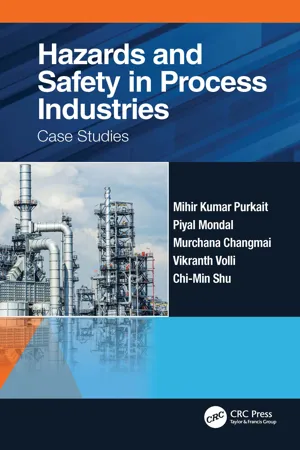
Hazards and Safety in Process Industries
eBook - ePub

Hazards and Safety in Process Industries

Case Studies

  1. 312 pages
  2. English
  3. ePUB (mobile friendly)
  4. Available on iOS & Android
eBook - ePub

Hazards and Safety in Process Industries

Case Studies

About this book

Safety in process industries is of utmost necessity to ensure protection from hazards. The aim of this book is to elucidate the hazards and preventive measures for a few of such specific industrial processes. Starting with overview of the prevalent industrial accidents, types of hazards and safety provisions, the book contains nineteen chapters with each one of them consisting of a unique case study comprising of basic causes, results and discussion, and protective measures to be adopted to overcome such situation. Topics covered include caprolactam storage tank accident, fire explosion accident caused by static electricity, and human factors risk and management in process safety and so forth. Aimed at researchers, professionals, graduate students in Chemical Engineering, Safety Management, Risk Assessment, Chemical Process Safety, this book:

  • Provides exhaustive coverage of industrial case studies on their hazards and safety issues in the process industry set-up.
  • Includes quantitative discussion on new and existing technologies and methodologies.
  • Explores high quality descriptive and quantified data for better visualization of each chapter.
  • Gives detailed description on various industrial accidents, their related consequences and available safety/preventive measures.
  • Discusses preventive measures taken by world class industries in their production plants.

Trusted by 375,005 students

Access to over 1.5 million titles for a fair monthly price.

Study more efficiently using our study tools.

Information

Publisher
CRC Press
Year
2021
Print ISBN
9780367516512
eBook ISBN
9781000362442

1 Introduction to Industrial Safety and Hazard

1.1 Background

Over decades, mankind has paid focus on the treatment of hazardous contaminants, and effluents (liquids and gases) from various industrial sectors for providing safety to humans and the environment (Volli and Purkait, 2015; Purkait et al., 2005; Mondal and Purkait, 2017). For safety reasons, attention was given to wastewater treatment (Mondal et al., 2020; Sriharsha et al., 2014), the treatment of underground water containing metals (Changmai et al. 2020a, 2020b) and also the treatment of hazardous contaminants (Mondal and Purkait, 2018, 2019). But it was analyzed after various serious incidents occurring in different industries that, apart from such attention, an increased should also be devoted towards working safety and following precautionary steps and measures in process units while working. A chemical manufacturing process is described as being inherently safer if it reduces or eliminates hazards associated with materials and operations used in the process, and this reduction or elimination is permanent and an inseparable part of the process technology. In these circumstances, a hazard is defined as a physical or chemical characteristic that has the potential for causing harm to people, the environment or property. The key to this definition is that the hazard is intrinsic to the material or to its conditions of storage or use. For example, chlorine is toxic by inhalation; gasoline is flammable and steam at 600 psig contains significant potential energy. These hazards are the basic properties of the materials and their conditions of usage and there is no way in which they can be changed. An inherently safer process reduces or eliminates the hazard by reducing the quantity of hazardous material or energy, or by completely eliminating the hazardous agent. A traditional approach to managing the risk associated with a chemical process is by providing layers of protection between the hazardous agent and the people, environment or property, which is potentially impacted.

1.2 Work Domain and Safety Instructions

Recently in all process manufacturing industries safety-related measures has been widely accepted and implemented. Each and every industry has come up with the proposal of safety protocols and measures to implement among its different process units. Chemical plants where high temperature, pressure and hazardous chemicals are involved should follow a policy on strict adherence to such safety protocols and the workers should follow such measures for their own benefit and also to reduce life risk and other environmental hazards that could affect the entire society (CCPS, 2003). Plant operations verifying that the licensee has instituted effective management measures to provide for the safe operation of the facility during both routine and abnormal conditions, to recognize non-routine events affecting safety, to utilize an internal reporting system and to identify and execute corrective actions to return the plant to a safe and secure condition after possible upsets. A few points for safe plant operations are outlined below:
  • Chemical process safety: Verifying that the licensee has implemented adequate measures for the protection of their workers, the public and the environment from hazardous chemicals that could adversely affect radiological safety or could be released from the processing of licensed radioactive material.
  • Criticality safety: Verifying that the licensee has implemented adequate controls to prevent accidents, fire and explosions with reference to the Factory Act.
  • Fire Protection: Verifying that the licensee has implemented controls to ensure that fires would not occur or would be limited through the safe handling and storage of hazardous materials.
  • Safeguards material: The control, accounting and physical protection of special hazardous materials, classified material and information security.
  • Radiological controls: Radiation protection, environmental protection, waste management and transportation.
  • Environmental protection: Verifying that the licensee has established and implemented a program that effectively protects the environment by measuring and controlling releases.
  • Waste management: Verifying that the licensee has established and implemented an effective program for hazardous waste management.
  • Maintenance and surveillance: Verifying that the licensee has established and implemented effective programs for both corrective and preventive maintenance, configuration management and surveillance testing activities, that cover all items relied on for safety and safeguards.
  • Training: Verifying the qualification and training of personnel relied on to perform functions necessary for adequate safety and safeguards.
  • Emergency preparedness: Verifying that the licensee has established and implemented an effective emergency management program to protect the workers, public and the environment in the event of reasonably postulated events that could threaten the facility.

1.3 Records and reports of prevalent industrial accidents

Several casualties have been reported over years because of industrial accidents, where sufficient precautious steps were not taken and implemented. There are several industries which have succumbed to such disasters, but, principally based on their high social impact, the energy, food and manufacturing industries have been discussed below, since these have faced several safety hazard issues over recent years.

1.3.1 Energy Industry

  • October 1957: The Windscale fire, the worst nuclear accident in the UK's history, released substantial amounts of radioact...

Table of contents

  1. Cover
  2. Half Title
  3. Title Page
  4. Copyright Page
  5. Dedication
  6. Table of Contents
  7. Preface
  8. Authors
  9. Chapter 1: Introduction to Industrial Safety and Hazard
  10. Chapter 2: A Study of a Caprolactam Storage Tank Accident through Root Cause Analysis with a Computational Approach
  11. Chapter 3: Fire Explosion Accident Caused by Static Electricity in a Propylene Plant
  12. Chapter 4: Thermal Hazard Accident during Hydrogen Peroxide Mixing with Propanone
  13. Chapter 5: Hydroelectric Power Plant Fire Accident
  14. Chapter 6: Thermal Accident of Methyl Ethyl Ketone Peroxide Plant
  15. Chapter 7: Case Study on the Integrated Self-Assessment Module for Fire Rescue Safety in a Chemical Plant
  16. Chapter 8: Chemical Releases in a Semiconductor Plant
  17. Chapter 9: Thermal Hazard and Safety during Combustion of 1-Butylimidazolium Nitrate
  18. Chapter 10: Safety and Flammability Analysis for Fuel–Air–Diluent Mixtures Plant
  19. Chapter 11: Advanced Calorimetric Technology for the Kinetic and Thermal Safety Analysis of Tert-butylperoxy-3,5, 5-trimethylhexanoate
  20. Chapter 12: Thermal Hazard Analysis and Its Application on Process Safety Assessments
  21. Chapter 13: Safety of Flammable Liquid Mixtures
  22. Chapter 14: Calorimetric Approach on the Thermal Hazard Assessment of Cumene Hydroperoxide
  23. Chapter 15: Evaluation of the Information System of Maintenance Efficiency in Petrochemical Plants
  24. Chapter 16: A Study on the Challenges in Emerging Economies to Industry 4.0 Initiatives for Supply Chain Sustainability
  25. Chapter 17: A Detailed Study on the Spatial Characteristics of Heavy Metal Pollution and Ecological Risk of Mining Area
  26. Chapter 18: Evaluation of Human Factors Risk and Management in Process Safety in Engineering
  27. Chapter 19: Analysis of Off-Site Emergency Procedures and Reciprocation for Nuclear Accidents
  28. Index

Frequently asked questions

Yes, you can cancel anytime from the Subscription tab in your account settings on the Perlego website. Your subscription will stay active until the end of your current billing period. Learn how to cancel your subscription
No, books cannot be downloaded as external files, such as PDFs, for use outside of Perlego. However, you can download books within the Perlego app for offline reading on mobile or tablet. Learn how to download books offline
Perlego offers two plans: Essential and Complete
  • Essential is ideal for learners and professionals who enjoy exploring a wide range of subjects. Access the Essential Library with 800,000+ trusted titles and best-sellers across business, personal growth, and the humanities. Includes unlimited reading time and Standard Read Aloud voice.
  • Complete: Perfect for advanced learners and researchers needing full, unrestricted access. Unlock 1.5M+ books across hundreds of subjects, including academic and specialized titles. The Complete Plan also includes advanced features like Premium Read Aloud and Research Assistant.
Both plans are available with monthly, semester, or annual billing cycles.
We are an online textbook subscription service, where you can get access to an entire online library for less than the price of a single book per month. With over 1.5 million books across 990+ topics, we’ve got you covered! Learn about our mission
Look out for the read-aloud symbol on your next book to see if you can listen to it. The read-aloud tool reads text aloud for you, highlighting the text as it is being read. You can pause it, speed it up and slow it down. Learn more about Read Aloud
Yes! You can use the Perlego app on both iOS and Android devices to read anytime, anywhere — even offline. Perfect for commutes or when you’re on the go.
Please note we cannot support devices running on iOS 13 and Android 7 or earlier. Learn more about using the app
Yes, you can access Hazards and Safety in Process Industries by Mihir Kumar Purkait,Piyal Mondal,Murchana Changmai,Vikranth Volli,Chi-Min Shu in PDF and/or ePUB format, as well as other popular books in Technology & Engineering & Chemical & Biochemical Engineering. We have over 1.5 million books available in our catalogue for you to explore.