eBook - ePub
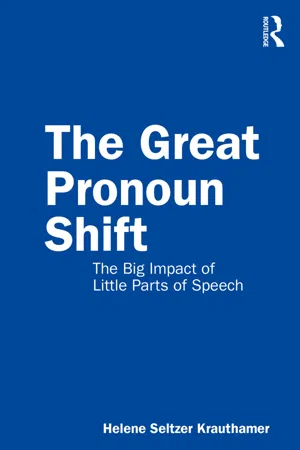
The Great Pronoun Shift
The Big Impact of Little Parts of Speech
- 140 pages
- English
- ePUB (mobile friendly)
- Available on iOS & Android
eBook - ePub
About this book
This book is a holistic exploration of personal pronouns in English and their development. In conversational prose and drawing on linguistic and psychological research, Helene Seltzer Krauthamer gives an overview of what pronouns are, why they are problematic, what they reveal about us, how they can be used effectively, where they came from, and where they are going. Assuming no specialized knowledge and with helpful real-world exercises at the end of each chapter, the book aids growth and inspires thought in students and other readers, spelling out the implications of these changes for teachers, writers, and all who write or speak in English.
Information
1
The Pronoun Problem, Again
Introduction
Pronoun problem? What pronoun problem? Unless you are an editor, an English teacher, a writer, a student, or almost any person belonging to Generation Z who, come to think of it, may not regard pronouns as a problem, you are probably unaware of the current pronoun crisis. But they (that is, pronouns) are making headlines. They are not only in the news, but they have been a problem for writers and speakers of English for quite a while for a variety of reasons. This chapter highlights recent news items and past issues that have arisen around those tiny parts of speech that most of us rarely consider until confronted by an editor, English teacher, or person with pronoun sensitivities.
Pronouns in the News
Here are some examples of how important pronouns have become:
Singular they was selected as the “word of the year” by the American Dialect Society in 2016 (Guo, 2016).
It was the theme of the New York Times crossword puzzle of November 7, 2017 (Poulos, 2017).
More alarmingly, a headline cries out “DC Will Fine You for Calling a Transgender Person the ‘Wrong’ Pronoun” (Jones, 2016), referring to a District of Columbia Office of Human Rights guide Valuing Transgender Employees and Applicants, which includes a section on how to “Use Proper Names and Pronouns” (Rodríguez-Roldán & Imse, 2016). This section includes a chart of pronouns including the gender neutral ze (“Ze smiled.”), zir (“I met zir.”), and zirself (“Ze is zirself.”) (Rodríguez-Roldán & Imse, 2016, p. 13). Under 4 DCMR § 808 (District of Columbia Municipal Regulations), “deliberately misusing a person’s preferred name or pronoun” constitutes harassment and a hostile environment (Rodríguez-Roldán & Imse, 2016, p. 9). The guide itself, in fact, uses the pronoun they in the singular sense, as in “Employers may not require an applicant to state whether they are transgender” (Rodríguez-Roldán & Imse, 2016, p. 9). Presumably, the antecedent in this example (the word that the pronoun is replacing) is “applicant” and not “employers.”
Jennifer Lopez (pop star for those of you unaware of popular culture or who are reading this a year from now) used singular they to refer to her sister’s child: “‘They were the one person selected to represent their school at #globalyoungleadersconference in Washington DC!!!’” (DaSilva, 2017). The news item includes a photo of a very attractive preteen of unknown gender, presumably the niece/nephew of JLo. (Note, by the way, how English does not have a slim, gender-neutral kinship term for the rather bulky expressions niece/nephew or sister’s child that I had to resort to in the previous sentences.)
An even more noteworthy story relates to a couple who are raising their baby named “Boozer” as a gender-neutral “they-by” by not revealing the child’s gender (even to the grandparents!) and consistently using the pronoun they (in addition to clothing Boozer in gender-neutral outfits and buying gender-neutral toys) to avoid the sexual bias inherent in our society (Ritschel, 2018). The parents say that they are waiting until the child is three years old when they expect the child to select the child’s gender. (Now note how useful a gender-neutral pronoun would be in the previous sentence to avoid the repetition of the phrase the child, as well as the possible misinterpretation that there is more than one child under discussion.)
Several news stories depict how universities, out of respect for the pronoun choices of their LGBTQ+ students, prepare guides to educate professors on the pronoun options, including the use of new pronouns such as ne and ve (Parke, 2018). These guides often stem out of offices of inclusion and diversity so that nonbinary, gender fluid, and trans individuals (terms that are also changing and may need to be defined to people of a certain generation) will not face harassment or discomfort in their classes.
A New York Times article (Bennett, 2016) explains how pronouns have become a reflection of the changing ways people want to express their identities through their use of pronouns, no longer a male/female dichotomy but an array of shifting and fluid forms. Besides discussing how several colleges have pronoun guides to allow students to select their preferred and unrestricted mode of self-reference, the article also mentions the television show Transparent where pronouns became a topic of discussion for one of the characters who is a transgender parent. Indeed, several shows now have characters who are transitioning, played by performers who have transitioned in real life. More on this in Chapter 3. Generally, once a person has transitioned, the pronouns simply match up with the person’s new gender, that is, he for trans males and she for trans females. However, this transition is not always easy for those who knew the person prior to the transition, and discourse about the past becomes particularly problematic (based on personal communication with a parent of a transitioning child).
Not everyone welcomes this new approach to pronouns. University of Toronto psychology professor Jordan Peterson has been in the news frequently and has been engaged in numerous debates about his refusal to use gender-neutral pronouns in his classes, as indicated by Canadian Bill C-16, part of the Canadian Human Rights Act. Peterson claims that the compelled use of pronouns violates his free speech and is an outgrowth of political correctness. His opposition point out that the bill does not dictate pronoun use, that there is no penalty for professors, and that the purpose of the bill is to protect the members of the transgender community from the significant harassment they have faced. One of his debaters, Brenda Cossman, a Canadian law professor, said, “The Oxford English Dictionary has just announced the word of the year as post-truth. I worry that a lot of the ideas about pronouns is located in that idea of post-truth” (Chiose, 2016/2017).
Many people, however, are open to these changes, particularly with the growing recognition of the significance of the population being affected, as well as how much harassment that population has been facing. Those who have always considered themselves to be nonbinary are lauding the state of California for introducing Assembly Concurrent Resolution (ACR) No. 260 (Christian, 2018). As part of its efforts to be the “gold standard” for ensuring equity for all its residents, California has proposed ACR 260, a bill legislating that language in state documents become gender neutral and avoid the use of he or she. The bill proposes repetition of nouns or the use of singular they to replace gendered pronouns he and she, stating that these are exclusionary. It explicitly justifies the use of singular they by citing its prevalence in language and its acceptance by style guides such as the Associated Press and the Chicago Manual of Style (ACR 260, 2018).
Already, government publications, such as the United States Navy Commanding Officers Transgender and Gender Transition Toolkit, use singular they. Here is a quote from this publication:
If a Sailor expresses to command leadership feelings of gender non-conformity, which in some cases can cause significant distress or anxiety, it is important to recognize the Sailor is likely under psychological strain that may place them [my bold] in a vulnerable position. (p. 2)
As these examples show, pronouns do matter to many people. They, of course, are just the surface of a deeper transition in our culture – our ability to perceive gender no longer as binary male or female but as a range. Pronouns just need to keep up.
The Pronoun Problem
Truth is, pronouns have been a problem for quite a while.
The problem reveals itself in the completion of this simple sentence:
Everyone loves _____ mother. (Example credited to Dennis Baron, in any of his admirable and readable works on this topic.)
How would you fill in the blank? Once upon a time, most of us automatically completed the blank with his, with nary a thought of masculinity. Known as generic he, the masculine pronoun was used to include all humans – male, female, and all the variants between. As waves of feminism washed over our culture, however, awakening everyone to the sexism inherent in language, generic he revealed itself as sexist. The Handbook of NonSexist Writing by Casey Miller and Kate Swift, first published in 1980, was a guide on ways to be more inclusive of women in language, with a chapter on “The Pronoun Problem.” While we became more conscious of our use of terms such as mailman and chairman and adopted Ms. into our honorifics, we had no replacement for generic he. Completing the sentence above resulted in the use of their, which, for many of us English teachers and strict grammarians, violates the rule of pronoun agreement that states that the pronoun must agree with its antecedent. Everyone, despite its plural meaning, is grammatically singular, as evidenced by its singular verb loves, so its pronoun should also be singular.
For a while, the alternative to generic he became he or she, and sometimes s/he, as well as other variants, but nobody could use these alternatives consistently without butchering the flow of discourse, and they were almost never used in speaking. The gender-neutral pronoun it was not acceptable since it denotes an object, not a person. The only time it is used for people is generally when referring to babies prior to knowing their sex, as in “Is it a boy or a girl?”, and even under those circumstances, people often prefer to say the baby. As a writing teacher, how often would I read paragraphs where the writer would properly begin he or she and then his or her, but by the end of the discourse resort to they/them/their, causing this finicky old English teacher to pull out her red pen and charge him or her with, what else, pronoun error.
Why Don’t We Think about Pronouns?
The simple fact is that most (other) people do not think about pronouns.
Pronouns do their job best when they are unnoticeable. They are tiny parts of speech that keep our language moving at its naturally rapid pace. In speech, they allow us to focus on the important parts of the sentence, such as nouns and verbs. They help us improve coherence. When said or read in the context of a sentence, they are typically unstressed. Please take a moment to read the following sentence out loud:
They are hoping the store is open when they get there.
Unless you were delibera...
Table of contents
- Cover
- Half Title
- Title Page
- Copyright Page
- Table of Contents
- List of Figures
- List of Tables
- Foreword
- Preface and Acknowledgments
- 1 The Pronoun Problem, Again
- 2 Pronouns in Print and on Broadway
- 3 Nonbinary Pronouns: In Transition
- 4 Pronouns for Pets, Planets, and Other Bodies
- 5 Where Art Thou?: Pronouns in History
- 6 Religious Pronouns: Thanks Be to Them!
- 7 Neopronouns: The Final Act of Self-Actualization
- 8 Breaking the Grammar Binary: The Third Word Category
- 9 What’s a Teacher-Student-Writer-Editor-Ally-Person to Do?
- Appendix: Signs of Them
- Index
Trusted by 375,005 students
Access to over 1.5 million titles for a fair monthly price.
Study more efficiently using our study tools.
Frequently asked questions
Yes, you can cancel anytime from the Subscription tab in your account settings on the Perlego website. Your subscription will stay active until the end of your current billing period. Learn how to cancel your subscription
No, books cannot be downloaded as external files, such as PDFs, for use outside of Perlego. However, you can download books within the Perlego app for offline reading on mobile or tablet. Learn how to download books offline
Perlego offers two plans: Essential and Complete
- Essential is ideal for learners and professionals who enjoy exploring a wide range of subjects. Access the Essential Library with 800,000+ trusted titles and best-sellers across business, personal growth, and the humanities. Includes unlimited reading time and Standard Read Aloud voice.
- Complete: Perfect for advanced learners and researchers needing full, unrestricted access. Unlock 1.5M+ books across hundreds of subjects, including academic and specialized titles. The Complete Plan also includes advanced features like Premium Read Aloud and Research Assistant.
We are an online textbook subscription service, where you can get access to an entire online library for less than the price of a single book per month. With over 1.5 million books across 990+ topics, we’ve got you covered! Learn about our mission
Look out for the read-aloud symbol on your next book to see if you can listen to it. The read-aloud tool reads text aloud for you, highlighting the text as it is being read. You can pause it, speed it up and slow it down. Learn more about Read Aloud
Yes! You can use the Perlego app on both iOS and Android devices to read anytime, anywhere — even offline. Perfect for commutes or when you’re on the go.
Please note we cannot support devices running on iOS 13 and Android 7 or earlier. Learn more about using the app
Please note we cannot support devices running on iOS 13 and Android 7 or earlier. Learn more about using the app
Yes, you can access The Great Pronoun Shift by Helene Seltzer Krauthamer in PDF and/or ePUB format, as well as other popular books in Languages & Linguistics & Grammar & Punctuation. We have over 1.5 million books available in our catalogue for you to explore.