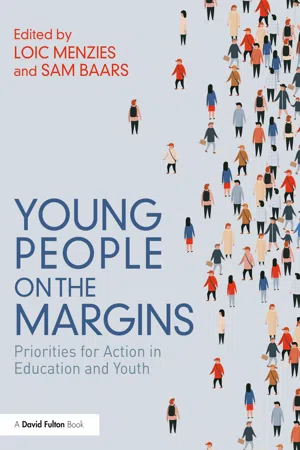
Young People on the Margins
eBook - ePub

Young People on the Margins

Priorities for Action in Education and Youth

  1. 186 pages
  2. English
  3. ePUB (mobile friendly)
  4. Available on iOS & Android
eBook - ePub

Young People on the Margins

Priorities for Action in Education and Youth

About this book

Our society leaves too many young people behind. More often than not, these are the most vulnerable young people, and it is through no fault of their own. Building a fair society and an equitable education system rests on bringing in and supporting them. By drawing together more than a decade of studies by the UK's Centre for Education and Youth, this book provides a new way of understanding the many ways young people in England are pushed to the margins of the education system, and in turn, society.

Each contributor shares the personal stories of the young people they have encountered over the course of their fieldwork and practice, combining this with accessible syntheses of previous studies, alongside extensive analysis of national datasets and key publications. By unpicking the many overlapping factors that contribute to different groups' vulnerability, the book demonstrates the need to understand each young person's life story and to respond quickly and collaboratively to the challenges they face. The chapters conclude with action points highlighting the steps individuals, institutions and policy makers can take to bring young people in from the margins.

Young People on the Margins showcases first-hand examples of where these young people's needs are being addressed and trends bucked, drawing out what can and must be learned, for teachers, leaders, youth workers and policy makers.

Trusted by 375,005 students

Access to over 1.5 million titles for a fair monthly price.

Study more efficiently using our study tools.

Information

Publisher
Routledge
Year
2021
Print ISBN
9781138360464
eBook ISBN
9780429781070

1Pushed out and left out

Understanding school exclusion

Loic Menzies and Abi Angus

1.1 Introduction

In the late 2000s I worked in a school in North West London. It was a tiny site packed in behind tall fences and across the road were more fences. Behind those, on an old playground, lay some portacabins, and inside these sat a transient group of pupils.
This was the school’s “inclusion unit”, where pupils on the fringe of exclusion were brought to learn, or at least be contained. Some of the time it “worked”, and pupils were successfully reintegrated; other times, it was a staging post on the way to more formal exclusion. This chapter explores the story of pupils like Francis who I taught there on my weekly trips across the road.
Every week when I arrived at the unit, Francis had taken another step down the road towards exclusion. But why? Surely something could have stopped what felt like an inexorable slide away from the mainstream.
This chapter sets out what I have learned since my days in the unit. It begins by outlining the implications of being “pushed out” of the mainstream, both for young people and society as a whole. We then explore how young people are pushed out, arguing that both formal and informal exclusion play a role. It is clear that formal and informal exclusion affect some young people more than others; I therefore highlight which young people are most likely to be excluded, but go beyond traditional analyses of excluded pupils’ demographics by investigating the underlying reasons why these young people are at greater risk of exclusion. I argue that this is crucial in order to understand how these young people’s life chances can be improved. Finally, I set out a number of changes that would ensure fewer pupils like Francis were pushed onto the margins.

1.2 Why do these young people matter?

Francis and his peers’ journey into, and on from, the unit were not unique. No one knows exactly how many pupils are in a similar position, but it is clear that the personal and social costs of school exclusion are huge.

1.2.1 The personal cost of exclusion

Chris Henwood is co-founder of Foundation Futures, an alternative education provider that supports excluded young people to re-engage with education. She explains the toll exclusion takes on many of the young people she works with, saying:
This is from their mouths… they feel excluded, forgotten about, tossed on the scrapheap, nobody gives a toss about them… some of the places in which they’re taught are horrible… one is in the back end of an old primary school and when you go in the door, you can see the damp up the walls and it’s got that horrible damp smell and the paint’s peeling… So, what these young people feel is that they’re not worth anything, nobody cares, they can’t fit in to an academic classroom, so they’re turfed out and they’re just pushed out and pushed aside and they haven’t got a voice at all [1].
National data on excluded pupils’ experiences paints a similarly bleak picture: nearly a quarter of pupils in PRUs and AP are educated in provision judged less than “good” by Ofsted, and in some areas such as the West Midlands this rises to over 50% [2]. On top of this, as we will see later in this chapter, many excluded young people unofficially ‘disappear’ from records. Whilst there are serious questions as to whether Ofsted judgements provide a meaningful and reliable measure of quality in the AP sector, it is clear that many excluded young people end up with little or no formal education, as was the case for Emily:
Emily is a 19-year-old from Newcastle. Growing up, Emily had an unstable family home. She would often argue with her mother and would be asked to leave the house. This resulted in her frequently drifting between her mother’s and her father’s houses and staying in each one temporarily.
At the age of 11, the death of one of Emily’s cousins devastated and deeply affected her and this had a serious impact on her education. Finding it difficult to deal with her emotions, Emily exhibited behaviour issues at school, and this eventually led to her exclusion from two schools.
Emily became homeless when her mother told her that she could no longer stay in the family home. At this time, she did not want to live with her father because none of her siblings would join her.
She is currently living in a hostel and explains that:
When I moved in to [Pupil Referral Unit], I started going with people who would cause trouble on a daily basis and then I didn’t want to get kicked out because that was the last school I would go to, so I changed, but then I ended up getting kicked out for something else. I didn’t go to school then; I went to the library for 45 minutes a d...

Table of contents

  1. Cover
  2. Half Title
  3. Endorsement Page
  4. Title Page
  5. Copyright Page
  6. Table of Contents
  7. List of Contributors
  8. Acknowledgements
  9. Introduction: Young People on the Margins
  10. Chapter 1: Pushed out and left out: Understanding school exclusion
  11. Chapter 2: Special educational needs and disabilities
  12. Chapter 3: Mental health
  13. Chapter 4: Area-based inequalities and the new frontiers in education policy
  14. Chapter 5: Gypsy, Roma and Traveller young people
  15. Chapter 6: Children who come into contact with social services
  16. Chapter 7: Education without a place to call home
  17. Chapter 8: Conclusion
  18. Index

Frequently asked questions

Yes, you can cancel anytime from the Subscription tab in your account settings on the Perlego website. Your subscription will stay active until the end of your current billing period. Learn how to cancel your subscription
No, books cannot be downloaded as external files, such as PDFs, for use outside of Perlego. However, you can download books within the Perlego app for offline reading on mobile or tablet. Learn how to download books offline
Perlego offers two plans: Essential and Complete
  • Essential is ideal for learners and professionals who enjoy exploring a wide range of subjects. Access the Essential Library with 800,000+ trusted titles and best-sellers across business, personal growth, and the humanities. Includes unlimited reading time and Standard Read Aloud voice.
  • Complete: Perfect for advanced learners and researchers needing full, unrestricted access. Unlock 1.5M+ books across hundreds of subjects, including academic and specialized titles. The Complete Plan also includes advanced features like Premium Read Aloud and Research Assistant.
Both plans are available with monthly, semester, or annual billing cycles.
We are an online textbook subscription service, where you can get access to an entire online library for less than the price of a single book per month. With over 1.5 million books across 990+ topics, we’ve got you covered! Learn about our mission
Look out for the read-aloud symbol on your next book to see if you can listen to it. The read-aloud tool reads text aloud for you, highlighting the text as it is being read. You can pause it, speed it up and slow it down. Learn more about Read Aloud
Yes! You can use the Perlego app on both iOS and Android devices to read anytime, anywhere — even offline. Perfect for commutes or when you’re on the go.
Please note we cannot support devices running on iOS 13 and Android 7 or earlier. Learn more about using the app
Yes, you can access Young People on the Margins by Loic Menzies, Sam Baars, Loic Menzies,Sam Baars in PDF and/or ePUB format, as well as other popular books in Education & Education General. We have over 1.5 million books available in our catalogue for you to explore.