Project Management Maturity Model
eBook - ePub

Project Management Maturity Model

  1. 212 pages
  2. English
  3. ePUB (mobile friendly)
  4. Available on iOS & Android
eBook - ePub

Project Management Maturity Model

About this book

Assisting organizations in improving their project management processes, the Project Management Maturity Model defines the industry standard for measuring project management maturity and agile and adaptive capabilities.

Project Management Maturity Model, Fourth Edition provides a roadmap showing organizations how to move to higher levels of organizational behavior, improving project success and organizational performance. It's a comprehensive tool for enhancing project management practices, covering areas critical to organizational improvement, such as the project management office, management oversight, and professional development. It also provides methods for optimizing project management processes and suggestions for deploying the model as a strategic tool in improving business outcomes. New material in each chapter also outlines good practices for implementing adaptive an agile processes. The book also includes the Project Portfolio Management Maturity Model, which covers best practices for determining portfolio maturity, setting short-term priorities, implementing benefits realization management, improving portfolio management processes and tracking progress.

The author, J. Kent Crawford, CEO of PM Solutions, describes the basics of project management maturity, including the benefits of assessing maturity, and presents a comprehensive framework for improving organization's processes. Chapters are based on the ten project management knowledge areas specified in the Project Management Institute's standard, the PMBOK Ā® Guide. This edition provides new and revised materials based on the PMBOK Ā® Guide including a fresh focus on agile and adaptive methods, benefits realization, and organizational change management. Organizations can use this book to:

  • Determine the maturity of your organization's project management processes
  • Gauge readiness for agile transformation
  • Map out a logical path to improve your organization's processes
  • Set priorities for short-term process improvement
  • Track and visualize improvements in project management over time
  • Learn to translate process maturity into business results

After an objective assessment, an organization can set its goals for increasing the capability of its processes and develop a plan for reaching those goals. This book is ideal for anyone involved with improving the capability of an organization's project and portfolio management processes.
Frequently asked questions

Yes, you can cancel anytime from the Subscription tab in your account settings on the Perlego website. Your subscription will stay active until the end of your current billing period. Learn how to cancel your subscription.
No, books cannot be downloaded as external files, such as PDFs, for use outside of Perlego. However, you can download books within the Perlego app for offline reading on mobile or tablet. Learn more here.
Perlego offers two plans: Essential and Complete
  • Essential is ideal for learners and professionals who enjoy exploring a wide range of subjects. Access the Essential Library with 800,000+ trusted titles and best-sellers across business, personal growth, and the humanities. Includes unlimited reading time and Standard Read Aloud voice.
  • Complete: Perfect for advanced learners and researchers needing full, unrestricted access. Unlock 1.4M+ books across hundreds of subjects, including academic and specialized titles. The Complete Plan also includes advanced features like Premium Read Aloud and Research Assistant.
Both plans are available with monthly, semester, or annual billing cycles.
We are an online textbook subscription service, where you can get access to an entire online library for less than the price of a single book per month. With over 1 million books across 1000+ topics, we’ve got you covered! Learn more here.
Look out for the read-aloud symbol on your next book to see if you can listen to it. The read-aloud tool reads text aloud for you, highlighting the text as it is being read. You can pause it, speed it up and slow it down. Learn more here.
Yes! You can use the Perlego app on both iOS or Android devices to read anytime, anywhere — even offline. Perfect for commutes or when you’re on the go.
Please note we cannot support devices running on iOS 13 and Android 7 or earlier. Learn more about using the app.
Yes, you can access Project Management Maturity Model by J. Kent Crawford in PDF and/or ePUB format, as well as other popular books in Business & Project Management. We have over one million books available in our catalogue for you to explore.

Information

Edition
4

Chapter 1

Describing Project Management Maturity

Until recently, the concept of ā€œmaturityā€ was seldom used to describe the state of an organization's effectiveness at performing certain tasks. Today, we find this maturity concept used increasingly to map logical ways to improve an organization's services. This concept took hold in the software industry. Why did this concept evolve in the software industry and why is it of interest to the project management profession? The answer to both of these questions rests in the underlying complexities that go into the successful completion of a project—software development or otherwise.
Looking at the software engineering industry where the existing maturity models originated, it is easy to see that there are many ways to approach the resolution of any single software problem. Software development efforts typically include many more variables, unknowns, and intangibles than we would consider ā€œnormalā€ for projects in many other industries. Because of this complexity, the expected result of a particular software project may be more dependent on the ā€œstarā€ developer in a company than anything else. Unfortunately, star developers go away, and when they do or when projects get so large and complex that the developer's influence on them is no longer dominant, the variation in project results becomes great and leads to inevitable frustration and disappointment. Obtaining predictable results becomes a real challenge.
Therefore, extensive government-funded research into how to evolve and measure an organization's effectiveness at developing software resulted in the Software Engineering Institute's first Capability Maturity Model, which evolved to the Capability Maturity Model Integrated (CMMI) and now the CMMI Institute. However, as we have seen through repeated use of this model in assessments, getting organizations to the ā€œrepeatable resultsā€ level can be challenging—never mind moving toward optimization of those processes.
Those of us in the project management arena have learned much from the efforts to improve effectiveness in the software industry. Applying project management concepts in any organization has many similarities to the complexities and intangibles of software development. Obtaining consistent results in any project environment involves understanding and measuring as many variables as those that exist in the software development industry. We have all seen the results of heroic efforts from project managers—efforts that rise above the processes and systems that support them. Take this single project manager (just like the single ā€œstarā€ developer in the software environment) out of the picture, and there goes the ability to ensure success. Organizations cannot afford to rely on heroic individuals; however, they need repeatable, reliable processes that become institutionalized. Hence, the need to look at an organization's complete picture of project management effectiveness or, as we call it, project management maturity.

Project Management Maturity Model

In organizations where we have done assessments, we have seen that the evolution of project management typically lags behind the development of other capabilities within a company.
Only when the need for project management becomes critical do many organizations pay attention to improving their project management skills. This lack of foresight frequently creates an environment in which the project management systems and infrastructure are not in place to support the needs of the practicing project management community.
Eventually, it becomes necessary to start taking a proactive look at the infrastructure required to progress in project management capability. In short, the need becomes so great that the organization must respond to growing business pressures. Often, this happens when executive management decides to take proactive action—but the question is: action in what direction and to what end?
A great number of interrelated challenges combine when trying to improve an organization's infrastructure: project managers aren’t getting the information they need to manage effectively; management fails to receive accurate forecasts of completion data; there is an inconsistent understanding of expectations. These areas are often where the value of a maturity assessment comes into play.
Any model selected to measure project management maturity must point out a logical path for progressive development. It may not be so important to know you are a Level 2 organization; what is important is to know what specific actions must be implemented to move the organization forward.
What is most important is that the organization has a vision and is moving to improve the capability of project management with precisely targeted efforts. Improving project management is a series of smaller steps, not giant leaps, and many organizations will never need to realize Level 5 maturity. Many organizations will achieve significant benefits by reaching the ā€œrepeatable processā€ level. In effect, a good model for the measurement of project management maturity creates a strategic plan for moving project management forward in an organization.

Model Description

Key Attributes of Knowledge Areas

The Project Management Institute's A Guide to the Project Management Body of Knowledge (PMBOKĀ® Guide) is an excellent point of reference for starting an examination of project management capability. It is already an accepted standard, and a great deal of ā€œbest practicesā€ information focuses on the knowledge areas outlined in the Guide. Unfortunately, the Guide presents a huge mass of knowledge to deal with. Measuring an organization's effectiveness in any one area requires that the area be broken down further into major components that relate the area to the successful implementation of project management.
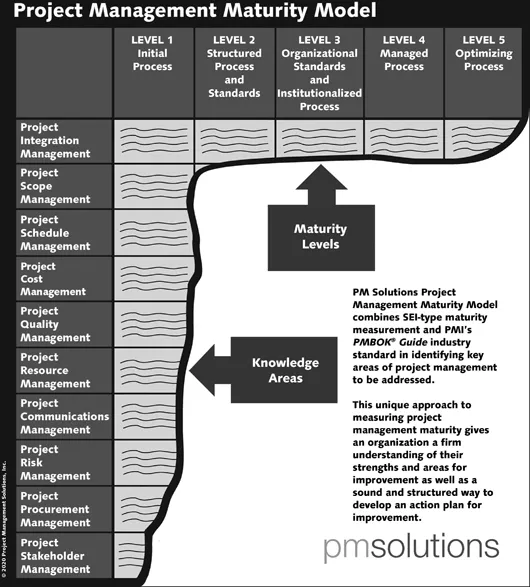
The model that PM Solutions developed utilizes the PMBOKĀ® Guide's ten knowledge areas and is patterned after the CMMI Stage Representative Model from the CMMI Institute. The model has five distinct levels of maturity and examines an organization's implementation across the ten project management knowledge areas (Figure 1.1). The five levels, similar to those in the CMMI models, are described below. Each level represents a discrete organizational capability based on summary-level characteristics.
Figure 1.1
Figure 1.1PM solutions’ project management maturity model utilizes the PMBOKĀ® Guide's ten knowledge areas and the CMMI Institute's stage representation of five levels of maturity as the basic framework. The new Agile/Adaptive maturity model assessment questions are included under each knowledge area, as well as in the PPM maturity model in Appendix B.

Levels of Project Management Maturity

Level 1: Initial Process
Ad hoc processes
Management awareness
Level 2: Structured Process and Standards
Basic processes; not standard on all projects; used on large, highly visible projects
Management supports and encourages use
Mix of intermediate and summary-level information
Estimates and schedules based on expert knowledge and generic tools
Project-centric focus
Level 3: Organizational Standards and Institutionalized Process
All processes standard for all projects and repeatable
Management has institutionalized processes
Summary and detailed information
Baseline and informal collection of actual data
Estimates and schedules may be based on industry standards and organizational specifics
Organizational focus
Informal analysis of project performance
Level 4: Managed Process
Processes integrated with corporate processes
Management mandates compliance
Management takes an organizational entity view
Solid analysis of project performance
Estimates and schedules normally based on organization specifics
Management uses data to make decisions
Level 5: Optimizing Process
Processes to measure project effectiveness and efficiency
Processes in place to improve project performance
Management focuses on continuous improvement

General Component Description

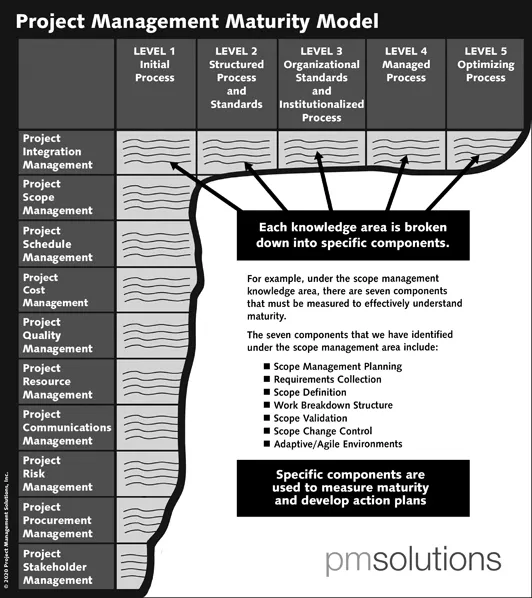
Because the knowledge requirement is very large within each of the PMBOKĀ® Guide's knowledge areas, it was necessary to break down each of the ten areas into key components (see Figure 1.2). This is where the real measurement of maturity takes place. For example, under the Project Scope Management knowledge area, there are six components that must be measured to effectively understand maturity. The six areas that we have identified within scope management include:
  • Scope Management Planning
  • Requirements Collection
  • Scope Definition
  • Work Breakdown Structure
  • Scope Validation
  • Scope Change Control
  • Adaptive/Agile Environment
Figure 1.2
Figure 1.2Each of the ten knowledge areas in the model has been broken down into key components. This example is drawn from Chapter 4, Scope Management.
These seven components are examined independently to determine the adequacy of defining and controlling the project scope.
Scope Management Planning is the ā€œhow toā€ of defining the project scope. This process describes how the project team develops a detailed project scope management plan that documents how the project team defines, validates, and controls project scope.
Requirements Collection is the assessment and development of processes, procedures, and standards relating to the collection of the business and technical requirements of the project.
Scope Definition describes how a detailed description of the project or product is developed.
Work Breakdown Structure examines the formality with which an organization identifies the complete scope of work to be performed. This includes looking at the related dictionary.
Scope Validation covers the verification of elements of the scope statement as acceptable deliverables.
Scope Change Control looks at the process of incorporating additions, changes, and deletions to a project.
From a quick look at these six co...

Table of contents

  1. Cover
  2. Half Title
  3. Series Page
  4. Title Page
  5. Copyright Page
  6. Contents
  7. Acknowledgments
  8. Introduction
  9. 1 Describing Project Management Maturity
  10. 2 Definitions of Maturity Levels
  11. 3 Project Integration Management
  12. 4 Project Scope Management
  13. 5 Schedule Management
  14. 6 Cost Management
  15. 7 Quality Management
  16. 8 Resource Management
  17. 9 Communications Management
  18. 10 Risk Management
  19. 11 Procurement and Vendor Management
  20. 12 Project Stakeholder Management
  21. 13 Now What? Using Your Maturity Assessment to Achieve Business Goals
  22. Epilogue
  23. Appendix A: Self-Assessment Survey
  24. Appendix B: PPM Maturity Model
  25. Appendix C: A Glossary of Terms for Adaptive/Agile Project Management
  26. References
  27. Index