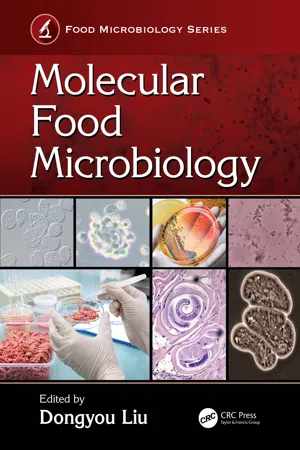
Molecular Food Microbiology
eBook - ePub

Molecular Food Microbiology

  1. 464 pages
  2. English
  3. ePUB (mobile friendly)
  4. Available on iOS & Android
eBook - ePub

Molecular Food Microbiology

About this book

The elucidation of DNA double helix in 1953 and the publication of DNA cloning protocol in 1973 have put wings under the sail of molecular biology, which has since quietly revolutionized many fields of biological science, including food microbiology. Exploiting the power and versatility of molecular technologies, molecular food microbiology extends and greatly improves on phenotypically based food microbiology, leading to the development of better diagnostics for foodborne infections and intoxications, and contributing to the design of more effective therapeutics and prophylaxes against foodborne diseases.

Forming part of the Food Microbiology series, Molecular Food Microbiology provides a state of art coverage on molecular techniques applicable to food microbiology. While the introductory chapter contains an overview on the principles of current DNA, RNA and protein techniques and discusses their utility in helping solve practical problems that food microbiology is facing now and in the future, the remaining chapters present detailed moleuclar analyses of selective foodborne viruses, bacteria, fungi and parasites.

Key Features:

  • Contains a state of art overview on moleuclar techniques applicable to food microbiology research and development
  • Presents in-depth molecular analysis of selective foodborne viruses, bacteria, fungi and parasites
  • Highlights the utility of molecular tecniques for accurate diagnosis and effective control of foodborne diseases
  • Includes expert contributions from international scientists involved in molecular food microbiology research
  • Represents a highly informative textbook for students majoring in food, medical, and veterinary microbiology
  • Offers a contemporary reference for scholars and educators wishing to keep abreast with the latest developments in molecular food microbiology

With contributions from international scientists involved in molecular food microbiology research, this book constitutes an informative textbook for undergraduates and postgraduates majoring in food, medical, and veterinary microbiology; represents an indispensable guide for food, medical, and veterinary scientists engaged in molecular food microbiology research and development; and offers a contemporary update for scholars and educators trying to keep in touch with the latest developments in molecular food microbiology.

Trusted by 375,005 students

Access to over 1.5 million titles for a fair monthly price.

Study more efficiently using our study tools.

Information

Publisher
CRC Press
Year
2021
Print ISBN
9780815359500
eBook ISBN
9781351120364

1

Molecular Food Microbiology
An Overview
Dongyou Liu
Royal College of Pathologists of Australasia Quality Assurance Programs
Contents
1.1 Introduction
1.2 DNA Techniques
1.2.1 DNA Structure and Function
1.2.2 DNA Purification
1.2.3 DNA Characterization
1.2.4 DNA Cloning
1.2.5 DNA Amplification
1.2.6 DNA Sequencing
1.2.7 Mutagenesis and Genome Editing
1.2.8 DNA Modification
1.3 RNA Techniques
1.3.1 RNA Structure and Function
1.3.2 RNA Purification
1.3.3 RNA Characterization
1.3.4 RNA Cloning
1.3.5 RNA Amplification
1.3.6 RNA Sequencing
1.3.7 RNA Interference
1.3.8 RNA Modification
1.4 Protein Techniques
1.4.1 Protein Structure and Function
1.4.2 Protein Purification
1.4.3 Protein Characterization
1.4.4 Protein Sequencing
1.4.5 Polyclonal and Monoclonal Antibodies
1.4.6 Protein Synthesis and Expression
1.4.7 Protein Modification
1.4.8 Protein Interaction
1.5 Utility of Molecular Techniques in Food Microbiology
1.5.1 Phylogenetic Analysis
1.5.2 Species Identification, Strain Typing, and Population Genetics
1.5.3 Antibiotic Resistance
1.5.4 Biosensors
1.5.5 Phage Therapy
1.5.6 Probiotics
1.5.7 Omics
1.5.8 Bioinformatics
1.6 Future Perspectives
References
Summary

1.1 Introduction

Earth is occupied by a diversity of biological organisms, ranging from viruses, bacteria, fungi, parasites, animals to plants. Among an estimated 1 × 1031 viral taxa (mostly phages), about 100 million occur in 1.74 million recognized species of vertebrates, invertebrates, plants, lichens, mushrooms, and brown algae (including ~320,000 viruses in mammals alone). Up to 1 billion bacterial taxa exist, of which ~4 million inhabit soil, ~2 million live in water (river, lake and sea), and ~4 million distribute in the atmosphere. The number of fungal taxa approaches 12 million, with 1,500 yeasts (out of estimated 150,000) and 120,000 filamentous fungi characterized so far. Although 6 million parasitic taxa are likely present, only 1,400 taxa are determined. Further, 1.4 million animal taxa (out of estimated 10-30 million in total) are known, including 1.3 million invertebrates and 66,000 vertebrates, whereas 307,000 plant taxa are identified.
Although a vast majority of microorganisms are free living and maintain symbiotic relationships with their hosts, some have the ability to take advantages of host temporary or long-term weaknesses for their own gains, and induce both innate and adaptive immune responses from as well as pathological changes in their hosts [1, 2 and 3]. To date, 1,407 microorganisms are implicated in human infections, including 208 viruses or prions, 538 bacteria (representing about 10% of 5,000 recognized taxa), 317 fungi (i.e. ~200 yeasts, ~100 filamentous fungi, and 16 microsporidia) and 344 parasites (i.e. 287 helminthes and 57 protozoa) (Table 1.1) [4]. Over 200 human diseases are attributable to pathogenic microorganisms (e.g., hepatitis A virus, norovirus, Bacillus cereus, Campylobacter, Clostridium perfringens, Escherichia coli, Listeria monocytogenes, Salmonella, Shigella, Staphylococcus aureus, Yersinia enterocolitica, Cryptosporidium parvum, Giardia lamblia) or their toxins (e.g., S. aureus enterotoxins, B. cereus emetic toxin, C. botulinum neurotoxins) that dwell in food or water and enter the hosts mainly via oral ingestion and occasionally direct/wound exposure (Table 1.1) [5].
Indeed, foodborne infections were responsible for 33 million disability-adjusted life year (DALY) worldwide and 128,000 hospital stays and 3,000 deaths in the USA in 2010 alone. Furthermore, a 2015 survey in the USA recorded a total of 20,107 foodborne infections involving Salmonella spp. (7,728), Campylobacter spp. (6,309), Shigella spp. (2,688), E. coli non-O157 (796), E. coli O157 (463), Vibrio spp. (192), Yersinia spp. (139), Listeria spp (116), and parasites (1,676), highlighting the disease-causing capacity of food- or water-borne microbial pathogens [6].
TABLE 1.1 Characteristics of pathogenic or toxigenic microbes implicated in foodborne infection or intoxication
CATEGORY
CHARACTERISTICS
Pathogenic viruses
RNA viruses may be single or double stranded (4–33 kb); relatively unstable with high error rate during transcription and high rate of recombination/reassortment during co-infection
DNA viruses may be single stranded (3–6 kb) or double stranded (5–375 kb); relatively stable with low error rate during transcription and low rate of recombination/reassortment during co-infection
Prions (or proteinaceous and infectious virions) are proteins with the ability to change the normal shape of host protein into the prion shape, which coverts even more host proteins into prions
Pathogenic bacteria
Gram-positive bacteria possess a cell wall composed of a thick layer (or several layers) of peptidoglycan attached to an inner cell membrane via lipoproteins and lipoteichoic acids, with a notable absence of an outer membrane
Gram-negative bacteria have a cell wall consisting of a thin layer of peptidoglycan sandwiched between an inner cell membrane and an outer membrane, which contains lipopolysaccharides (LPS, made up of lipid-A, core polysaccharide, and O-antigen) in its outer leaflet and phospholipids in the inner leaflet, with a notable absence of teichoic acids and lipoids
Pathogenic fungi
Yeasts are single-celled organisms that reproduce by budding or binary fission; of ~700 known species, 200 are implicated in superficial, cutaneous, subcutaneous, and systemic infections
Filamentous fungi (~100,000 species identified so far) generate tubular, elongated, and thread-like (filamentous) cellular structures (so-called hyphae), which contain multiple nuclei and extend at tips; filamentous fungi often cause superficial, cutaneous, and subcutaneous infections and produce mycotoxins that lead to food poisoning
Microsporidia are relatives of zygomycetes (possession of chitin and trehalose; sequence similarity in α- and β-tubulin as well as Hsp70 genes), display features reminiscent of both prokaryotes (small genome, 16S and 23S RNA) and eukaryotes (nucleus, mitotic spindle-separated chromosome, cytoskeleton, polyadenylation on mRNA), and produce highly resistant oval or pyriform spores; of ~1,200 species identified, 16 are associated with human diseases
Pathogenic parasites
Protozoa are small (~50 μm), unicellular eukaryotes (~50,000 species identified); human pathogenic protozoa belong mainly to the phyla Sarcomastigophora (amoebae and flagellates, generally reproducing by asexual binary fission) and Apicomplexa (sporozoa, reproducing by both asexual sporogony/schizogony and sexual gamogony)
Cestodes (tapeworms) have a head (scolex) with sucking organs, a segmented body, but lack alimentary canal; each segment is hermaphrodite
Trematodes (flatworms or flukes) have a nonsegmented, usually leaf-like body, with two suckers but no distinct head; contain an alimentary canal (but no anus) and are hermaphrodite; however, schistosomes are thread like and form separate sexes
Nematodes (round worms) appear round in cross section; have body cavities, a straight alimentary canal, and an anus; form separate sexes
Toxigenic bacteria
Endotoxin [i.e., lipopolysaccharide (LPS) or lipooligosaccharide (LOS), also called intracellular toxin] constitutes part of the outer membrane in Gram-negative cell wall and is mostly released upon bacterial disintegration
Exotoxin (also called extracellular toxin) is a soluble, diffusible protein produced by virulent Gram-positive and occasionally Gram-negative bacterial strains
Toxigenic fungi
Aflatoxins (Aspergillus flavus, A. parasiticus, A. fumigatus, A. bombycis, A. ochraceoroseus, A. nomius, A. pseudotamari, and Penicillum islandicum), fumonisins [Fusarium verticillioides (formerly F. moniliforme = Gibberella fujikuroi), F. proliferatum, F. nygamai, and Alternaria alternata f. sp. lycopersici], ochratoxins (Aspergillus alliaceus, A. auricomus, A. carbonarius, A. glaucus, A. melleus, A. niger, A. ochraceus, and P. verrucosum), patulin [P. griseofulvum (formerly P. patulum or P. urticae)], trichothecenes (Fusarium, Myrothecium, Phomopsis, Stachybotrys, Trichoderma, and Trichothecium), zearalenone [F. graminearum (teleomorph Gibberella zeae), F. culmorum, F. equiseti, F. crookwellense, and F. moniliformae], ergot alkaloids (Claviceps purpurea), 3-nitropropionic acid (Aspergillus), mushroom toxins [α-amanitin from death cap (Amanita phalloides); gyromitrin from Helvella mushrooms; muscarine from Inocybe and Clitocybe mushrooms]
Toxigenic marine bacteria, dinoflagellates, algae, and coral
Domoic acid (marine diatoms Pseudo-nitzschia and Nitzschia; red alga Chondria armata), okadaic acid (dinoflagellates Prorocentrum lima and Dinophysis), pectenotoxin (Dinophysis), azaspiracid (dinoflagellates Azadinium spinosum, Azadinium dexteroporum, Amphidoma languida, and Protoperidinium crassipes), yessotoxin (dinoflagellates Protoceratium reticulatum, Lingulodinium polyedrum, and Gonyaulax spinifera), brevetoxin (dinoflagellates Karenia brevis, Chatonella marina, C. antiqua, and C. cf. verruculosa), ciguatoxin (dinoflagellate Gambierdiscus toxicus), palytoxin (coral Palythoa and dinoflagellate Ostreopsis), saxitoxin (dinoflagellates Alexandrium, Gymnodinium catenatum, Pyrodinium bahamense; cyanobacteria Anabaena, Aphanizomenon, Cylindrospermopsis, Lyngbya, Planktothrix, Oscillatoria), cyclic imine (dinoflagellates Karenia selliformis, Alexandrium ostenfeldii, A. peruvianum, and Vulcanodinium rugosum), scombrotoxin (a histamine produced by spoilage bacteria Vibrio, Pseudomonas, Photobacterium, Morganella, Raoultella, Hafnia, etc.), tetrodotoxin (marine bacteria Vibrio, Aeromonas, Pseudomonas, Shewanella, Alteromonas, Caulobacter, Roseobacter, Alcaligenes)
As a branch of biological science, food microbiology examines t...

Table of contents

  1. Cover
  2. Half Title
  3. Series Page
  4. Title Page
  5. Copyright Page
  6. Table of Contents
  7. Series Preface
  8. Preface
  9. Editor
  10. Contributors
  11. 1 Molecular Food Microbiology: An Overview
  12. Section I Molecular Analysis and Manipulation of Foodborne Viruses
  13. Section II Molecular Analysis and Manipulation of Foodborne Bacteria
  14. Section III Molecular Analysis and Manipulation of Foodborne Fungi
  15. Section IV Molecular Analysis and Manipulation of Foodborne Parasites
  16. Index

Frequently asked questions

Yes, you can cancel anytime from the Subscription tab in your account settings on the Perlego website. Your subscription will stay active until the end of your current billing period. Learn how to cancel your subscription
No, books cannot be downloaded as external files, such as PDFs, for use outside of Perlego. However, you can download books within the Perlego app for offline reading on mobile or tablet. Learn how to download books offline
Perlego offers two plans: Essential and Complete
  • Essential is ideal for learners and professionals who enjoy exploring a wide range of subjects. Access the Essential Library with 800,000+ trusted titles and best-sellers across business, personal growth, and the humanities. Includes unlimited reading time and Standard Read Aloud voice.
  • Complete: Perfect for advanced learners and researchers needing full, unrestricted access. Unlock 1.5M+ books across hundreds of subjects, including academic and specialized titles. The Complete Plan also includes advanced features like Premium Read Aloud and Research Assistant.
Both plans are available with monthly, semester, or annual billing cycles.
We are an online textbook subscription service, where you can get access to an entire online library for less than the price of a single book per month. With over 1.5 million books across 990+ topics, we’ve got you covered! Learn about our mission
Look out for the read-aloud symbol on your next book to see if you can listen to it. The read-aloud tool reads text aloud for you, highlighting the text as it is being read. You can pause it, speed it up and slow it down. Learn more about Read Aloud
Yes! You can use the Perlego app on both iOS and Android devices to read anytime, anywhere — even offline. Perfect for commutes or when you’re on the go.
Please note we cannot support devices running on iOS 13 and Android 7 or earlier. Learn more about using the app
Yes, you can access Molecular Food Microbiology by Dongyou Liu in PDF and/or ePUB format, as well as other popular books in Medicine & Microbiology. We have over 1.5 million books available in our catalogue for you to explore.