'In drama, we are the creators. Like in a skeleton, the bones of drama only work together. The human context-the situation, the people and their relationships-are the flesh. The body is given shape and animated by the way we focus those basic elements, and how we place them in space and time. We breathe life into the body through the story and the tension we create, and we give it language and movement to express itself, clothing the drama with its mood and symbols.'In 1987 Brad Haseman and John O'Toole released Dramawise, a dynamic guide to drama education. This book stands as a definitive text for teachers, students and drama practitioners, shaping many classroom programs and curricula at a state, national and international level. Dramawise Reimagined is the successor. It reaches beyond the original concepts, offering newly challenging drama activities that reflect complex questions in today's society.The result is a complete coursebook for students and teachers of secondary-school drama, featuring activities that thoroughly detail each element of drama. This is done using process dramas and plays from the wider world. Practical drama activities are supported with in-depth discussion of each of the elements of dramatic form, as well as traditional and contemporary dramatic meanings and approaches to play-making contextualised by the elements of theatre.
eBook - ePub
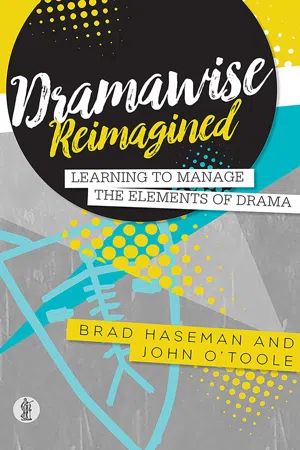
Dramawise Reimagined
Learning to manage the elements of drama
- English
- ePUB (mobile friendly)
- Available on iOS & Android
eBook - ePub
About this book
Information
Topic
EducationSubtopic
Teaching Arts & Humanities
chapter 1
the human context
All drama work involves imagining a make-believe world and stepping into the shoes of its inhabitants. For this pretend world to be meaningful and purposeful, it must have aspects of the real world in it that we can recognise, relate to and identify with. In other words, a human context consisting of a situation involving people and their roles and relationships.
Inventing an imagined world, and inviting others to step into it, is incredibly easy—it’s one of those things we humans do naturally (and that, so far as we know, no other creatures can do). Let’s see how easy.
ACTIVITY 1 OBJECT CIRCLE
In this game, you will be invited into an imaginary world, and the only rule is that you must accept the invitation, then invent another imaginary world to invite the next person into.
- Everybody stands in a circle, with Student A holding an object (any smallish object—a book, a keyring, a scarf).
- Student A: you decide quickly what the object will be transformed into— something similar in shape and size—and who might in real life be giving it to somebody else.
- The invitation: make eye contact with somebody across the circle—Student B— then go over and give your object to them, making the dramatic context clear. For instance, if you have transformed the object into a notebook, you might say, ‘Psst … here are the secret plans for the nuclear reactor—don’t let anyone see you taking them.’ The invitation should be made seriously, respectful of the game.
- Accepting the invitation: Student B must take the object and reply appropriately according to that dramatic situation: e.g. ‘Thank god you’re here, I thought you might have been arrested. I’ll make sure they get to you-know-who.’
- The exchange need not last any longer than that. Now Student B must turn the object into something quite different, in a new dramatic situation, and make an invitation from that situation to Student C across the circle: e.g. ‘Professor, take a look at this amazing specimen I just brought back from the Amazon jungle.’
- Continue until everybody in the group has had a turn.
- The game works very well if the imaginary objects and fictional worlds are easily believable and recognisable, and the offers accepted seriously and immediately. It works even better when the invitations are imaginative.
Play the game again, each time with a more awkward object (e.g. a chair), and think of more bizarre and challenging invitations—e.g. ‘Would you look after my dog for a bit please?—he doesn’t bite often!’ By now everybody will be accepting the fictional worlds, and trusting each other, so laughter is fine and you can have a lot of fun as this game develops.
In that simple activity, you have sown the seeds of as many new dramas as there are people in the group. In each exchange, the two participants stepped into an imaginary human context. This is the first element of drama. We will begin to explore this element by considering five key questions. These are often referred to as the Five Ws:
What is happening?
Where is it happening?
When is it happening?
Who is it happening to?
What’s at stake?
The first four are the subject of this chapter; the fifth is the subject of Chapter 2.
The Dramatic Situation—What’s Happening, Where and When
In understanding a drama, it is nearly always helpful to look at these questions first, to find out what the dramatic situation is. And to show how easy it is to develop a situation you have invented, let’s try another drama game. This game is rather like the last, but will take us further into the dramatic situation.
ACTIVITY 2 ROLE CIRCLE
- Everybody stands in a circle, with the leader (the teacher or a student) in the middle. Everybody else is going to take on the role of the same person, and answer questions as that person.
- The leader takes the role of a detective, and explains that this investigation is into an incident that occurred some time last Friday.
- The leader then asks someone at random their name. That person must respond with a fictional name. Then the leader, starting each query with that name, asks questions of other people, one at a time, each question building on the previous answer.
- The only rule is that when you answer you must accept everything that has already been said, and neither contradict it nor block a question with ‘I don’t know’ or an impossible or unrealistic response.
- Make sure that a sensible story emerges. Until you are spoken to, listen carefully and remember the answers given to the detective’s questions. For example: Detective: What’s your name?Student A: Mary.Detective: (to another student) Mary who?Student B: Mary Johnson.Detective: (to a third student) How old are you, Mary?Student C: Twenty.Detective: (to a fourth student) Mary Johnson, where were you at 7 pm onFriday night?Student D: In town with my friends.Detective: (to a fifth student) Whereabouts in town?Student E: In the shopping mall.Detective: (to a sixth student) How many friends?Student F: Two—my sister and her boyfriend.Detective: (to a seventh student) Which of you first saw the trouble start?Student F: Her boyfriend.Detective: What exactly did he see?… and so on.
- Run this investigation until everybody has had a turn, or until the incident and the Three Ws have become clear. What’s happening?When is it happening?Where is it happening?
- Run this game a few times from different starting points, and perhaps with the leader not as a detective, but another kind of questioner, such as a suspicious parent, or a time traveller from another age.
Role—Who it is Happening to
As the last two activities showed, you can’t portray a human situation without people being the most important part of it. In theatre and drama these fictional people are known as the characters, and in improvised and process drama, which we use throughout this book to explore its elements, we will be role-playing those characters.
Role-playing does not need elaborate acting skills; when you take on a role you are simply representing a point of view. You can portray this simply, honestly and as yourself—you don’t need to ‘act the part’ with special voices, costumes or funny walks, and often not even props. What you do need in improvisation is the ability to signal and negotiate your role and relationships with the other players.
ACTIVITY 3 NEGOTIATING ROLE AND RELATIONSHIPS
- Form pairs and find a space apart from everyone else. Decide who is A and who is B.
- A then moves away from B, and takes a few seconds to think of a situation (...
Table of contents
- Cover
- Title
- Join The Dramawise Community
- Introduction
- Chapter 1: The Human Context
- Chapter 2: Dramatic Tension
- Chapter 3: Focus
- Chapter 4: Place And Space
- Chapter 5: Time
- Chapter 6: Narrative
- Chapter 7: Language
- Chapter 8: Movement
- Chapter 9: Mood
- Chapter 10: Symbols
- Chapter 11: Traditional Dramatic Meanings
- Chapter 12: Contemporary Dramatic Meanings
- Chapter 13: Playmaking
- Conclusion
- References
- Acknowledgements
- Index
- About the Authors
- Copyright Details
- Also Available From Currency Press
Trusted by 375,005 students
Access to over 1.5 million titles for a fair monthly price.
Study more efficiently using our study tools.
Frequently asked questions
Yes, you can cancel anytime from the Subscription tab in your account settings on the Perlego website. Your subscription will stay active until the end of your current billing period. Learn how to cancel your subscription
No, books cannot be downloaded as external files, such as PDFs, for use outside of Perlego. However, you can download books within the Perlego app for offline reading on mobile or tablet. Learn how to download books offline
Perlego offers two plans: Essential and Complete
- Essential is ideal for learners and professionals who enjoy exploring a wide range of subjects. Access the Essential Library with 800,000+ trusted titles and best-sellers across business, personal growth, and the humanities. Includes unlimited reading time and Standard Read Aloud voice.
- Complete: Perfect for advanced learners and researchers needing full, unrestricted access. Unlock 1.5M+ books across hundreds of subjects, including academic and specialized titles. The Complete Plan also includes advanced features like Premium Read Aloud and Research Assistant.
We are an online textbook subscription service, where you can get access to an entire online library for less than the price of a single book per month. With over 1.5 million books across 990+ topics, we’ve got you covered! Learn about our mission
Look out for the read-aloud symbol on your next book to see if you can listen to it. The read-aloud tool reads text aloud for you, highlighting the text as it is being read. You can pause it, speed it up and slow it down. Learn more about Read Aloud
Yes! You can use the Perlego app on both iOS and Android devices to read anytime, anywhere — even offline. Perfect for commutes or when you’re on the go.
Please note we cannot support devices running on iOS 13 and Android 7 or earlier. Learn more about using the app
Please note we cannot support devices running on iOS 13 and Android 7 or earlier. Learn more about using the app
Yes, you can access Dramawise Reimagined by Brad Haseman,John O'Toole,John O’Toole in PDF and/or ePUB format, as well as other popular books in Education & Teaching Arts & Humanities. We have over 1.5 million books available in our catalogue for you to explore.