- 352 pages
- English
- ePUB (mobile friendly)
- Available on iOS & Android
eBook - ePub
Patisserie
About this book
This classic book, widely known and used by patissiers is a professional text on the art of patisserie. In the twenty years that Patisserie has been published there have been great changes in almost every aspect of this art, and the author has thoroughly updated this new edition to take account of these.
Updated in paperback format the revised edition of this classic text is now even more affordable, practical and enjoyable. Complete with the original, beautiful seventy-three colour photographs, each shows clearly how the finished product should be presented, and a wide range of diagrams demonstrate the more complex processes.
New dishes have been added, for example, pavlova, sticky toffee pudding, blinis, pasta dough, frangipan apple, cheesecake, and sugar balls, while some of the existing ones have been amended or replaced. Additional information on fruits, and on using eggs or egg substitutes in patisserie have been included. Of special interest are the chapters on equipment, commodities, and hygiene, which include the provisions of the Food Hygiene (Amended) Regulations 1990, as far as they affect the patisserie section of the catering industry.
Information
1 | Patisserie equipment, |
Equipment (Figures 1, 2 and 3)
It is a legal requirement that equipment with which food comes into contact or is liable to come into contact is kept clean and kept in such good order, repair and condition to enable it to be effectively cleaned. Equipment must be non-absorbent. In the past, a lot of the equipment and utensils used by the patissier were constructed of wood. These should now be replaced with non-absorbent polypropylene or stainless steel alternatives.
A whole range of equipment is used by the patissier – from an oven to a patty pan – but some items merit special attention as follows.
Bain-marie
When in use, the main precaution is to see that the pan is never allowed to burn dry. When not in use, the bain-marie should be emptied, cleaned inside and out, washed in hot detergent water, then rinsed and dried.
Baking sheets
These are made of either aluminium or steel.
Aluminium
This has the advantage of being light in weight, rustless, and able to conduct heat more quickly. Its main disadvantage is that it is a softer metal and is, therefore, not so durable. It must, therefore, be treated with care. When scraping off food soils never use a steel scraper as this will scratch the surface and may remove some of the metal. The best method of cleaning is to use water with a mild disinfectant. If a scraper has to be employed, use either a celluloid or nylon one.
Steel
Although this will stand up to more harsh treatment, its obvious disadvantage is its liability to rust. If water is used to wash the tin, always thoroughly dry afterwards. Often the cause of rust can be traced back to buns being left on the tin to cool. When this happens, the steam trapped between the tin and the bun condenses to water and, if left, rusts away that part of the tin under the bun.
Of whatever metal the baking sheet is made, make sure that the corners are really well cleaned. It is here that the particles of food accumulate and if left will bake onto the surface of the tin to leave a soil which is difficult to remove. When cleaning baking tins, concentrate on the corners and the centre will clean itself!
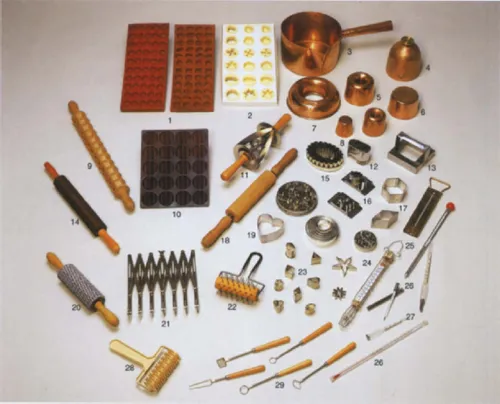
1 Rubber moulds for fondant centres
2 Marzipan and pastillage flower cutters
3 Copper boiling saucepan
4 Bomb mould
5 Pouding souffle moulds
6 Charlotte mould
7 Savarin mould
8 Danish mould
9 Ravioli roller
10 Petits florentine chocolate moulds
11 Croissant cutter
12 Seahorse fleuron cutter
13 Danish pastry cutter
14 Ribbed roller
15 Assorted cutters
16 Crimping tool
17 Petits torten moulds
18 Patterned roller
19 Petit torte mould
20 Basket roller
21 Tracy cutter
22 Roller docker
23 Small petits fours cutters
24 Aspic cutters
25 Sugar boiling thermometers
26 Dough thermometers
27 Saccharometers
28 Trellis cutter
29 Chocolate dipping forks
Figure 1 Equipment
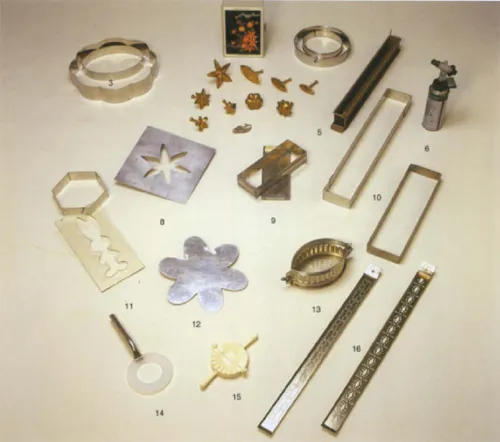
1 Torten ring
2 Flan ring
3 Torten rings
4 Boiling sugar moulds
5 Pate croûte mould
6 Blowtorch
7 Torten ring
8 Tuille stencil
9 Glace bisquit mould
10 Torten mould for slices
11 Rabbit stencil
12 Metal template
13 Pie mould
14 Stencil for japs
15 Savoury pie crimper
16 French torten stencils
Figure 2 Equipment
Brushes
These need washing and thoroughly drying at regular intervals. If left, there is a build up of food particles adhering to the bristles which quickly reduces the efficiency of the brushes. This is particularly prevalent with board brushes used for brushing such commodities as flour which, when wet, forms a tenacious paste which dries hard on the bristle.
Cake machines and attachments
These should be regularly serviced and lubricated to ensure freedom from breakdown. One of the most annoying faults with these machines is the leakage of oil which tends to drip into the mixing. If this happens when sponges or meringues are being made, they could be completely ruined. Cleaning of machines after each use is desirable but, if moving parts like the blade of a mincer are involved, thorough drying is essential to prevent rust formation. Traces of mixings left on the handles, etc. of the machine are not only unhygienic but can contaminate other mixings. It is important that these mixers should not be overloaded. This can easily happen by allowing them to mix stiff pastes and doughs. It is better to mix these by hand if in doubt.
Bowls, whisks, beaters, etc. should always be washed in very hot water to eliminate traces of grease which can have disastrous consequences to mixes such as meringues and sponges.
Cloths (muslin, jelly bags, and piping bags)
These should be regularly laundered and sterilized. Often pastry is left wrapped in a damp cloth. It should be remembered that such practice increases the risk of attack by mould and could infect the goods with this micro-organism and others.
Cutters
Pastry cutters are usually very poorly cared for. They are comparatively fragile utensils and, with misuse, quickly lose their shape. Always ensure that cutters are put away in their boxes clean and dry. If cutters are replaced in their boxes without proper cleaning, the food particles adhering can go bad without anyone noticing. When cleaning, special attention should be given to the rim where food particles can easily become lodged. If the cutters are washed, make sure that they are really well dried out before replacing in their boxes; otherwise rust will soon be apparent.
Cutting boards
A variety of non-absorbent hygienic cutting boards are now available, the majority of which can be obtained in different colours to minimize cross-contamination and the picking up of odours, for example fruit and chocolate will readily pick up the odour of onions.
Docker
This is a wooden disc with protruding points used to make a number of small holes in pastry. Roller dockers are now available which greatly speeds up this operation. When cleaning it, it is essential to remove any food soil from the points.
Dredgers
These are used for giving a light dusting of flour, icing sugar, etc. Since the same kind of dredger is used for these materials, it is important to have some means of identification; otherwise the flour could be mistaken for sugar and vice versa. Regular cleaning is again recommended with a regular change of contents.
Drying cabinet
This is a useful piece of equipment for keeping goods such as pulled and blown sugar pieces, nougat, etc., in perfect condition. It consists of an airtight, dust-proof cabinet on the base of which provision is made for a tray containing silica gel. This will absorb moisture in the cabinet, which if left would ruin such sugar goods by gradually reducing the sugar to syrup. The silica gel is removed and heated at regular intervals to evaporate the moisture collected and to revert the gel to its dry state before returning it to the cabinet. The silica gel is usually sold with a blue test paper which turns red when the gel needs reheating.
Showpieces made from boiled sugar w...
Table of contents
- Front Cover
- Half Title
- Dedication
- Title Page
- Copyright
- Contents
- Preface to the Second Edition
- Preface to the First Edition
- Acknowledgements
- 1 Patisserie equipment, hygiene and ingredients
- 2 Short pastries, flans and tarts
- 3 Puff pastries
- 4 Sponge goods
- 5 Meringue goods
- 6 Cakes
- 7 Chou pastries
- 8 Torten and gâteaux
- 9 Petits fours sees
- 10 Petits fours glacés
- 11 Afternoon tea fancies
- 12 Savoury goods
- 13 Fermented goods
- 14 Sweet sauces
- 15 Bavarois and jelly sweets
- 16 Fruit and other sweets
- 17 Puddings
- 18 Chocolate work
- 19 Almond and other pastes
- 20 Sugar work
- 21 Preserves, creams and icings
- 22 Ices
- Glossary of patisserie terms
- Temperature conversion table
- Index
Trusted by 375,005 students
Access to over 1.5 million titles for a fair monthly price.
Study more efficiently using our study tools.
Frequently asked questions
Yes, you can cancel anytime from the Subscription tab in your account settings on the Perlego website. Your subscription will stay active until the end of your current billing period. Learn how to cancel your subscription
No, books cannot be downloaded as external files, such as PDFs, for use outside of Perlego. However, you can download books within the Perlego app for offline reading on mobile or tablet. Learn how to download books offline
Perlego offers two plans: Essential and Complete
- Essential is ideal for learners and professionals who enjoy exploring a wide range of subjects. Access the Essential Library with 800,000+ trusted titles and best-sellers across business, personal growth, and the humanities. Includes unlimited reading time and Standard Read Aloud voice.
- Complete: Perfect for advanced learners and researchers needing full, unrestricted access. Unlock 1.5M+ books across hundreds of subjects, including academic and specialized titles. The Complete Plan also includes advanced features like Premium Read Aloud and Research Assistant.
We are an online textbook subscription service, where you can get access to an entire online library for less than the price of a single book per month. With over 1.5 million books across 990+ topics, we’ve got you covered! Learn about our mission
Look out for the read-aloud symbol on your next book to see if you can listen to it. The read-aloud tool reads text aloud for you, highlighting the text as it is being read. You can pause it, speed it up and slow it down. Learn more about Read Aloud
Yes! You can use the Perlego app on both iOS and Android devices to read anytime, anywhere — even offline. Perfect for commutes or when you’re on the go.
Please note we cannot support devices running on iOS 13 and Android 7 or earlier. Learn more about using the app
Please note we cannot support devices running on iOS 13 and Android 7 or earlier. Learn more about using the app
Yes, you can access Patisserie by Leonard J Hanneman in PDF and/or ePUB format, as well as other popular books in Art & Hospitality, Travel & Tourism Industry. We have over 1.5 million books available in our catalogue for you to explore.