What is the place of human free will in our lives if all our actions are the result of some other cause? Does our processing unconscious beliefs or desires make us less free? Is our free will necessarily restricted if we do not choose our own beliefs?
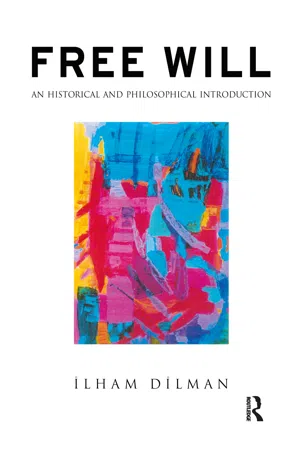
The debate between free will and its opposing doctrine, determinism, is one of the key issues in philosophy. Free Will: An historical and philosophical introduction provides a comprehensive introduction to this highly important question and examines the contributions made by sixteen of the most outstanding thinkers from the time of early Greece to the twentieth century:
*Homer *Sophocles *Platto *Aristotle *St Augustine *St Thomas Aquinas *Descaartes *Spinoza *Hume *Kant *Schopehauer *Freud *Sartre *Weil *Wittgenstein *Moore
Ilham Dilman brings together all the dimensions of the problem of free will with examples from literature, ethics and psychoanalysis. Drawing out valuable insights from both sides of the free will-determinism divide, and he provides an accessible and highly readable introduction to this perennial problem.
- 288 pages
- English
- ePUB (mobile friendly)
- Available on iOS & Android
eBook - ePub
About this book
Information
Part I Early Greek Thinkers Moral determinism and individual responsibility
1 Homer and the Iliad Necessity and Grace
DOI: 10.4324/9780203002384-1
1 War: Its Hazards and Necessities
Early Greek thinkers, whether they be poets, dramatists or philosophers, had a tragic perception of the subjection of human beings to what they themselves initiate. But they thought of it as subject to their own character and of that, in turn, as subject to something in them all, something which belongs to ‘human nature’. Some represented this as a subjection to a destiny with which the exceptional individual is in struggle, though as helpless in the face of it as the rest. They thought further that the direction in which he was moving inexorably and where he would end up was accessible to a certain kind of perception or insight, given often to those lacking physical sight – viz Teiresias in Oedipus Rex – and so not distracted by interests rooted in its vision – viz the importance of detachment for the possibility of knowledge in the Phaedo.
In Homer’s poem the Iliad human beings initiate the Trojan war. The poem represents the men fighting on both sides as caught up in and enslaved by it. It is they who wage the war, but they become what the war makes of them. Yet it is because they are human that they become what the war makes of them. They are transformed by their pursuit of victory: both by the nearness of victory before it eludes them and by the nearness of death when victory slips from them. On the crest of its wave they are oblivious of their own vulnerability and are hard with and merciless towards those on the brink of defeat. In this blindness to themselves and to others, in the arrogance which hides their kinship to those at their mercy and makes them indifferent to their plight, they are puppets whose strings are pulled by their fortune in the war. They are not its architect. It is their fortune which makes them arrogant, and that fortune in turn is subject to chance and so open to change. The arrogance which it engenders is thus an empty bubble sustained temporarily by a lie about the human condition.
When it is their turn to be in the trough of the wave they come to know what it is to be at the mercy of others who are as hard with them as they themselves were with others. They come to see that their previous good fortune was not something they could have relied on and that it was not their due or desert. In the face of defeat they experience their impotence and the illusory character of the power they had. It was not really theirs. They and the power they exercised were not one but two, and when it was not theirs to exercise because they came face to face with somebody stronger or suffered a chance set back they were left exposed to the same power in the hands of others. That power was not theirs since it was now wielded by others and they were its object. This is not a grammatical platitude about the way power is individuated. It is a truth to which those who wield power and are drunk with it are blind: while they wield it they really think they are invulnerable and immortal.
Thus power, the poem shows, while it is something which many, perhaps most people, find desirable and seek, is not something anyone can appropriate or make his own. Those who have it are deceived by the idea it gives them that they can overcome any obstacle that stands in the way of what they want and that they are safe against any predatory attack. No one can be that. They are deceived equally by the idea it gives them that it is there to stay with them, that it is something they hold and so something they can keep. In reality not only is it by chance that they are able to exercise the power they exercise, but they are also its slave. It determines their conduct and they do not know how to get on without it.
At home, before the expedition, the Greeks each had their own individual life and character. They had their family, wife and children, and the different preoccupations that filled their lives. On the battleground all this is a memory, almost unreal. The Trojans are, of course, on their home ground, exerting themselves to defend it. But it was they who brought the Greeks to their doorstep. It was Paris, their king Priam’s son, who kidnapped Menelaus’ beautiful wife Helen. The Greeks are there to reclaim her and avenge the kidnapping. But if that is what leads the Greeks to mount the Trojan expedition, once the catch has been released, the spring which is set free has an inertia all its own. It drags all concerned into a milieu in which they are no longer in control over their actions.
While they act in character, they are cut off from the things that are of importance and interest to them in the life in which they have up to now been themselves. Being in exile from that life their life has been arrested and they have been taken over by the desire to crush the enemy and to defend themselves. It is only in short intervals, during lulls in the fighting, when they can remember and mourn, that their humanity is restored, only to be lost again. Within their one-dimensional life on the battle field, they have no choice but to obey what takes them over: they have to prevail over the enemy, teach them a lesson, avenge their dead. As the scores to settle mount each side is further and further anchored in their determination to prevail, to avenge, to destroy. That is how they are locked in an endless cycle of reaction and counter-reaction, each side bent on destroying the other, whatever it takes to do so, that is at whatever cost to themselves.
In such a scene their physical strength and prowess is the only thing they can count on; it is the only thing on which their sense of self, of being someone to be reckoned with, depends. It is the other side of despair; for without it they have nothing, they are nothing, and they are at the mercy of those who know no mercy. They cling to it and it turns them into things.
This is a powerful picture of human subjection, of the slavery of individuals to a cycle of reactions that are natural but mindless – mindless because in his uprooted state the individual has very little to mind: to care, to respect, to take into consideration. With the rupture inherent in such uprootedness, the natural reactions that take over are those of self-assertion and retaliation to any threats to such assertion, taken as insult to the self, and self-preservation. The reactions of self-assertion are ruthlessly aggressive, while those of self-preservation have their source in near-animal fears. Both sets of reactions are human, but at source they are entangled with the activation of the capacity to survive that is part of all biological life.
When I spoke of ‘rupture’ just now I meant from the many-dimensionality of human life. A human being is free who can move within these many dimensions and choose within their framework. Anything that severs the individual from access to what is part of his life enslaves him. Thus an individual who is unable to take into consideration any of it in his actions because it has lost its reality for him, temporarily or permanently, is someone driven to what he does.
2 Simone Weil on the Iliad: Necessity and Grace
Simone Weil who has written a very searching and thoughtful essay on the Iliad takes a deeper view of what the poem portrays and expresses. She characterizes it as ‘le poem de la force’; she says that force is its real subject. It changes, she says, all those it touches, all those who are subject to it, into things: its victims, the weak, as well as those who wield it, the strong – like Achilles. In those it crushes it wipes out all inner life. Those who have been crushed by it, in their affliction, cannot think of either the past or the future, they cannot compare their present state with anything, they cannot rebel or make plans for the future. As she puts it:
At first war is easy and is loved basely. The day comes when fear, defeat and the death of comrades bring the soul of the warrior to its knees before necessity. War then stops being a game or a dream; the warrior comes to see that it is real, that it contains death. Death changes from being a limit imposed in advance on the future to being the future itself. Then one cannot think of anything in the future without passing through the idea, the image of death. Thus war erases all idea of an end – of something to aim at – even the aims of the war. …Those who are there do nothing that will bring it to an end. Intolerable afflictions of this kind last on account of their own weight … because they take away the resources necessary for coming out of them.(Weil 1963, p. 29 my translation)
Force petrifies, she argues, differently but equally, the souls of all those who are its victims and those who manipulate it (p. 32). Those who manipulate it become drunk with it. We shall see how this connects with Plato’s claim that those into whose souls evil has entered no longer know what they are doing and have lost all mastery over themselves. Those who wield force walk in a medium which offers no resistance to their progress, since brute force eliminates obstacles. They do not, therefore, feel the need to plan, consider how to realize their intentions, to attend, give thought to and negotiate difficulties. They become, as we say, ‘too big for their boots’, contemptuous of what stands in their way and careless. ‘They ignore the fact that their power is limited and finally they find that things no longer obey them’ (p. 21).
Thus the attraction of power, once one gives in to it, sets off an automatic chain of reactions: drunkenness with power generates ‘hubris’, an arrogant self-confidence, which regards all obstacles and difficulties with contempt. That leads one to ignore the limits of one’s power. Sooner or later one exceeds these limits and is delivered to fate: one passes to the other side and becomes the victim of force. The same fate awaits those into whose hands force now passes and the cycle goes on indefinitely. Men are thus not the initiators of the events depicted in the Iliad; they are the passive or inert vehicles through which these events take place. They are the cogs in a mechanism of nature which, in tune with the early Greeks, Simone Weil calls necessity. The battles, she says, are not decided by men who calculate, enter into deals, take resolutions and execute them, but by men who have become bereft of their faculties, transformed into the grade of inert matter, which is nothing but passivity, and so by blind forces (p. 32).
The Iliad, she says, gives us a just representation of the empire of force and, therefore, of the rule of necessity in human life. Men are its slaves. She further believes that force occupies the centre stage in human affairs: it is at the centre of all human history (p. 11). It forms part of what elsewhere she called ‘moral gravity’, a counterpart in the human world of Newton’s gravity which operates in the physical world (Weil 1948). She compares the way it erases inner life with the way nature does, when vital needs such as hunger come into play, say, with starvation. That too erases all inner life, even the pain of a mother – the way Niobé, when she is tired of tears, thinks of eating, or the way sleep overtakes those crying at the death of their comrades.
But although necessity thus rules in the human world, the early Greeks had a conception of something with which they contrasted the determinism to which they gave prominence in their literature and philosophy with something else. Simone Weil calls it grace:
The lightness of those who manipulate without respect and without taking any thought the men and things they have or think they have at their mercy, the despair which forces the soldier to destroy, the way the slave and the defeated are crushed, the massacres, all contribute to making a scene of undiluted horror. Force is its sole hero. The result would have been a gloomy monotony, had there not been, scattered here and there, some luminous moments, moments brief and divine in which men have a soul. The soul which thus awakes, for a moment, to be lost soon after because of the empire of force over the souls of men, is awakened pure and intact. In such moments there appears no ambiguous, complicated or troubled sentiment; only courage and love illuminate such sentiments. Sometimes a man thus finds his soul in self-deliberation, such as when Hector in front of Troy, without any help from God or man, tries on his own to stand and face his destiny. The other moments when men find their souls are those in which they love. Almost none of the pure forms of love between human beings is absent in the Iliad(p. 33).
‘These moments of grace are rare in the Iliad,’ she says, ‘but they suffice to make us feel with extreme regret what violence destroys and will destroy’ (p. 35). She then points out the ‘accent of inconsolable bitterness which continually makes itself felt’ in the poem, a ‘bitterness which proceeds from tenderness, one which extends to all human beings equally like the clarity of the sun’, one which, however, ‘never lowers itself into complaint’.
Justice and love, which can never have a place in this scene of extreme and unjust acts of violence, bathe them with their light, without ever becoming visible other than by the accent of the verse. Nothing precious, destined or not to destruction, is despised, the misery of all concerned is exposed without dissimulation or disdain, no man is put above or below the condition that is common to all men, everything that is destroyed is regretted. The victors and the vanquished are equally close to the author and the audience and made of the same clay as them(pp. 35–6).
She talks of this as the just expression of affliction (p. 40). For ‘the cold brutality of the facts of war are not disguised by anything, since neither victors nor the vanquished are admired, but not despised or hated either’. They are both represented as the victims of force; it is the gods who decide the changing fate of the combatants. They are like the particles of water that are one moment on the crest of a wave, the next moment at the trough. This is an image Simone Weil uses elsewhere. It is a just expression because it comes from the perspective of love and justice: ‘the idea of justice illuminates it without ever intervening in what is depicted’ (p. 38). She means that there is no suggestion of any compensation of the injustices depicted, no suggestion that there will be any time when the wrongs that are depicted will be righted or compensated. The poem offers no such consolation.
3 Homer's Objectivity: Love and Detachment
Alexander Pope wrote that ‘Nature and Homer were the same’ (Essays on Criticism, p. 124). In an essay on Anna Karenina Lionel Trilling compares Pope on Homer and Matthew Arnold who said something similar about Tolstoy to the effect that Anna Karenina is not a work of art but a piece of life. He comments that the ‘objectivity’ which Arnold finds in Tolstoy’s novel and Pope in Homer’s poem is an illusion:
Homer gives us, we are told, the object itself without interposing his personality between it and us. He gives us the person or thing or event without judging it, as Nature itself gives it to us. And to the extent that this is true of Homer, it is true of Tolstoy. But again we are dealing with a manner of speaking. Homer and Nature are of course not the same, and Tolstoy and Nature are not the same. Indeed, what is called the objectivity of Homer or of Tolstoy is not objectivity at all. Quite to the contrary it is the most lavish and prodigal subjectivity possible, for every object in the Iliad or in Anna Karenina exist in the medium of what we must call the author’s love. But this love is so pervasive, it is so constant, and it is so equitable, that it creates the illusion of objectivity … For Tolstoy everyone and everything has a saving grace. Like Homer, he scarcely permits us to choose between antagonists’(Trilling 1955, p. 68–9).
Others, such as Kierkegaard, have pointed out that in the kind of judgement that is in question here truth is subjectivity. In other words here we are in the sphere of the personal, and where the person making a judgement does not or cannot speak for himself he has nothing to say at all. But that does not mean that no distinction can be made between different judgements that belong to the personal. Thus Trilling contrasts Tolstoy’s ‘objectivity’ with Flaubert’s:
Flaubert’s objectivity is charged with irritability and Tolstoy’s with affection … it is when a novelist really loves his characters that he can show them in their completeness and contradiction, in their failures as well as in their great moments, in their triviality as well as in their charm … What we call Tolstoy’s obje...
Table of contents
- Cover Page
- Half Title Page
- Title Page
- Copyright Page
- Table of Contents
- Introduction
- PART I Early Greek thinkers: moral determinism and individual responsibility
- PART II The coming of age of Christianity: morality, theology and freedom of the will
- PART III The rise of science: universal causation and human agency
- PART IV The age of psychology: reason and feeling, causality and free will
- Notes
- Bibliography
- Index
Trusted by 375,005 students
Access to over 1.5 million titles for a fair monthly price.
Study more efficiently using our study tools.
Frequently asked questions
Yes, you can cancel anytime from the Subscription tab in your account settings on the Perlego website. Your subscription will stay active until the end of your current billing period. Learn how to cancel your subscription
No, books cannot be downloaded as external files, such as PDFs, for use outside of Perlego. However, you can download books within the Perlego app for offline reading on mobile or tablet. Learn how to download books offline
Perlego offers two plans: Essential and Complete
- Essential is ideal for learners and professionals who enjoy exploring a wide range of subjects. Access the Essential Library with 800,000+ trusted titles and best-sellers across business, personal growth, and the humanities. Includes unlimited reading time and Standard Read Aloud voice.
- Complete: Perfect for advanced learners and researchers needing full, unrestricted access. Unlock 1.5M+ books across hundreds of subjects, including academic and specialized titles. The Complete Plan also includes advanced features like Premium Read Aloud and Research Assistant.
We are an online textbook subscription service, where you can get access to an entire online library for less than the price of a single book per month. With over 1.5 million books across 990+ topics, we’ve got you covered! Learn about our mission
Look out for the read-aloud symbol on your next book to see if you can listen to it. The read-aloud tool reads text aloud for you, highlighting the text as it is being read. You can pause it, speed it up and slow it down. Learn more about Read Aloud
Yes! You can use the Perlego app on both iOS and Android devices to read anytime, anywhere — even offline. Perfect for commutes or when you’re on the go.
Please note we cannot support devices running on iOS 13 and Android 7 or earlier. Learn more about using the app
Please note we cannot support devices running on iOS 13 and Android 7 or earlier. Learn more about using the app
Yes, you can access Free Will by Ilham Dilman in PDF and/or ePUB format, as well as other popular books in Philosophy & Free Will & Determinism in Philosophy. We have over 1.5 million books available in our catalogue for you to explore.