![]()
Part One
The Meaning of Marketing in Travel and Tourism
Part One sets out the key definitions of travel and tourism and outlines the component sectors of the visitor economy that are referred to throughout the book. The subject of marketing is introduced, especially for those who are coming new to the subject, and the special characteristics of travel and tourism to which marketing responds are explained.
This part of the book also explains the main factors in the external business environment that influence tourism market demand and supply in all parts of the world.
![]()
Chapter 1
Introducing Travel and Tourism
‘There are few regions of the world where tourism does not make an impact’
Kamila Pirowska c/r Bournemouth University.
Tourism comprises the activities of persons travelling to and staying in places outside their usual environment for not more than one consecutive year for leisure, business and other purposes.
(WTO, 1992: subsequently ratified by the UN Statistical Commission in 1994)
This chapter introduces and defines the subject matter of this book. First it identifies for practical marketing purposes the nature of travel and tourism and the sectors of the modern visitor economy it supports. Secondly it indicates the role of tourism in the global economy of the twenty-first century and its growth potential in the next decade.
After Studying this Chapter you should be able to Understand:
• How travel and tourism is defined internationally.
• How to identify the main component parts of tourism.
• The limitations of the term tourism industry and the wider concept of visitor economy.
• The linkages between demand and supply in tourism.
• Trends in the global economy that have redefined the significance of tourism in modern societies and created what many now identify as the world’s largest industry.
Although the niceties of definitions can be debated endlessly, the authors of this book believe that travel and tourism is best understood as a market. It is a market that reflects the demands of consumers for a very wide range of travel-related products and the supply of services by a wide array of commercial and public sector organizations. It is widely claimed that this total market is now serviced by the world’s largest industry. In the twenty-first century increasing interest is being shown in many countries in the potential of global travel and tourism as an important contributor to economic development, measured in terms of investment, employment and balance of payments. In developed countries in particular there is also increasing interest in the potential environmental and cultural contributions of tourism to the social and cultural life of host communities and to the built and ‘There are few regions of the world where tourism does not make an impact’ Kamila Pirowska c/r Bournemouth University. natural environments. Effectively managed, tourism can play an important role in more sustainable developments at visited destinations; tourism is also of interest because of its ubiquitous nature. There are very few regions of the modern world where tourism and the contribution of the visitor economy to residents’ lives are not a relevant consideration and travel extends to all parts of most countries. As a result tourism sustains not only international organizations such as airlines, tour operators and hotels but also thousands of small and medium-sized enterprises (SMEs) that are vital elements in most economic systems.
Recognition of potential is, however, matched by growing concerns about the negative effects of travel and tourism in the conspicuous use of energy and water supplies, impact on CO2 emissions, global warming and climate change, and damage to marine environments and the ecosystems of some destinations developed as major tourism resorts.
Marketing is a subject of vital concern in travel and tourism because, in practical terms, it harnesses the power of massive commercial forces as well as government and regulatory influences. As explained in Chapters 2 and 3, it is the principal management influence that can be used to shape the size and behaviour of a major, growing global market.
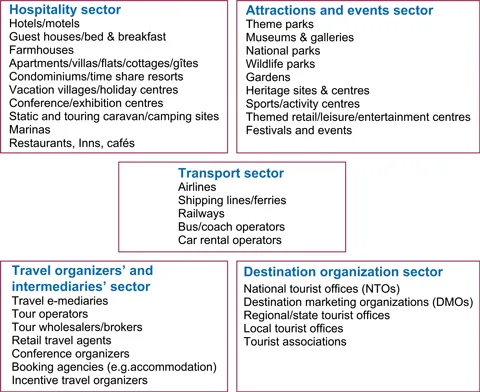
Within the total market there are many sub-markets or segments, and many products designed and provided by a wide range of organizations, which are categorized in Fig. 1.1 (p.11). As an overall market, travel and tourism is best understood in terms of demand and supply. Marketing is introduced in Chapter 2 as the vital linking mechanism between supply and demand focused on exchange transactions in which consumers exercise preferences and choices, and exchange their time and money in return for the supply of particular travel experiences or products. For reasons discussed subsequently, the principles and practice of marketing are also highly relevant to tourism resources for which no market price is charged, such as national parks and historic towns. Marketing is a vital role for national tourism organizations (NTOs) and other area organizations identified as destination management organizations (DMOs), most of which are not directly engaged in the sale of products although they are increasingly involved with commercial partners that are.
FIGURE 1.1 The five main sectors in travel and tourism
An Overview of Travel and Tourism Demand
In defining travel and tourism for the purposes of this book it is useful to follow the basic classification system used in nearly all countries where measurement exists. This system is discussed in detail in most introductory texts and it is based on three overall categories of visitor demand with which any country is concerned; each is a different sector of the total market:
1. International visitors, who are residents of countries other than that being visited and travelling for tourism purposes (see below). Also known as inbound tourism.
2. International visitors, who are residents of a country visiting other countries and travelling for tourism purposes. Also known as outbound tourism.
3. Residents visiting destinations within their own country’s boundaries and travelling for tourism purposes. Also known as domestic tourism.
Readers should note that it is the concept of visiting and the term visitors that underlie all definitions of travel and tourism. It is for this reason that the modern concept of visitor economy rather than the traditional tourism industry is addressed later in this chapter.
Defining travel and tourism is a primary responsibility of the UN World Tourism Organization (UNWTO), which undertook a major review of its definitions at an international conference on travel and tourism statistics in Ottawa in 1991. In 1994 revised definitions were adopted by the United Nations (UN) Statistical Commission. The following are the principal terms adopted then and used today:
Visitors to describe all travellers who fall within agreed definitions of tourism.
Tourists or staying visitors to describe visitors who stay overnight at a destination.
Same-day visitors, or excursionists, to describe visitors who arrive and depart on the same day.
Same-day visitors are mostly people who leave home and return there on the same day, but may be tourists who make day visits to other destinations away from the places where they are staying overnight.
As outlined above, these three categories are easy to understand. In practice the technicalities and costs of achieving statistical precision in measuring both international and domestic visitor numbers are extremely complex. Despite agreed international guidelines, no uniformity yet exists in the measurement methods used around the world. Eurostat, for example, which publishes the statistics for tourism in Europe, issues guidelines for the collection of data but has to rely on the different methodologies used by individual countries to compile their data.
While the definition of travel and tourism outlined in this chapter will be adequate for the working purposes of those involved in marketing, this book does not set out to be a detailed study of the nature of tourism. Readers seeking further elaboration of concepts and measurement issues are referred to the reading suggestions noted at the end of the chapter. Marketing managers will, of course, require their own definitions of the market segments with which they are involved, and these will be far more detailed than the broadly indicative aggregate categories introduced here (see Chapter 6).
International Tourism
Visitors who travel to and stay in countries other than their normal country of residence for less than a year are described as international tourists. They are usually treated by governments as the most important market sector of tourism because, compared with domestic tourists, they typically spend more, stay longer at the destination, use more expensive transport and accommodation, and bring in foreign currency which contributes to a destination country’s international balance of payments. Because it crosses national borders, international tourism is usually easier to measure than domestic tourism and such visitors tend to be more recognizable as tourists in their form of dress and behaviour patterns at destinations.
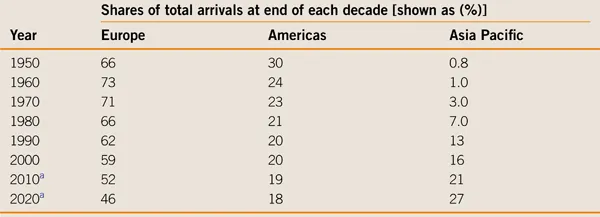
Around the world, measured as arrivals or trips, the numbers of international tourists and their expenditure have grown strongly since the 1950s, notwithstanding temporary fluctuations caused by the major international energy and economic crises such as those of the early 1970s, 1980s and 1990s or political crises such as those occasioned by the war in the Gulf, 9/11 in 2001 and the Iraq invasion in 2003. The overall growth pattern is revealed in Tables 1.1 and 1.2, and the reasons for it are discussed in some detail in Chapters 4 and 5. For the purposes of this introduction it is sufficient to note the recent growth and current size of the international market, and to be aware of consistently confident projections that international tourism will continue to grow well into the twenty-first century, fuelled in large part by the growth in the global economy and the development of China and India in particular as major generators of tourism. Although annual fluctuations in volume reflecting economic and political events are certain and likely to be related to efforts to reverse global warming and climate change, current UNWTO projections are for annual growth of the order of some 4% per annum over the period to 2020 as a whole. The rapid growth in share of international arrivals projected for the Asia Pacific region (Table 1.2) has major implications for the future of world travel and tourism. (See also WTO, 2007.)
| TABLE 1.1 | Recorded and projected growth in worldwide international tourist arrivals, 1950–2020 |
Year | International arrivals (millions) | Index of growth for each decade |
| 1950 | 25.3 | – |
| 1960 | 69.3 | 274 |
| 1970 | 165.8 | 239 |
| 1980 | 275.9 | 173 |
| 1990 | 436.1 | 160 |
| 2000 | 683.3 | 150 |
| 2005 | 803.4 | – |
| 2010a | 1000.0 | 146 |
2020a | 1600.0 | 160 |
|
|
|
| TABLE 1.2 | Changes in UNWTO world regional shares of international tourism arrivals, 1950–2020 |
At present, reflecting the proximity of borders in Europe, it is common for well over half the adult population living in Northern Europe to have made one or more international tourist visits during the previous five years, mostly on vacation. Experience of international travel is very much less for Americans, reflecting the size of the USA and the distances most of them have to travel to make international trips. US inter-state tourism, e.g. between the North East and Florida, should perhaps be viewed as similar in principle to tourism between European countries over similar distances, especially as the latter develop the European Union with new member states, using its widely adopted currency, the euro.
Although not shown separately in Tables 1.1 and 1.2, international same-day visits are an important market sector in countries with common land frontiers, such as the USA and Canada, the Netherlands and Germany, and Malaysia and Singapore. Because of the speed and efficiency of cross-Channel ferries and the Channel Tunnel, same-day visits between Britain and France and Britain and Belgium are also important elements of the total market for tourism.
Domestic Tourism and Day Visits
Visitors who travel and stay overnight within the boundaries of their own country are classified as domestic tourists. Domestic tourism has two impor...