Pressure on national and local governments to rapidly develop their tourism potential to meet demand and produce benefits, makes it more essential than ever to plan carefully and consider the human and environmental impacts of tourism development. That is why, as Secretary-General of the World Tourism Organization, I am pleased to see the serious analysis of the problems and prospects of the tourism sector as presented in this third edition.
-- Francesco Frangialli, Secretary-General, World Tourism Organization
Now in its third edition, Global Tourism draws on the insight of thirty-nine contributors to chronicle and foresee the effects of tourism on contemporary society. Contributors provide interdisciplinary, international perspectives on the critical questions, problems, and opportunities facing the tourism industry.
Invaluable to academics and professionals alike, Global Tourism offers a comprehensive exploration of the key issues in tourism. Authors draw on their individual insights to assess and critique contemporary tourism and take a view of the future.
Fully revised and re-developed, new chapters examine:
* The future of tourism
* Difference in travel characteristics of significant travel segments
* Sustainability standards in the global economy
* Crisis management in tourist destinations
* Tourism and social identities
* Tourism, mobility, and global communities
CONTRIBUTORS INCLUDE: Brian Archer (University of Surrey), Gurhan Aktas (T.C. Dokuz Eylul University), Bill Bramwell (Sheffield Hallam University), Peter M Burns (University of Brighton), Nancy E. Chesworth (Mount St. Vincent University), Tim Coles (University of Exeter), Chris Cooper (The University of Queensland), Graham M.S. Dann (University of Luton), Thomas Lea Davidson (Davidson-Peterson Associates, Inc.), Sara Dolnicar (University of Wollongong), David Timothy Duval (University of Otago), Larry Dwyer (University of New South Wales), Xavier Font (Leeds Metropolitan University), Alan Fyall (Bournemouth University), Brian Garrod (University of Wales, Aberystwyth), Donald Getz (University of Calgary), Alison Gill (Simon Fraser University), Frank Go (Erasmus University), Ebru Gunlu (T.C. Dokuz Eylul University), Michael Hall (University of Otago), Simon Hudson (University of Calgary), Donald Macleod (University of Glasgow), David Mercer (RMIT University), Graham Miller (University of Surrey), Michael Morgan (Bournemouth University), Peter Murphy (La Trobe University), Philip Pearce (James Cook University), Stanley C. Plog (Plog Research and SPC Group), Garry Price (La Trobe University), Linda K. Richter (Kansas State University), Lisa Ruhanen (University of Queensland), Chris Ryan (University of Waikato), Gordon D. Taylor (Tourism Canada, retired)), William F. Theobald (Purdue University), Seldjan Timur (University of Calgary), Birgit Trauer (University of Queensland), Stephen Wanhill (Bournemouth University), Peter W. Williams (Simon Fraser University)
- 592 pages
- English
- ePUB (mobile friendly)
- Available on iOS & Android
eBook - ePub
Global Tourism
About this book
Part One
Clarification and Meaning: Issues of Understanding
Introduction
Tourism has grown significantly since the creation of the commercial airline industry and the advent of the jet airplane in the 1950’s. By 1992, it had become the largest industry and largest employer in the world. Together with this growth there have emerged a number of extremely critical issues facing the industry in terms of the impacts it has already had on destination areas and its residents, and the future prospects for people and places into the coming decades.
One of the major issues in gauging tourism’s total economic impact is the diversity and fragmentation of the industry itself. Theobald (Chapter 1) suggests that this problem is compounded by the lack of comparable tourism data since there has been no valid or reliable means of gathering comparable statistics. He proposes that the varying definitions of tourism terms internationally, and the complex and amorphous nature of tourism itself have led to difficulty in developing a valid, reliable, and credible information system or database about tourism and its contribution to local, regional, national and global economies.
The author provides an introduction to the context, meaning and scope of tourism beginning not simply with basic definitions, but also a discussion on the derivation of those definitions. This leads to sections on how tourism data is gathered, measures of tourism, basic tourism units, and classification of both tourism supply and demand. Finally, he chronicles the major international developments that have occurred between 1936 and 1994 whose objectives were to reduce or eliminate the incomparability of gathering and utilizing tourism statistics.
Davidson (Chapter 2) links the question of whether tourism is really an industry to the misunderstanding, resistance and hostility that often plague proponents of travel and tourism as worthy economic forces in a modern economy. He questions the common practice, especially as suggested in the literature of referring to tourism as an industry. He contends that such a designation may not be correct, and that tourism is not an industry at all. He states that much of the current misunderstanding, resistance and even hostility plaguing proponents of tourism may be due to its mistakenly being called an industry. Three arguments for tourism’s designation as an industry are: it needs to gain the respect it now lacks among other competing economic sectors; it needs sound, accurate and meaningful data in order to assess its economic contribution, and; it needs to provide a sense of self-identity to its practitioners.
Similar to the previous chapter, the author decries the difficulty in defining the terms tourist and tourism among others. He contends that tourism is not an industry at all and suggests that rather than a production activity or product, tourism should be viewed as a social phenomenon, an experience or a process. Therefore, defining tourism as an industry is incorrect and demeaning to what it really is. While the editor agrees with the author that tourism is largely a social phenomenon and experience, and the tourism industry is complex and difficult to define precisely, nevertheless, he believes the preponderance of evidence supports the position that tourism can be industrially classified and measured, and therefore, can indeed be counted as an industry. The debate continues.
For many people, much time and effort is expended by looking back to an earlier time in their lives, perhaps in an attempt to recapture a past that for them was happier or more rewarding than what the future might hold. The past has always been more orderly, more memorable, and most of all, safer.
A provocative insight on the meaning and substance of tourism is provided by Dann (Chapter 3), striking at the heart of the motivation for so much travel: nostalgia. The Western drive of escapism to the numerous outlets of yesteryear are enhanced by the ‘evocation of the past as a promise to the future’. The author states that tourism is the nostalgia industry of the future. He suggests that tourism has employed nostalgia for its own financial advantage. A strong connection between nostalgia and tourism is explored, especially as related to historical figures, accommodations, attractions and cultural institutions. In addition, it is pointed out that tourists often have a strange fascination for tragic, macabre or other equally unappealing historical sites.
Nostalgia is grounded in dissatisfaction with social arrangements, both currently and likely continuing into the future. Nostalgia tourism that provides an alternative to the present does so by recourse to an imagined past that people often believe is fact. The author suggests that nostalgia tourism is really the antithesis of reality tourism.
Natives in Third World countries living for generations in one village could not comprehend the concept of nostalgia. On the other hand, today’s dislocated Western tourist often travels in order to experience nostalgia. Tourism collateral literature and publicity which is based upon nostalgic images of the past promote glamour and happiness, provide something to be envied, and return love of self to the reader. Nostalgia is big business, and when it is associated with the world’s leading industry, tourism, it offers unlimited financial possibilities.
Although collaboration is now commonplace in most industrial sectors, Fyall and Garrod (Chapter 4) suggest that for years, the tourism industry was (and remains in some instances) highly fragmented and independent. With the accelerating pace of technological innovation and the continuing trend toward globalization, traditional competitive and adversarial relationships between competing business organizations is giving way to collaborative arrangements between them.
For many tourism organizations, performance is dependent on establishing collaborative relationships in order to better serve the customer. The message this chapter conveys is that due to economic, social and political pressures, the primary concern of tourism organizations must shift from an individual and competitive focus to an inter-organizational, collaborative domain. The authors provide examples of tourism collaboration and suggest that it is becoming increasingly more difficult for organizations to survive in competitive isolation in tourism.
1The Meaning, Scope, And Measurement of Travel and Tourism
Background
Travel has existed since the beginning of time when primitive man set out, often traversing great distances, in search of game that provided the food and clothing necessary for his survival. Throughout the course of history, people have travelled for purposes of trade, religious conviction, economic gain, war, migration, and other equally compelling motivations. In the Roman era, wealthy aristocrats and high government officials also travelled for pleasure. Seaside resorts located at Pompeii and Herculaneum afforded citizens the opportunity to escape to their vacation villas in order to avoid the summer heat of Rome. Travel, except during the Dark Ages, has continued to grow, and throughout recorded history has played a vital role in the development of civilizations.
Tourism as we know it today is distinctly a twentieth-century phenomena. Historians suggest that the advent of mass tourism began in England during the industrial revolution with the rise of the middle class and relatively inexpensive transportation. The creation of the commercial airline industry following World War II and the subsequent development of the jet aircraft in the 1950s signaled the rapid growth and expansion of international travel. This growth led to the development of a major new industry: tourism. In turn, international tourism became the concern of a number of world governments because it not only provided new employment opportunities, but it also produced a means of earning foreign exchange.
Today tourism has grown significantly in both economic and social importance. The fastest growing economic sector of most industrialised countries over the past several years has been in the area of services. One of the largest segments of the service industry, although largely unrecognised as an entity in some of these countries, is travel and tourism. According to the World Travel & Tourism Council (2003) (WTTC), travel and tourism is the biggest industry in the world on virtually any economic measure, including gross output, value added, capital investment, employment, and tax contributions. In 2003, the industry’s gross output was estimated to be in excess of US$4.5 billion of economic activity (total demand), more than 10 percent of the total gross national product spending. The travel and tourism industry is one of the world’s largest employers, with nearly 195 million jobs, or 7.6 percent of all employees. This industry is the world’s leading industrial contributor, producing 10.2 percent of the world gross domestic product, and accounting for capital investment in excess of US$685 billion in new facilities and equipment. In addition, it contributes more than US$650 billion in direct, indirect, and personal taxes each year. As indicated by Table 1.1, research conducted by the World Tourism Organization (WTO) show the almost uninterrupted growth of tourism since 1950.
Table 1.1 World Tourism Growth: 1950–2002
Year | International Tourist Arrivals (millions) | International Tourist Receiptsa (billions in US$) |
1950 | 25.3 | 2.1 |
1960 | 69.3 | 6.8 |
1970 | 165.8 | 17.9 |
1980 | 286.0 | 105.3 |
1985 | 327.2 | 118.1 |
1990 | 457.3 | 263.4 |
1995 | 552.3 | 406.5 |
1996 | 596.5 | 435.6 |
1997 | 618.2 | 439.6 |
1998 | 626.4 | 442.5 |
1999 | 652.2 | 456.3 |
2000 | 696.7 | 474.4 |
2001 | 692.7 | 462.2 |
2002b | 715.6 | 478.0 |
a International transport receipts excluded.
b Estimates.
Source: World Tourism Organization. 2003. World Tourism in 2002: Better than Expected Madrid: WTO News Release.
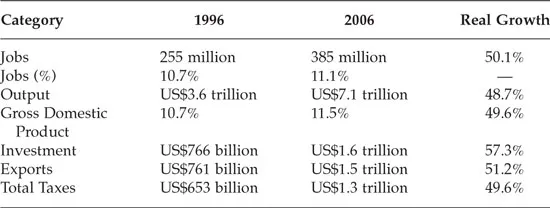
Frechtling (2001) suggests that Futurist John Naisbitt in his best-selling book, Global Paradox, subscribes to the concept that tourism will be one of the three industries that will drive the world economy into the twenty-first century. Reinforcing Naisbitt’s concept is data provided for the WTTC suggesting that there will continue to be significant increases in tourism in the coming years (Table 1.2).
Table 1.2 WTTC Research Projections for Economic and Employment Growth (world estimates 1996–2006)
Source: World Travel & Tourism Council, Research & Statistical Data. 1997. Worldwide Web page, http://www.wttc.org/.
The WTTC (2003) predicted that during the next decade, world travel and tourism is expected to achieve annualized real growth of:
- 4.6 percent in total travel and tourism demand to US$8.939 billion in 2013;
- 3.6 percent for the industry directly to US$2.279 billion and to US$6.461 billion for the travel and economy overall in 2013;
- 2.2 percent in travel and tourism employment to 83,893,600 jobs directly in the industry, and 2.4 percent to 247,205,000 jobs in the travel and tourism economy overall in 2012;
- 7.1 percent in visitor exports, rising to US$1.308 billion in 2013;
- 4.3 percent in terms of capital investment, increasing to US$1.308 billionin 2013; and
- 3.0 percent in terms of government expenditures to US$378.2 billion in 2013.
However, one of the major problems of the travel and tourism industry that has hidden or obscured its economic impact is the diversity and fragmentation of the industry itself. The travel industry includes hotels, motels, and other types of accommodation; restaurants and other food services; transportation services and facilities; amusements, attractions, and other leisure facilities; gift shops; and a large number of other enterprises. Because many of these businesses also serve local residents, the impact of spending by visitors can easily be overlooked or underestimated. In addition, Meis (1992) points out that the tourism industry involves concepts that have remained amorphous to both analysts and decision makers. Moreover, in all nations, this probl...
Table of contents
- Cover Page
- Half Title Page
- Title Page
- Copyright Page
- Contents
- Foreword
- Preface
- List of Contributors
- Part One: Clarification and Meaning Issues of Understanding
- Part Two: Part Two Results and Residuals The Issue of Impacts
- Part Three: Changing Directions Planning and Development Issues
- Part Four: Places and Products Marketing and Consumer Issues
- Part Five: Bureaucracy and Procedure Geopolitical and Policy Issues
- Part Six: People, Places, Things Alternate Issues
- Index
- Index
Trusted by 375,005 students
Access to over 1.5 million titles for a fair monthly price.
Study more efficiently using our study tools.
Frequently asked questions
Yes, you can cancel anytime from the Subscription tab in your account settings on the Perlego website. Your subscription will stay active until the end of your current billing period. Learn how to cancel your subscription
No, books cannot be downloaded as external files, such as PDFs, for use outside of Perlego. However, you can download books within the Perlego app for offline reading on mobile or tablet. Learn how to download books offline
Perlego offers two plans: Essential and Complete
- Essential is ideal for learners and professionals who enjoy exploring a wide range of subjects. Access the Essential Library with 800,000+ trusted titles and best-sellers across business, personal growth, and the humanities. Includes unlimited reading time and Standard Read Aloud voice.
- Complete: Perfect for advanced learners and researchers needing full, unrestricted access. Unlock 1.5M+ books across hundreds of subjects, including academic and specialized titles. The Complete Plan also includes advanced features like Premium Read Aloud and Research Assistant.
We are an online textbook subscription service, where you can get access to an entire online library for less than the price of a single book per month. With over 1.5 million books across 990+ topics, we’ve got you covered! Learn about our mission
Look out for the read-aloud symbol on your next book to see if you can listen to it. The read-aloud tool reads text aloud for you, highlighting the text as it is being read. You can pause it, speed it up and slow it down. Learn more about Read Aloud
Yes! You can use the Perlego app on both iOS and Android devices to read anytime, anywhere — even offline. Perfect for commutes or when you’re on the go.
Please note we cannot support devices running on iOS 13 and Android 7 or earlier. Learn more about using the app
Please note we cannot support devices running on iOS 13 and Android 7 or earlier. Learn more about using the app
Yes, you can access Global Tourism by William F. Theobald in PDF and/or ePUB format, as well as other popular books in Business & Hospitality, Travel & Tourism Industry. We have over 1.5 million books available in our catalogue for you to explore.