![]()
This chapter provides guidance for those new to the subject on how to set about the study of building construction. It includes general notes on a number of over-arching principles, statutory requirements, standards and procedures that apply to the construction process, particularly to houses. These are also highlighted, but not necessarily discussed in detail, in the chapters that follow. Reference is also made in this chapter to sources where further information on building construction and design may be found.
The book focuses on low-rise domestic construction, i.e. houses of two or three storeys and bungalows. Where appropriate, reference is made to flats/apartments, although these are more often to be found in high-rise buildings, which are outside of the scope of this book.
House construction in England and Wales is the main focus of the book. While specific practices that differ from those in Scotland and Northern Ireland may exist, the principles of construction are similar throughout the United Kingdom.
It must be realised that the construction process is a continuum. The development and application of new design and building techniques, materials and components never ceases. The environment in which it takes place does not remain constant. The performance requirements of buildings are continually increasing. The way in which space is used as well as the appearance (internally and externally) of buildings are all subject to frequent change as they react to shifts in the housing market, driven by consumer demand, government legislation and the influence of building designers.
How to ‘read’ construction
Some students of building construction have no difficulty in assimilating and understanding what it is all about. The written descriptions and the details set out in the construction diagrams all make logical sense from the moment they open their first textbook. Others simply struggle; however often they read the text and review the diagrams and photographs, all they see is a fog of facts and details, none of which makes clear sense. Even if one part does become clear, making connections with the other areas of construction remains difficult.
How is it possible to overcome this challenge?
Many students do overcome this initial barrier, including at least one of the authors who spent the first year of his studies wondering if the construction of a building would ever make sense. There is probably no ‘Eureka!’ moment for most of us; it is simply a matter of working out a strategy that enables us to comprehend the construction process and its details.
One method of study that creates difficulties for many students of construction is attempting to learn the subject from just reading one or more textbooks. Construction is very much a hands-on subject and attempting to learn about it by simply cramming information from a book is not highly productive. The learning process needs a much more pro-active engagement with the subject. This book can provide basic knowledge, but the student also needs the stimulus of going out and looking at buildings in the light of that knowledge. This will aid assimilation. If possible, also look at active building operations. It is also very helpful to sketch or draw construction details, whether from real life or from a textbook.
The importance of learning how to sketch
It is an important skill for any student of construction (and for the experienced practitioner as well) to be able to sketch or draw construction details, whether from real life or by copying from a textbook. Sketching, in this sense, means freehand drawing, while drawing is based on the use of straight edges and set-squares to aid greater accuracy (and confidence). You may have heard of technical drawing, which normally involves drawing to scale, but that level of accuracy is not needed at this stage, unless you plan to make design part of your future profession. As a beginner, you may also find it helpful to purchase a good book on architectural draughtsmanship.
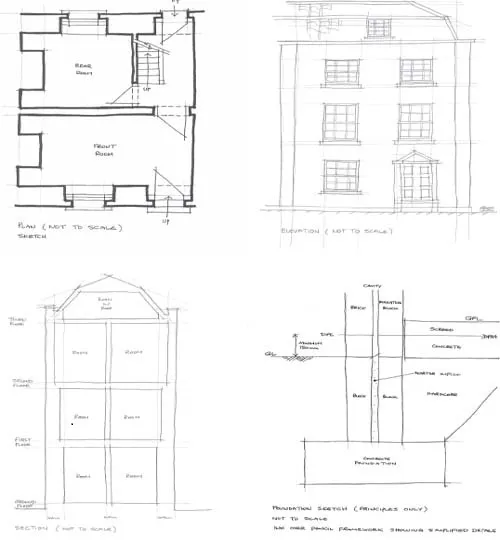
In this book, as in other books on construction, there are many diagrams showing plans, sections and elevations of houses. These, in combination with the accompanying text, help to explain design and construction principles and application. An example of each is illustrated opposite.
The first point to understand is that you need to learn to sketch (or draw) what you actually see. Choose a simple diagram from the book and then redraw it as a sketch. Always sketch or draw using a fairly soft pencil, such as HB. It can be helpful to sketch on graph paper, especially if you lack confidence in your draughtsmanship. At the first attempt lines may be wobbly, but that is unimportant. What matters is that the sketch gives you a better appreciation of the construction detail. The lines will become straighter and more clearly defined with practice. Use light pencil lines to start with to shape an outline or framework of what you see (at this stage a ruler may be helpful) and then firm the lines up (freehand) to make a copy of what you see – you can try inking them in as shown in the sketch of the floor plan opposite. Such an exercise will transform the selected detail, be it of a foundation or a roof, from some vague representation in your textbook to hard fact that means something to you. If it does not work first time, repeat the exercise as many times as necessary for the construction detail to become meaningful. The use of different coloured pencils or pens to highlight particular details can also aid your knowledge assimilation.
Repetition of the exercise for the same piece of detail or sketching of the different parts of a building should enable you to master a skill that you initially feared. It is surprising how students who believe that they have no artistic or technical ability can, with application, develop sufficient drawing skill to really aid their understanding of construction details and processes. Even a crude sketch, clearly executed, can be informative. Sketching also means clearer communication of construction principles and ideas generally in terms of examinations or in a future career.
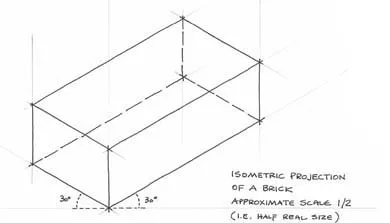
As practice makes you more proficient, you could practise sketching what is known as an orthographic projection. This is a method where you draw or sketch a three-dimensional object, such as a brick or a house, in two dimensions, i.e. on a sheet of paper. Detailed guidance on how to go about this can be obtained from books on draughtsmanship, where you will find that there are a number of different types of orthographic projection, including isometric projection. You could start by sketching something simple, such as a brick, and graduate to more adventurous subjects. An example of a brick drawn in isometric projection is shown on page 4.
The first three sketches are of a Georgian house – plan, elevation and section. The fourth sketch (bottom right) is of a modern foundation and cavity wall. In all of them, you can see the initial pencil framework on which the hard detail is finally sketched.
This diagram is an example of an isometric projection of a brick. Note how much more informative it is than simple diagrams of each of the side and end elevations.
When undertaking detailed design of a building, it is usual practice to produce scale drawings showing the design information. Sketching, in contrast, is not usually to scale as it is difficult to draw freehand to an exact scale. The technical drawings, i.e. plans, elevations and sections, are normally drawn to one or more scales that reflect the level of detail required by the development team, so that land, buildings or objects shown are represented at a size that is in proportion to actual size – normally a smaller scale for land and a larger scale for construction details. For example, 1/50 (which means that the drawing is one-fiftieth of the full-size subject) would be used for a floor plan or elevation, while 1/200 would be used for a site plan showing a proposed building in outline plus the land on which it sits. Today, technical drawings for building projects are normally produced by computer-aided design (CAD) systems.
Some key terms
You also need to become familiar with some of the key terms that are used by construction designers and contractors. They include elements of construction, materials and components.
An element of construction (or element) is the term used to describe the basic units from which a building is formed, such as the walls, the floors and the roof. A simple building, such as a garage, will have six elements – four external walls, the ground floor and the roof. A building of complex design will have many more elements: external and internal walls, several floors and possibly a number of different roofs. The elements are carefully fitted together so that, in principle, walls provide support to each other as well as to floors and roofs.
Each element is formed from various materials and may contain components. For example, a wall may be solid or have two skins with a cavity between. A solid wall may be formed from one or more materials. Each skin of a cavity wall can be formed from different materials, for example, an outer skin of brick and an inner skin of concrete blocks. The wall may have one or more components built into it, such as a window or a door. Internal fittings, such as kitchen units or wash basins, etc., are also components.
Buildings consist of above- and below-ground construction. That part of the construction below ground is known as the substructure, all of the structure above ground level is called the superstructure.
The construction process is further divided between first fix and second fix. First fix comprises all construction from foundations to the provision of plaster on walls and includes all carcassing joinery (e.g. roof and floor timbers), plumbing pipework and electrical wiring. Second
fix denotes that part of the construction process that completes the building and includes finishing joinery (e.g. staircases, skirtings, door frames and doors), plumbing fittings and electrical components. These two terms are more likely to be used during the actual construction process rather than when a building is being designed.
Metric and imperial dimensions
One final point must be made. Until comparatively recently, UK building design and construction was based on the imperial system of measurement rather than the metric system. All construction design and manufacture is now based on the latter and you will find only metric dimensions used in this book.
However, when inspecting and dealing with construction in older buildings, it should be noted that component and material sizes do not readily translate between the two measurement systems and, therefore, it is helpful, but not essential, to have knowledge of both. Some metric sizes make sense (e.g. a 200mm × 100mm piece of timber), others are odd conversions from the old imperial sizes, one example being that of a standard brick. Under the imperial system, its nominal measurements including the mortar joints were 9″ (228.6mm) long × 4½″ (114.3mm) wide × 3″ (76.2mm) high. A metric brick is nominally sized at 225mm × 112.5mm × 75mm which, although slightly smaller, is a close conversion from the imperial size. Metrification also means that care must be taken when working on older buildings to take account of sizing differences, although some manufacturers of materials and components do still provide imperial products for the refurbishment market.
The statutory control of building and development
Historic background
The materials and techniques used in the construction of our houses have changed considerably during the past few hundred years. This evolution is due to a number of factors besides the obvious one of advances in technology. Economic, political and social pressures have all played their part in affecting the quality of our built environment. Perhaps the most influential factors were the social pressures brought about by the realisation of the connection between poor housing and ill health. This led to a number of Acts of Parliament from the Victorian period onwards that eventually established basic requirements for decent housing conditions. These requirements included adequate sanitation, water supply, natural light, ventilation, and freedom from damp. These criteria still influence the way that houses are designed and built today and many of them are covered by the Building Regulations, which were first introduced in 1965 and have been amended several times since. The primary purpose of the Building Regulations is to establish minimum standards to ensure the health and safety of the building's occupants. They do not, as some people assume, necessarily define quality or levels of workmanship.
Other legislation affecting the construction of houses includes Public Health Acts, Housing Acts, Plan...