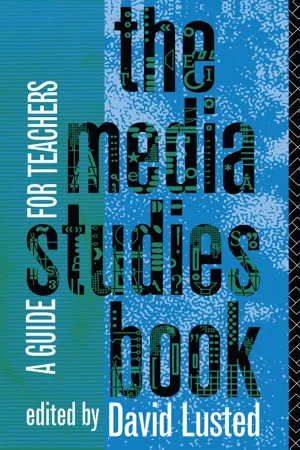
- 248 pages
- English
- ePUB (mobile friendly)
- Available on iOS & Android
eBook - ePub
About this book
Introducing media criticism as well as teaching about the media, in inter-disciplinary and 'across the curriculum' teaching, this is the first critical reference book on the important curriculum initiatives taking place in media education. The core of the book is a collection of essays on key concepts from media studies, including 'language', 'narrative', 'institution', 'audience', 'representation', and 'the production process'. Written by teachers for teachers, these essays organise ideas through classroom activities, with a full listing of teaching materials , resources, agencies, and publications in media education. Contributors: Tim Blanchard, Gill Branston, David Buckingham, Jenny Grahame, Karen Manzi and Allan Rowe, Ben Moore, Gillian Swanson, Adrian Tilley, and Tana Wollen.
Information
Chapter 1
Teaching about the media
INTRODUCTION
Why teach about the media? There are a number of possible answers to this question, which derive from quite different views of the media and of young people. Yet most arguments for Media Studies begin with two significant assertions. The first concerns the amount of time children spend with the media. Statistics on television viewing, for example, suggest that children today spend more time watching television than they spend in school. If we add to this the amount of time spent watching films, reading comics and magazines, and listening to records, we arrive at figures which typically provoke a mixture of surprise and horror – particularly, perhaps, among teachers, who are likely to feel that their students’ time would be far better spent on activities they themselves consider more edifying. The second assertion appears to follow inexorably from the first. If the media are such a major element in children’s lives, it seems self-evident that they must exert a very powerful influence on their ways of thinking about the world – and as such, teachers simply cannot afford to ignore them.
These assertions are certainly very persuasive. Teachers who have sought to establish a place for Media Studies in the school curriculum, often in the face of considerable opposition, have used them to great effect. This may well be because this view of the power of the media has an appeal to most shades of political opinion. Many people on the Right regard the media as agents of moral depravity, while many on the Left see them as carriers of objectionable ideologies: yet they are united in a view of the media as a powerful and predominantly negative influence – an influence which schools have a responsibility to resist.
While these assertions may therefore appear quite convincing, in devising effective approaches to teaching about the media, it is necessary to look beyond them, and in certain ways to qualify them. In this respect, it is important to make a distinction between the simpler, more rhetorical arguments which may be of use in promoting Media Studies, and the more complex understandings which should inform classroom practice. Media Studies teaching clearly needs to be grounded in a thorough understanding of children’s experience of the media – an experience which the more simplistic notions of ‘influence’ do not adequately explain. In particular, I shall argue here that teaching about the media should be based on the view that children are active producers of meaning, and that this production of meaning is fundamentally a social activity.
PERSPECTIVES ON CHILDREN AND THE MEDIA
Concern about the influence of the media on young people has a very long history.1 Perhaps the earliest recorded example is Plato’s Republic, written four hundred years before Christ, which warns its readers about the dangerous effects of the theatre on Greek youth. In more recent times, this attention has focused particularly on those mass-produced media forms which have been especially popular with a working-class audience. There have been successive waves of public concern and outrage about popular literature (in the nineteenth century), the cinema (notably in the 1920s and 1930s), children’s comics (in the 1950s) and, most recently, television and video. In this section, I shall briefly identify three popular contemporary perspectives on children and television. Despite significant differences between them, there are important underlying continuities; and it is these continuities, this ‘commonsense wisdom’ about the media, which often seems to inform the work of teachers and schools.
‘Moral panics’
For many writers, and particularly for many politicians, questions about children and television are almost inevitably questions about children and television violence. Although researchers have experienced considerable difficulty, to say the least, in establishing causal connections between television violence and violent behaviour,2 the belief that such connections do exist is extremely widely held. Indeed, such a belief is often asserted as ‘simple common sense’ which no rational person could possibly dispute.
This concern about the effects of television violence may usefully be seen as part of a broader anxiety about the collapse of social order. For example, the most recent wave of debate – the moral panic around so-called ‘Video Nasties’ – can be traced back to the aftermath of the inner city disturbances of 1981. Politicians keen to present these disturbances as instances of a general decline in respect for law and order argued that the media were a central causal factor. Thus, we had the alleged ‘copycat’ riots: young people in Handsworth took to the streets after watching TV reports of violence in Soweto, people in Tottenham then imitated the TV reports of Handsworth, and so on.3 Less directly, it was also argued that television violence, and in particular ‘Video Nasties’, were contributing to a general rise in violent crime among young people. The debates around the Video Recordings Act of 1984, and subsequently Winston Churchill’s Bill to extend the Obscene Publications Act to television in 1986, focused particularly on the dangers to young people, and on the failure of parents (significantly working-class parents) to exert adequate control over their children’s viewing.4
One of the main problems with such arguments is that they are typically based on very inadequate evidence, not merely about the scale of the phenomenon but also about its presumed effects. The ‘Video Nasties’ research,5 for example, signally fails to prove any causal connection between viewing and violent behaviour – in fact, all it proves, in painstaking detail, is that many ‘experts’ believe there to be such a connection! As a result, it inevitably fails to account for the complexity of children’s understanding and the pleasures they may derive from viewing such material. In this way, the moral panic about television violence may deflect attention away from other possible causes of social unrest, and sets a very limited agenda for public debate, which effectively excludes any more sophisticated understanding of the relationship between children and television.
‘The plug-in drug’
A second major area of concern about children and television focuses on its effects, not so much on children’s behaviour, as on their thought processes. The emphasis here is not primarily on the content of television, but on the nature of the activity of viewing itself. Marie Winn’s symptomatically-titled The Plug-in Drug is a representative example of this approach.6 It provides a barrage of research evidence to support the view that television undermines family life and destroys children’s capacity for intelligent thought. Thus, we are told that watching television retards the development of the brain, blunts the senses and encourages mental laziness. It impairs children’s sense of their own identity, their linguistic abilities and their attention span. Furthermore, because of their addiction to television, children are deprived of play and of the opportunity to participate in the interpersonal rituals of family life. The metaphor of television-as-a-drug recurs throughout Winn’s book: TV is ‘an insidious narcotic’, children are ‘TV Zombies’ who watch in a ‘trance-like state’ which ‘blots out’ the real world, and parents are urged to help their children ‘kick the TV habit’. Reading (which, as a more private activity, could be seen to induce an even greater sense of social isolation) is regarded as an inherently superior form of mental training, which develops powers of concentration and imagination stunted by television – although, according to Winn, this is only the case with real books, not newspapers or the kind of popular fictions she disparagingly terms ‘non-books’.
Neil Postman, in a similarly polemical account, argues that television is primarily responsible for the ‘disappearance of childhood’.7 He describes television as a ‘total disclosure medium’ which has led to a blurring of the distinction between adulthood and childhood: because of television, adults can no longer keep ‘secrets’ from children and ‘protect’ them from adult ways. As a result, children have begun to dress like adults (and vice-versa), use bad language, have sex earlier and are generally more ill-mannered than they used to be. As in Marie Winn’s book, television is also seen as a primary cause of social unrest, rising crime rates and the kind of discontent among young people which surfaced in the 1960s, with the coming of age of the first ‘television generation’.
Here again, the family is enjoined to resist television, although its ability to do so has been progressively undermined by its enemy. Likewise, for both writers, the school is seen as the last bastion of a dying print culture: the use of television within education is described by Winn as ‘an act of true desperation’, and a dangerous distraction from the primary aim of eliminating television.
It would be easy to mock the barely restrained hysteria of such arguments and to demonstrate their contradictions. In the case of Marie Winn, the evidence she adduces to support her case is extremely partial, and in many instances highly impressionistic; and Neil Postman is ultimately unable to prove a causal connection between television and the broad social developments he describes. Yet perhaps the major omission from both accounts is of any consideration of the pleasures which lead children to watch television in the first place. According to Winn, watching television derives from a pathological inadequacy on the part of children, which is encouraged by the weakness and irresponsibility of their parents. Children are merely victims of a dangerous addiction which they are powerless to resist.
‘The consciousness industry’
Where the previous two perspectives were concerned primarily with the influence of television on children’s behaviour and on their cognitive development, a third view – of the media as ‘consciousness industries’ – is more explicitly concerned with their influence on attitudes and beliefs. The media are seen here as a primary means whereby the ruling class maintains its ideological domination of subordinate classes. A series of fairly direct causal connections are drawn between the capitalist ownership of media industries, the ideologies contained within media output, and the acceptance of such ideologies by audiences.
Media research has increasingly come to question and to qualify this approach: indeed, it is probably fair to say that much of the best work in the field has developed through an implicit debate with and against what is often described as ‘economic determinism’.8 Nevertheless, the simplicities of a ‘conspiracy theory’ do retain an undeniable attraction, very similar to the attractiveness of the commonsense beliefs already outlined. As Ian Connell9 has argued, the tendency to blame the media has become almost routine for many on the Left. Yet, as he suggests, it is based on a view of audiences as the innocent victims of a powerful ‘propaganda machine’: the idea that the media are able to impose particular ‘biased’ attitudes on audiences is an oversimplification which ignores the active participation of viewers in making meaning.
‘Blaming the media’ has its parallels in attitudes towards children and television, and in particular on the question of stereotyping. Analyses of media content – often statistical analyses which, for example, quantify the numbers of men and women appearing in particular occupational roles – have typically been used as evidence to support broad rhetorical assertions about the role of the media in forming stereotyped beliefs.10 The media are regarded as a direct source of undesirable attitudes which children adopt, often ‘unconsciously’. There is little sense here that children may compare their experience of television with their experience of the social world, or that they may question or distance themselves from the representations it provides. Here again, the concentration on the media as the primary source of influence may deflect attention away from other, perhaps more direct, and therefore more powerful, sources. Finally, this perspective also seeks to discount or invalidate the pleasures which children derive from watching television. Pleasure is regarded as the sugar for the ideological pill, as a distraction which enables television to exert its unpleasant effects on children’s minds. Pleasure is something to be deeply suspected, and which we must encourage children to ‘own up’ to if we are to free them from it.
Continuities
Despite the significant differences between these three approaches, both in terms of their areas of concern and their political perspectives, there is a remarkable continuity between them. In different ways, they all provide a reassuringly simple account of the relationship between children and television; and it is perhaps this very simplicity which accounts for their undeniable attraction, particularly for those of us who have been educated into a respect for the authority and superiority of print. Yet it is precisely this simple ‘commonsense’ view which I am seeking to question here.
First, each of these approaches regards the media as an extremely powerful and almost exclusively harmful influence. In each case, the media are defined as a primary cause of undesirable social changes. For the Right, the media are responsible for various forms of moral decline and degeneracy; for the Left, they are often blamed for the failure of socialism to win the hearts and minds of the masses. In each case, blaming the media may relieve us of the painful necessity of looking for other possible reasons for such decline or failure – on the one hand, for example, in the inequalities and contradictions within the social fabric or within the institution of the family or, on the other hand, in the relationship between the official organizations of the Left (political parties and trade unions) and those on whose behalf they claim to operate.
Second, each approach implicitly regards media audiences as made up of passive consumers. Children, in particular, are seen as innocent and vulnerable targets for media manipulation, largely incapable of resisting its seductive and beguiling messages. This is ev...
Table of contents
- Cover
- Halftitle
- Title
- Copyright
- Contents
- List of illustrations
- Notes on contributors
- Acknowledgements
- Introduction
- 1 Teaching about the media
- Concepts in Media Studies
- Index
Trusted by 375,005 students
Access to over 1.5 million titles for a fair monthly price.
Study more efficiently using our study tools.
Frequently asked questions
Yes, you can cancel anytime from the Subscription tab in your account settings on the Perlego website. Your subscription will stay active until the end of your current billing period. Learn how to cancel your subscription
No, books cannot be downloaded as external files, such as PDFs, for use outside of Perlego. However, you can download books within the Perlego app for offline reading on mobile or tablet. Learn how to download books offline
Perlego offers two plans: Essential and Complete
- Essential is ideal for learners and professionals who enjoy exploring a wide range of subjects. Access the Essential Library with 800,000+ trusted titles and best-sellers across business, personal growth, and the humanities. Includes unlimited reading time and Standard Read Aloud voice.
- Complete: Perfect for advanced learners and researchers needing full, unrestricted access. Unlock 1.5M+ books across hundreds of subjects, including academic and specialized titles. The Complete Plan also includes advanced features like Premium Read Aloud and Research Assistant.
We are an online textbook subscription service, where you can get access to an entire online library for less than the price of a single book per month. With over 1.5 million books across 990+ topics, we’ve got you covered! Learn about our mission
Look out for the read-aloud symbol on your next book to see if you can listen to it. The read-aloud tool reads text aloud for you, highlighting the text as it is being read. You can pause it, speed it up and slow it down. Learn more about Read Aloud
Yes! You can use the Perlego app on both iOS and Android devices to read anytime, anywhere — even offline. Perfect for commutes or when you’re on the go.
Please note we cannot support devices running on iOS 13 and Android 7 or earlier. Learn more about using the app
Please note we cannot support devices running on iOS 13 and Android 7 or earlier. Learn more about using the app
Yes, you can access The Media Studies Book by David Lusted in PDF and/or ePUB format, as well as other popular books in Education & Teaching Arts & Humanities. We have over 1.5 million books available in our catalogue for you to explore.