
- 224 pages
- English
- ePUB (mobile friendly)
- Available on iOS & Android
eBook - ePub
Human Resource Management in the Hospitality and Tourism Industry
About this book
This fully updated and expanded second edition of Human Resource Management examines the role of human resource management in the hospitality and tourism industry. The subject is approached from four perspectives: * the social psychology of managing people * the economics of labour * the practical techniques * strategy.
The author argues that labour costs, labour utilisation, labour market behaviour and pay are inseparable from the skills of managing people. The book contains an important analysis of the labour market for this industry and now, in its second edition includes, among others, chapters on attitude measurement, customer-employee relations, questionnaire design and organizational change.
Human Resource Management in the Hospitality and Tourism Industry is written in a clear, user-friendly style and offers a challenging view of the subject and an opportunity to learn an important aspect of management in an applied context. It is appropriate for degree level students and practitioners in the industry.
1 Introduction
Is hotel and catering management unique?
Every industry thinks it is unique and, in a very real sense, each industry is right. Every technological process and each type of service does present different problems to its managers, probably has its own labour markets and, for those who work in it, has its own culture. What is more, the role of uniqueness can never be underestimated in a person's psychology. We all like to be different!
The case for the hotel and catering industry appears to be a particularly strong one. It has, after all, a lot of conspicuous features. What with all those uniforms, strange sounding job titles, tipping and unsocial hours, not to mention the high levels of entrepreneurship and labour mobility. It is not too surprising to hear a claim for being a bit special. The unsocial hours factor alone suggests that at least as 'a life' hotel and catering management is out of the ordinary.
Well, just when you thought it was safe to declare for uniqueness, along come two contrary arguments which together constitute what might be called the pure management approach. Looked at solely as a 'managerial task' running a hotel, restaurant or institutional establishment can be seen as a set of systems and processes common to managing anything. This approach does not ignore the special features but treats them as things to be measured and analysed and turned into information that will help managers make good decisions. This is the approach of scientific management. It is greatly undervalued, and therefore underused, by hotel and catering managers. Perhaps the argument that is more easily appreciated is that like any other business, hotel and catering establishments have to make profits and maintain cash flow and, therefore, can be run on business principles. What both these arguments are saying is that 'business is business' and 'managing is managing' whatever the industry. They are undeniably true, yet acceptance of them does not really contradict the case for uniqueness. They are not mutually exclusive arguments. In addition to the business thinking and the clinical analysis of data, there is the need to know what you are managing, especially in a service industry. In a manufacturing industry there is usually a time gap between production and selling with several processes and intermediary agents in between. This is not so with service industries. There is an immediacy about service which requires managers to anticipate, adjust or react in a time span. This immediacy flows directly from four features of the industry, which are so all pervasive that they account for most of what might be called the character of life in the industry. These features are:
- Constant fluctuations in short-term customer demand This is often referred to by sales people as short-term sales instability. What it means is that business fluctuates by the week, the day, the hour. For the worker, this means that his or her job has an irregular work flow. For the business, this means a problem of adjusting labour supply to demand and hence the use of part time and casual labour and a pay system which alters earnings by customer demand, i.e. tipping or some appropriate surrogate.
- The demand for labour is direct In the hotel and catering industry labour is demanded for what it can produce, people are not machine minders. This means that productivity is based on personal ability and effort. Consequently, there are great individual differences between workers' output. Concepts of productivity are, therefore, about judgements of human capacity.
- The subjective nature of standards Concepts like 'hospitality', 'service', 'cleanliness' are all matters of subjective judgement. This means that every worker's output is judged subjectively. This has the effect of making the actual relationships between managers and workers crucial to standards. In a factory this would not be the case at all. There, they would have methods of measuring output formally. When you cannot measure formally it is difficult to build a bureacracy in the organization. Rules always require specified standards. However, subjectivity means that standards are open to interpretation. Bureaucracy can be a blessing in disguise. In the absence of explicit standards there is a potential for conflicts to arise between workers and customers and between workers themselves – housekeeping want the room to be 'perfect', reception want it now; a speed versus quality dilemma.
- Transferability of skills The kind of skills that workers in the hotel and catering industry possess are generally confined to that industry. This makes for an efficient labour market between the various sectors of the industry. This, together with the relatively unskilled nature of some of the work, encourages the high labour mobility pattern which is often such a conspicuous feature of the industry.
These features create the immediacy which so characterizes management in this industry. It is not to say that managers simply run around 'coping' but it is to suggest that there is a tendency for the short term to be dominant. Even going up the hierarchy does not escape the sense of immediacy. The product is perishable. A room not sold tonight is gone for ever. Sometimes the fluctuations are of sufficient volume to be constantly developed in respect of the longer view. This is why the thrust of this book is towards managing the present and organizing for the future. Knowing your business means knowing what is possible and what your customer considers to be good. What with all this fluctuation and subjectivity around the one thing you must be is organized! This book argues that the management of labour in the hotel and catering industry has to accommodate the primary characteristics of the industry. Perhaps it would be useful at this point just to list the characteristics that are likely to be found in the hotel and catering industry:
- A set of skills specific to the industry.
- A range of skills for each occupation.
- Subjectively judged standards.
- Unevenly paced work.
- Seasonal employment patterns.
- Lack of bureaucracy.
- Complicated pay systems.
- An in-built speed versus quality dilemma.
- Unsocial hours.
- Part time and casual employment.
Most of these conspicuous characteristics can be explained by the four principal features. Managers are part of the features. It is the context in which they manage. Recognizing this, the book focuses on the understanding of behaviour and the understanding of labour markets as the two primary educational needs of managers in the industry. It also recognizes that 'business is business' and 'managing is managing' and good practice in management applies everywhere. The immediacy of hotel and catering management does not deny the need for good, or excuse bad, administrative and investigative techniques. For this reason, the book explains relevant and useful techniques of labour administration and tackles issues that are crucial to the corporate management of labour.
An Anatomy of the Hotel and Catering Labour Market
2 Understanding labour markets
All organizations live in a labour market environment, it is the sea on which they sail. To complain about the labour market is like the captain of a ship complaining about the sea. Yet labour markets are invariably problematic to organizations because they are mostly invisible things. In order to make sense of Chapter 3, which analyses hotel and catering labour markets, it is necessary to look first at some basic ideas and concepts that appertain to understanding labour markets. These are:
- What are labour markets?
- Is recruitment related to labour turnover?
- The idea of internal labour markets.
What are labour markets?
Labour markets exist on two levels; factual and perceptual. At any one time, people will be seeking employment or trying to change their jobs. Simultaneously, employers will be seeking new employees. Wage rates will be set, recruitment policies implemented, people will need training, people will have to move. This is the daily life of labour markets. Thousands of independent decisions made by employers and employees make up the trends in mobility, the surpluses of or shortages of supply, the excesses or lack of demand. In other words, whatever the state of supply and demand in a labour market, it is brought about by the independent and unconnected decisions of thousands of people.
According to conventional economic theory, supply and demand will be brought into equilibrium by the price of labour, i.e. the rate of pay. However, behind the assumption of a perfect market is a perfect flow of information between buyers and sellers of labour. In a perfect world the buyers would know how many have the skills they desire, how many would like to learn them and where these people are. Conversely, people would know how many vacancies there are, in what organizations and at what rate of pay.
Labour markets run on information, but they are invariably less than perfect mechanisms. What both buyers and sellers are left with is their perceptions and assumptions of supply and demand. We may think that there is no current demand for our skills, yet it may be that there is! An employer may think it is going to be easy to recruit a certain skill and set the rate accordingly, but may find that it is not. In the absence of perfect information and measurement, trial and error is both the decision process and a learning source.
While it is difficult to know a labour market, learning about it is a matter of reading signals in society such as the general level of employment, education trends and major changes in the birth rate. More important however, is to look closer to home at the local labour market and particularly at the rate of labour turnover, competitors' pay rates, the number of vacancies and the number of applicants per vacancy. It is also possible to survey local markets in various ways.
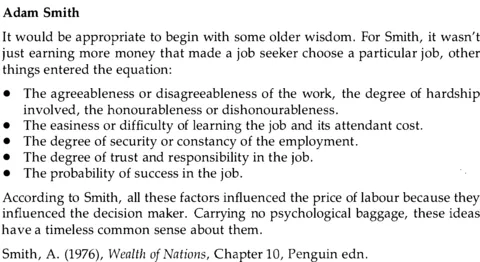
Despite the problem of imperfect information, it would be wrong to assume that managers do not have any control over the labour market because they do. For a start, although all organizations are involved in the national labour market, what counts to the health of the organization is the performance of its local labour market and the particular segments of it that are salient. What arbitrates the size of these markets is the degree of specialization of the organization. If the skills required are very specific to the organization, then there is a choice between fishing in a small pond or doing a lot of training. If the skills are generally held in the wider population, then the market will be larger and it is a case of trawling with a large net.
Notwithstanding the size of the labour markets, managers have at their disposal a wide range of tools for meeting the problems of labour markets, e.g. increasing pay, more training, altering hiring standards, promoting from within, plus many more. Increasing pay, for example, might not only attract more people, but may do so by extending the geographical limits of the local market by revaluing 'travel to work costs'.
Labour markets are always an unknown quality, but acceptance of that and a willingness to try to understand what is going on is essential to labour management. All manpower policies, but particularly those relating to recruitment and training are, to a large extent, dependent on labour market factors.
One concept central to labour markets is that of elasticity. It is necessary to understand the economic notion of elasticity. Quite simply, if pay is the driving force of the market, how responsive is the demand for labour to rises and falls in the rate of pay and how responsive is the supply of labour to rises and falls in the rate of pay? If, for example, we could obtain any amount of labour at one particular rate, then we would say that the supply of labour is perfectly elastic. If, however, we need to increase pay to get more labour then the supply of labour is, to a degree, inelastic. The graph in Figure 2.1 illustrates the point.
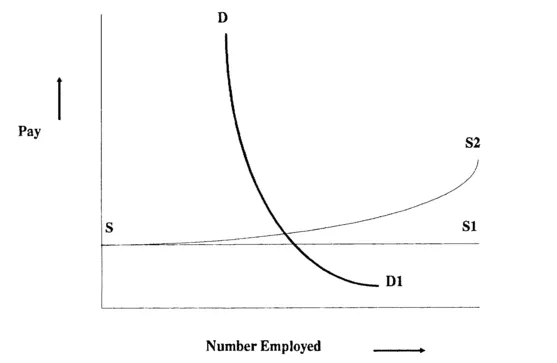
Figure 2.1
Here, pay is plotted against the number of workers – labour supply. The line S–Sl represents perfect elasticity, The line S–S2 represents a degree of inelasticity – in other words this line is responsive to pay. The demand for labour can be expressed in exactly the same terms, only this time the slope is from right to left, as more labour would be demanded at the lower price – line D–Dl represents a particular level of demand. You will have deduced from all this that the slope of the line represents the degree of elasticity.
Is recruitment related to labour turnover?
Having said that labour markets are slightly mysterious unknowable things, it will come as a pleasant surprise to know that there is one aspect of labour market behaviour that is universal enough to be predictable; so reliable in fact that it should enter all calculations of recruitment. What is this potent factor? Quite simply, it is the common sense notion that 'the longer a person stays in a job, the less likely he or she is to leave'. In reverse this reads 'a person is more likely to leave a job the shorter his or her period of service in that job'. The uncertainties of a job and surroundings are likely to be greater when a person first enters a job – does it meet expectations? It is in this early period that a person has a high propensity to leave. Conversely, the longer a person stays in a job the more comfortable it becomes; it begins to fit like an old overcoat.
This behavioural tendency has real significance for labour management because it unites recruitment with labour turnover. The golden rule is that the rate of each rises and falls together with just a short time lag. When recruitment goes up, so does labour turnover. This may astound. Surely when business is expanding people will want to stay? Maybe, but when business is expanding the proportion of new recruits with a high propensity to leave is higher than normal. Thus the number of leavers increases. Some examples of the significance of this will be helpful.
A case of expansion
Suppose a company needs to substantially increase its manpower in respect of one particular occupation. For years it has employed sixty in number and 20 per cent leave every year. Half of these vacancies are filled by promotionfrom a...
Table of contents
- Cover
- Title
- Copyright
- Contents
- Preface
- 1 Introduction
- Part One An Anatomy of the Hotel and Catering Labour Market
- Part Two People at Work
- Part Three Some Useful Techniques
- Part Four Human Resource Management and Quality
- Part Five Management at the Corporate Level
- Further reading
- Index
Trusted by 375,005 students
Access to over 1.5 million titles for a fair monthly price.
Study more efficiently using our study tools.
Frequently asked questions
Yes, you can cancel anytime from the Subscription tab in your account settings on the Perlego website. Your subscription will stay active until the end of your current billing period. Learn how to cancel your subscription
No, books cannot be downloaded as external files, such as PDFs, for use outside of Perlego. However, you can download books within the Perlego app for offline reading on mobile or tablet. Learn how to download books offline
Perlego offers two plans: Essential and Complete
- Essential is ideal for learners and professionals who enjoy exploring a wide range of subjects. Access the Essential Library with 800,000+ trusted titles and best-sellers across business, personal growth, and the humanities. Includes unlimited reading time and Standard Read Aloud voice.
- Complete: Perfect for advanced learners and researchers needing full, unrestricted access. Unlock 1.5M+ books across hundreds of subjects, including academic and specialized titles. The Complete Plan also includes advanced features like Premium Read Aloud and Research Assistant.
We are an online textbook subscription service, where you can get access to an entire online library for less than the price of a single book per month. With over 1.5 million books across 990+ topics, we’ve got you covered! Learn about our mission
Look out for the read-aloud symbol on your next book to see if you can listen to it. The read-aloud tool reads text aloud for you, highlighting the text as it is being read. You can pause it, speed it up and slow it down. Learn more about Read Aloud
Yes! You can use the Perlego app on both iOS and Android devices to read anytime, anywhere — even offline. Perfect for commutes or when you’re on the go.
Please note we cannot support devices running on iOS 13 and Android 7 or earlier. Learn more about using the app
Please note we cannot support devices running on iOS 13 and Android 7 or earlier. Learn more about using the app
Yes, you can access Human Resource Management in the Hospitality and Tourism Industry by Michael Riley in PDF and/or ePUB format, as well as other popular books in Business & Hospitality, Travel & Tourism Industry. We have over 1.5 million books available in our catalogue for you to explore.