eBook - ePub
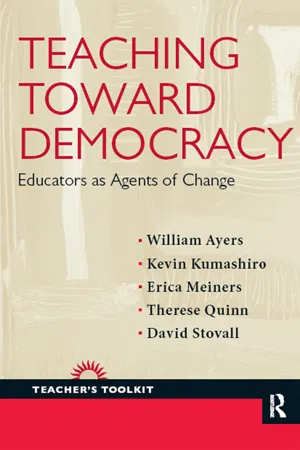
Teaching Toward Democracy
Educators as Agents of Change
- 154 pages
- English
- ePUB (mobile friendly)
- Available on iOS & Android
eBook - ePub
Teaching Toward Democracy
Educators as Agents of Change
About this book
"Teaching Toward Democracy" examines the contested space of schooling and school reform with a focus on the unique challenges and opportunities that teaching in a democratic society provides. Teaching in and for democracy involves developing particular qualities of mind that teachers explore and work to develop as they become more effective educators. Some chapters open with familiar experiences in the lives of teachers in schools (working with parents and communities, or dealing with classroom discipline and management) and illuminate that commonplace in new, helpful, and sometimes startling, ways. Other chapters present possible interventions any teacher might make in any classroom for example, using the arts as an organizing center and metaphor for teaching more generally, or rethinking the press of politics on our every day practice. This book foregrounds the central idea that democratic ideals are a necessary starting point and context in which to enact our teaching here and now."
Information

CHAPTER ONE
OPENING THE CLASSROOM DOOR

• Building the Environment for Learning
• Atmosphere, Experience, Technique, Voice
• Creating a Democratic Culture
• Embracing Contradictions
• Finding the Wisdom in the Room
THERE’S SO MUCH to learn, so much to know and to do as we make our wobbly ways into teaching, that it can seem entirely overwhelming: “this can’t be done,” we hear ourselves saying over and over. That’s an entirely common and natural feeling, and you’re not alone. If you stick with it, break it down, and take it step by step, there can be an end to the tunnel where joy and light and even a little ecstasy live side by side with awe. Of course, the end of any particular tunnel is the beginning of other horizons and newer challenges; welcome to the dynamic world of the classroom.
Before we open our own classroom door, let’s take a short voyage that just might shine a different kind of light on our experiences here and now.
On a recent evening in a small, poorly lit classroom high in the hills above Caracas, Venezuela, a literacy circle was under way: ten people had pulled their chairs close together—a young woman of perhaps age nineteen, a grandmother over sixty-five years old, two men in their forties—and were struggling to read. They were listening to each other’s stories, offering commentary and suggestions for further elaboration, sometimes on the writing itself but as often on the content covered by the narrative. “If the child is crying from a tooth coming,” the older woman told the nineteen-year-old, who had read a two-sentence piece about staying up with her fussy baby, “nursing won’t help; put some rum on her gums to settle the pain.”
This class was part of Mission Robinson, a broad nationwide education outreach effort in Venezuela. Against this brief description of a literacy class, consider Margaret Atwood’s poem “A Poor Woman Learns to Write,” which centers on an illiterate peasant working laboriously to print her name with a stick in the dirt. The woman never thought that she could do it, the poet notes, not her—this lofty writing business was for much more important people than her. But she does do it; she prints her name, “her first word so far”; and she looks up and smiles.
The woman in the poem—like the students in Mission Robinson—is living out a universal rhythm that embodies education at its very best: she simply wrote her name, but in the process she changed herself forever, and she altered, then, the conditions of her life. As the adults in Mission Robinson write their words, they also transform their circumstances—in small ways, perhaps, but who can know where it will lead?—and another world becomes, suddenly and surprisingly, possible. This is the magic that awaits us in every classroom.

Key concept
A classroom is any space with or without walls where people assemble with an expectation of teaching and learning.
A classroom is any space with or without walls where people assemble with an expectation of teaching and learning.
BUILDING THE ENVIRONMENT FOR LEARNING
Imagine your first (or your next) classroom. Open the door and peek in. Look around; take that first tentative step forward. This classroom is yours! You’re neither a visitor nor a tourist nor a casual acquaintance any longer. This will soon become home base for you and for a yet unseen group of young people, and it’s now tied up with your dynamic and developing teacher identity. Take another step, a bolder one this time. And another.
You’re a teacher now, and this space will be a public reflection of you: your preferences and priorities and expectations for your students and for yourself, your sense of what knowledge and learning are all about, your choices, your standards and experiences—all of this and more is worked up and embodied in your learning environment. Right from the start it’s essential to think as deeply as you can about all of it: What knowledge and experiences are of most value? What core beliefs about people, about human dignity and freedom, about democracy, about learning and living a good life will be apparent for all to see and experience?
Now is the best time to take stock, perhaps to make a list of core values that will become a part of your classroom no matter what. Write it up, write it down. Post it on your wall or your bathroom mirror. Carry it around in your pocket. Call it “MY CLASSROOM COMMITMENTS: No Matter What!”
Focus point
Take the elegant but straightforward idea that every human being is a three-dimensional creature much like yourself; a person with hopes, dreams, skills, and experiences; each with a body, a mind, and a spirit that must somehow be valued, respected, and represented in your classroom and somehow taken into account in your teaching. If you take this as a value you intend to carry in your pocket into the classroom—if it’s something you want to take as an ironclad commitment to live out every day no matter what—and to embed deep within the classroom structure, culture, and environment, it challenges you to find concrete ways to reject and resist actions that treat students as objects and any gestures that erase, obliterate, ignore, or silence any other human being. This is easy enough to say, this simple injunction, but excruciatingly difficult to enact in the daily lives of schools or classrooms, especially in places where labeling students, sorting them into hierarchies, and managing their behaviors have become the commonplace markers of good teaching. How will you deal with this? What alternative markers will represent and illuminate your valuing of students’ lives?
Next to this core value, then, you might begin to make a second list, the beginnings of a chart—perhaps “Ten Action Steps Toward Realizing My Dream.” So say you agree, and you have this first value listed: respect for persons, full recognition of the humanity of everyone who enters my classroom. How will that look concretely in practice? What demands does it make? What will you do (and promise yourself never to do) in your teaching? You will need to generate some ideas, some actual items that could bring this value to life in the trembling and messy reality of a gaggle of real kids in real school time and real school space. Maybe your chart is morphing into a system of file folders bristling with practical arts, curricular projects, instructional approaches, possible trips into the community, readings, free writes, books, story starters, guest speakers, aesthetic considerations, visitors, poetry, music and songs, work assignments, websites, films, community resources, recipes, community service possibilities, physical challenges, and encounters with the arts. One folder might be titled “The Physical Environment”; it would denote places for each student to keep his or her work and materials, spaces for students to express and create, both individually and together, and perhaps a wall dedicated to “our families and our community.” A folder marked “Routine and Rhythm of the Day” might include ideas for an opening class meeting geared toward building a culture of respect and recognition, and for a closing activity to note the accomplishments of the day and to anticipate tomorrow. “Management Issues” might include reminders (Note to self: Never threaten or humiliate a kid, no matter what!) and positive plans (I’ll have only a single rule posted, and work out all problems in this light: “This is our learning environment, and we treat one another and one another’s work with generous respect”).
Make a list of core values that will become a part of your classroom no matter what.
Now take another step into your classroom. You’re a unique human being, a person unlike any other, and this space ought to reflect that singular humanity. You’re also now a teacher, and this classroom is one place where your teaching will be enacted and your full humanity lived. As you build your classroom, remember your commitments and your expectations for both yourself and your students. How do you want to live here with twenty-five or thirty other people? What are you inviting them into?
Some classrooms embody reading and writing, and they announce in a zillion ways that literacy in all its forms is valued here. This is likely something you’ll want to establish from the start: books, magazines, comics everywhere; an author’s corner and a cozy space to curl up with reading materials; the walls bristling with student writing, drafts, and edits; an author of the week featured at one table. Other classrooms give other messages: sit down and be quiet; face front because all knowledge is at the front; be obedient and compliant. What messages will your space embody and communicate? Go back and keep adding to your “No Matter What!” list.
You have to start to figure out how you’re going to live here with some degree of satisfaction, comfort, ease, and even joy, and that won’t happen unless you take initiative to breathe life into the environment from the start. Look at it. Walk around in it. Smell and touch it. Now ask yourself how you’re going to make this space your own. A house is not a home, as the old song says; it needs people and love to bring it to life. A classroom is not a learning environment, either, at least not automatically. Not yet. Get busy.
Right away you might want to bring in some plants and pets, or your favorite music and magazines, or paintings or posters or poems, or chess and backgammon and Go, or perhaps a small fridge and a coffeemaker. Books, for sure—books and books and books. You don’t want to check your personhood at the door, or to pretend that you’re just an interchangeable cog in a mass impersonal machine called school. Whatever makes some spot your own place, however you write your signature on a space, do it here and do it now. The point is to set down some of your unique human roots. Put those things on your list too.
The classroom will reflect your humanity, but because the classroom belongs to the students as well, it will reflect or diminish the humanity of each of them, too—maybe they should bring in pets and plants and poems and books, just as you’re planning to do. The trick is to be bold and modest, assertive but humble. The received wisdom of teaching tells you to keep everything neat and systematized, chairs in a row, teacher front and center, behavioral charts in view, the engineering of learning embodied in the room arrangement, but is this how you see learning and growth? What does each of your students need? And just as important, what does each one bring? What do you need, and what do you bring? What are the consequences of your teaching for these students?
This is one of the great challenges of teaching: you will find that every student you encounter is an unruly spark of meaning-making energy on a voyage of discovery and surprise; that is, you will learn that each is unique, like you, each a dynamic work in progress, unfinished, contingent, leaning forward. If you decide to embrace that diversity (as opposed to spending gobs and stacks of energy denying and suppressing it), your classroom will of necessity become a work in progress as well, unfinished, ever changing, and contingent. Put it on your list. You can’t build a generic classroom, a place for all people and all times, and then keep it clean and orderly and humming along over the next thirty years. Each year is different, each child presents new opportunities and different challenges, and each group has its own dynamics and personalities. You need to make the classroom your own, for sure, and simultaneously you need to give the classroom away. This is never an easy thing to do.
Focus point
Of course, this classroom isn’t your only place on earth—you don’t live behind the chalkboard or underneath the desk; you have a home, a community, a family, and a bunch of social groups you call your own—and it isn’t yours alone. This classroom will belong as well to every student who walks through the door and, through each of them, to every family and friend, every network and connection, every concentric circle of community. Take a deep breath. This expansive, collective sense of ownership, participation, and presence—this feeling that a trillion threads of humanity are happily haunting the place—is really exciting, but it can get super complicated too. A big challenge for you will be to help each one find a way to claim it, to resource and redefine it, to vitalize those ghosts, and finally to own it. You’ll be figuring this out for a long, long time, so file it away. There’s a whole lot of history and humanity worked up in here already, and a lot more to come, so let’s go back to the beginning: this classroom is yours.
Focus point
Every built environment reflects a range of ideas, values, preferences, instincts, and experiences. You need to think now about how your deepest moral commitments toward people, youth, and teaching will be made manifest and become embodied in your classroom—about how you will create a space that’s an extension of those values. Imagine that a year from now some of us will drop by your classroom to see how you’re doing: What do you hope that we would immediately realize about you and your teaching intentions simply by walking through the door? What artifacts of learning and teaching would be readily apparent, and what would we surely find by digging a little deeper?
It’s up to you to decide how to build an environment that purposefully and intentionally displays what you value for yourself and for your students. Will it challenge and nurture the wide range of people who will actually pass through your classroom door? Will it be a space where students are visible and expected to use their minds well, to derive knowledge from information, to invest thought with courage, to connect consciousness to conduct, to tell their own stories, ask their own questions, and pursue their o...
Table of contents
- Cover
- Half Title
- Title Page
- Copyright Page
- Table of Contents
- Series Foreword
- Introduction
- 1 Opening the Classroom Door
- 2 Slow, Active, and Surprising: Remaking Teaching Through the Arts
- 3 Our Communities Deserve Justice! Social Justice Teaching and Community Building
- 4 Resisting the Pedagogy of Punishment
- 5 Improving Educational Policy: Reframing the Debate, Reclaiming Public Voice
- Afterword
- Index
- About the Authors
Trusted by 375,005 students
Access to over 1.5 million titles for a fair monthly price.
Study more efficiently using our study tools.
Frequently asked questions
Yes, you can cancel anytime from the Subscription tab in your account settings on the Perlego website. Your subscription will stay active until the end of your current billing period. Learn how to cancel your subscription
No, books cannot be downloaded as external files, such as PDFs, for use outside of Perlego. However, you can download books within the Perlego app for offline reading on mobile or tablet. Learn how to download books offline
Perlego offers two plans: Essential and Complete
- Essential is ideal for learners and professionals who enjoy exploring a wide range of subjects. Access the Essential Library with 800,000+ trusted titles and best-sellers across business, personal growth, and the humanities. Includes unlimited reading time and Standard Read Aloud voice.
- Complete: Perfect for advanced learners and researchers needing full, unrestricted access. Unlock 1.5M+ books across hundreds of subjects, including academic and specialized titles. The Complete Plan also includes advanced features like Premium Read Aloud and Research Assistant.
We are an online textbook subscription service, where you can get access to an entire online library for less than the price of a single book per month. With over 1.5 million books across 990+ topics, we’ve got you covered! Learn about our mission
Look out for the read-aloud symbol on your next book to see if you can listen to it. The read-aloud tool reads text aloud for you, highlighting the text as it is being read. You can pause it, speed it up and slow it down. Learn more about Read Aloud
Yes! You can use the Perlego app on both iOS and Android devices to read anytime, anywhere — even offline. Perfect for commutes or when you’re on the go.
Please note we cannot support devices running on iOS 13 and Android 7 or earlier. Learn more about using the app
Please note we cannot support devices running on iOS 13 and Android 7 or earlier. Learn more about using the app
Yes, you can access Teaching Toward Democracy by William Ayers,Kevin Kumashiro,Erica Meiners,Therese Quinn,David Stovall in PDF and/or ePUB format, as well as other popular books in Education & Education General. We have over 1.5 million books available in our catalogue for you to explore.