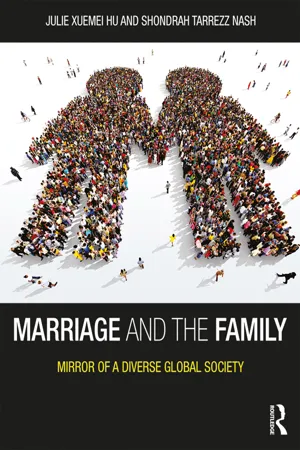
Marriage and the Family: Mirror of a Diverse Global Society is a comprehensive text about marriage and the family in sociology, family science, and diversity studies. The book is divided into four parts: studying marriage patterns and understanding family diversity; developing and maintaining intimate relationships; tackling family issues and managing household crises; and appreciating contemporary living arrangements in a diverse American society and across the global community. Marriage and the Family is unique in its focus on diversity as well as its global perspective. Diversity Overview boxes feature vignettes of family diversity in America. Global Overview boxes invite students to experience family life in different areas of the world. Indeed, families become a mirror that helps students see a diversifying American society and a globalizing world.
eBook - ePub
Marriage and the Family
Mirror of a Diverse Global Society
- 766 pages
- English
- ePUB (mobile friendly)
- Available on iOS & Android
eBook - ePub
About this book
Information
Part I
Introduction to Marriage and the Family
1
The Meaning of the Family and Marriage
Learning Outcomes
Upon completion of the chapter, students should be able to:
- explain how the family is a primary group and a social institution
- analyze the functions of the family in traditional and modern society
- describe various definitions of family and household
- compare nuclear families and extended families
- explain the formation of conjugal and consanguineous families
- apply unilineal and bilateral descent to the analysis of traditional family and modern family
- describe the characteristics of the patriarchal family and the matriarchal family
- describe forms of family based on residence
- explain trends in forms of family
- compare monogamy and polygamy
- analyze the impact of open marriage and polyamory on the family
- explore family life from a diversity and global approach.
Brief Chapter Outline
- Pre-test
- Family as a Mirror of a Diverse Global Society
- Family as the Center of Culture in Society
- Family as Primary Group; Family as Social Institution
- Functions of the Family
- Provision of Intimate and Sexual Relationships; Reproduction; Economic Cooperation; Socialization of Children
- Meanings of Family and Household
- Definitions of Family; Definitions of Household
- Family as the Center of Culture in Society
- Forms of Family
- Forms of Family Based on Structure
- Types of Nuclear Families; Extended Family
- Forms of Family Based on Kinship
- Consanguineous Family; Conjugal Family; Types of Kinship; Kinship Norms
- Forms of Family Based on Descent
- Unilineal Descent; Patrilineal Family; Matrilineal Family; Bilateral Descent; Egalitarian Family
- Forms of Family Based on Authority
- Patriarchal Family; Matriarchal Family
- Forms of Family Based on Residence
- Patrilocal Family; Matrilocal Family; Neolocal Family
- Forms of Family Based on Structure
- Trends in Family Forms
- Demographic Trends in Families
- Forms of Family through Marriage and Remarriage
- Forms of Family Outside Marriage
- Diversity Overview on Single Life
- Forms of Marriage
- Polygamy
- Polygyny; Polyandry
- Monogamy
- Consanguineous Marriage
- Forms of Consensual Non-monogamy (CNM)
- Open Relationships; Polyamorous Relationships; Group Marriage
- Polygamy
- Framework of the Text: Diversity and Global Approach
- Diversity Approach: Dimensions of Diverse Family Life
- Race and Ethnicity; Social Class; Gender; Sexual Orientation; Religion
- Global Approach
- Diversity Approach: Dimensions of Diverse Family Life
- Global Overview on Family Structure and Marriage Patterns
- A Final Note
- Summary
- Key Terms
- Discussion Questions
- Suggested Film and Video
- Internet Sources
- References
Pre-test
Engaged or active learning is a powerful strategy that leads to better learning outcomes. One way to become an active learner is to begin the chapter and try to answer the following true/false statements from the material as you read. You will find that you have ready answers to these questions upon the completion of the chapter.
The family is a primary group. | T | F |
Family members include the householder and related people by birth, marriage, or adoption. | T | F |
Family household members include the householder, family members, and all unrelated people. | T | F |
Unilateral descent is divided into patrilineal and matrilineal descent. | T | F |
Another term for extended family is multigenerational household. | T | F |
A family of neolocal residence is a family in which people live in their own home. | T | F |
Trends in family forms include stepfamilies, cohabiting families, childfree families, single-parent families, and grandparent families. | T | F |
Polygamy is practiced on a traditional and religious basis in most countries. | T | F |
Polyamory is a form of open marriage or relationship that is practiced in modern society. | T | F |
Family diversity is a way of embracing such dimensions as race, ethnicity, class, gender, sexual orientation, and religion. | T | F |

Upon completion of this section, students should be able to:
LO1: Explain how the family is a primary group and a social institution.
LO2: Analyze the functions of the family in traditional and modern society.
Angela was 21 and home on winter break from her third year at the university. After seeing the Broadway show Cabaret, Angela and her parents walked slowly toward Rockefeller Center to admire the Christmas tree there, which had become a symbol of that holiday for many people in New York and beyond. Angela and her parents gathered with a sea of other visitors to look up at the tree, to listen to Christmas carols, and to celebrate the spirit of Christmas. Later, as she walked away, Angela felt filled with special warmth from being around her family at Christmastime.
All American families have their own celebrations. For some, like Angela’s family, Christmas is an important celebration. Other Americans celebrate Kwanzaa—a weeklong celebration honoring African American culture. Jewish American families celebrate Hanukkah or the Jewish Festival of Lights. Indian American families celebrate the Hindu festival Diwali. And when Muslim Americans celebrate Eid al-Fitr and Eid al-Adha, New York City closes schools for these two holy days. New York City schools also close for the Chinese Lunar New Year. What traditional holidays do you celebrate in your family?
Family as a Mirror of a Diverse Global Society
As these examples show, at the center of any celebration is the family. The activity of traditional celebrations takes place at home. This makes the holiday season a perfect time for families to come together and celebrate. This section explores how families are the center of culture and share a unique heritage. In fact, we can say that families are a mirror that helps us understand our diverse global society.
Family as the Center of Culture in Society
The metaphor of the family as a mirror of society can be traced back to the Greek philosophers Socrates (ca. 470–399 BCE), Plato (ca. 428–348 BCE), and Aristotle (ca. 384–322 BCE). They considered the family a model for the ways in which societies are organized. For example, a monarchy is a political system in which power is embodied in one person or family through lines of inheritance and is reflective of one way of organizing society. Monarchal societies mirror the patriarchal family, with people obeying the king as children obey their father, which in turn helps maintain social order. Healthy families are a mirror of a healthy and ordered society.
Human societies include hunting and gathering, horticultural and pastoral, agricultural, industrial, and post-industrial societies according to technological and economic development. The United States is a post-industrial society—post-industrialism (Bell, 1973) is based on computer technology that produces information and supports a service industry. Society refers to groups of people who share a common culture in a geographic location. This definition can be broken down into three components.
- First, individual people are the basic component of society.
- When individuals interact and develop relationships with each other, they form the second component: social groups. People living and working in social groups share a common culture and maintain their own heritage.
- Social institutions are the third component of society. Social institutions fulfill a society’s basic needs. For example, families are one important social institution.
Why do families embrace the culture to which they belong? Culture and society are closely connected. Society cannot exist without culture because culture helps hold society together. Culture—a way of life within a society or social group—is central to family life. Culture includes material culture and non-material culture. Material culture refers to tangible objects that the people of a society make and use. For example, on her way to Rockefeller Center, Angela bumped into other visitors bundled in warm clothes and enjoyed the street food. She saw vehicles yielding to pedestrians in the crosswalk. The food, clothes, and cars that Angela saw are examples of material culture. Food is a universal item of material culture, but the way people eat—a non-material item—varies widely from one culture to the next. For example, people in Japan and China eat with chopsticks, while people in Western countries eat with forks and knives. Non-material culture refers to intangible creations that influence the behavior of the members of a society. Non-material culture includes beliefs, values, norms, symbols, and sanctions. The languages people speak, the holidays they celebrate, traffic rules they obey, and American values (e.g., freedom) they accept are examples of non-material culture.
Subculture is a culture shared by a category of people within a society. This concept has been applied to cultural differences based on gender, age, ethnicity, religion, occupation, social class, etc. If Angela is a 21-year-old pharmacist with an Italian background, she falls within the subcultures of Generation Y, the middle class, Italian Americans, and health-care professionals. Subcultures are not opposed to the principles of the mainstream culture. For example, most American people celebrate Independence Day and believe in the power of the Constitution. At the same time, ethnic families may observe family traditions that help keep them grounded in their subcultures and help children retain ethnic identity. Indeed, the family functions as transmitter of ethnic subculture. For example, research has shown the persistence of ethnic identity among second- and fourth-generation Italian American adults (Alessandria et al., 2016).
Family as Primary Group
Families maintain their cultural heritage within a social group. Formally defined, social groups are characterized by more than two people, frequent interaction, a sense of belongingness, and a feeling of interdependence. Sociologists distinguish primary groups from secondary groups. A primary group is a small group whose relationships are face to face and personal. The family is an example of a primary group. The primary group is what we generally refer to as family members related by blood, marriage, adoption, and relatives. Families share lasting relationships and support and buffer each other against stress. A secondary group is a large group whose relationships are impersonal and goal-oriented. People engage in educational and career pursuits in secondary groups on a daily basis. Social groups such as workplaces and universities are secondary groups.
Family as Social Institution
Sociologists viewed the family as a social institution (Komarovsky & Waller, 1945). As noted earlier, a social institution is an organized system of social relationships which embodies values and procedures and meets basic needs of the society (Horton et al., 1983). Basic social institutions include the family, marriage, religion, politics, the economy, and education. Families are related to other social institutions, and reflect the different religious, educational, political, and economic features of a society. For example, a study of four time periods (up to 1500, from 1500 to 1700, from 1700 to 1900, and after 1900) in England reveals that the family and education are structurally interrelated (Musgrave, 1971). Human beings develop different social institutions depending upon the basic needs of the s...
Table of contents
- Cover
- Half Title
- Title
- Copyright
- Dedication
- Contents
- Preface
- Acknowledgments
- PART I INTRODUCTION TO MARRIAGE AND THE FAMILY
- PART II DEVELOPMENT AND MAINTENANCE OF RELATIONSHIPS
- PART III CHALLENGES TO MARRIAGE AND THE FAMILY
- PART IV DYNAMICS IN FAMILY LIVING ARRANGEMENTS
- Index
Trusted by 375,005 students
Access to over 1.5 million titles for a fair monthly price.
Study more efficiently using our study tools.
Frequently asked questions
Yes, you can cancel anytime from the Subscription tab in your account settings on the Perlego website. Your subscription will stay active until the end of your current billing period. Learn how to cancel your subscription
No, books cannot be downloaded as external files, such as PDFs, for use outside of Perlego. However, you can download books within the Perlego app for offline reading on mobile or tablet. Learn how to download books offline
Perlego offers two plans: Essential and Complete
- Essential is ideal for learners and professionals who enjoy exploring a wide range of subjects. Access the Essential Library with 800,000+ trusted titles and best-sellers across business, personal growth, and the humanities. Includes unlimited reading time and Standard Read Aloud voice.
- Complete: Perfect for advanced learners and researchers needing full, unrestricted access. Unlock 1.5M+ books across hundreds of subjects, including academic and specialized titles. The Complete Plan also includes advanced features like Premium Read Aloud and Research Assistant.
We are an online textbook subscription service, where you can get access to an entire online library for less than the price of a single book per month. With over 1.5 million books across 990+ topics, we’ve got you covered! Learn about our mission
Look out for the read-aloud symbol on your next book to see if you can listen to it. The read-aloud tool reads text aloud for you, highlighting the text as it is being read. You can pause it, speed it up and slow it down. Learn more about Read Aloud
Yes! You can use the Perlego app on both iOS and Android devices to read anytime, anywhere — even offline. Perfect for commutes or when you’re on the go.
Please note we cannot support devices running on iOS 13 and Android 7 or earlier. Learn more about using the app
Please note we cannot support devices running on iOS 13 and Android 7 or earlier. Learn more about using the app
Yes, you can access Marriage and the Family by Julie Xuemei Hu,Shondrah Tarrezz Nash in PDF and/or ePUB format, as well as other popular books in Social Sciences & Gender Studies. We have over 1.5 million books available in our catalogue for you to explore.