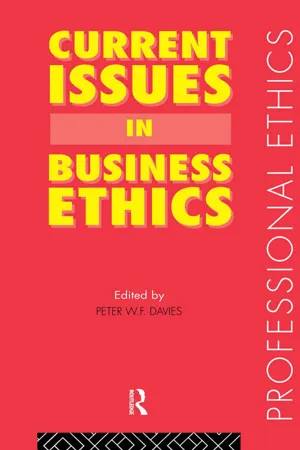
Current Issues in Business Ethics analyzes the questions which underlie business activities, arguing that the prime object for a legitimate business must be sustainability. It also looks at the issues between individuals and business and asks whether businesses can support their employees as an alternative to family and church. Finally it assesses the impact of most recent trends in business looking at:
* the activities of multinational companies
* the changing gender balance
* privatization
* the loss of power of the trade unions.
- 224 pages
- English
- ePUB (mobile friendly)
- Available on iOS & Android
eBook - ePub
Current Issues in Business Ethics
About this book
Part I
MACRO ISSUES
MACRO ISSUES
The role and legitimacy of business activity
INTRODUCTION TO PART I
Part I – Macro Issues: The role and legitimacy of business activity has four contributions. In Chapter 1, Business Philosophy: Searching for an authentic role, Peter Davies sets out to get to the heart of various perspectives on the meaning and purpose of business activity in the first place. As is suggested, if we believe the purpose of business is ‘to maximise profit’, then our viewpoint on business ethics will differ considerably from that of those who believe its purpose is ‘to provide meaningful employment’. The five different perspectives Davies discusses point towards business’s basic meaning and purpose as a vocation, as a crucial upholder of democracy, as a way of leaving the planet in better shape, as a financial wealth creator, and as a forum for developing people’s virtuous characters. Each perspective makes a valid contribution, but in the end the context of time and place will suggest that one may be particularly more relevant and necessary than the others. The question is not so much ‘which is the right one?’, but ‘which perspective (or paradigm) will prevail, and will it prevail at the appropriate time?’ Certainly, four of the five perspectives suggest a broadening-out of the values associated with business, but with the current Friedmanite ‘business is business’ paradigm being long established and well entrenched, it seems that only a major crisis for business survival will actually provide a basis for a genuine challenge to this worldview.
In Chapter 2, Whose business is it anyway? The question of sustainability, Marek Lubelski and Raff Carmen put the case that the prevailing emphasis in the 1990s and beyond should be genuine sustainable development; herein lies the true role and legitimacy of business. Of all the external forces pressing on business, it is probably correct to say that the environmental one has been the most strong and persistent. The 1992 Rio Earth Summit got leaders of over 120 nations to sign up to Agenda 21, but is any real change happening? At the senior business level, Lubelski and Carmen suggest not. Despite various promising initiatives and some rigorous investigative research which they outline, the ‘business is business’ and ‘North over South’ views still predominate – we continue to have maldevelopment. But at a different level they suggest that all is not lost. Cultural resistance to the old paradigm (the culture of competition and power) is manifesting itself at grassroots level in the form of the popular (or informal) economy. These are more regionally based, and provide smaller scale and genuinely sustainable ways of exchanging goods and services. In this they point to the ecosystems perspective, outlined in Chapter 1; and in their concluding section they refer to the (neglected) issue of ownership and control (see the ‘democracy’ perspective in Chapter 1). If the regenerative power of culture is to be fully realised, then these issues of ownership and control must be addressed.
In Chapter 3, Corporate Governance and Ethics, Philip Stiles does address this issue from the angle of corporate governance. This is less a question of pure ownership, and more one of control and accountability. Stiles examines two key areas: the relationship between the board and the shareholders, and the relationship of the board with the shareholders to society as a whole. If the board should set the ethical framework within which the company operates, then how is this significant role to be achieved? With unitary boards (the German system of two-tier boards seems a non-starter), non-executive directors are always caught in the paradox of having to be involved enough in the company to ask searching questions, but also to maintain adequate distance and independence. This has led to calls for greater shareholder involvement in running the company, but such interventions are often only at the extremes, and too little too late. In terms of the relationship with society, the stakeholder model is taken as given, and critically examined. This requires greater disclosure of information and representation (the ownership question again) if it is to work – something fiercely resisted by companies. This all leads to the question: self-regulation, or legislation? It seems the former will prevail if companies are seen politically to act legitimately in the public’s eyes. In the final analysis, Stiles suggests the effectiveness of corporate governance still rests on the integrity of the people involved – a virtue ethics approach (see Chapter 1).
In Chapter 4, Business and its Social Responsibility, Andrew Wilson takes the notion of a company’s ‘licence to operate’ as a way of investigating the role and legitimacy of business activity. Discerning customers, jobseekers, investors and employees are all creating a changed external environment which companies ignore at their peril. The argument that the growing number of ‘ethical consumers’ and ‘ethical investors’ continues to put pressure on companies to behave more responsibly seems sound enough. The argument that ‘discerning jobseekers’ who are concerned to work only for companies with a good ethical reputation seems initially less persuasive in a time of high unemployment, but inexorable demographic changes, coupled with the cost to companies of not recruiting the right people of high calibre who stay for a reasonable length of time, suggest that this will be an increasingly important factor in the future. Changing employee expectations also mean that companies are going to have to ‘walk the talk’ about people being their greatest asset, and develop organisational cultures that engender fairness and respect if they are to get any company loyalty in return. All this, Andrew Wilson suggests, lends support to the argument that (in the long term) good ethics is good business; without it, companies will lose their licence to operate.
If there is any validity in the democratic process, then the public’s assessment of the role and legitimacy of business will, sooner or later, be reflected in changes in the law, and changes in the values and attitudes of business people. The discussion in Part I is essentially grappling with the implications of the stakeholder model of business. How accountable is a manager to the various stakeholders? How can that accountability be practically realised? What power should the various stakeholders have in relation to the activities of businesses? These questions are all being asked in a climate of changing expectations for greater transparency and clearer accountability. No doubt the debate will rage on, but it is difficult to see how far such issues can be resolved without opening up the question of ownership (financial, as well as conceptual). Indeed, the ownership question is closely related to motivation and therefore underlies many of the chapters in Part II.
1
BUSINESS PHILOSOPHY
Searching for an authentic role
Peter W. F. Davies
INTRODUCTION
Much of the debate about the various issues in business ethics is fuelled by implicit and differing philosophies of business. Clearly, if you believe that the basic role of business is ‘to maximise profit’, then your analysis of business ethics issues will differ considerably from that of those who assume that the basic role of business is ‘to provide meaningful employment’. Not only do such hidden assumptions undermine the value of the business ethics debate, but the danger of such generally teleological approaches is that they may focus too much on ends, with the means getting less-than-adequate emphasis. Philosophy equally addresses both, by asking two fundamental questions of any phenomenon which is the subject of its investigation; its meaning, and its purpose. Put into the context of business activity these roughly translate into:
1 What is the meaning of business (activity)?
2 What purpose is in it (if any)?
This chapter looks at the second question first, via an examination of five differing ethical perspectives of modern-day business, and then attempts to draw out both the meaning of business in relation to each perspective, and also the implications for business ethics theory from each of the differing views. My own bias is a belief that the historical context is very important; what has gone before in large measure shapes our current understanding in the world of ideas, as well as shaping the physical world. For business, this influence of the past cannot be fully understood without due appreciation of developments in technology.1
A WESTERN CHRISTIAN THEOLOGICAL PERSPECTIVE
In the West we have been deeply affected by Christianity in our understanding of all areas of life, including business. The starting point for a Christian understanding of business as a cultural activity would normally be Niebuhr’s classic on Christian social ethics, Christ and Culture.2 Niebuhr’s five archetypal answers each lead to differing understandings of the meaning and purpose of business, so I will focus here on aspects widely accepted in the Christian tradition. God, it is believed, has a purpose for every individual’s life, which includes the cultural collective contexts of those lives, such as business activity. Recently however, Christianity has been severely blamed by environmentalists for business’s exploitative attitudes towards nature (the ecology) which (it is claimed) the Christian religion has sanctioned.3 This has been due to Christianity’s emphasis on human beings as the pinnacle of creation, and on the afterlife, and these two are held responsible for desacralising and debasing the value of nature in the here and now, hence sanctioning business short-termism. Such an accusation, though, is based on a narrow interpretation of Genesis 1:28 (‘And God said unto them … have dominion over …’4). Perhaps also, historically, the Protestant Work Ethic at its worst could be said to have sanctioned any work (however dangerous and demeaning) as of value in God’s eyes, as well as ...
Table of contents
- Cover
- Half Title
- Title Page
- Copyright Page
- Dedication
- Table of Contents
- List of Contributors
- Acknowledgements
- Introduction
- Part I Macro issues: the role and legitimacy of business activity
- Part II Micro issues: the relationship between the individual and the business organisation
- Part III Some current trends and their impact on business ethics
- Select annotated bibliography for further reading
- Index
Trusted by 375,005 students
Access to over 1.5 million titles for a fair monthly price.
Study more efficiently using our study tools.
Frequently asked questions
Yes, you can cancel anytime from the Subscription tab in your account settings on the Perlego website. Your subscription will stay active until the end of your current billing period. Learn how to cancel your subscription
No, books cannot be downloaded as external files, such as PDFs, for use outside of Perlego. However, you can download books within the Perlego app for offline reading on mobile or tablet. Learn how to download books offline
Perlego offers two plans: Essential and Complete
- Essential is ideal for learners and professionals who enjoy exploring a wide range of subjects. Access the Essential Library with 800,000+ trusted titles and best-sellers across business, personal growth, and the humanities. Includes unlimited reading time and Standard Read Aloud voice.
- Complete: Perfect for advanced learners and researchers needing full, unrestricted access. Unlock 1.5M+ books across hundreds of subjects, including academic and specialized titles. The Complete Plan also includes advanced features like Premium Read Aloud and Research Assistant.
We are an online textbook subscription service, where you can get access to an entire online library for less than the price of a single book per month. With over 1.5 million books across 990+ topics, we’ve got you covered! Learn about our mission
Look out for the read-aloud symbol on your next book to see if you can listen to it. The read-aloud tool reads text aloud for you, highlighting the text as it is being read. You can pause it, speed it up and slow it down. Learn more about Read Aloud
Yes! You can use the Perlego app on both iOS and Android devices to read anytime, anywhere — even offline. Perfect for commutes or when you’re on the go.
Please note we cannot support devices running on iOS 13 and Android 7 or earlier. Learn more about using the app
Please note we cannot support devices running on iOS 13 and Android 7 or earlier. Learn more about using the app
Yes, you can access Current Issues in Business Ethics by Peter W. F. Davies in PDF and/or ePUB format, as well as other popular books in Business & Business Ethics. We have over 1.5 million books available in our catalogue for you to explore.