Transforming Social Work Practice shows that postmodern theory offers new strategies for social workers concerned with political action and social justice. It explores ways of developing practice frameworks, paradigms and principles which take advantage of the perspectives offered by postmodern theory without totally abandoning the values of modernity and the Enlightenment project of human emancipation. Case studies demonstrate how these perspectives can be applied to practice.
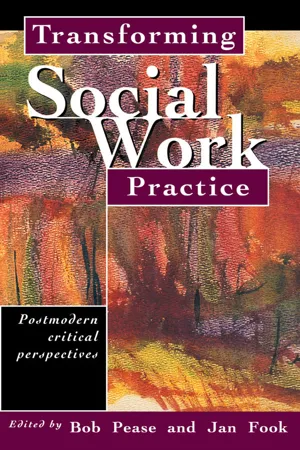
- 240 pages
- English
- ePUB (mobile friendly)
- Available on iOS & Android
eBook - ePub
About this book
Information
1 Postmodern critical theory and emancipatory social work practice
Bob Pease and Jan Fook
What does postmodern critical theory offer in shaping directions for social work practice? This is the question that motivated us to bring together this collection of papers.
The book grew out of a series of lunchtime discussions in 1995 and 1996 between social work academics in Melbourne who were interested in discussing the implications of postmodernism for progressive practice in social work. At that time, there was little social work literature on the development of postmodern social theory and there was even less engagement with postmodernism by radical social work writers.
The book is thus a collaborative attempt to define and develop a new discourse of theory and practice in social work which we call postmodern critical social work.1 A specific focus of this book is bringing together contemporary theoretical and empirical work by a range of social work researchers who are involved in working through the implications of postmodern critical theory for social work practice. Most of the contributors to this volume are involved in attempts to construct emancipatory approaches to practice in specific fields of social work. The book is thus a contribution to the wider struggle of deconstructing traditional social work in order to formulate strategies of emancipatory practice.
In this introductory chapter, we provide some personal and theoretical background to the development of emancipatory perspectives in social work. We then locate the book within the context of the current theoretical debates about postmodernism and consider their implications for the future of emancipatory social work. The last section summarises our version of postmodern critical theory and shows how the various chapters address this perspective.
WHY THE POSTMODERN TURN? BOB’S STORY
I felt a strong sense of disquiet during my education as a social worker. I had an intuitive reaction against much of what was taught under the rubric of social work theory and practice. I had no systematic political analysis at this time and I suspect that some of my rebellion stemmed from my own lived experience of working-class life, as much of this was at odds with the middle- class conceptions of working-class clients conveyed to students in the classroom.
The integration of theory and practice was of particular interest to me and I struggled hard to relate the theoretical and technical knowledge of the classroom to the realities of my placement experiences. Although there were educational expectations that these should be integrated, little guidance was provided on how one actually did this.
With six months to go before graduating, I decided to take a year’s leave of absence from social work to examine these issues more thoroughly. During this time, I studied political economy and became involved in activist community politics. I became clearer about my own purposes and about what theories I wanted to integrate with what practices.
At this time, I came to see the relevance of a Marxist analysis for understanding many of the issues that social workers were confronted with. But I had little understanding of how one could utilise this framework in daily practice. I had grasped some Marxist insights about the social world, but I had no understanding of the dialectical method that Marx used to derive these insights and hence no way to use such a method to construct a radical practice. During this time, I began to feel the impact of the women’s movement and feminist analyses, so I began to temper my developing Marxist analysis with a feminist understanding of personal-political connections. These connections were further affirmed through the influence of the radical therapy movement. In addition to these theoretical influences, I gained my first apprenticeship as a community organiser in the fields of housing, unemployment and health issues.
With a clearer sense of social purpose and a political practice behind me, I returned to the study of social work and finished my degree. Upon graduation, I obtained a job as a community development officer in the ‘dying days’ of the Australian Assistance Plan (AAP). Following the demise of the AAP, I coordinated a resource centre for community action groups. Much of my work during this time involved the establishment of alternative community-based social services projects. In the development of these services, we endeavoured to create alternative collectivist/democratic structures and aimed to link service provision with collective action. In this context I began to explore the implications of class and gender analyses for direct service work. At about this time, there were early attempts to construct paradigms for radical practice (Galper 1975; Bailey and Brake 1975; Corrigan and Leonard 1978). Being located outside the state maximised opportunities for these radical frameworks to be tested out in practice.
Throughout the time I was associated with these alternative social services, I monitored and assessed my attempts to relate the radical models to my practice. To facilitate this self-evaluation of practice, I set up a study/support group of progressive social workers, maintained a daily diary of my work and wrote a series of discussion papers on my practice. I did not conceptualise these activities at the time as research. They were just my attempts to make sense of what I was doing. It has taken me a long time to validate this reflective practice as research and to recognise the potential within such research for the generation of new knowledge.
At the time, however, I thought that theorising and teaching in academia would provide opportunities for exploring the many unanswered questions that my practice and my reflections upon it had raised. So I entered social work education in 1980. In the practice subjects that I taught, I was able to bring together some of my practice and experience with my developing structural analysis. But, of course, I did not have all the answers and the available radical social work literature left much to be desired, as I knew from my own practice.
I felt a need for my own theorising to be more grounded in the practice reality of social workers. I thus began a collaborative inquiry into the attempts of radical practitioners to construct progressive practices in their work (Pease 1987, 1990). In the early days of this research, I hoped to construct a model of radical practice by integrating the experiences of the practitioners into a coherent practice framework. What I found, however, was a plurality of radical approaches. During the research, a multiplicity of views were expressed about both radical analysis and strategy in social work. Rather than try to encapsulate them within a framework of my own making, I constructed a one-act play to allow the different voices to be heard. At this point, I had never heard of postmodernism; looking back now, however, I realise that this was my first step towards a postmodern theorising about political practice.
It would be some years later when I enrolled in a doctorate to theorise the subjectivities and practices of profeminist men that I would revisit these questions (Pease 1996). From my first encounters with feminist literature in the 1970s, I had been influenced by feminist theorising about men. However, this did not provide specific guidance for practice because the subject of men has not been given a central priority in feminist theorising. I had explored sex role theory and psychoanalytical and Jungian ideas, but I soon came to recognise the limitations of these theories for examining men’s social power and institutionalised dominance. I then examined social constructionist approaches to masculinity that emphasised men’s material and economic position and their social practices at home and at work. In the end, I found these approaches limiting as well because they did not provide sufficient guidance on how men could change their subjectivities and practices. I thus found myself confronting the same dilemmas I had encountered when practising, teaching and researching radical social work. To work through these issues, I began to read about the intersections of feminism, postmodernism and critical theory and to consider the implications these developments had for changing men and masculinities.
As I report in detail in Chapter 7, postmodern critical theory enabled me to move beyond the dualism that existed between voluntarism and structural determinism. I began to see how non- patriarchal subject positions for men could be discursively produced and how it was possible for men to reformulate their interests to challenge gender domination. It gave me a sense of agency in the face of the material and social basis of patriarchy. It also provided a language with which to revisit the unresolved dilemmas I had encountered with structural approaches to social work practice (Moreau 1990; Mullaly 1993), the more contemporary expressions of radical social work. The conversations that began to take place with Jan and other colleagues about these issues in 1995 became the basis for this book.
WHY THE POSTMODERN TURN? JAN’S STORY
As a young social worker in the late 1970s, I graduated with an awareness that casework was seen as inherently conservative, and that community work was seen as the ‘right-minded’ path to follow. Yet this simple dichotomy did not seem to me to fit the world of my early practice. I worked with people in my first job who, although strong and empowered volunteers—some of them trailblazers in the field of intellectual disability services—still needed emotional support, and sometimes more explicit counsel ling, to help them cope with the daily stresses of parenting children with intellectual disabilities.
My disquiet with this over-simplistic dichotomy, this forced choice of ‘casework versus community work’, carried over into my experience of postgraduate study, when I decided I would try to research the problem of ‘radical casework’. What I found was another disquieting dichotomy, a world in which it seemed that male academic theorising sociologists tried to teach female practising social workers better social work by ‘converting’ them to a world of theory (e.g. Althusser), which incidentally seemed to be ‘owned’ by the male academic sociologists. Since I was neither male nor a sociologist, but was at the time an academic and a social worker, I found the dichotomy inadequate as a representation of my own experience and identity.
I had always had a love of theory, but did not feel that it had to come at the expense of practice. Neither could I see why community work had to be practised in the annihilation of casework, and similarly, I could not see why academic (and by definition, male) teaching had to necessarily devalue the experience of female practitioners. These were the beginnings of my disaffection with the culture of radicalism, although I was—and still am—a strong proponent of radical (and structural) social work analysis, I began to question many of the practical expressions, the lived experience, of radicalism.
I continued to observe instances in which the culture of radicalism seemed to me to be limited. For instance, in my teaching of radical casework practice, I am often struck by how students seem to think that ‘radical’ and ‘traditional’ practices must be, by definition, mutually exclusive. Therefore they feel they cannot use a skill radically if it has already been taught to them in a ‘traditional’ practice class. This type of thinking leads mostly to radical inaction.
This phenomenon is similar to what I term a ‘commodification’ of theory, as if radical theory consists of a material set of ideas which can be transferred from one person to another. A person becomes radical if they can take on all the right ideas—they have thus become converted. This way of thinking, however, is potentially disempowering, since it assumes that the source of radicalism comes from ‘outside’ the person, and lies solely in the the acceptance of certain beliefs. There is a danger that the experience of the ‘unconverted’ will be devalued and discounted, and there is therefore potential for radicalism to be experienced as disempowering (by those who by definition don’t have it).
Another example of how radicalism can be experienced as disempowering was put to me by one of my own students recently. She related how, as a woman of South Asian heritage and appearance, she had felt quite disempowered when she came out of a class on structural social work which had clearly labelled people like herself as ‘disadvantaged’ and ‘oppressed’. She hadn’t felt that way before she went into the class, but she now felt that the source and cause of her ‘problems’ were located in the social structure (and so, by definition, the actions to address them must be too). She experienced a sense of classic alienation—a distancing from the ability to change her situation—because she had been labelled and categorised in a deterministic way.
For me, this potentially deterministic thinking also fails to account for my own experience in relation to another important aspect of my life. I happen to be of third-generation Australian- born Chinese descent. I appear racially Chinese, but have been raised with a primarily white Australian identity (as happened to many non-Anglo people during the 1950s in Australia). I do, in this sense, have one foot each in both the advantaged and disadvantaged classes. Simple structural analysis fails to be meaningful for my identity, because it fails to allow for seeming contradictions in people’s behaviour and identities. These types of reflections on the limitations of theorising inherent in radicalism led me to examine much more closely the epistemological assumptions inherent in my own thinking.
At about the same time that I was becoming unhappy about the cultural expressions of social work radicalism, I became involved in developing a new postgraduate social work practice program. I realised, to my consternation, that I could not peddle the usual material (update on practice theories), since a good number of the potential students had only recently compl...
Table of contents
- Cover Page
- Half Title Page
- Title Page
- Copyright Page
- Foreword
- Table of Contents
- Contributors
- Part I Deconstructing the professional and organisational context of social work
- Part II Dealing with diversity and difference
- Part III Rethinking critical practice
- Part IV Reconstructing social work education
- Part V Critically interrogating the postmodern
- Index
Trusted by 375,005 students
Access to over 1.5 million titles for a fair monthly price.
Study more efficiently using our study tools.
Frequently asked questions
Yes, you can cancel anytime from the Subscription tab in your account settings on the Perlego website. Your subscription will stay active until the end of your current billing period. Learn how to cancel your subscription
No, books cannot be downloaded as external files, such as PDFs, for use outside of Perlego. However, you can download books within the Perlego app for offline reading on mobile or tablet. Learn how to download books offline
Perlego offers two plans: Essential and Complete
- Essential is ideal for learners and professionals who enjoy exploring a wide range of subjects. Access the Essential Library with 800,000+ trusted titles and best-sellers across business, personal growth, and the humanities. Includes unlimited reading time and Standard Read Aloud voice.
- Complete: Perfect for advanced learners and researchers needing full, unrestricted access. Unlock 1.5M+ books across hundreds of subjects, including academic and specialized titles. The Complete Plan also includes advanced features like Premium Read Aloud and Research Assistant.
We are an online textbook subscription service, where you can get access to an entire online library for less than the price of a single book per month. With over 1.5 million books across 990+ topics, we’ve got you covered! Learn about our mission
Look out for the read-aloud symbol on your next book to see if you can listen to it. The read-aloud tool reads text aloud for you, highlighting the text as it is being read. You can pause it, speed it up and slow it down. Learn more about Read Aloud
Yes! You can use the Perlego app on both iOS and Android devices to read anytime, anywhere — even offline. Perfect for commutes or when you’re on the go.
Please note we cannot support devices running on iOS 13 and Android 7 or earlier. Learn more about using the app
Please note we cannot support devices running on iOS 13 and Android 7 or earlier. Learn more about using the app
Yes, you can access Transforming Social Work Practice by Jan Fook, Bob Pease, Jan Fook,Bob Pease in PDF and/or ePUB format, as well as other popular books in Social Sciences & Health Care Delivery. We have over 1.5 million books available in our catalogue for you to explore.