- 284 pages
- English
- ePUB (mobile friendly)
- Available on iOS & Android
eBook - ePub
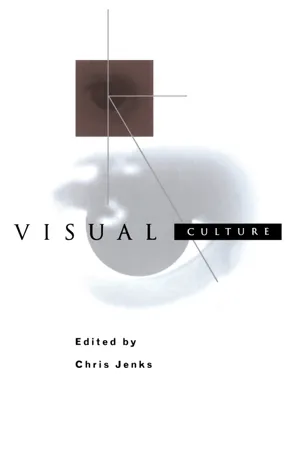
Visual Culture
About this book
In Visual Culture the 'visual' character of contemporary culture is explored in original and lively essays. The contributors look at advertising, film, painting and fine art journalism, photography, television and propaganda. They argue that there is only a social, not a formal relation between vision and truth. A major preoccupation of modernity and central to an understadning of the postmodern, 'vision' and the 'visual' are emergent themes across sociology, cultural studies and critical theory in the visual arts. Visual Culture will prove an indispensable guide to the field.
Information
1
THE CENTRALITY OF THE EYE IN WESTERN CULTURE
An Introduction
Seeing comes before words. The child looks and recognises before it can speak. But there is also another sense in which seeing comes before words. It is seeing which establishes our place in the surrounding world; we explain that world within words, but words can never undo the fact that we are surrounded by it. The relation between what we see and what we know is never settled.1
Any attempt to establish a social theory of visuality seems beset by paradox. In Western society we have, over time, come to regard sight as providing our immediate access to the external world. But beyond this, and perhaps because of this belief, visual ability has become conflated with cognition, and in a series of very complex ways. On the one hand, vision is lionised among the senses and treated as wholly autonomous, free and even pure. Yet on the other hand, visual symbols are experienced as mundane and necessarily embedded, and their interpretation is regarded as utterly contingent. As Mitchell’s work on imagery informed us, the idea of vision and the idea as vision have a history.2 ‘Idea’ derives from the Greek verb meaning ‘to see’. This lexical etymology reminds us that the way that we think about the way that we think in Western culture is guided by a visual paradigm. Looking, seeing and knowing have become perilously intertwined. Thus the manner in which we have come to understand the concept of an ‘idea’ is deeply bound up with the issues of ‘appearance’, of picture, and of image. As the ‘early’ Wittgenstein stated: ‘A picture is a fact.’ And, ‘A logical picture of facts is a thought.’3
The content and form of things is, we might suggest, to be approached in terms of how they ‘look’. The manifest ‘phono-logo-centrism’ of this book about ‘visualising’ culture attests to this point – we begin from visual forms and talk and theorise and achieve understanding of those forms through mental constructs. Merleau-Ponty addressed this point in terms of the issue of perception:
The perceived thing is not an ideal unity in the possession of an intellect … it is rather a totality open to a horizon of an infinite number of perspectival views which blend with one another according to a given style, which defines the object in question.Perception is thus paradoxical. The perceived thing is itself paradoxical; it exists only in so far as someone can perceive it.4
It has been forcefully argued by Jay that modernity’s project was most effectively achieved through the privileging of ‘sight’ and that modern culture has, in turn, elected the visual to the dual status of being both the primary medium for communication and also the sole ingress to our accumulated symbolic treasury.5 The modern world is very much a ‘seen’ phenomenon. Sociology however, itself in many senses the emergent discourse of modernity, has been rather neglectful of addressing cultural ocular conventions and has subsequently become somewhat inarticulate in relation to the visual dimension of social relations.6
THE MIND’S EYE
The problems of theorising vision as a social practice begin, perhaps, when we investigate the foundations of our ways of understanding things within modern Western culture. Rorty, at the outset of his ‘mirror of nature’ thesis, provided a description of modern philosophy’s project and an account of its peculiar lineage – both of which, he argued, clearly contributed to our present state of confusion concerning the ‘seen’ – and established a commonplace view that mental representations are essentially reflections of an external reality.7 Philosophy principally regards its problems as universal and believes its methods to be concerned with either confirming or contradicting every claim to understanding. In this sense philosophy underwrites all culture in that culture can be recognised as the eternal, collective, reaffirmation of humankind’s coming to ‘know’ nature, as distinct from the animal kingdom’s innate inability to exist as anything other than a continuous part of nature. Culture, as a form of mediation, enables a distancing from nature and a control over natural occurrence, facilitated through symbolic representation. Such processes rest not reductively upon a ‘natural’ disposition of being human but rather upon a theory of human nature. This is also a formative idea in Ivins’s views on the rationalisation of sight:
At the very beginning of human history men discovered in their ability to make pictures a method for symbolization of their visual awareness which differs in important respects from any other symbolic method that is known. As distinguished from purely conventional symbols, pictorial symbols can be used to make precise and accurate statements even while themselves transcending definition.8
Our contemporary views on epistemology were, Rorty informed us, shaped by a combination of Cartesian ideas concerning ‘mental substance’ and Lockean ideas concerning ‘mental processes’. Descartes’s cogito centred understanding on an independent, located and subjective mind – a finite capacity and disposition – waiting to be unified with Locke’s conception of active ‘mentalism’, or what we might describe as the practices by which we come to know. This powerful combination, that is, this now ‘active’ ‘mind’, was latterly situated by Kantian philosophy within a total and unified cosmos which was both organised through and knowable in terms of pure reason itself.
The metaphysical questions addressing the real characteristics of the ‘outside’ nature and the ‘inside’ mind were seemingly held in abeyance (or just taken for granted) and philosophy’s project became dedicated to the ‘rigorous’ and ‘scientific’ divination of the accurate and most appropriate transportation of the ‘outside’ into the ‘inside’.9 The conventional highway for this transport has been the senses, but primarily ‘sight’. Such empirical rather than intuitive theories of knowing have marked out the epoch of modernity: a period we might describe as the ‘opening of vision’.
This historical scenario established an absurd dichotomy in the relation between ‘self’ and ‘other’, two moments which could now be more appositely reformed as ‘the receptacle’ and ‘the spectacle’;10 or perhaps ‘the vision’ and ‘the ultimately visual’. This scenario also fostered the emergence of the ‘mind’-less empiricism and ‘value’-less positivism as the methodological strategies that were to both dominate and, unintentionally, retard the development of modern social theory.
Our contemporary realisation of this inquisitorial dichotomy between ‘self’ and ‘other’ in sociological work has subsequently settled into the sanitised methodological form of ‘observation’. ‘Observation’ has become a root metaphor within social and cultural research, and an extensive vocabulary of ‘visuality’, applied in an almost wholly unreflexive manner, has become instrumental in our manoeuvres for gaining access to and understanding the concerted practices of human communities.11 As Lowe has stated: ‘The perceptual field thus constituted … was fundamentally nonreflexive, visual and quantitative.’12 The implementation of the concept of ‘observation’ in socio-cultural research, and its obvious general acceptability, are by no means accidental or arbitrary. Such usage and its institutionalisation are refinements of the conventional ‘ocularcentrism’ abroad within the wider culture.13 We daily experience and perpetuate the conflation of the ‘seen’ with the ‘known’ in conversation through the commonplace linguistic appendage of ‘do you see?’ or ‘see what I mean?’ to utterances that seem to require confirmation, or, when seeking opinion, by inquiring after people’s ‘views’. (For the pedagogue such habitual interrogative phrasing can assume the form and regularity of punctuation: a habit radically, and poignantly, arrested in my own experience after having taught people with severe visual impairment.) The point to be established is that routinely the voir in savoir speaks through our daily knowing and through our tacit rules of agreement.
The social theorist, since the turn of the century, appears to have been locked into a stance of ‘observation’ and this is a position at odds with the conceptual leaps achieved within other scientific disciplines during the same period. While contemporary physicists, for example, conjure up metaphors to designate their un-available phenomena and the supposed relationships that hold between them (like ‘charm’) the social theorist has for too long adhered to a classical view of science predicated upon three anachronistic principles: (1) a mechanistic view of the universe as a whole interrelated totality; (2) a principled acceptance that an intrinsic order resides within phenomena as external forms; and (3) the necessary contingency being that understanding proceeds through the ‘independence’ of an observer’s sight.
The idea of observation within the tradition of social theory implies a studied passivity and a disengagement. We can detect a theorist who is skilled in watching, contemplating and spectating, but there is also the suspicion of the icy and self-gratifying gaze of the voyeur. This version of the observer demands the necessity of standing back, an aim of seeing from a distance or, perhaps most favoured of all, the privilege of looking down from an elevated platform. Goffman even likened the stance to that of ‘the fly on the wall’. This, in terms of perspective, is what Nicod described as: ‘our so-called visual distance which alone is correct enough for science’.14
Such a notion of ‘observation’ seems intent on the reduction of social experience to the behaviour of pure perception: this, paradoxically, also reduces the practice of ‘vision’ to the behaviour of pure perception! A strangely self-inflicted one-dimensionality and a reductive abandonment to natural disposition. This supposed reduction generates what Mitchell called ‘the innocent eye’, of which he said:
When this metaphor becomes literalized, when we try to postulate a foundational experience of ‘pure’ vision, a merely mechanical process uncontaminated by imagination, purpose, or desire, we invariably discover one of the few maxims on which Gombrich and Nelson Goodman agree: ‘the innocent eye is blind.’ The capacity for a purely physical vision that is supposed to be forever inaccessible to the blind turns out to be itself a kind of blindness.15
However, as Bryson has pointed out, in relation to art history, it is critical that vision should be realigned with interpretation rather than with mere perception.16 And as Bourdieu has succinctly stated: ‘Any art perception involves a conscious or unconscious deciphering.’17
‘Observation’, though bland in its significations, has, ironically, become an instructive concept. As a metaphor for method or technique within the social sciences or cultural studies ‘observation’ drags behind it an excess baggage of ontological and epistemological assumptions, albeit unexplicated, that can direct us to the origins of ‘our ways of seeing’ through modernity. Three items are paramount: (1) assumptions concerning the finite and ‘visible’ character of social phenomena; (2) assumptions concerning the ‘clear sightedness’, that is, the moral and political disposition of the theorist; and (3) assumptions concerning the manner of ‘visual’ relationship that sustains between the theorist and his/her phenomena. In large part these sets of assumptions have been subsumed under the analytic posture that has become both stereotyped and generalised under the blanket term ‘positivism’. Others before me have made thorough and valuable attempts to formalise the key characteristics of positivism, in the senses of it being both a technical philosophical term and also a cultural disposition, and I shall therefore only briefly rehearse some of their arguments here.18
THE DOCTRINE OF IMMACULATE PERCEPTION
Positivism, for social theory, came into prominence through the highly influential works of Auguste Comte. It was he who envisaged sociology, his ‘queen of the sciences’, becoming the culmination of the endeavours of positive philosophy. Sociological positivism was, for Comte, the pinnacle of an intellectual rational-reformist trajectory developed as a response to the social, and moral, instability that had been precipitated by the French Revolution. Sociology was allocated the role of completing a supposed hierarchical evolution of all scientific disciplines: it was to supersede all other forms of thought. Particularly to be transcended, within Comte ‘s ‘Law of Three Stages’, were the developmental stages of ‘theological’ and ‘metaphysical’ forms of cognition (and we might note that ‘metaphysical questions’ have remained the anathema of positivisms, such as that of the ‘Vienna Circle’, ever since). Proper (modern) scientific thought, Comte envisaged, was initially to grow out of a knowledge of great generality, relating to phenomena furthest from humankind’s own involvement, like deities. Having transcended this beginning, understanding should then metamorphose steadily onwards towards a stage of great specificity, relating to the phenomena of closest proximity to immediate human experience, that is, the law-governed things that surround us.
Such an epistemological evolution heralds the advance and arrival of the ‘observer’. As humankind’s attention is directed more and more closely towards itself and its immediate environment, quite simply more and more objects enter into ‘vision’. From the opaque distance required of gods, through the hazy and incalculable horizons of metaphysics, to the necessity and familiarity of things-in-themselves, inexorably the world drew nearer and nearer, it became more focused, and it assumed the vivid shapes of empirical phenomena. This passage is, however, forgetful of Hegel’s pronouncement that in the familiar we find the most strange and the least known. Nevertheless, we have, with Comte’s guidance and in the dour company of his ‘observer’, descended from heaven to earth and we are met with the positivist revelation, that ‘what can be seen can also be believed in!’ Conveniently, but not coincidentally, this historic...
Table of contents
- Cover
- Half Title
- Title Page
- Copyright Page
- Table of Contents
- List of figures
- List of contributors
- Acknowledgements
- 1 The Centrality of the Eye in Western Culture: An Introduction
- 2 Advertising: The Rhetorical Imperative
- 3 Reporting and Visualising
- 4 Fractured Subjectivity
- 5 The City, the Cinema: Modern Spaces
- 6 Fabulous Confusion! Pop Before Pop?
- 7 An Art of Scholars: Corruption, Negation and Particularity in Paintings by Ryman and Richter
- 8 Watching your Step: The History and Practice of the Flâneur
- 9 Reich Dreams: Ritual Horror and Armoured Bodies
- 10 Television: Not so Much a Visual Medium, More a Visible Object
- 11 Foucault’s Optics: The (in) Vision of Mortality and Modernity
- 12 Managing ‘Tradition’: The Plight of Aesthetic Practices and their Analysis in a Technoscientific Culture
- 13 Photography and Modern Vision: The Spectacle of ‘Natural Magic’
- 14 Three Images of the Visual: Empirical, Formal and Normative
- Index
Trusted by 375,005 students
Access to over 1.5 million titles for a fair monthly price.
Study more efficiently using our study tools.
Frequently asked questions
Yes, you can cancel anytime from the Subscription tab in your account settings on the Perlego website. Your subscription will stay active until the end of your current billing period. Learn how to cancel your subscription
No, books cannot be downloaded as external files, such as PDFs, for use outside of Perlego. However, you can download books within the Perlego app for offline reading on mobile or tablet. Learn how to download books offline
Perlego offers two plans: Essential and Complete
- Essential is ideal for learners and professionals who enjoy exploring a wide range of subjects. Access the Essential Library with 800,000+ trusted titles and best-sellers across business, personal growth, and the humanities. Includes unlimited reading time and Standard Read Aloud voice.
- Complete: Perfect for advanced learners and researchers needing full, unrestricted access. Unlock 1.5M+ books across hundreds of subjects, including academic and specialized titles. The Complete Plan also includes advanced features like Premium Read Aloud and Research Assistant.
We are an online textbook subscription service, where you can get access to an entire online library for less than the price of a single book per month. With over 1.5 million books across 990+ topics, we’ve got you covered! Learn about our mission
Look out for the read-aloud symbol on your next book to see if you can listen to it. The read-aloud tool reads text aloud for you, highlighting the text as it is being read. You can pause it, speed it up and slow it down. Learn more about Read Aloud
Yes! You can use the Perlego app on both iOS and Android devices to read anytime, anywhere — even offline. Perfect for commutes or when you’re on the go.
Please note we cannot support devices running on iOS 13 and Android 7 or earlier. Learn more about using the app
Please note we cannot support devices running on iOS 13 and Android 7 or earlier. Learn more about using the app
Yes, you can access Visual Culture by Chris Jenks in PDF and/or ePUB format, as well as other popular books in Arte & Teoria e critica dell'arte. We have over 1.5 million books available in our catalogue for you to explore.