Working with Venues for Events
eBook - ePub

Working with Venues for Events

A Practical Guide

  1. 244 pages
  2. English
  3. ePUB (mobile friendly)
  4. Available on iOS & Android
eBook - ePub

Working with Venues for Events

A Practical Guide

About this book

This is a book for aspiring event managers, providing both a theoretical and a practical guide to selecting and working with venues as part of the event planning process.

The book explores the different types of venues available to event managers, from unique venues such as historical buildings and theatres to sporting and academic venues, analysing the specific characteristics, benefits and drawbacks that distinguish them. It also illustrates how venues function and are managed, incorporating key aspects of venue management including staffing, marketing, legislation, production, scheduling and administration. Sustainability, ethics and technology are also integrated throughout, along with a vast range of industry examples of different venue types and events from around the world.

Comprehensive and accessible, Working with Venues for Events offers students an essential understanding of how event managers can successfully negotiate, work with and plan for a successful event in a variety of venue settings. This is an invaluable resource for anyone with an interest in events management.
Frequently asked questions

Yes, you can cancel anytime from the Subscription tab in your account settings on the Perlego website. Your subscription will stay active until the end of your current billing period. Learn how to cancel your subscription.
No, books cannot be downloaded as external files, such as PDFs, for use outside of Perlego. However, you can download books within the Perlego app for offline reading on mobile or tablet. Learn more here.
Perlego offers two plans: Essential and Complete
  • Essential is ideal for learners and professionals who enjoy exploring a wide range of subjects. Access the Essential Library with 800,000+ trusted titles and best-sellers across business, personal growth, and the humanities. Includes unlimited reading time and Standard Read Aloud voice.
  • Complete: Perfect for advanced learners and researchers needing full, unrestricted access. Unlock 1.4M+ books across hundreds of subjects, including academic and specialized titles. The Complete Plan also includes advanced features like Premium Read Aloud and Research Assistant.
Both plans are available with monthly, semester, or annual billing cycles.
We are an online textbook subscription service, where you can get access to an entire online library for less than the price of a single book per month. With over 1 million books across 1000+ topics, we’ve got you covered! Learn more here.
Look out for the read-aloud symbol on your next book to see if you can listen to it. The read-aloud tool reads text aloud for you, highlighting the text as it is being read. You can pause it, speed it up and slow it down. Learn more here.
Yes! You can use the Perlego app on both iOS or Android devices to read anytime, anywhere — even offline. Perfect for commutes or when you’re on the go.
Please note we cannot support devices running on iOS 13 and Android 7 or earlier. Learn more about using the app.
Yes, you can access Working with Venues for Events by Emma Delaney,Emma Nolan in PDF and/or ePUB format, as well as other popular books in Business & Hospitality, Travel & Tourism Industry. We have over one million books available in our catalogue for you to explore.

Information

Chapter 1
The evolution of venues

Chapter Outline
1.1 Introduction
1.2 Venues rooted in early civilisations
1.3 Venues from the Middle Ages
1.4 The Industrial Revolution and venue development
1.5 Hospitality providers
1.6 Unique venues: historical buildings
1.7 Unique venues: theatres and cinemas
1.8 Using unique venues
1.9 Sporting venues
1.10 Using sporting venues
1.11 Purpose-built event venues
1.12 Using purpose-built venues
1.13 Academic venues
1.14 The events industry today
1.15 The future of venues
1.16 The evolution of venues – the venue manager’s perspective
1.17 Summary
1.18 Further reading
Learning Outcomes
By the end of Chapter 1, you should be able to:
  • Appreciate the history of event venues
  • Categorise venues according to their primary function
  • Understand the benefits and challenges of using different types of venues
  • Recognise patterns in past, current and future venue development

1.1 Introduction

The twentieth-century event manager has a diverse range of venues to choose from as the backdrop to their next event. Today visitor attractions, theatres, museums, universities and sporting complexes compete for event business against hotels and purpose-built conference and exhibition space. Most venues are multipurpose in function and can accommodate all manner of events. Today parties, celebrations, festivals, cultural events, meetings, weddings
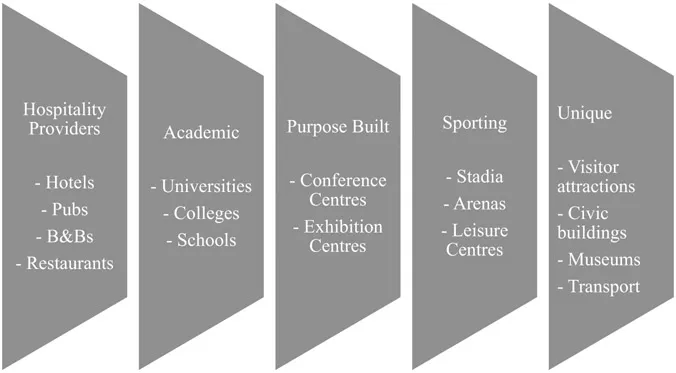
Figure 1.1 Venue categories.
Table 1.1 Venue characteristics
Venue type Typical characteristics

Hospitality providers
  • Catering facility on site
  • Accommodation on site
  • Competitive hire charges
  • Additional facilities (pool, spa, golf course etc.)
  • Rural and urban locations
  • Disproportionate number of bedrooms compared to capacity of event space
Academic venues
  • Number of well-equipped rooms/lecture halls
  • On-site sporting facilities
  • Some accommodation, but this may not be high quality
  • Competitively priced
  • Restricted availability
Purpose-built venues
  • Excellent access (e.g. service roads/dock doors/entrances)
  • Good floor loading limits and ceiling heights
  • Blank canvas for theming
  • Superior electricity network
  • Large lighting and sound rigs
  • Potentially expensive (to hire/to decorate)
  • Large capacities (but unsuitable for intimate gatherings)
Sporting venues
  • Varied and generous capacities
  • Competitive rates
  • Restricted availability
  • Strong transport links
  • Limited ambience for small events
Unique venues
  • Wow factor
  • Restricted availability
  • Limited access/on-site facilities
  • Restrictions on theming/decoration
  • Restrictive spaces
  • Expensive
and sporting competitions can all be successfully hosted in many venues. However, comparatively few of today’s buildings were originally designed and built to accommodate events. Most were constructed for a very different purpose and have since entered into the events industry in order to secure a secondary source of income. By reviewing key moments in history we can identify and understand how different types of venues have emerged and developed. Venues that have a similar background and the same primary function today also typically share features such as architectural design and layout. They also have shared characteristics such as when they are and are not available for events and what the event manager can and cannot do within the space. This chapter will provide you with insight into what to expect from working within different types of venues and how to use this to your advantage when designing and delivering an event. We will briefly review key developments in society that have led to the construction of various types of venues and look at the characteristics that they share. The chapter includes tips on how these can be both beneficial to the event manager but can also present them with a particular set of challenges to be aware of. The chapter includes case studies and illustrations of a range of venues and takes a look ahead to the future of venue development for the events industry. The categories of venues that will be covered in this chapter are illustrated in Figure 1.1 with a summary of their key characteristics shown in Table 1.1.

1.2 Venues Rooted in Early Civilisations

The tourism, leisure, hospitality and events industries are deep rooted in our history and culture. Some of our most ancient civilisations – the Egyptians, Mayans and Aztecs – explored leisure pursuits and developed sporting rituals and competitions (Masterman, 2009). The Greeks and the Romans developed purpose-built venues to accommodate their large-scale sporting events and of course many of these amphitheatres and colosseums can still be visited. Some of the more well-preserved venues are not just visitor attractions but are still in use today such as the Ancient Theatre of Epidaurus.
Case Study 1.1 The Ancient Theatre of Epidaurus
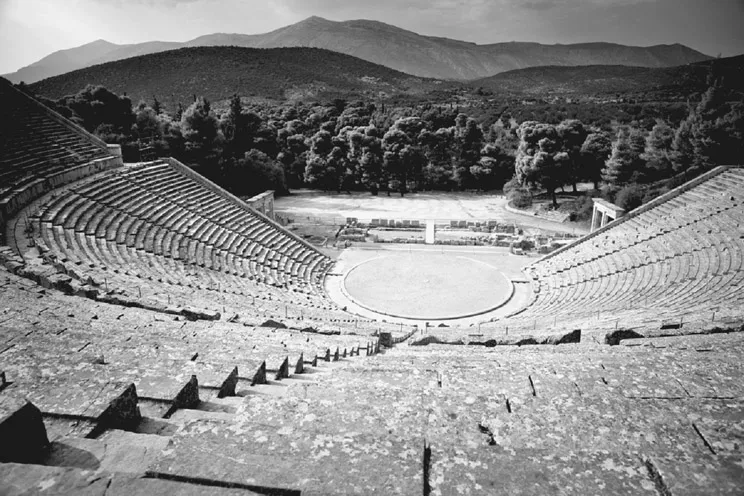
The Ancient Theatre of Epidaurus is situated within the archaeological site of the Sanctuary of Asklepios, in an elevated valley surrounded by mountains in the Peloponnese area of Greece, approximately 2 hours from Athens.
The theatre was originally constructed in the fourth century BC and was later extended in the mid-second century BC. It was built to stage plays and performances but it was also used for athletic and artistic competitions. The theatre seats 14,000 within an auditorium that is nestled into the natural curve of Mount Kynortio at an incline of 26 degrees. Fifty five rows of bench seating are set out across two sections separated by a semi-circular aisle. The theatre has a circular orchestra pit and a two-tier stage building (skene) from which backdrops can be suspended. Due to the perfect geometric design, the theatre has excellent acoustics and unlike many other theatres of the same period, the Romans did not alter it. Therefore although the venue has been carefully restored in recent years, it still retains its original design.
Image 1.1 The Ancient Theatre of Epidaurus.
Credit: Ivan Bastien/Shutterstock.
From the time it was constructed the theatre was used regularly until the invasion of the Goths in AD 395. In the following century Theodosios the Great banned all activities at the Sanctuary and for nearly a millennium the theatre was left abandoned and fell into disrepair. In 1881, the Archaeological Society began to excavate the site and discovered that the auditorium was in a reasonably good condition although the stage building had completely eroded. The rediscovery of the famous theatre generated much public interest and revived a passion for classical drama. This led to a 10-year long project intended to restore and relaunch the venue once it had been made safe and suitable for performances. The project was a success and by 1936 the Greek government had introduced yearly festivals with performances of ancient drama being staged once again at Epidaurus. The theatre became a popular venue once more with leading musicians and playwrights keen to experiment with using the space for various theatrical and musical performances.
In the 1950s the Greek government launched the Athens and Epidaurus Festival and granted the National Theatre exclusive use of the venue for major operatic, dance and musical productions. This partnership cemented the theatre as a leading venue in the Greek arts sector. The festival is still running today and continues to draw in a broad audience to attend traditional and contemporary performances and productions.
In 1988, the theatre, along with the entire Sanctuary of Asklepios, was made a UNESCO World Heritage Site and since then further restorative work has taken place at the venue to include replacing seats and repairing the auditorium’s ancient drainage system. Today the theatre is a bustling visitor attraction drawing in thousands of international visitors every year. It continues to be well used by actors, actresses, directors, composers, choreographers and set designers alike for a variety of classical and modern productions.
Source: ‘Athens and Epidaurus Festival’ available from http://greekfestival.gr
Both the Greek and Roman way of life led to the creation of a primitive tourism industry. The ancient Olympic Games that took place in Greece from 776BC to AD393 became extremely popular drawing in visitors from across the country and creating a demand for accommodation. And as the Roman Empire extended and established into the fifth century, two branches of tourism developed as a consequence of the acquisition of more and more overseas territories. Firstly, these territories needed to be managed, leading to the creation of business tourism – as a number of Romans needed to travel across the Empire for business related purposes. In parallel, Roman seaside resorts were developed for a prosperous Italian society looking for holiday destinations and thus creating a domestic tourism sector. Rome, the capital city, emerged as a significant tourism destination due to its stature as the heart of the empire. Consequently a number of venues were built including inns and taverns to service the needs of local residents and visitors (Page, 2012).

1.3 Venues From the Middle Ages

The demise of the Roman Empire was followed by the start of the Middle Ages. This time in history saw the spread of Christianity which replaced the pleasure seeking Romanesque way of life with feudalism whereby society was divided into the land governing nobility and the working class tenants. For the working class majority of the population, leisure time was limited and often confined to religious celebration. Although outdoor festivals took place, these were usually organised as gatherings that were to strengthen allegiance to the church and the state who dually controlled the population (Andrews and Leopold, 2013). As the only communal venue within a rural community, the church would serve to accommodate not just religious devotion but also primitive meetings and gatherings.
In more recent years, the decline in the number of Christians has led to the closure of many churches. However, a number of entrepreneurial investors have bought and transformed churches into vibrant and quirky modern day venues while retaining and preserving some of their historic features.
The Middle Ages also saw the development of additional branches of tourism including religious tourism, as pilgrimages to holy sites became very popular, and health tourism to spa towns and cities such as Buxton and Bath. This led to further creation of hospitality-providing venues such as inns and taverns. These venues were multipurpose in function as they gave the local community a watering hole but they also supplied much needed accommodation for travellers and served as ideal venues for meetings, celebrations and social gatherings. Only in more recent times have we labelled these venues as pubs and although many counties across the UK claim to be home to the oldest pub in the country, ultimately it is very difficult to attribute this accolade to a particular venue. Nonetheless many historic inns and taverns have survived for centuries and continue to operate today as pubs with facilities for many types of small events. These venues are still very appropriate for meetings and parties as they typically have private function rooms which can frequently be hired at no charge, providing the bar and food service facilities will be well used and a number of them continue to offer accommodation too. Image 1.3 is of the Pipe and Glass Inn located in East Yorkshire. The pub is a former coaching inn and parts of the venue date back to the seventeenth century.
However, the construction of the more sophisticated hotel accommodation that we are used to today is rooted in what happened in the nineteenth century when the Industrial Revolution was at its peak.
Case Study 1.2 One Marylebone
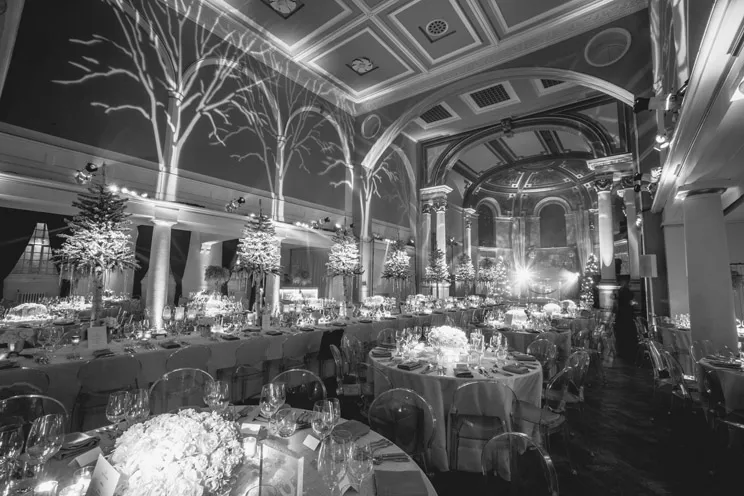
One Marylebone, formally Holy Trinity Church, was built in 1826–28 to the designs of Sir John Soane to celebrate the defeat of Napoleon. Soane (1753–1837) was arguably England’s finest architect in the neoclassical style. His architectural works are distinguished by their clean lines, massing of simple form, decisive detailing, careful proportions and skilful use of light sources. His best-known work is the Bank of England, a building that has had a widespread effect upon commercial architecture. Grade I listed by English Heritage, One Marylebone is one of only three London churches by Soane; it was the most expensive and now considered to be the most architecturally distinguished. His use of the neoclassical is evident in the portico of the church and his constant desire to work with light is most evident in the first floor galleries. Apart from the loss of the original chancel, the basic structure of Soane’s church survives complete and is of huge national architectural and historical significance.
Image 1.2 Soane Hall, One Marylebone.
Source: One Events.
One Marylebone opened its doors as a hireable events space in 2008 and quickly became one of the leadi...

Table of contents

  1. Cover
  2. Title
  3. Copyright
  4. Dedication
  5. CONTENTS
  6. List of figures
  7. List of images
  8. List of tables
  9. List of case studies
  10. List of industry expert’s view boxes
  11. International examples
  12. Preface
  13. Acknowledgements
  14. List of abbreviations
  15. 1 The evolution of venues
  16. 2 Incorporating venues into the design of events
  17. 3 Choosing a destination
  18. 4 Initial venue considerations
  19. 5 Sustainability in event and venue management
  20. 6 Organising a site visit
  21. 7 Working with venue suppliers
  22. 8 Technology
  23. 9 Understanding venue charges
  24. 10 Contracts and licensing
  25. 11 The role of the venue in event preparation, delivery and evaluation
  26. 12 Venue-based employment
  27. Glossary
  28. Bibliography
  29. Index