GPU Parallel Program Development using CUDA teaches GPU programming by showing the differences among different families of GPUs. This approach prepares the reader for the next generation and future generations of GPUs. The book emphasizes concepts that will remain relevant for a long time, rather than concepts that are platform-specific. At the same time, the book also provides platform-dependent explanations that are as valuable as generalized GPU concepts.
The book consists of three separate parts; it starts by explaining parallelism using CPU multi-threading in Part I. A few simple programs are used to demonstrate the concept of dividing a large task into multiple parallel sub-tasks and mapping them to CPU threads. Multiple ways of parallelizing the same task are analyzed and their pros/cons are studied in terms of both core and memory operation.
Part II of the book introduces GPU massive parallelism. The same programs are parallelized on multiple Nvidia GPU platforms and the same performance analysis is repeated. Because the core and memory structures of CPUs and GPUs are different, the results differ in interesting ways. The end goal is to make programmers aware of all the good ideas, as well as the bad ideas, so readers can apply the good ideas and avoid the bad ideas in their own programs.
Part III of the book provides pointer for readers who want to expand their horizons. It provides a brief introduction to popular CUDA libraries (such as cuBLAS, cuFFT, NPP, and Thrust),the OpenCL programming language, an overview of GPU programming using other programming languages and API libraries (such as Python, OpenCV, OpenGL, and Apple's Swift and Metal,) and the deep learning library cuDNN.
THIS book is a self-sufficient GPU and CUDA programming textbook. I can imagine the surprise of somebody who purchased a GPU programming book and the first chapter is named “Introduction to CPU Parallel Programming.” The idea is that this book expects the readers to be sufficiently good at a low-level programming language, like C, but not in CPU parallel programming. To make this book a self-sufficient GPU programming resource for somebody that meets this criteria, any prior CPU parallel programming experience cannot be expected from the readers, yet it is not difficult to gain sufficient CPU parallel programming skills within a few weeks with an introduction such as Part I of this book.
No worries, in these few weeks of learning CPU parallel programming, no time will be wasted toward our eventual goal of learning GPU programming, since almost every concept that I introduce here in the CPU world will be applicable to the GPU world. If you are skeptical, here is one example for you: The thread ID, or, as we will call it tid, is the identifier of an executing thread in a multi-threaded program, whether it is a CPU or GPU thread. All of the CPU parallel programs we write will use the tid concept, which will make the programs directly transportable to the GPU environment. Don’t worry if the term thread is not familiar to you. Half the book is about threads, as it is the backbone of how CPUs or GPUs execute multiple tasks simultaneously.
1.1 EVOLUTION OF PARALLEL PROGRAMMING
A natural question that comes to one’s mind is: why even bother with parallel programming? In the 1970s, 1980s, even part of the 1990s, we were perfectly happy with single-threaded programming, or, as one might call it, serial programming. You wrote a program to accomplish one task. When done, it gave you an answer. Task is done … Everybody was happy … Although the task was done, if you were, say, doing a particle simulation that required millions, or billions of computations per second, or any other image processing computation that works on thousands of pixels, you wanted your program to work much faster, which meant that you needed a faster CPU.
Up until the year 2004, the CPU makers IBM, Intel, and AMD gave you a faster processor by making it work at a higher speed, 16 MHz, 20 MHz, 66 MHz, 100 MHz, and eventually 200, 333, 466 MHz … It looked like they could keep increasing the CPU speeds and provide higher performance every year. But, in 2004, it was obvious that continuously increasing the CPU speeds couldn’t go on forever due to technological limitations. Something else was needed to continuously deliver higher performances. The answer of the CPU makers was to put two CPUs inside one CPU, even if each CPU worked at a lower speed than a single one would. For example, two CPUs (cores, as they called them) working at 200 MHz could do more computations per second cumulatively, as compared to a single core working at 300 MHz (i.e., 2 × 200 > 300, intuitively).
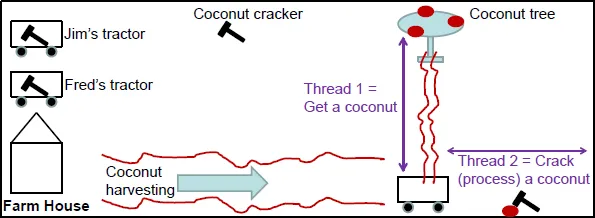
FIGURE 1.1 Harvesting each coconut requires two consecutive 30-second tasks (threads). Thread 1: get a coconut. Thread 2: crack (process) that coconut using the hammer.
Even if the story of “multiple cores within a single CPU” sounded like a dream come true, it meant that the programmers would now have to learn the parallel programming methods to take advantage of both of these cores. If a CPU could execute two programs at the same time, this automatically implied that a programmer had to write those two programs. But, could this translate to twice the program speed? If not, then our 2 × 200 > 300 thinking is flawed. What if there wasn’t enough work for one core? So, only truly a single core was busy, while the other one was doing nothing? Then, we are better off with a single core at 300 MHz. Numerous similar questions highlighted the biggest problem with introducing multiple cores, which is the programming that can allow utilizing those cores efficiently.
1.2 MORE CORES, MORE PARALLELISM
Programmers couldn’t simply ignore the additional cores that the CPU makers introduced every year. By 2015, INTEL had an 8-core desktop processor, i7-5960X [11], and 10-core workstation processors such as Xeon E7-8870 [14] in the market. Obviously, this multiple-core frenzy continued and will continue in the foreseeable future. Parallel programming turned from an exotic programming model in early 2000 to the only acceptable programming model as of 2015. The story doesn’t stop at desktop computers either. On the mobile processor side, iPhones and Android phones all have two or four cores. Expect to see an ever-increasing number of cores in the mobile arena in the coming years.
So, what is a thread? To answer this, let’s take a look at the 8-core INTEL CPU i7-5960X [11] one more time. The INTEL archive says that this is indeed an 8C/16T CPU. In other words, it has 8 cores, but can execute 16 threads. You also hear parallel programming being incorrectly referred to as multi-core programming. The correct terminology is multi-threaded programming. This is because when the CPU makers started designing multi-core architectures, they quickly realized that it wasn’t difficult to add the capability to execute two tasks within one core by sharing some of the core resources, such as cache memory.
ANALOGY 1.1: Cores versus Threads.
Figure 1.1 shows two brothers, Fred and Jim, who are farmers that own two tractors. They drive from their farmhouse to where the coconut trees are every day. They harvest the coconuts and bring them back to their farmhouse. To harvest (process) the coconuts, they use the hammer inside their tractor. The harvesting process requires two separate consecutive tasks, each taking 30 seconds: Task 1 go from the tractor to the tree, bringing one coconut at a time, and Task 2 crack (process) them by using the hammer, and store them in the tractor. Fred alone can process one coconut per minute, and Jim can also process one coconut per minute. Combined, they can process two coconuts per minute.
One day, Fred’s tractor breaks down. He leaves the tractor with the repair shop, forgetting that the coconut cracker is inside his tractor. It is too late by the time he gets to the farmhouse. But, they still have work to do. With only Jim’s tractor, and a single coconut cracker inside it, can they still process two coconuts per minute?
1.3 CORES VERSUS THREADS
Let’s look at our Analogy 1.1, which is depicted in Figure 1.1. If harvesting a coconut requires the completion of two consecutive tasks (we will call them threads): Th...
Table of contents
Cover
Half-title Page
Title Page
Copyright Page
Dedication
Contents
List of Figures
List of Tables
Preface
About the Author
Part I Understanding CPU Parallelism
Part II GPU Programming Using CUDA
Part III More To Know
Bibliography
Index
Trusted by 375,005 students
Access to over 1.5 million titles for a fair monthly price.
Study more efficiently using our study tools.
Frequently asked questions
Yes, you can cancel anytime from the Subscription tab in your account settings on the Perlego website. Your subscription will stay active until the end of your current billing period. Learn how to cancel your subscription
No, books cannot be downloaded as external files, such as PDFs, for use outside of Perlego. However, you can download books within the Perlego app for offline reading on mobile or tablet. Learn how to download books offline
Perlego offers two plans: Essential and Complete
Essential is ideal for learners and professionals who enjoy exploring a wide range of subjects. Access the Essential Library with 800,000+ trusted titles and best-sellers across business, personal growth, and the humanities. Includes unlimited reading time and Standard Read Aloud voice.
Complete: Perfect for advanced learners and researchers needing full, unrestricted access. Unlock 1.5M+ books across hundreds of subjects, including academic and specialized titles. The Complete Plan also includes advanced features like Premium Read Aloud and Research Assistant.
Both plans are available with monthly, semester, or annual billing cycles.
We are an online textbook subscription service, where you can get access to an entire online library for less than the price of a single book per month. With over 1.5 million books across 990+ topics, we’ve got you covered! Learn about our mission
Look out for the read-aloud symbol on your next book to see if you can listen to it. The read-aloud tool reads text aloud for you, highlighting the text as it is being read. You can pause it, speed it up and slow it down. Learn more about Read Aloud
Yes! You can use the Perlego app on both iOS and Android devices to read anytime, anywhere — even offline. Perfect for commutes or when you’re on the go. Please note we cannot support devices running on iOS 13 and Android 7 or earlier. Learn more about using the app
Yes, you can access GPU Parallel Program Development Using CUDA by Tolga Soyata in PDF and/or ePUB format, as well as other popular books in Computer Science & Computer Graphics. We have over 1.5 million books available in our catalogue for you to explore.