- 384 pages
- English
- ePUB (mobile friendly)
- Available on iOS & Android
eBook - ePub
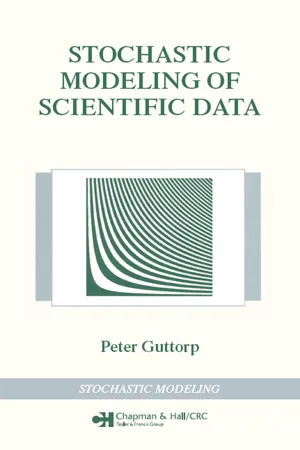
Stochastic Modeling of Scientific Data
About this book
Stochastic Modeling of Scientific Data combines stochastic modeling and statistical inference in a variety of standard and less common models, such as point processes, Markov random fields and hidden Markov models in a clear, thoughtful and succinct manner. The distinguishing feature of this work is that, in addition to probability theory, it contains statistical aspects of model fitting and a variety of data sets that are either analyzed in the text or used as exercises. Markov chain Monte Carlo methods are introduced for evaluating likelihoods in complicated models and the forward backward algorithm for analyzing hidden Markov models is presented. The strength of this text lies in the use of informal language that makes the topic more accessible to non-mathematicians. The combinations of hard science topics with stochastic processes and their statistical inference puts it in a new category of probability textbooks. The numerous examples and exercises are drawn from astronomy, geology, genetics, hydrology, neurophysiology and physics.
Information
Publisher
Chapman and Hall/CRCYear
2018Print ISBN
9780367449001
9780412992810
Edition
1eBook ISBN
9781351413657
Table of contents
- Cover
- Half Title
- Title Page
- Copyright Page
- Dedication
- Table of Contents
- Preface
- CHAPTER 1. Introduction
- CHAPTER 2. Discrete time Markov chains
- CHAPTER 3. Continuous time Markov chains
- CHAPTER 4. Markov random fields
- CHAPTER 5. Point processes
- CHAPTER 6. Brownian motion and diffusion
- APPENDIX A. Some statistical theory
- APPENDIX B. Linear difference equations with constant coefficients
- APPENDIX C. Some theory of partial differential equations
- References
- Index of results
- Applications and examples
- Index of notation
- Index of terms
- Data sets
Trusted by 375,005 students
Access to over 1.5 million titles for a fair monthly price.
Study more efficiently using our study tools.
Frequently asked questions
Yes, you can cancel anytime from the Subscription tab in your account settings on the Perlego website. Your subscription will stay active until the end of your current billing period. Learn how to cancel your subscription
No, books cannot be downloaded as external files, such as PDFs, for use outside of Perlego. However, you can download books within the Perlego app for offline reading on mobile or tablet. Learn how to download books offline
Perlego offers two plans: Essential and Complete
- Essential is ideal for learners and professionals who enjoy exploring a wide range of subjects. Access the Essential Library with 800,000+ trusted titles and best-sellers across business, personal growth, and the humanities. Includes unlimited reading time and Standard Read Aloud voice.
- Complete: Perfect for advanced learners and researchers needing full, unrestricted access. Unlock 1.5M+ books across hundreds of subjects, including academic and specialized titles. The Complete Plan also includes advanced features like Premium Read Aloud and Research Assistant.
We are an online textbook subscription service, where you can get access to an entire online library for less than the price of a single book per month. With over 1.5 million books across 990+ topics, we’ve got you covered! Learn about our mission
Look out for the read-aloud symbol on your next book to see if you can listen to it. The read-aloud tool reads text aloud for you, highlighting the text as it is being read. You can pause it, speed it up and slow it down. Learn more about Read Aloud
Yes! You can use the Perlego app on both iOS and Android devices to read anytime, anywhere — even offline. Perfect for commutes or when you’re on the go.
Please note we cannot support devices running on iOS 13 and Android 7 or earlier. Learn more about using the app
Please note we cannot support devices running on iOS 13 and Android 7 or earlier. Learn more about using the app
Yes, you can access Stochastic Modeling of Scientific Data by Peter Guttorp in PDF and/or ePUB format, as well as other popular books in Mathematics & Probability & Statistics. We have over 1.5 million books available in our catalogue for you to explore.