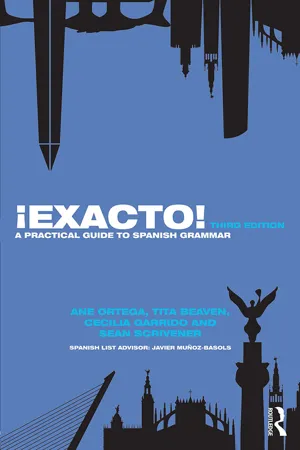
¡Exacto! is an accessible guide to Spanish grammar.
Using an appealing visual layout, the essentials of Spanish grammar are presented in tables and charts allowing learners to navigate the information easily and view explanations, examples of usage and any exceptions to the rule at a glance.
Key features:
Grids and tables ensure key information is available for quick reference and review
Graded to allow students to hone in on the material most suited to their current level
Coverage of Spanish as a world language, with examples from different varieties of Peninsular Spanish and Latin American Spanish
Grammar and workbook in one, with exercises within each unit to practise and consolidate learning
A glossary of grammatical terminology ensures all explanations within the book are clear and accessible
An answer key making it ideal for self-study.
Suitable for class use and independent study, this new edition of ¡Exacto! is the ideal grammar reference and practice resource for all learners of Spanish, from beginners to advanced students.
Frequently asked questions
Yes, you can cancel anytime from the Subscription tab in your account settings on the Perlego website. Your subscription will stay active until the end of your current billing period. Learn how to cancel your subscription.
At the moment all of our mobile-responsive ePub books are available to download via the app. Most of our PDFs are also available to download and we're working on making the final remaining ones downloadable now. Learn more here.
Perlego offers two plans: Essential and Complete
Essential is ideal for learners and professionals who enjoy exploring a wide range of subjects. Access the Essential Library with 800,000+ trusted titles and best-sellers across business, personal growth, and the humanities. Includes unlimited reading time and Standard Read Aloud voice.
Complete: Perfect for advanced learners and researchers needing full, unrestricted access. Unlock 1.4M+ books across hundreds of subjects, including academic and specialized titles. The Complete Plan also includes advanced features like Premium Read Aloud and Research Assistant.
Both plans are available with monthly, semester, or annual billing cycles.
We are an online textbook subscription service, where you can get access to an entire online library for less than the price of a single book per month. With over 1 million books across 1000+ topics, we’ve got you covered! Learn more here.
Look out for the read-aloud symbol on your next book to see if you can listen to it. The read-aloud tool reads text aloud for you, highlighting the text as it is being read. You can pause it, speed it up and slow it down. Learn more here.
Yes! You can use the Perlego app on both iOS or Android devices to read anytime, anywhere — even offline. Perfect for commutes or when you’re on the go. Please note we cannot support devices running on iOS 13 and Android 7 or earlier. Learn more about using the app.
Yes, you can access ¡Exacto! by Ane Ortega,Tita Beaven,Cecilia Garrido,Sean Scrivener in PDF and/or ePUB format, as well as other popular books in Languages & Linguistics & Languages. We have over one million books available in our catalogue for you to explore.
Accentuation – acentuación – refers to the stress or relative emphasis in pronunciation that is given to a syllable in a word. In Spanish, like in any other language, all words have a stressed syllable – sílaba tónica. With one type of exception, in Spanish words carry just one stress, which is fixed, that is, it does not change depending on the place or function of the word in the sentence. Any syllable of the word can carry stress: the final syllable (reloj, colchón), the penultimate syllable (biblioteca, automóvil), the antepenultimate syllable (océano, teléfono) and the fourth-to-last syllable (llévatelo,dígamelo).
1.1 General written accentuation rules in Spanish
In the written language in Spanish there are general rules governing accentuation, so that it is obvious how a word should be stressed just by looking at it.
The basic general accentuation rules in Spanish are:
All words ending in a vowel are stressed on the penultimate (last but one) syllable: libro, ventana, arrecife.
All words ending in the consonants -n or -s are also stressed on the penultimate syllable: comen,hablas,campos, resumen, carcajadas.
All words ending in any other consonant are stressed on the final syllable: bistec, universidad,reloj, unilateral,avestruz.
If words don’t follow the rules above they will have a written accent called acento ortográfico or tilde, to indicate the syllable where the stress falls.
The following examples show words that end in a vowel, -n or -s but are not stressed on the penultimate syllable, and which therefore have a written accent on the stressed syllable:
Similarly, the following words ending in a consonant (other than -n or -s) are not stressed on the last syllable, and therefore also have a written accent:
lápiz,césped,déficit,árbol,álbum,Óscar,cráter.
Double stress: adverbs ending in -mente
Adverbs that end in -mente have two stresses. They are formed from adjectives or adverbs and the ending -mente (corresponding to -ly in English). One of the stresses is placed on the adjectival or adverbial part of the word, and the second on the first syllable of -mente: generalmente, paradójicamente, repetidamente,fácilmente. Whether they have a written accent depends on the general rules explained above.
☞ For further information about adverbs ending in -mente go to Unit 10.
1.2 Diacritic accent (tilde diacritica)
Sometimes accents are used to distinguish words that sound the same but have different meanings or grammatical functions. This type of accent is called a diacritic accent.
Diacritic accent with monosyllables
In the case of words of one syllable (monosílabos) the written accent is used with the word that carries more emphasis because of its meaning. Examples include: él/el, mí/ mi, tú/tu, sí/si, sé/se, té/te, dé/de.
él (personal pronoun): Él es el hermano de Miguel. (He is Miguel's brother.) el (definite article): El libro es interesante.(The book is interesting.)
mi (personal pronoun): La carta es para mi. (The letter is for me.) mi (possessive adjective): Mi madre se llama Inés.(My mother's name is Inés.)
tú (personal pronoun): Yo estoy bien, Jy tú? (I am fine, and you?) tu (possessive adjective): Me gusta tu casa. (I like your house.)
si (adverb): St, quiero café.(Yes, I want some coffee.) si (conjunction): Voy al parque si no llueve. (I will go to the park if it doesn't rain.)
sé (first person singular of verb saber): ¡No sé nada!(I don...
Table of contents
Cover
Title
Copyright
Contents
How to use this book
Glossary
1 Accentuation
2 Nouns
3 Articles
4 Qualifying adjectives
5 Personal pronouns
6 Demonstratives
7 Possessives
8 Numerals
9 Indefinites
10 Adverbs
11 Interrogatives
12 Prepositions
13 Interjections
14 The Spanish verb
15 Impersonal forms of the verb
16 Present tenses of the indicative
17 Future tenses of the indicative
18 Past tenses of the indicative
19 Imperatives
20 Conditional tenses
21 Subjunctive tenses
22 Special verbs
23 Special verb constructions
24 Sentence organisation: the simple sentence
25 Negatives
26 Sentence organisation: compound and complex sentences