What do public administrators and policy analysts have in common? Their work is undertaken within networks formed when different organizations align to accomplish a policy function. This second edition of Governance Networks in Public Administration and Public Policy offers a conceptual framework for describing governance networks and provides a theoretical and empirical foundation in their construction.
Based on research and real-life experience, the book highlights the interplay between public actors and policy tools, details the skills and functions of public administrators in the context of networked relationships, and identifies the reforms and trends in governing that lead to governance networks. This practical text makes complex concepts accessible, so that readers can engage in them, apply them, and deepen their understanding of the dynamics unfolding around them. This second edition includes:
A dedicated chapter on "complexity friendly" meso-level theories to examine core questions facing governance network analysis.
New applications drawn from the authors' own work in watershed governance, transportation planning, food systems development, electric energy distribution, the regulation of energy, and response and recovery from natural disasters, as well as from unique computational modeling of governance networks.
Instructor and student support materials, including PowerPoint® presentations and writable case study templates, may be found on an accompanying eResource page.
Governance Networks in Public Administration and Public Policy, 2e is an indispensable core text for graduate and postgraduate courses on governance and collaboration in schools of Public Administration/Management and Public Policy.
The Emergence of Governance Networks: Historical Context, Contemporary Trends, and Considerations
Inter-organizational, inter-governmental, and inter-sectoral coordination, of course, has always been important in American administration.
—Donald Kettl1
In this opening chapter we make two arguments: (1) that governance networks have always been an integral feature of democratic governments, and (2) that several contemporary trends have accentuated the importance that governance networks play in modern democracies. Recognizing what is at stake here, we lay out several areas of consideration around which we organize the book.
We anchor our first argument around a thought experiment first introduced by Thomas Paine in his classic pamphlet Common Sense. We use this thought experiment to argue that modern democratic governments are dependent on the evolution of informal social networks into more formalized and complex network structures. We argue that the separation of powers embodied in the U.S. Constitution (and borrowed from the trilateral form of government first developed in Great Britain) can be interpreted in terms of basic network structures. We also recognize how the early discussions about states’ rights and the federalist system ultimately structured the networked features of intergovernmental relations that we find in the United States today. Drawing again on Paine’s thought experiment, we briefly trace the history of intersector relations that emerged out of colonists’ concerns about the roles of religious organizations and trading companies. We conclude this section by recognizing that a “politics of structure” (Wise, 1994) has always marked the relationships between governments, corporations, and nonprofit organizations.
We then turn to some of the contemporary trends that are influencing the development of more recent innovations in governance. We chart how the moves to devolve, privatize, regulate and partner are contributing to the evolution of governance network structures. We lay the foundation for considering how these trends help shape who participates in governance networks, what roles and authorities they wield, and what functions they take on.
We presume that governance networks operate within democratic systems. We discuss the extent to which the network turn that we describe here is leading to the undermining of state sovereignty or may be serving to form the basis of new forms of “democratic anchorage.” We conclude the chapter with an overview of the major themes that will guide the remainder of the book.
Networks as an Inherent Property of the U.S. Government
During the late 1700s, in what came to be the eastern seaboard of the United States, some critical debates were being had about the proper roles and configurations of government. Those debates concerned power, who had it, and how was it was to be exercised. These debates were not occurring simply as a rhetorical exercise of fancy, but to inform the construction of new institutions and social structures. The weighing of these ideas led to active experimentations that, some argue, are still going on today. We argue that questions of network governance were at the heart of these deliberations.
In 1776, Thomas Paine authored the most widely read pamphlet of his era, Common Sense. In laying out an argument for the overthrow of the British monarchy, Paine provided his readers with a thought experiment designed to surface what he believed to be the place of government in the lives of free citizens. The thought experiment begins with a vision of a small band of settlers arriving in a pristine natural environment, with no signs of an existing human civilization. He asks the readers to think about what life would be like if there were no governments:
A thousand motives will excite them thereto; the strength of one man is so unequal to his wants and his mind so unfitted for perpetual solitude that he is soon obliged to seek assistance and relief of another, who in his turn requires the same. Four or five united would be able to raise a tolerable dwelling in the midst of a wilderness, but no man might labor out the common period of life without accomplishing anything; when he had felled timber, he could not remove it, nor erect it after it was removed; hunger would urge him from his work and every different want call him a different way….
Thus necessity, like a gravitating power, would soon form our newly arrived emigrants into society, the reciprocal blessings of which would supersede and render the obligations of law and government unnecessary while they remained perfectly just to each other; but as nothing but Heaven is impregnable to vice, it will unavoidably happen that … they will begin to relax in their duty and attachment to each other, and this remissness will point out the necessity of establishing some form of government to supply the defect of moral virtue.
Some convenient tree will afford them a statehouse, under the branches of which the whole colony may assemble to deliberate on public matters. It is more than probable that their first laws will have the title only of regulations, and be enforced by no other penalty than public disesteem. In this first parliament every man by natural right will have a seat.
But as the colony increases, the public concerns will increase likewise, and the distance at which members may be separated will render it too inconvenient for all of them to meet on every occasion as at first…. This will point out the convenience of their consenting to leave the legislative part to be managed by a select number chosen from the whole body, who are supposed to have the same concerns at stake which those who appointed them and who will act in the same manner as the whole body would act were they present…. And as [these representatives engage in] frequent interchange will establish a common interest with every part of the community, they will mutually and naturally support each other, and on this … depends the strength of government and the happiness of the governed.
(Paine, as quoted in Adkins, 1953, pp. 5–6)
At first, Paine claims, this small band of settlers would have to fend for themselves, relying on each other to build homes and common infrastructures, hunt and forage for food, and eventually, cultivate the land. As the population grows, the informal ties that bind this small group are not enough to meet the needs of community. Certain members of the community may begin to specialize based on their particular skill sets and interests. This community soon has its share of carpenters, blacksmiths, farmers, etc. At its smaller scales, conflicts may be worked out between community members. However, at some critical point the complexity of living and working together gets to be too much to handle through informal means. Paine asks the reader, rhetorically, what would this community do? He describes what happens next. Community members would convene under “some convenient tree” to determine the rules of the community and, ultimately, how these rules are to be set and enforced. A fledgling government would be born out of what had been previously an informal network of settlers. Paine essentially argues that governments exist because communities of human beings reach a certain size, at which point their informal networks need to be formalized, leading to the establishment of government institutions. Revisiting Paine’s thought experiment reminds us that our first governments emerged out of informal social networks.
Paine made the argument that monarchies were not a suitable form of government because they place control of society out of the hands of ordinary citizens. The founders recognized that displacing kings and queens as sovereign rulers did not do away with a more rudimentary consideration, namely, who had the power to decide and act on behalf of the public? The later feudal systems of Europe were arranged as hierarchies, with the monarch at the top. Power flowed from the top down. Rejecting monarchies, the founders understood that power needed to flow through some new form of institutional structure. They placed a great deal of faith in the capacity of institutional structures to mitigate wanton exercise of power. Steeped in assumptions regarding the self-interested nature of human behavior, these founders sought to devise a structure of government designed to defuse the concentration of power from the hands of the few to the institutional structures of the many. Although they did not explicitly use the term, the founders essentially turned to network structures for a solution.
The founders sought to devise a structure of government designed to defuse the concentration of power from the hands of the few to the institutional structures of the many.
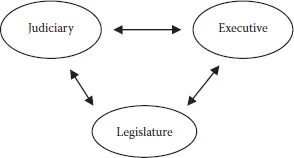
The framers of the U.S. Constitution had a problem to solve. They were chiefly concerned about the concentration of power into the hands of a monarch, and wary of humans’ proclivity to act selfishly and concentrate power around them. Noted political scientist and historian of colonial political thought, Ralph Ketcham concludes that, “By 1787, not only had the theory of self-government been widely debated, but virtually every conceivable device for implementing it had been suggested, if not tried” (Ketcham, 1986, p. 3). The framers’ ultimate solution was to devise a network of three separate institutions of authority (what network researchers refers to as “nodes”) that we now describe in terms of legislative, judicial, and executive branches. Each branch would have its own combinations of checks and balances in relation to the other branches.
These checks and balances may be explained in terms of one branch having authority over the others, as well as all branches sharing authorities with each other. Thus, the separation of powers flows through relational, networked ties that may be vertically, horizontally, or diagonally articulated (Figure 1.1).
In essence, the founders intuitively understood one of the major contributions that separate, distinct, yet interdependent networks of institutions bring to the study and design of systems of governance, namely, that relational power may be conveyed through both vertical (hierarchical) and horizontal (collaborative) ties. Because each branch of government has its share of checks and balances vis-à-vis the others, they are encouraged to find ways to build strong horizontal ties between them and, when substantive disagreements persist, wield vertical authority to keep the other branches in check.
In Table 1.1 we adapt Thomas Birkland’s matrix, in which he describes the separation of powers, identifying instances when the legislative, executive, or judicial branch of government exerts authority over the other branches. We have added descriptors for instances of when one branch has authority over the others (see the first row) and instances of when one branch defers authority to one of the others (see the first column). As an example, the executive branch may wield principal authorities over the legislative branch when laws are recommended or vetoed, and make regulations that have the force of law, and in so doing, exert a certain measure of power and authority over the legislative branch.
Donald Kettl observes that “the Constitution—in its drafting, its structure, and its early function—was a remarkable balancing act of complex issues, political cross-pressures, and boundary-defined responses. … For generations since, flexible, bend-without-breaking boundaries have been the foundation of American government” (2006, p. 11). To this end, the network configuration of government conceived by the framers of the U.S. Constitution allows for frequent “border crossings” between branches and levels of government as well as between agencies and units within a particular branch. Because governments are network structures in their own right, we must be careful not to assume that government interests are represented by one unified actor.
Figure 1.1Separation of Powers.
Table 1.1Authority Distributed across the Separation of Powers
Principal Authority Over
Legislature
Executive
Judiciary
Agent Authority To
Legislature
Make laws
Recommend laws; veto laws; make regulations that have the force of law
Review laws to determine legislative intent; new interpretations = law making
Executive
Override vetoes; legislative vetoes of regulation; impeach president
Enforce and implement laws
Review executive acts; restrain executive actions
Judiciary
Impeach judges; call witnesses in hearings
Pardon criminals; nominate judges
Interpret laws
Source: Adapted from Birkland, An Introduction to the Policy Process: Theories, Concepts, and Models of Public Policy Making, M. E. Sharpe, New York, 2001, p. 47.
...
Table of contents
Cover
Half Title
Title Page
Copyright Page
Dedication
Table of Contents
List of Figures
List of Tables
About the Authors
Preface to the New Edition
Preface to the First Edition
Introduction: Why Governance Networks?
1 The Emergence of Governance Networks: Historical Context, Contemporary Trends, and Considerations
2 Defining the Governance Network as a Unit of Analysis
3 The Actors within Governance Networks
4 The Ties between Actors
5 Network Level Functions
6 Network Level Structures
7 Governance Networks as Complex Adaptive Systems
8 How Are Governance Networks Managed?
9 The Hybridized Accountability Regimes of Governance Networks
10 Governance Network Performance Management and Measurement
11 Meso Level Theories for Governance Network Analysis
12 Governance Networks Analysis: Implications for Practice, Education, and Research
13 Postscript: The Case for Stronger Democratic Anchorage in Governance Networks
Bibliography
Index
Trusted by 375,005 students
Access to over 1.5 million titles for a fair monthly price.
Study more efficiently using our study tools.
Frequently asked questions
Yes, you can cancel anytime from the Subscription tab in your account settings on the Perlego website. Your subscription will stay active until the end of your current billing period. Learn how to cancel your subscription
No, books cannot be downloaded as external files, such as PDFs, for use outside of Perlego. However, you can download books within the Perlego app for offline reading on mobile or tablet. Learn how to download books offline
We are an online textbook subscription service, where you can get access to an entire online library for less than the price of a single book per month. With over 1.5 million books across 990+ topics, we’ve got you covered! Learn about our mission
Look out for the read-aloud symbol on your next book to see if you can listen to it. The read-aloud tool reads text aloud for you, highlighting the text as it is being read. You can pause it, speed it up and slow it down. Learn more about Read Aloud
Yes! You can use the Perlego app on both iOS and Android devices to read anytime, anywhere — even offline. Perfect for commutes or when you’re on the go. Please note we cannot support devices running on iOS 13 and Android 7 or earlier. Learn more about using the app
Yes, you can access Governance Networks in Public Administration and Public Policy by Christopher J. Koliba,Jack W. Meek,Asim Zia,Russell W. Mills in PDF and/or ePUB format, as well as other popular books in Politica e relazioni internazionali & Politica. We have over 1.5 million books available in our catalogue for you to explore.