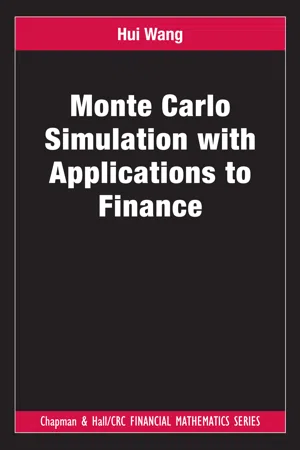
Developed from the author's course on Monte Carlo simulation at Brown University, this text provides a self-contained introduction to Monte Carlo methods in financial engineering. It covers common variance reduction techniques, the cross-entropy method, and the simulation of diffusion process models. Requiring minimal background in mathematics and finance, the book includes numerous examples of option pricing, risk analysis, and sensitivity analysis as well as many hand-and-paper and MATLAB coding exercises at the end of every chapter.
- 291 pages
- English
- PDF
- Available on iOS & Android
eBook - PDF
Monte Carlo Simulation with Applications to Finance
About this book

Chapter
1
Review
of
Probability
Probability
theory
is
the
essential
mathematical
tool
for
the
design
and
analysis
of
Monte
Carlo
simulation
schemes.
It
is
assumed
that
the
reader
is
somewhat
familiar
with
the
elementary
probability
concepts
such
as
ran-
dom
variables
and
multivariate
probability
distributions.
However,
for
the
sake
of
completeness,
we
use
this
chapter
to
collect
a
number
of
basic
re-
sults
from
probability
theory
that
will
be
used
repeatedly
in
the
rest
of
the
book.
1.1
Probability
Space
In
probability
theory,
sample
space
is
the
collection
of
all
possible
outcomes.
Throughout
the
book,
the
sample
space
will
be
denoted
by
Ω
.
A
generic
element
of
the
sample
space
represents
a
possible
outcome
and
is
called
a
sample
point
.
A
subset
of
the
sample
space
is
called
an
event
.
1.
The
empty
set
is
denoted
by
∅
.
2.
The
complement
of
an
event
A
is
denoted
by
A
c
.
3.
The
intersection
of
events
A
and
B
is
denoted
by
A
∩
B
or
simply
AB
.
4.
The
union
of
events
A
and
B
is
denoted
by
A
∪
B
.
A
probability
measure
P
on
Ω
is
a
mapping
from
the
events
of
Ω
to
the
real
line
R
that
satisfies
the
following
three
axioms:
(i)
P
(
Ω
)
=
1.
Table of contents
- Front Cover
- Preface
- Contents
- 1. Review of Probability
- 2. Brownian Motion
- 3. Arbitrage Free Pricing
- 4. Monte Carlo Simulation
- 5. Generating Random Variables
- 6. Variance Reduction Techniques
- 7. Importance Sampling
- 8. Stochastic Calculus
- 9. Simulation of Diffusions
- 10. Sensitivity Analysis
- A. Multivariate Normal Distributions
- B. American Option Pricing
- C. Option Pricing Formulas
- Bibliography
Trusted by 375,005 students
Access to over 1.5 million titles for a fair monthly price.
Study more efficiently using our study tools.
Frequently asked questions
Yes, you can cancel anytime from the Subscription tab in your account settings on the Perlego website. Your subscription will stay active until the end of your current billing period. Learn how to cancel your subscription
No, books cannot be downloaded as external files, such as PDFs, for use outside of Perlego. However, you can download books within the Perlego app for offline reading on mobile or tablet. Learn how to download books offline
Perlego offers two plans: Essential and Complete
- Essential is ideal for learners and professionals who enjoy exploring a wide range of subjects. Access the Essential Library with 800,000+ trusted titles and best-sellers across business, personal growth, and the humanities. Includes unlimited reading time and Standard Read Aloud voice.
- Complete: Perfect for advanced learners and researchers needing full, unrestricted access. Unlock 1.5M+ books across hundreds of subjects, including academic and specialized titles. The Complete Plan also includes advanced features like Premium Read Aloud and Research Assistant.
We are an online textbook subscription service, where you can get access to an entire online library for less than the price of a single book per month. With over 1.5 million books across 990+ topics, we’ve got you covered! Learn about our mission
Look out for the read-aloud symbol on your next book to see if you can listen to it. The read-aloud tool reads text aloud for you, highlighting the text as it is being read. You can pause it, speed it up and slow it down. Learn more about Read Aloud
Yes! You can use the Perlego app on both iOS and Android devices to read anytime, anywhere — even offline. Perfect for commutes or when you’re on the go.
Please note we cannot support devices running on iOS 13 and Android 7 or earlier. Learn more about using the app
Please note we cannot support devices running on iOS 13 and Android 7 or earlier. Learn more about using the app
Yes, you can access Monte Carlo Simulation with Applications to Finance by Hui Wang in PDF and/or ePUB format, as well as other popular books in Business & Finance. We have over 1.5 million books available in our catalogue for you to explore.