- 462 pages
- English
- ePUB (mobile friendly)
- Available on iOS & Android
eBook - ePub
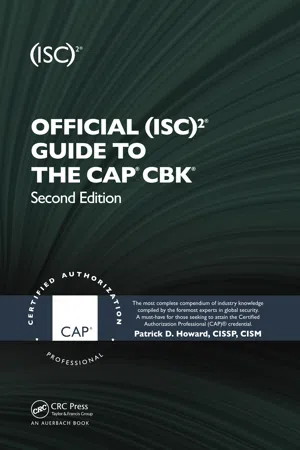
Official (ISC)2® Guide to the CAP® CBK®
About this book
Significant developments since the publication of its bestselling predecessor, Building and Implementing a Security Certification and Accreditation Program, warrant an updated text as well as an updated title. Reflecting recent updates to the Certified Authorization Professional (CAP) Common Body of Knowledge (CBK) and NIST SP 800-37, the Official
Information
Chapter 1
Security Authorization of Information Systems
Security authorization includes a tiered risk management approach to evaluate both strategic and tactical risk across the enterprise. The authorization process incorporates the application of a Risk Management Framework (RMF), a review of the organizational structure, and the business process/mission as the foundation for the implementation and assessment of specified security controls. This authorization management process identifies vulnerabilities and countermeasures and determines residual risks. The residual risks are evaluated and deemed either acceptable or unacceptable. More controls must be implemented to reduce unacceptable risk. The system may be deployed only when the residual risks are acceptable to the enterprise.
Certified Authorization Professional (CAP®) Candidate Information Bulletin, November 2010
Introduction
I once made the acquaintance of an information system security officer (ISSO) in a federal department who had what he defined as airtight security for his major application. During my assessment, I found that he had implemented government security authorization guidance for his application as well as could possibly be imagined and had fully documented all the controls protecting the system. Three years later when I returned to recertify the system for reauthorization, the system could not be recertified. When I was told that the ISSO had been transferred, the problem became quite clear to me. The process that the ISSO had used to protect his system was limited only to his single, well-protected application and had not been institutionalized elsewhere in the organization.
To be effective, a system authorization program must be greater than the efforts of isolated, well-intentioned individuals like this ISSO and must be implemented on an enterprise-wide level. A program implemented at this highest organizational level first and foremost permits consistency across the entire organization. Further, the implementation of a successful enterprise system authorization program can greatly promote the implementation of a likewise effective information security program for an organization.
An enterprise security authorization program can be considered successful if it provides an effective means of identifying and meeting requirements, permits efficient oversight of its activities, and provides assurance that necessary controls are implemented at the system level. For the purposes of this discussion, an enterprise program is one that supports the entire organization and that either is independent of any other program or has a significant degree of independence to implement guidance of a higher-level program. This equates to a corporate- or department-level government organization. An enterprise program is distinct from its business unit-level components, which relate to elements of the overall enterprise program. Security authorization for a line of business will normally focus on an interrelated grouping of information technology systems that support a tightly focused business function.
The information contained in this chapter applies to efforts to build an enterprise security authorization program from the ground up, as well as efforts to expand an existing program with additional capabilities or with a revised orientation. This chapter discusses the ingredients necessary to construct a successful enterprise system authorization program. This includes information sections on key elements of such a program; a detailed discussion of system authorization roles and responsibilities; incorporation of system authorization into the system development life cycle (SDLC); causes of the failure of many system security authorization programs; system authorization project planning; elements of an organization-level system inventory process; and the work of dealing with interconnected systems. Also, this chapter provides an overview of the application of the Risk Management Framework (RMF) of the National Institute of Standards and Technology (NIST) to information systems as well as fundamentals of information system risk management according to NIST Special Publication (SP) 800-37, Revision 1.
System authorization is a comprehensive methodology that consists of a number of individual processes, most of which the reader will probably recognize. It is the combining of these related processes into a unified risk management approach that gives...
Table of contents
- Preface
- Acknowledgments
- About the Author
- Chapter 1: Security Authorization of Information Systems
- Chapter 2: Information System Categorization
- Chapter 3: Establishment of the Security Control Baseline
- Chapter 4: Application of Security Controls
- Chapter 5: Assessment of Security Controls
- Chapter 6: Information System Authorization
- Chapter 7: Security Controls Monitoring
- Chapter 8: System Authorization Case Study
- Chapter 9: The Future of Information System Authorization
- Appendix A: References
- Appendix B: Glossary
- Appendix C: Sample Statement of Work
- Appendix D: Sample Project Work Plan
- Appendix E: Sample Project Kickoff Presentation Outline
- Appendix F: Sample Project Wrap-Up Presentation Outline
- Appendix G: Sample System Inventory Policy
- Appendix H: Sample Business Impact Assessment
- Appendix I: Sample Rules of Behavior (General Support System)
- Appendix J: Sample Rules of Behavior (Major Application)
- Appendix K: Sample System Security Plan Outline
- Appendix L: Sample Memorandum of Understanding
- Appendix M: Sample Interconnection Security Agreement
- Appendix N: Sample Risk Assessment Outline
- Appendix O: Sample Security Procedure
- Appendix P: Sample Certification Test Results Matrix
- Appendix Q: Sample Risk Remediation Plan
- Appendix R: Sample Certification Statement
- Appendix S: Sample Accreditation Letter
- Appendix T: Sample Interim Accreditation Letter
- Appendix U: Certification and Accreditation Professional (CAP®) Common Body of Knowledge (CBK®)
- Appendix V: Answers to Review Questions
Trusted by 375,005 students
Access to over 1.5 million titles for a fair monthly price.
Study more efficiently using our study tools.
Frequently asked questions
Yes, you can cancel anytime from the Subscription tab in your account settings on the Perlego website. Your subscription will stay active until the end of your current billing period. Learn how to cancel your subscription
No, books cannot be downloaded as external files, such as PDFs, for use outside of Perlego. However, you can download books within the Perlego app for offline reading on mobile or tablet. Learn how to download books offline
Perlego offers two plans: Essential and Complete
- Essential is ideal for learners and professionals who enjoy exploring a wide range of subjects. Access the Essential Library with 800,000+ trusted titles and best-sellers across business, personal growth, and the humanities. Includes unlimited reading time and Standard Read Aloud voice.
- Complete: Perfect for advanced learners and researchers needing full, unrestricted access. Unlock 1.5M+ books across hundreds of subjects, including academic and specialized titles. The Complete Plan also includes advanced features like Premium Read Aloud and Research Assistant.
We are an online textbook subscription service, where you can get access to an entire online library for less than the price of a single book per month. With over 1.5 million books across 990+ topics, we’ve got you covered! Learn about our mission
Look out for the read-aloud symbol on your next book to see if you can listen to it. The read-aloud tool reads text aloud for you, highlighting the text as it is being read. You can pause it, speed it up and slow it down. Learn more about Read Aloud
Yes! You can use the Perlego app on both iOS and Android devices to read anytime, anywhere — even offline. Perfect for commutes or when you’re on the go.
Please note we cannot support devices running on iOS 13 and Android 7 or earlier. Learn more about using the app
Please note we cannot support devices running on iOS 13 and Android 7 or earlier. Learn more about using the app
Yes, you can access Official (ISC)2® Guide to the CAP® CBK® by Patrick D. Howard in PDF and/or ePUB format, as well as other popular books in Computer Science & Certification Guides in Computer Science. We have over 1.5 million books available in our catalogue for you to explore.