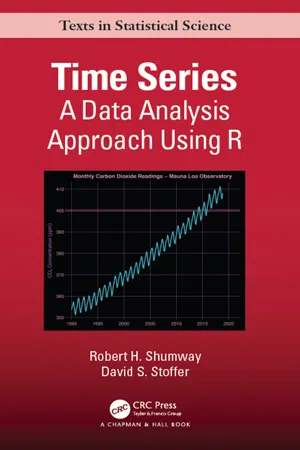
Time Series
eBook - ePub

Time Series

A Data Analysis Approach Using R

  1. 259 pages
  2. English
  3. ePUB (mobile friendly)
  4. Available on iOS & Android
eBook - ePub

About this book

The goals of this text are to develop the skills and an appreciation for the richness and versatility of modern time series analysis as a tool for analyzing dependent data. A useful feature of the presentation is the inclusion of nontrivial data sets illustrating the richness of potential applications to problems in the biological, physical, and social sciences as well as medicine. The text presents a balanced and comprehensive treatment of both time and frequency domain methods with an emphasis on data analysis.

Numerous examples using data illustrate solutions to problems such as discovering natural and anthropogenic climate change, evaluating pain perception experiments using functional magnetic resonance imaging, and the analysis of economic and financial problems. The text can be used for a one semester/quarter introductory time series course where the prerequisites are an understanding of linear regression, basic calculus-based probability skills, and math skills at the high school level. All of the numerical examples use the R statistical package without assuming that the reader has previously used the software.

Frequently asked questions

Yes, you can cancel anytime from the Subscription tab in your account settings on the Perlego website. Your subscription will stay active until the end of your current billing period. Learn how to cancel your subscription.
No, books cannot be downloaded as external files, such as PDFs, for use outside of Perlego. However, you can download books within the Perlego app for offline reading on mobile or tablet. Learn more here.
Perlego offers two plans: Essential and Complete
  • Essential is ideal for learners and professionals who enjoy exploring a wide range of subjects. Access the Essential Library with 800,000+ trusted titles and best-sellers across business, personal growth, and the humanities. Includes unlimited reading time and Standard Read Aloud voice.
  • Complete: Perfect for advanced learners and researchers needing full, unrestricted access. Unlock 1.4M+ books across hundreds of subjects, including academic and specialized titles. The Complete Plan also includes advanced features like Premium Read Aloud and Research Assistant.
Both plans are available with monthly, semester, or annual billing cycles.
We are an online textbook subscription service, where you can get access to an entire online library for less than the price of a single book per month. With over 1 million books across 1000+ topics, we’ve got you covered! Learn more here.
Look out for the read-aloud symbol on your next book to see if you can listen to it. The read-aloud tool reads text aloud for you, highlighting the text as it is being read. You can pause it, speed it up and slow it down. Learn more here.
Yes! You can use the Perlego app on both iOS or Android devices to read anytime, anywhere — even offline. Perfect for commutes or when you’re on the go.
Please note we cannot support devices running on iOS 13 and Android 7 or earlier. Learn more about using the app.
Yes, you can access Time Series by Robert Shumway,David Stoffer,Robert H. Shunway,David S. Stoffer,Robert H. Shumway in PDF and/or ePUB format, as well as other popular books in Mathematics & Probability & Statistics. We have over one million books available in our catalogue for you to explore.

Chapter 1

Time Series Elements

1.1 Introduction

The analysis of data observed at different time points leads to unique problems that are not covered by classical statistics. The dependence introduced by the sampling data over time restricts the applicability of many conventional statistical methods that require random samples. The analysis of such data is commonly referred to as time series analysis.
To provide a statistical setting for describing the elements of time series data, the data are represented as a collection of random variables indexed according to the order they are obtained in time. For example, if we collect data on daily high temperatures in your city, we may consider the time series as a sequence of random variables, x1, x2, x3,…, where the random variable x1 denotes the high temperature on day one, the variable x2 denotes the value for the second day, x3 denotes the value for the third day, and so on. In general, a collection of random variables, {xt}, indexed by t is referred to as a stochastic process. In this text, t will typically be discrete and vary over the integers t = 0, ±1, ±2,… or some subset of the integers, or a similar index like months of a year.
Historically, time series methods were applied to problems in the physical and environmental sciences. This fact accounts for the engineering nomenclature that permeates the language of time series analysis. The first step in an investigation of time series data involves careful scrutiny of the recorded data plotted over time. Before looking more closely at the particular statistical methods, we mention that two separate, but not mutually exclusive, approaches to time series analysis exist, commonly identified as the time domain approach (Chapter 4 and 5) and the frequency domain approach (Chapter 6 and 7).

1.2 Time Series Data

The following examples illustrate some of the common kinds of time series data as well as some of the statistical questions that might be asked about such data.
Image
Figure 1.1 Johnson & Johnson quarterly earnings per share, 1960-I to 1980-IV (top). The same data logged (bottom).
Example 1.1. Johnson & Johnson Quarterly Earnings
Figure 1.1 shows quarterly earnings per share (QEPS) for the U.S. company Johnson & Johnson and the data transformed by taking logs. There are 84 quarters (21 years) measured from the first quarter of 1960 to the last quarter of 1980. Modeling such series begins by observing the primary patterns in the time history. In this case, note the increasing underlying trend and variability, and a somewhat regular oscillation superimposed on the trend that seems to repeat over quarters. Methods for analyzing data such as these are explored in Chapter 3 (see Problem 3.1) using regression techniques.
If we consider the data as being generated as a small percentage change each year, say rt (which can be negative), we might write xt=(1+rt)xt4, where xt is the QEPS for quarter t. If we log the data, then log(xt)=log(1+rt)+log(xt4), implying a linear growth rate; i.e., this quarter’s value is the same as last year plus a small amount, log(1 + rt). This attribute of the data is displayed by the bottom plot of Figure 1.1.
The R code to plot the data for this example is,1
library(astsa) # we leave this line off subsequent examples
par(mfrow=2:1)
tsplot(jj, ylab="QEPS", type="o", col=4, main="Johnson & Johnson Quarterly Earnings")
tsplot(log(jj), ylab="log(QEPS)", type="o", col=4)
Image
Figure 1.2 Yearly average global land surface and ocean surface temperature deviations (1880–2017) in °C.
Example 1.2. Global Warming and Climate Change
Two global temperature records are shown in Figure 1.2. The data are (1) annual temperature anomalies averaged over the Earth’s land area, and (2) sea surface temperature anomalies averaged over the part of the ocean that is free of ice at all times (open ocean). The time period is 1880 to 2017 and the values are deviations (°C) from the 1951–1980 average, updated from Hansen et al. (2006). The upward trend in both series during ...

Table of contents

  1. Cover
  2. Half Title
  3. Title Page
  4. Copyright Page
  5. Table of Contents
  6. Preface
  7. 1 Time Series Elements
  8. 2 Correlation and Stationary Time Series
  9. 3 Time Series Regression and EDA
  10. 4 ARMA Models
  11. 5 ARIMA Models
  12. 6 Spectral Analysis and Filtering
  13. 7 Spectral Estimation
  14. 8 Additional Topics *
  15. Appendix A R Supplement
  16. Appendix B Probability and Statistics Primer
  17. Appendix C Complex Number Primer
  18. Appendix D Additional Time Domain Theory
  19. Hints for Selected Exercises
  20. References
  21. Index